Theobromine: The Gentle, Slow Stimulant Hiding in Your Chocolate
Roon Team
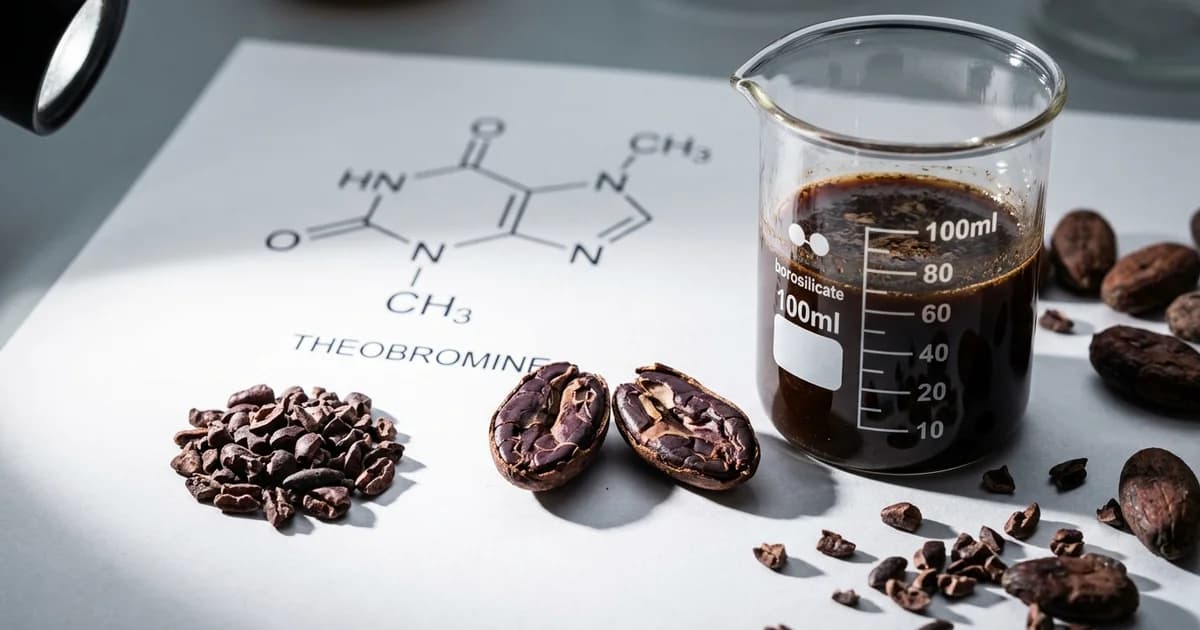
Theobromine: The Gentle, Slow Stimulant Hiding in Your Chocolate
The reason a square of dark chocolate makes you feel pleasantly awake instead of wired has a name, and it isn't caffeine. It's theobromine, the primary stimulant in cacao and a close chemical cousin of the molecule in your morning coffee.
Theobromine works slower, lasts longer, and hits softer than caffeine. That sounds like an upgrade. In practice, it's a trade-off, and understanding the trade-off tells you a lot about how stimulants actually work in your body.
This is a look at what theobromine does, how it compares to caffeine, and why "gentle and long" often comes with a quiet asterisk: it can also mean weak.
Key Takeaways
- Theobromine is the main stimulant in chocolate, present in far higher amounts than caffeine in cocoa.
- It belongs to the methylxanthine family, the same chemical group as caffeine and theophylline.
- Its effects are milder and slower than caffeine's, with a longer half-life that keeps it in your system for many hours.
- The same chemistry that makes theobromine toxic to dogs makes it relatively gentle in humans, because we metabolize it efficiently.
- "Long and smooth" is a real benefit, but past a point it shades into "subtle to the point of barely noticeable."
What Is Theobromine?
Theobromine is a naturally occurring alkaloid found mainly in the cacao bean, which means it shows up in chocolate, cocoa powder, and to a smaller degree in tea and the kola nut. Despite the name, it contains no bromine. The "bromo" comes from Theobroma, the cacao genus, which translates roughly to "food of the gods."
Chemically, theobromine sits in the methylxanthine family. That's the group of plant compounds that also includes caffeine and theophylline (the drug once used for asthma). All three share a similar molecular skeleton and a similar trick: they block adenosine, the brain chemical that builds up over a waking day and makes you feel sleepy.
Here's the key difference. Caffeine has two methyl groups arranged one way; theobromine has them arranged another. That small structural shift changes how strongly each molecule grabs onto adenosine receptors, and it's most of the reason theobromine feels so much softer.
Theobromine Effects: What It Actually Does
The headline theobromine effects are mild stimulation, smooth-muscle relaxation, and a gentle lift in mood and alertness, without the sharp edge of a caffeine spike. It nudges your nervous system rather than shoving it.
A few of the better-documented actions:
- Stimulation of the central nervous system. Theobromine blocks adenosine receptors like caffeine does, but with weaker affinity, so the wakefulness boost is subtler.
- Vasodilation. It relaxes blood vessels and smooth muscle, which is partly why cocoa shows up so often in cardiovascular research.
- Mild diuretic action. It increases urine output, though less aggressively than caffeine.
- Cough suppression. Theobromine has been studied as a cough suppressant, with some trials suggesting it can quiet the cough reflex.
The cardiovascular angle is the most studied. A randomized trial published in the American Heart Association journal Hypertension found that cocoa with higher doses of theobromine had measurable effects on blood pressure, though the results were more nuanced than a simple "it lowers blood pressure" headline. You can read the study in Hypertension.
Not every study is glowing. A trial published on NCBI found that theobromine did not improve fasting or post-meal vascular function in overweight and obese subjects. That's the honest picture of most "gentle" compounds: real but modest, and inconsistent across populations.
Theobromine vs Caffeine: The Real Comparison
The simplest way to frame theobromine vs caffeine is this: caffeine is the sprinter and theobromine is the long-distance walker. Caffeine hits hard and clears relatively fast. Theobromine arrives quietly and lingers for hours.
That difference comes down to two things: how tightly each binds to adenosine receptors, and how long each stays in your bloodstream.
| Property | Caffeine | Theobromine |
|---|---|---|
| Chemical family | Methylxanthine | Methylxanthine |
| Relative potency | Strong | Mild (roughly one-tenth the punch) |
| Onset | Fast (30–45 min, faster sublingually) | Slow and gradual |
| Half-life | ~5 hours | ~7–10 hours |
| Main natural source | Coffee, tea | Cacao, chocolate |
| Typical feel | Sharp alertness, possible jitters | Smooth, subtle, easy mood lift |
| Crash risk | Moderate to high | Low |
The takeaway from that table is that theobromine's gentleness is a feature and a limitation at the same time. You get fewer jitters and a softer landing. You also get a much weaker effect, which is why no one drinks hot cocoa to power through a deadline.
If you want a deeper breakdown of how caffeine itself behaves, the trade-offs of dose, and why pairing matters, see our guide on caffeine and L-theanine for focus.
Theobromine in Chocolate: How Much Are You Getting?
Theobromine in chocolate scales with cocoa content, so darker chocolate carries far more of it than milk chocolate, and white chocolate has essentially none. The more cacao solids, the more theobromine.
A rough sense of the gradient:
- Cocoa powder is the most concentrated common source.
- Dark chocolate (70%+ cacao) carries a meaningful dose per serving.
- Milk chocolate has much less, diluted by milk and sugar.
- White chocolate has effectively zero, since it's made from cocoa butter, not cocoa solids.
This is also why chocolate is genuinely dangerous for dogs. Dogs metabolize theobromine far more slowly than humans do, so it builds to toxic levels. According to the Washington State University Veterinary Teaching Hospital, the same compound that gives us a mild, pleasant lift can cause serious poisoning in dogs, with darker chocolate posing the greatest risk.
The species gap is the whole story. In humans, efficient liver enzymes clear theobromine steadily. In dogs, that clearance crawls, and the methylxanthine accumulates.
Theobromine Half-Life: Why It Lingers
Theobromine's half-life in humans runs roughly 7 to 10 hours, considerably longer than caffeine's, which is why its effects feel drawn out and low-key rather than sharp. Half-life is simply the time it takes your body to clear half of a dose.
A longer half-life cuts both ways. On the upside, you avoid the steep drop-off that produces a caffeine crash, because the decline is slow and even. On the downside, a dose late in the day can still be hanging around at bedtime, which is worth keeping in mind if you eat dark chocolate at night.
Theobromine gets broken down primarily in the liver, where it's metabolized into other compounds and eventually cleared. The pace of that clearance is exactly what separates a manageable human dose from a toxic canine one.
The Bigger Lesson: When "Gentle and Long" Means "Weak"
Theobromine is a useful case study in stimulant design. Slow onset, long half-life, and a soft ceiling sound ideal on paper. The catch is that the same properties that make a compound smooth also make it mild.
You can't get a strong, clean, all-day cognitive lift from theobromine alone. The molecule simply doesn't bind hard enough. To feel meaningfully alert from chocolate, you'd need to eat an amount of it that brings along a lot of sugar and fat you probably don't want.
This is why the most effective stimulant formulas don't chase a single "perfect" molecule. They combine a strong, fast actor with compounds that smooth its edges and stretch its duration. The goal is the best of both timelines: quick onset and a long, even tail, without the jitters or the crash.
The Bottom Line on Theobromine
Theobromine is the quiet engine behind chocolate's gentle lift, a mild methylxanthine that trades caffeine's intensity for a slower, longer, smoother profile. It relaxes blood vessels, nudges alertness, and lingers in your system for the better part of a day.
It's also a reminder that "gentle" and "weak" sit on the same spectrum. A compound soft enough to never give you jitters is usually too soft to power real focus on its own. The interesting work in cognitive performance isn't finding one ideal molecule. It's combining the right ones so onset, strength, and duration all line up.
Frequently Asked Questions
Is theobromine the same as caffeine?
No, but they're close relatives. Both are methylxanthines that block adenosine to promote alertness. Theobromine binds more weakly, so it produces a milder, slower, longer-lasting effect than caffeine. Caffeine gives you a sharper, faster lift with a higher chance of jitters. Think of them as two siblings with very different personalities built on the same chemical frame.
How long does theobromine stay in your system?
Theobromine has a half-life of roughly 7 to 10 hours in humans, longer than caffeine's roughly 5 hours. That means a single dose can stay measurable in your bloodstream for most of a day. The slow clearance is why theobromine's effects feel drawn out and even rather than sharp, and why dark chocolate late at night can still be active at bedtime.
Which chocolate has the most theobromine?
Cocoa powder and high-percentage dark chocolate carry the most theobromine, because the compound lives in the cocoa solids. The higher the cacao percentage, the more theobromine per serving. Milk chocolate has much less, and white chocolate has essentially none, since it's made from cocoa butter rather than cocoa solids.
Why is theobromine toxic to dogs but not humans?
The difference is metabolism speed. Humans clear theobromine efficiently through liver enzymes, so a normal chocolate serving stays well within safe limits. Dogs break it down far more slowly, so it accumulates to toxic levels. Per the Washington State University Veterinary Teaching Hospital, darker chocolate poses the greatest risk to dogs because it packs more of the compound.
Does theobromine give you energy like caffeine?
Sort of, but much more gently. Theobromine offers a mild boost in alertness and mood and relaxes blood vessels, but it lacks caffeine's punch. You won't get a strong, deadline-crushing focus from theobromine alone without eating an impractical amount of chocolate. Its strength is smoothness, not power.
Are there real health benefits to theobromine?
The most studied theobromine benefits involve cardiovascular function and cough suppression, though results are mixed. Some research links cocoa's theobromine to effects on blood pressure, while other trials found no improvement in vascular function. The honest read is that theobromine's benefits appear real but modest, and they vary by dose and population.
Is theobromine in tea and coffee too?
Theobromine appears in tea in small amounts and in trace amounts in coffee, but cacao is by far its richest source. Tea's main stimulant is caffeine, accompanied by L-theanine and a little theobromine. If you want a meaningful dose of theobromine, chocolate and cocoa are where you'll find it.
Why Roon Skips Theobromine on Purpose
Theobromine makes a clean argument for one of the trickiest problems in cognitive performance: smooth and long usually means weak. We built Roon around that exact trade-off, which is why our formula doesn't lean on theobromine at all.
Instead of one gentle molecule, Roon uses a four-ingredient stack designed to give you fast onset and a long, even tail: 80 mg caffeine for the strong, quick lift, 60 mg L-theanine to take the edge off, and 25 mg methylliberine (Dynamine) plus 5 mg theacrine (TeaCrine) to extend the smooth part of the curve. Delivered sublingually, it works in 5 to 10 minutes and holds for 6 to 8 hours with no jitters, no crash, and no tolerance buildup.
To be clear, Roon is not a chocolate replacement and it isn't a substitute for sleep, food, or a sane schedule. It's a tool for the hours you need to focus. If you've ever wished the gentle lift from dark chocolate actually had some staying power behind it, try Roon.
Written by Roon Team