Theobromine vs Caffeine: Two Methylxanthines
Roon Team
Theobromine vs Caffeine: Two Methylxanthines, Two Very Different Buzzes
Eat a square of dark chocolate at 9 p.m. and you sleep fine. Drink an espresso at the same time and you stare at the ceiling until 2 a.m. Both contain methylxanthines. Both are stimulants on paper. So why does one feel like a gentle nudge and the other like a fire alarm?
The answer in the theobromine vs caffeine comparison comes down to two things: how strongly each molecule grabs your brain's adenosine receptors, and how long it lingers in your blood before your liver clears it. They are chemical cousins. They behave like different animals.
This piece breaks down the mechanism, the half-lives, and the real-world effects, then explains why pharmacology nerds care so much about the gap between them.
Key Takeaways
- Caffeine is the strong, fast one. It peaks in 30 to 60 minutes and has a half-life of roughly 5 hours.
- Theobromine is the slow, mild one. It peaks in 2 to 3 hours and has a half-life of about 6 to 8 hours.
- Both block adenosine, but caffeine binds far more aggressively, which is why it dominates the alertness response.
- Theobromine acts more on your blood vessels and heart than your central nervous system, though its effect on blood pressure is mixed in the trial data.
Theobromine vs Caffeine: The Same Family, Different Jobs
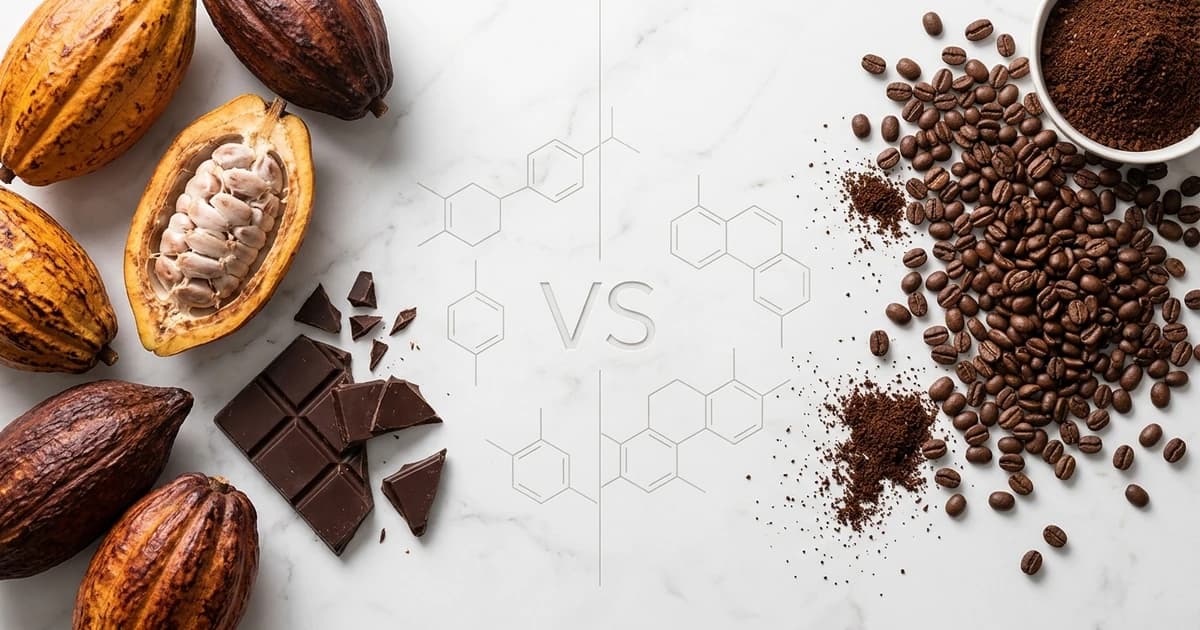
Caffeine and theobromine are both methylxanthines, a class of compounds that also includes theophylline. Chemically they are nearly identical. Caffeine just carries one extra methyl group, and that small structural difference changes everything about how they feel.
Caffeine is the primary stimulant in coffee, tea, and energy drinks. Theobromine is the main alkaloid in cocoa, which is why it carries the botanical name of the cacao tree, Theobroma.
Here is the twist most people miss. Theobromine is also a metabolite of caffeine. When your liver processes caffeine, it converts a chunk of it into theobromine. So when you drink coffee, you end up with both molecules in your system at once, on two different clocks.
Is Theobromine a Stimulant? Sort Of, but Not Like Caffeine
Theobromine is technically a stimulant, but it does not stimulate your brain the way caffeine does. Theobromine is a heart stimulator and diuretic but has no marked stimulant effect on the human central nervous system. That single line explains why chocolate never wires you the way an espresso does.
Both molecules work by blocking adenosine receptors. Adenosine is the chemical that builds up across your day and signals your brain that it is time to wind down. Caffeine acts as an adenosine receptor antagonist, blocking the adenosine receptor to keep you from feeling sleepy. Theobromine targets the same A1 and A2A receptors, but it binds far more weakly.
The result is a softer effect. A controlled study on the psychopharmacology of theobromine in healthy volunteers concluded that, unlike caffeine, theobromine does not produce caffeine-like stimulating properties. It nudges, it does not shove.
There is a second mechanism worth knowing. Theobromine also inhibits phosphodiesterase, which raises cAMP inside cells. By inhibiting these enzymes, theobromine increases cyclic adenosine monophosphate (cAMP) levels in cells, which, in turn, leads to various physiological effects such as vasodilation and smooth muscle relaxation. That is why theobromine acts more on your blood vessels than your focus.
Theobromine vs Caffeine Half-Life: Why Timing Is the Whole Story
The single most useful number in this comparison is the half-life. It tells you how long each compound sticks around, and it explains the entire difference in how they feel.
Caffeine hits fast and clears at a moderate pace. The mean half-life of caffeine in plasma of healthy individuals is about 5 hours. It also peaks quickly, reaching maximum blood concentration within 30 to 60 minutes of your first sip.
Theobromine plays a longer game. The elimination half-life of theobromine is between 6 and 8 hours. And it is slow off the line too. While caffeine peaks after only 30 minutes, theobromine requires 2 to 3 hours to peak.
Put those numbers together and the chocolate-at-9-p.m. puzzle solves itself. Theobromine rises gently, never spikes hard at your brain's alertness receptors, and tapers off without the abrupt drop that caffeine can produce when its blockade lifts and backed-up adenosine floods in at once.
The Theobromine Caffeine Half-Life Table
| Property | Caffeine | Theobromine |
|---|---|---|
| Methylxanthine class | Yes | Yes |
| Time to peak | 30 to 60 minutes | 2 to 3 hours |
| Half-life | ~5 hours | ~6 to 8 hours |
| Adenosine receptor binding | Strong | Weak |
| Primary felt effect | Alertness, focus | Mild mood lift, vasodilation |
| CNS stimulation | Strong | Minimal |
| Main dietary source | Coffee, tea, energy drinks | Cocoa, dark chocolate |
Theobromine vs Caffeine Effects on the Body
The clearest split between these two shows up in how they affect your cardiovascular system. Caffeine tends to raise blood pressure modestly, especially in people who do not drink it often. Theobromine does close to the opposite.
Theobromine and Blood Pressure
Theobromine behaves as a vasodilator, meaning it relaxes and widens blood vessels. Theobromine is thought to have an endothelium-independent vasodilating effect by inhibiting the breakdown of cAMP in the arterial smooth muscle cell.
The clinical signal is mixed, not clean. In one randomized crossover trial published in the American Heart Association journal Hypertension, researchers tested cocoa drinks with natural or high-dose theobromine in 42 adults with mildly raised blood pressure. The high-dose theobromine cocoa (979 mg) lowered central systolic blood pressure by about 4.3 mmHg, but it did not lower peripheral pressure and slightly raised 24-hour ambulatory systolic pressure. So the vascular story is more nuanced than a simple drop.
This is part of why dark chocolate keeps showing up in cardiovascular research, and why the theobromine blood pressure angle interests researchers far more than its weak buzz. None of this is medical advice, and theobromine is not a treatment for hypertension. It is a physiological observation worth understanding.
Theobromine and Mood
Theobromine is not pure sedation either. The same healthy-volunteer research that found it lacked caffeine-like stimulation tested doses from 250 to 1,000 mg and showed its mood effects were dose-dependent and distinct from caffeine's: where caffeine produced a clear stimulant-like lift, theobromine did not, and the higher doses actually nudged mood ratings in a more negative direction.
Chocolate vs Coffee Stimulant: What You Actually Feel
The chocolate vs coffee stimulant question is really a question of dose and dominance. A cup of coffee delivers roughly 80 to 100 mg of caffeine, a strong dose of the aggressive molecule. A bar of dark chocolate delivers a few hundred milligrams of theobromine plus a small amount of caffeine, a large dose of the gentle molecule.
That is why coffee jolts and chocolate soothes. The coffee buzz is caffeine's tight grip on your adenosine receptors. The chocolate effect is theobromine's loose grip, its vasodilation, and its slow, even curve.
If you want sharp, immediate alertness, caffeine wins by a wide margin. If you want a soft, long, low-key lift, theobromine is the quieter partner. Most people who love both are responding to two different chemicals doing two different jobs.
Conclusion: Half-Life Is the Hidden Variable
Theobromine and caffeine look almost identical on a molecular diagram, yet they produce completely different experiences. Caffeine binds hard, peaks fast, and clears in about five hours, which is why it sharpens focus and occasionally rattles you. Theobromine binds weakly, peaks slowly, lingers for six to eight hours, and works more on your blood vessels than your brain.
The lesson is not that one beats the other. It is that a stimulant's half-life and binding strength shape how it feels just as much as the dose does. A fast, hard-hitting compound gives you a spike. A slow, gentle one gives you a plateau. Understand the curve and you understand the buzz.
Frequently Asked Questions
Is theobromine a stimulant?
Yes, but a weak one. Theobromine is classified as a mild stimulant and a diuretic, and it does stimulate the heart. Its effect on the central nervous system, the alertness and wakefulness you associate with caffeine, is minimal. Controlled research found it does not produce caffeine-like stimulating properties, which is why chocolate rarely keeps you awake the way coffee does.
Which has a longer half-life, theobromine or caffeine?
Theobromine has the longer half-life. Caffeine clears in roughly 5 hours, while theobromine takes about 6 to 8 hours to drop by half. Theobromine also peaks more slowly, at 2 to 3 hours versus caffeine's 30 to 60 minutes. So theobromine both arrives and leaves on a gentler, more drawn-out schedule than caffeine.
Does theobromine raise or lower blood pressure?
The evidence is mixed. Theobromine acts as a vasodilator, relaxing and widening blood vessels by raising cAMP in arterial smooth muscle. A randomized trial using theobromine-enriched cocoa lowered central systolic blood pressure by about 4 mmHg but did not lower peripheral pressure and slightly raised 24-hour ambulatory pressure, so the picture is nuanced rather than a clean reduction. Caffeine, by contrast, tends to raise blood pressure slightly. Theobromine is not a treatment for high blood pressure, just a compound researchers find interesting.
Why does coffee wire me but chocolate does not?
Because coffee is dominated by caffeine, the molecule that binds your adenosine receptors hard and fast. Chocolate is dominated by theobromine, which binds the same receptors weakly and slowly. Even though dark chocolate can contain a large amount of theobromine, the gentle nature of that molecule means you feel a soft lift instead of a sharp jolt.
Is theobromine the same as caffeine?
No, though they are close relatives. Both are methylxanthines, and caffeine carries one extra methyl group. That small difference makes caffeine a much stronger central nervous system stimulant. Theobromine is also produced when your liver metabolizes caffeine, so drinking coffee leaves both compounds in your system at the same time, working on different timelines.
Can theobromine cause a crash like caffeine?
Theobromine is far less likely to produce a noticeable crash. Caffeine's crash happens because it blocks adenosine receptors, then releases them all at once when it clears, letting backed-up adenosine flood in. Theobromine's grip on those receptors is weak and its decline is slow, so the comedown is gradual rather than abrupt.
The Half-Life Layering Lesson, Applied
If this article makes one thing clear, it is that two stimulants with different half-lives feel completely different even when they share a chemical family. A fast molecule spikes. A slow molecule plateaus. The interesting part is what happens when you put short- and long-acting compounds together on purpose.
That layering idea is the design principle behind Roon. Each sublingual pouch combines four compounds chosen for their timing: 80 mg caffeine for the fast onset, 60 mg L-theanine to smooth caffeine's edge, plus 25 mg methylliberine (Dynamine) and 5 mg theacrine (TeaCrine), two slower methylxanthine relatives that extend the curve. The goal is 6 to 8 hours of steady focus with no jitters and no hard crash.
Roon is not a substitute for sleep, and it will not turn chocolate into coffee. It is a way to apply the half-life lesson from this article on purpose. If you want to feel what deliberate stimulant layering does, try Roon and notice the curve, not just the kick.
Written by Roon Team