Half Caff Coffee Caffeine and How to Blend Your Own
Key Takeaways
- Half caff is a blend of regular and decaf coffee, usually 50/50, and no FDA definition we found pins it down.
- By our USDA and FDA math, an 8 oz cup of a 50/50 blend has about 48 to 55 mg of caffeine, against about 95 mg for regular.
- Folgers and Nespresso sell half-caff products, but neither prints a milligram figure on its product page.
- You can mix it at home at any ratio, from 75/25 down to 25/75, using the table below.
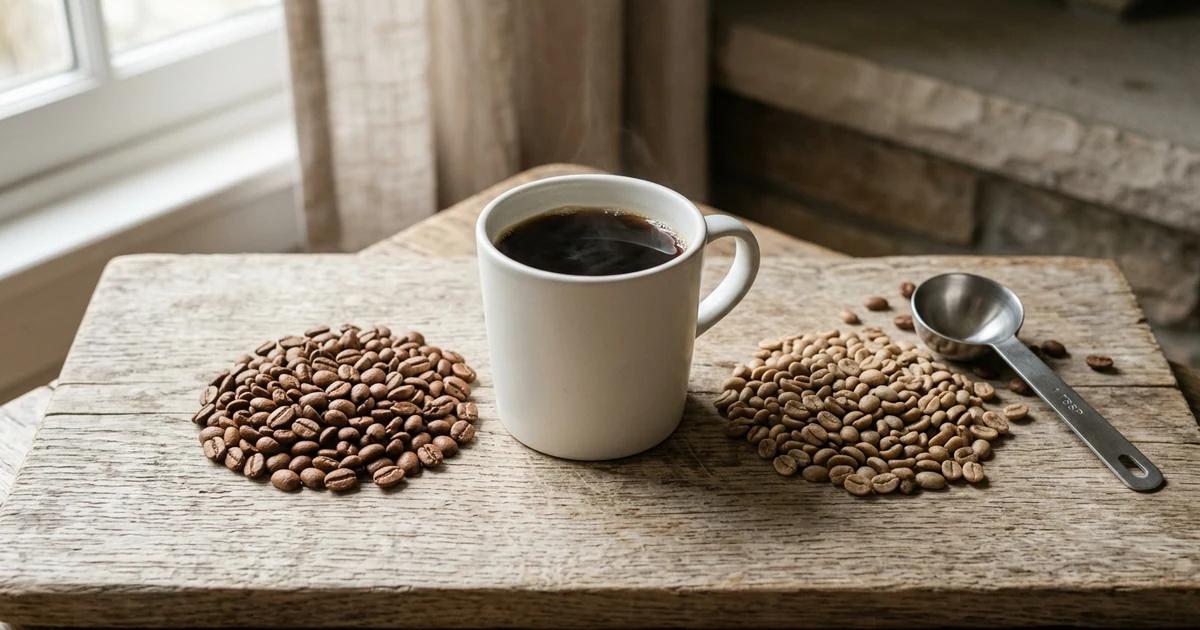
Half caff coffee is a blend of regular and decaffeinated coffee, usually 50/50. Using USDA's figure for brewed coffee (about 95 mg per 8 oz) and the FDA's 2 to 15 mg for decaf, an 8 oz cup of a 50/50 blend works out to about 48 to 55 mg. Folgers and Nespresso sell half-caff products but neither prints a milligram figure.
Half Caff Caffeine by Blend Ratio
| Regular : decaf | Caffeine per 8 fl oz | Caffeine per 12 fl oz |
|---|---|---|
| 100 : 0 (regular) | about 95 mg | about 142 mg |
| 75 : 25 | about 72 to 75 mg | about 107 to 112 mg |
| 50 : 50 (half caff) | about 48 to 55 mg | about 73 to 82 mg |
| 25 : 75 | about 25 to 35 mg | about 38 to 52 mg |
| 0 : 100 (decaf) | 2 to 15 mg (FDA) | 3 to 23 mg |
Source: Computed from USDA FoodData Central 171890 (brewed coffee, 40 mg per 100 g; 8 fl oz ≈ 237 g) and the FDA's decaf range. Actual cups vary with beans, grind and brew strength.
Formula: caffeine = share regular × 95 mg + share decaf × (2 to 15 mg).
What Is Half Caff Coffee?
Half caff is coffee blended from regular and decaffeinated beans, most often in equal parts. The term is informal; we found no FDA definition, and brands spell it "half caff," "half-caf" or "half caffeinato."
Folgers Half Caff says "made with a blend of 50% decaffeinated coffee" and notes that "Caffeine levels may vary." No milligrams appear on the page. Nespresso Half Caffeinato is described as a blend of decaffeinated and regular Arabica with "Half the caffeine but all the taste," and it also prints no mg.
How to Make Half Caff Coffee at Home
1. Pick two coffees with a similar roast
Buy one regular and one decaf in the same roast family, so neither half overpowers the other in the cup.
2. Measure at a 50/50 ratio
Folgers' measuring guide calls for 1 tablespoon per 6 fl oz of water. For half caff, use ½ tbsp regular and ½ tbsp decaf per serving.
3. Mix grounds, then brew
Combine both scoops in a single filter or press before brewing for even extraction. You can also brew each separately and mix 1:1.
4. Adjust the ratio
The table covers 75/25 and 25/75 splits. Start at 50/50 and nudge until you settle on a number worth writing down.
5. Pods: alternate or buy half-caff
You cannot split a K-Cup. Alternate a regular and a decaf pod across the day, or buy Folgers Half Caff K-Cups (10, 12 or 24 count). More on pod caffeine: caffeine in a K-Cup.
Half Caff vs Decaf vs Regular
| Brew | Caffeine per 8 fl oz |
|---|---|
| Regular | about 95 mg |
| Half caff (50/50) | about 48 to 55 mg |
| Decaf | 2 to 15 mg (FDA) |
Decaf is not caffeine-free. The FDA puts the range at 2 to 15 mg per cup, so your afternoon "decaf" still carries a measurable dose. More detail: caffeine in decaf coffee and decaf espresso.
Can You Order Half Caff at a Coffee Shop?
Yes. Dutch Bros says espresso drinks can be made with decaf espresso and that "You can also order as half-caf for less caffeine." At other shops, ask the barista: for espresso drinks, half-caf usually means half regular and half decaf shots. Dutch Bros does not publish per-drink half-caf figures, so there is no chain number to quote. See Dutch Bros caffeine content.
Half Caff Instant and Pods
USDA lists a "half the caffeine" instant powder (FDC 174126) at about 1,570 mg per 100 g of dry powder. One teaspoon (1 g) comes to roughly 16 mg, and a 2 g packet to about twice that. More on instant: caffeine in instant coffee.
Nespresso's Half Caffeinato capsule brews a 7.77 fl oz cup and sells for $14.00 per sleeve of 10 capsules ($1.40 each) on nespresso.com (Nov 14, 2026). Nespresso prints no mg for it. Broader capsule numbers: Nespresso pod caffeine chart.
Troubleshooting
- Tastes flat. Pair similar roast levels. A light-roast decaf next to a dark-roast regular can taste uneven.
- Still keeps you up. Half caff is still caffeine. Try 25/75, or move the cup earlier in the day.
- Want a precise number. Half caff can only give an estimate. No brand prints milligrams. If knowing your exact dose matters, look for a product that prints one.
Related from Roon
- How much caffeine is in a cup of coffee
- How much caffeine is in decaf coffee
- How to quit caffeine
- How is decaf coffee made
Frequently Asked Questions
Does half caff have exactly half the caffeine of regular coffee?
Close, but not precisely half. By the 50/50 math, an 8 oz cup lands at about 48 to 55 mg versus about 95 mg for regular. Beans, water temperature and brew time all shift the number, and no commercial blend guarantees a precise halving.
Is half caff useful for cutting back on caffeine?
It is one practical step-down method. By our math, each half-caff cup in place of regular drops your intake by roughly 40 to 47 mg without changing your brewing routine. You can taper further with a 25/75 ratio. For a full reduction plan, see how to quit caffeine.
How much caffeine is in Folgers Half Caff?
Folgers does not publish a milligram figure. Its page says "made with a blend of 50% decaffeinated coffee" and notes "Caffeine levels may vary." Using our USDA and FDA math, a 50/50 brewed cup estimates at about 48 to 55 mg per 8 oz. Treat that as an estimate, not a label claim.
Is half caff coffee safe during pregnancy?
The FDA advises anyone who is pregnant, trying to become pregnant or breastfeeding to talk to their health care provider about caffeine. Half caff still contains caffeine, so it is not a substitute for that conversation.
A Known Dose Instead of a Guess
The recurring problem with half caff is that nobody prints a number. Folgers says "50% decaffeinated." Nespresso says "half the caffeine." Neither tells you the milligrams. When your mornings need precision, Roon prints every dose on the tin: 80 mg caffeine, 60 mg L-theanine, 25 mg methylliberine (Dynamine) and 5 mg theacrine (TeaCrine) per pouch. Zero nicotine and zero sugar (it contains sucralose), placed under the lip. If you are cutting caffeine on a clinician's advice, stay with that plan; this is for the hours you do want caffeine.
The methylliberine is what stretches the window. In a randomized, double-blind crossover study (n=12), co-administering methylliberine with caffeine cut caffeine's oral clearance from 41.9 to 17.1 L/hr and extended its half-life from 7.2 to 15 hours without raising the peak (study). That study dosed 100 mg methylliberine with 150 mg caffeine, roughly 4x and 1.9x what a single Roon pouch contains, so the direction of the effect carries over but the exact magnitude does not. Expect one pouch to carry you for roughly 6 to 8 hours of noticeable effect. Because clearance is slower, it belongs in the morning or early afternoon, at least 8 hours before you plan to sleep.
On a 12-tin subscription, a tin of 15 pouches runs from $9.16 per tin. One pouch, one printed number to plan around.
Sources
- USDA FoodData Central 171890: Brewed coffee
- USDA FoodData Central 174126: Instant coffee, half the caffeine
- FDA: Spilling the Beans: How Much Caffeine Is Too Much?
- Folgers Half Caff ground coffee
- Folgers Half Caff K-Cup pods
- Folgers: How to Measure Coffee
- Nespresso Half Caffeinato
- Dutch Bros: Caffeine-Free Drinks
- Methylliberine and caffeine PK interaction study
Written by Roon Team