Golf Fatigue: Why the Back Nine Falls Apart and the Fix
Roon Team
Golf Fatigue: Why the Back Nine Falls Apart and the Fix
Golf fatigue is three problems stacked on each other: physical load (around 17,000 steps and 880 kcal burned over five hours of walking), mental drain (decision fatigue that measurably degrades putting and scoring as holes accumulate), and fuel depletion (blood sugar and hydration both tanking by the turn). The fix is timing, not toughness. Eat by hole 6, drink every hole, refuel at the turn, and if you use caffeine, dose it at the turn as well as the first tee.
Key Takeaways
- A walking round burns roughly 880 kcal and covers 17,000 steps, enough to reduce leg power by the 12th hole.
- Of 10 studies on mental fatigue in golf, 7 focused on putting, the skill that degrades first.
- Just 1.5 percent body-mass loss from dehydration cut shot distance by 14 meters in trained golfers.
- The only caffeine trial in golf dosed twice, before the round and again at the turn, because a single first-tee dose does not last 18 holes.
| Cause | Sign on the course | Fix | When |
|---|---|---|---|
| Physical fatigue | Rotation shrinks, arms take over, carry drops | Walk smart, rest at par 3s | Ongoing |
| Mental fatigue | Missed short putts, poor club selection | Pre-shot routine, simplify decisions | Back nine |
| Low blood sugar | Brain fog, shaky focus, irritability | 20-30 g carbs per hour | Hole 6-7 and the turn |
| Dehydration | Shorter shots, worse accuracy, headache | 500-750 ml per nine holes | Every hole |
| Caffeine wearing off | Flat energy, concentration dip after hole 12 | Second moderate dose at the turn | The turn |
Why Do I Play Worse on the Back Nine?
You shot 40 on the front and 47 on the back. The wheels came off somewhere around 14. Three measurable things happened.
Your body spent more than it took in. A 2025 randomized crossover study in the European Journal of Sport Science tracked 16 male golfers walking versus riding. Walkers logged 17,007 +/- 1,708 steps and burned 880 +/- 279 kcal over five hours. Clubhead speed and ball speed stayed the same, but countermovement-jump decline was larger after walking, suggesting greater leg-power fatigue by the 12th hole that could affect carry distance in less fit or older golfers.
Your brain ran out of bandwidth. A 2025 systematic review in PLOS One (Pan et al., 10 studies) found that mental fatigue and score decline tracked hole count in a 36-hole tournament (Doan et al.), and lab-induced mental fatigue impaired putting accuracy (Shin et al.). Seven of 10 studies examined putting. Your 4-footer on 16 is harder than the same putt on 2 because your decision-making capacity shrank.
You ran dry. In a 2012 study by Smith et al. (J Strength Cond Res), seven low-handicap golfers who lost just 1.5 percent of body mass saw shot distance drop from 128.6 m to 114.6 m and off-target error nearly double from 4.1 m to 7.9 m. A full club of distance and double the miss, from dehydration you probably did not notice.
Physical Fatigue: When the Swing Goes Armsy
When your legs and core tire, rotation range shrinks and the arms take over. That "armsy" feel where the path wanders and contact gets thin. The EJSS walking study's leg-power decline by the 12th hole lines up with the point where cumulative energy expenditure outpaced mid-round fuel intake.
You do not need a gym program before Saturday. You need calories and water before the fatigue sets in, not after.
Mental Fatigue: Why Putting Suffers First
Putting demands the most precision per unit of effort. A drive tolerates a degree of error across 250 yards; a 4-foot putt does not. That is why the PLOS One review found 7 of 10 golf fatigue studies zeroed in on putting. When your brain is tired from four hours of green-reading and club-selecting, the highest-precision skill breaks first.
Simplify your back-nine decisions. Commit to a pre-shot routine that removes deliberation. Pick the center of the green instead of chasing pins.
Fuel and Water: The Numbers That Matter
A 2023 crossover trial in Nutrients gave 11 competitive golfers about 30 g of carbohydrate per hour via gummies. Perceived fatigue was lower from hole 6 onward (p < 0.001) and concentration was higher (p = 0.032). Scores did not change in 11 players, but the golfers felt better and stayed more focused. Feeling less fatigued on 14 is worth a lot.
The hydration targets from the research:
- Pre-round: 400-500 ml of water, about an hour before tee time (Hydracaddie)
- Per nine: 500-750 ml, sipped every hole rather than gulped at the turn
- Daily share on the course: TPI estimates 40-50 percent of your total daily water intake should happen during the round
- Carbs: 20-30 g per hour, starting before you feel hungry
For specific snack ideas timed to each stretch of holes, see Best Golf Snacks for 18 Holes.
Does Caffeine Help Golf Fatigue?
One trial has tested caffeine directly in competitive golf. Mumford et al. (2016) ran a double-blind, placebo-controlled crossover with 12 male golfers (handicap 3-10) across a 36-hole tournament. Each golfer received a caffeine supplement (roughly 155 mg per dose) before the round and again after nine holes.
| Measure | Caffeine | Placebo | p value |
|---|---|---|---|
| Total score (18 holes) | 76.9 +/- 8.1 | 79.4 +/- 9.1 | 0.039 |
| Greens in regulation | 8.6 +/- 3.3 | 6.9 +/- 4.6 | 0.035 |
| Drive distance | About 3% longer | Baseline | 0.047 |
| Self-reported energy | Higher | Baseline | 0.025 |
| Self-reported fatigue | Lower | Baseline | 0.05 |
| Heart rate / putting posture | No difference | No difference | NS |
That is 2.5 strokes lower, nearly two more greens hit, about 3 percent longer drives, more energy, and less fatigue, with no change in heart rate, breathing, or putting posture. Caffeine did not "steady the hands." It sustained focus and power output.
The design detail that matters: the study dosed twice. Caffeine's half-life is typically 3-7 hours (the Mondal et al. PK study measured 7.2 hours for caffeine alone), so plasma levels are falling by the 13th hole. If your only caffeine is a morning cup, you are running the back nine on half a dose.
Caffeine Formats for the Course
- Coffee: Familiar, but cooling fast, gone in one slug, bathroom stop around hole 12.
- Energy drink: A can in the cart, sugar in many product lines, carbonation.
- Caffeine gum (e.g., Golf Gum): About 80 mg per piece, $20.99 for 5 packs, no liquid. Caffeine only.
- Caffeine pouch (e.g., Roon): 80 mg caffeine with 60 mg L-theanine, sits in the lip, focus that lasts to the back nine.
A 2025 systematic review and meta-analysis in Nutrition Reviews (50 RCTs reviewed, 15 included in meta-analyses) found that the combination of caffeine and L-theanine improved attention-switching accuracy, increased alertness, and reduced tiredness compared to placebo. That profile, sustained attention without extra jitteriness, maps well to the back nine. More on the athlete evidence: The Calm Focus Stack Behind Better Reaction Time.
The Hole-by-Hole Fueling Plan
| When | What to do |
|---|---|
| Pre-tee (60 min before) | 400-500 ml water; carbs and protein; first caffeine dose if you use it |
| Holes 1-5 | Sip water every hole (250-375 ml across five holes) |
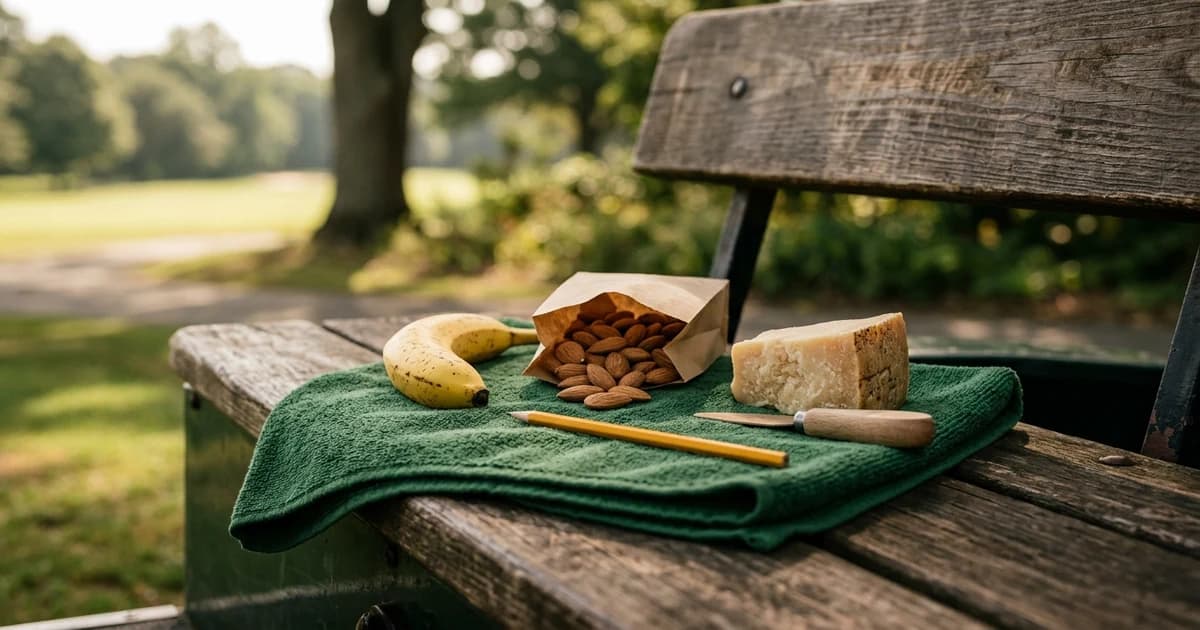
| Holes 6-7 | First snack: 20-30 g carbs (banana, gummies, granola bar) |
| The turn | Refill water; 20-30 g carbs; second moderate caffeine dose if you use it |
| Holes 10-13 | Keep sipping; this is where the front-nine fuel either carries you or runs out |
| Holes 14-15 | Second snack: another 20-30 g carbs |
| Post-round (first hour) | 20-30 g protein, fluids, a real meal within 90 minutes |
Signs You Overdid the Caffeine
Racing heart over a putt, shaky hands on the grip, or a headache that was not there on the 10th tee. The FDA's general guidance for healthy adults is up to 400 mg of caffeine per day. Two 155 mg doses eat most of that budget. If you had a large morning coffee and want a turn dose, keep it moderate: 80-100 mg. More on daily limits: How Many Caffeine Pouches a Day and How Long Does Caffeine Stay in Your System.
If unusual tiredness persists after light activity like a cart round, talk to a clinician. That is not golf fatigue.
Why You Are So Tired After Golf
Post-round exhaustion is the calorie and fluid deficit catching up. You burned 880 kcal, lost 40-50 percent of your daily water needs, and spent five hours in the sun. Three things to do in the first hour: drink 500 ml of water, eat 20-30 g of protein, and get out of direct sun. A 1 PM finish lands right in the afternoon dip, which makes it worse.
Timing Beats Toughness
The back nine does not fall apart because you lack grit. It falls apart because the front nine burned through your fuel, your water, and your first caffeine dose on a predictable schedule, and you did not reload. The research converges: feed early (hole 6, not hole 10), hydrate continuously (every hole, not at the turn), and if caffeine is part of your round, plan for two doses, not one.
Frequently Asked Questions
Why do I get tired on the back nine?
Three things converge around holes 10-13: physical fatigue from 17,000 steps and 880 kcal of expenditure, mental fatigue from four hours of decision-making, and fuel depletion from not eating or drinking enough during the front nine.
Why does my golf swing fall apart when I am tired?
Fatigued legs and core lose rotational range, so the arms compensate. The result is the "armsy" swing: shorter carry, inconsistent contact. A 2025 EJSS study found that walking golfers showed greater leg-power decline (countermovement-jump) compared to cart riders by the 12th hole, despite the same clubhead speed and ball speed.
Is golf physically tiring?
Yes. A walking 18-hole round averages about 17,000 steps, roughly 880 kcal burned, over approximately five hours. Even cart rounds logged over 6,000 steps and 456 kcal in the same study.
Does caffeine help golf fatigue?
One double-blind crossover trial (Mumford et al., 2016) found that a caffeine supplement, dosed before and after nine holes, lowered scores by 2.5 strokes, increased greens in regulation, and reduced perceived fatigue. These results belong to the study's protocol and dose (roughly 155 mg twice). Your results will depend on your tolerance and timing.
What should I eat to avoid fatigue during a round of golf?
Aim for 20-30 g of carbohydrate per hour, starting at holes 6-7 with a second snack at holes 14-15. A 2023 Nutrients trial found that golfers who consumed about 30 g of carbs per hour reported lower fatigue from hole 6 onward and higher concentration. Good options: bananas, energy gummies, granola bars, trail mix.
Why am I so tired after golf?
A walking round burns 880 kcal and depletes 40-50 percent of your daily water needs. Combined with sun exposure and the afternoon dip, post-round exhaustion is a calorie, fluid, and heat deficit hitting at once. Rehydrate, eat protein and carbs, and get out of direct sun within the first hour.
Why the Turn Is the Right Place for Your Second Dose
The Mumford trial did not dose once. It dosed at the first tee and at the turn, because the researchers understood that a single caffeine hit does not cover five hours of play. That redosing problem is what most golfers ignore: the morning coffee is metabolized by the 12th hole, and the back nine runs on fumes.
Roon is an 80 mg caffeine pouch with 60 mg L-theanine, 25 mg methylliberine (Dynamine), and 5 mg theacrine (TeaCrine). The methylliberine is there for duration: a randomized, double-blind crossover PK study (n=12) found that co-administering methylliberine with caffeine cut caffeine's oral clearance from 41.9 to 17.1 L/hr and extended its half-life from 7.2 to 15 hours, with no increase in peak concentration. That study used 100 mg methylliberine and 150 mg caffeine, roughly 4x the methylliberine and 1.9x the caffeine in a Roon pouch, so the effect will be smaller at Roon's dose. The direction is the same: slower clearance, longer tail, same peak. That is why Roon targets a 6-8 hour felt window from 80 mg.
One pouch sits in your lip, requires no liquid, no chewing, and no bathroom stop on 12. From $9.16 per tin on subscription ($0.61 per pouch) or $15.00 for a one-time 4-tin order ($1.00 per pouch). Roon is not a swing fix, a hydration plan, or a substitute for eating real food on the course. The 2.5 strokes in the study belong to that study's protocol. The timing principle is yours to test. One trade-off: a longer caffeine half-life means stop at least 8 hours before bed.
Related from Roon
- Best Golf Snacks for 18 Holes
- Dehydration and Cognitive Function
- How Long Does Caffeine Stay in Your System
- The Calm Focus Stack Behind Better Reaction Time
Written by Roon Team