Golf Snacks for 18 Holes: What to Pack and When to Eat
Golf Snacks for 18 Holes: What to Pack and When to Eat
The best golf snacks deliver 20 to 30 g of carbohydrate per hour alongside some protein and salt, eaten in small amounts around holes 6 to 7, the turn, and holes 14 to 15. Drink 500 to 750 ml of water per nine holes, and keep one non-food alertness option in your pocket for the back nine. Three controlled golf feeding trials all found the same thing: carbs reduce perceived fatigue, but they do not change your score. Pack for endurance, not miracles.
Key Takeaways
- A walking round burns roughly 880 kcal over five hours and covers 17,000 steps. That is a low-grade endurance event, not a stroll.
- Carbohydrate intake of 20 to 30 g per hour cuts perceived fatigue from about hole 6 onward, though no trial has shown a scoring benefit.
- Hydration matters more than food. A 1.5% body-mass water loss reduced shot distance by 11% and nearly doubled off-target error in one study.
- Caffeine, dosed twice per round during a 36-hole tournament, was associated with 2.5 fewer strokes per round in the only controlled golf caffeine trial.
Hole-by-Hole Fueling Schedule
| Window | What to eat or drink | How much | Why |
|---|---|---|---|
| Pre-tee (60 min before) | Oatmeal, toast with PB, or a banana; water | 300 to 400 kcal; 400 to 500 ml fluid | Top off glycogen, start hydrated |
| Holes 1 to 5 | Water every 2 to 3 holes | 2 to 3 mouthfuls per hole | Prevent early deficit |
| Holes 6 to 7 | Banana, almonds, or half an oat bar | ~20 g carbs | Fatigue appears around hole 6 in trial data |
| The turn | Half sandwich, jerky + crackers, or cheese + fruit | 300 to 400 kcal, carbs + protein | Biggest refuel window |
| Holes 10 to 13 | Water; small handful of trail mix if hungry | Sip every hole | Avoid post-turn slump |
| Holes 14 to 15 | Dates, pretzels, gel, or chews; caffeine if needed | ~20 g carbs | The back-nine fade zone |
| Post-round (within 60 min) | Real meal with 20 to 30 g protein | Full plate | Recovery |
This schedule aligns with the Hydracaddie 18-hole nutrition plan, which recommends 20 to 30 g of carbs per hour, 500 to 750 ml per nine, and snacking at the same windows.
Why a Round Is a 5-Hour Endurance Event
Golf does not feel like exercise until you check the numbers. A 2025 study in the European Journal of Sport Science measured 16 competitive male golfers in a randomized crossover design: walkers logged 17,007 steps and burned 880 kcal over rounds averaging 5 hours 6 minutes. Cart riders still hit 6,274 steps and 456 kcal.
You have probably seen the claim that walking 18 burns "about 1,400 calories." That number traces to a 2010 estimate cited by Golf.com and includes carrying clubs. The measured figure in a controlled trial is lower, but 880 kcal over five hours is still the equivalent of a long, slow bike ride. Your body needs fuel on a schedule, not just at the turn.
What the Golf Feeding Trials Found
Gummies every hole (Nutrients, 2023). Eleven competitive golfers ate carbohydrate gummies on every hole, roughly 30 g of carbs per hour. Perceived fatigue was lower from hole 6 (p < 0.001) and concentration was higher (p = 0.032). Score, putting, drive distance, and clubhead speed did not change.
High-carb groups (Nutrients, 2024). Male golfers across three carbohydrate levels in a double-blind parallel-group design. Both high-carb groups reported less fatigue after 18. No difference in any performance metric.
Carbs vs. carbs-plus-protein (Nutrition and Health, 2022). Thompsett et al. gave six male golfers 30 g carbs, 15 g protein plus 15 g carbs, or a zero-calorie control. Fatigue scores: 3.0, 2.5, and 4.0. Performance did not differ. The sample is tiny, so treat this as directional.
The takeaway: snacks fix the fade, not the swing. You will feel less drained by hole 15. Your handicap stays where it is.
12 Best Golf Snacks Worth Packing
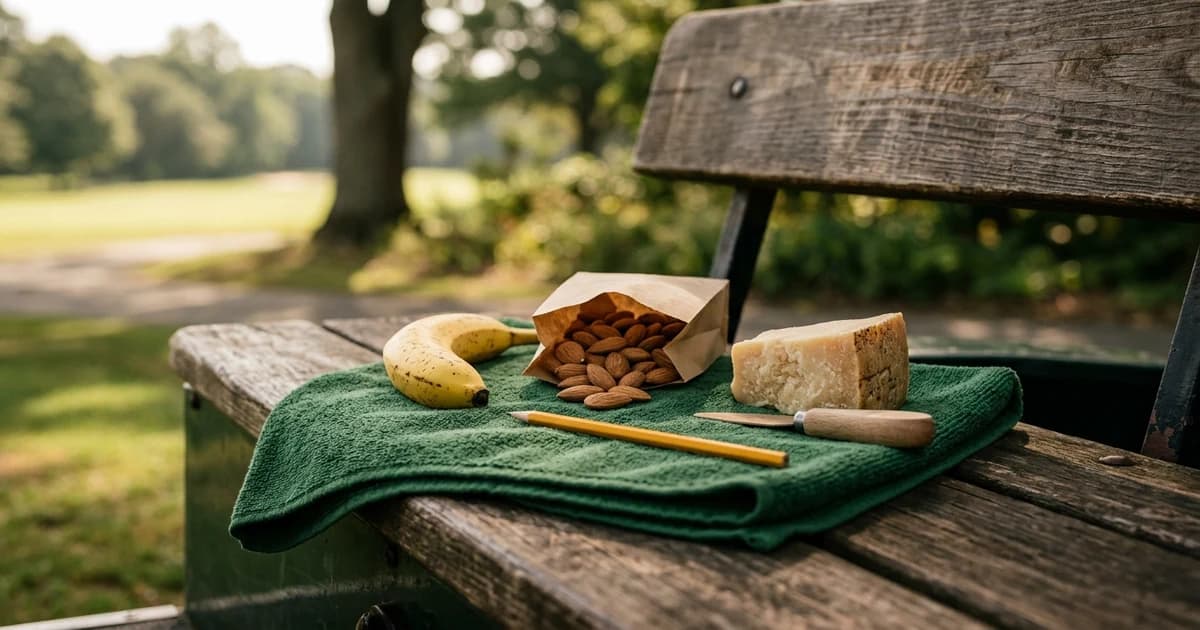
- Banana. Holes 6 to 7 or the turn. About 27 g of fast carbs, potassium, and it fits in a side pocket.
- Dates or dried apricots. Holes 14 to 15. Dense portable sugar. Four Medjool dates deliver roughly 72 g of carbs.
- Beef or turkey jerky. The turn. 10 to 15 g of protein, shelf-stable, salty enough to support electrolytes.
- Almonds or mixed nuts. Holes 6 to 7. Protein, fat, slow energy release. Pre-portion into a bag.
- Half a peanut-butter sandwich. Pre-tee or the turn. Carbs, fat, protein. Wrap in foil.
- Hard cheese and crackers. The turn. Cheddar and Gruyère tolerate heat better than soft cheese.
- Oat bar. Holes 6 to 7 or the turn. 20 to 40 g carbs depending on brand. This is your golf energy bar baseline. Look for at least 3 g fiber and under 10 g added sugar.
- Trail mix (skip the candy). Holes 10 to 13. Nuts plus raisins or cranberries. Chocolate melts, and the sugar spike is not what you need at hole 11.
- Pretzels. Holes 14 to 15 or any hot day. Fast carbs plus sodium.
- Boiled egg. The turn. 6 g protein, nearly zero carbs. Best with an ice pack in the cart.
- Gel or chews. Holes 14 to 15 on hot days. Pure fast carbs when solid food sounds terrible.
- Orange or apple slices. The turn. Hydration, vitamin C, and carbs. Pre-slice and bag the night before.
What Should You Eat at the Turn?
Aim for 300 to 400 kcal split between carbs and protein. A half sandwich with jerky, cheese and crackers with fruit, or an oat bar with a banana all work.
The mistake most golfers make is eating too much. A 700-calorie hot dog, fries, and a beer from the snack shack puts your body into digestion mode right when holes 10 to 12 demand precision. Eat enough to feel fueled, not enough to feel full.
How Much Water Should You Drink During a Round of Golf?
The Titleist Performance Institute recommends 40 to 50% of your total daily water intake on the course. A practical plan: 400 to 500 ml about 60 minutes before tee time, then 500 to 750 ml per nine, roughly 2 to 3 mouthfuls every hole.
The stakes are real. Smith et al. (2012) studied seven low-handicap golfers who lost just 1.5% of body mass. Shot distance dropped from 128.6 m to 114.6 m, off-target error nearly doubled from 4.1 m to 7.9 m, and distance-judgment error rose from 4.1 m to 8.8 m. A small water deficit, a large accuracy problem. For more on how dehydration affects attention and decision-making, the pattern extends beyond golf.
What Goes in the Pocket That Is Not Food
The only controlled caffeine trial in golf, Mumford et al. (2016), gave 12 male golfers (handicap 3 to 10) a caffeine supplement before the round and again after nine holes at roughly 1.9 mg/kg per dose (about 155 mg). The caffeine group scored 76.9 vs. 79.4 (p = 0.039), hit more greens in regulation (8.6 vs. 6.9, p = 0.035), drove about 3% longer (p = 0.047), and reported less fatigue. The design detail that matters: they dosed twice, because a single morning dose does not reach hole 15.
What fits in a golf bag or pocket?
- First-tee coffee. Familiar and effective, but gone by the turn.
- Energy drink. A can in the cart, often with 25 to 35 g of sugar, plus a bathroom stop. See how long energy drinks actually last.
- Caffeine gum. Golf Gum (Liquid Core) delivers about 80 mg caffeine per piece, 5 per pack (check Liquid Core for current pricing). Gum onset and doses vary.
- Caffeine pouch. Roon delivers 80 mg caffeine with 60 mg L-theanine, 25 mg methylliberine (Dynamine), and 5 mg theacrine (TeaCrine) in a zero-nicotine sublingual pouch. Nothing to drink, spit, or chew. The calm-focus stack is designed for 6 to 8 hours of steady alertness. Onset: 5 to 10 minutes.
None of these "lower your score." The Mumford results belong to that study. But a second caffeine dose at the turn follows the same logic the researchers used.
Snacks to Leave in the Car
- Candy bars. Fast sugar spike, crash around holes 12 to 13.
- Large muffins. 400 to 600 kcal of refined carbs. A sluggish back nine waiting to happen.
- Sugary sports drinks. 30 to 40 g of sugar per serving in many brands. Water plus a real snack does the same job.
- Beer. Diuretic, not hydration. Save it for the 19th hole.
Choosing the Right Golf Snacks for Your Round
The feeding trials tell a clear story: steady carbohydrate intake reduces perceived fatigue from about hole 6 onward, and hydration protects accuracy more than any single food choice. Pack 20 to 30 g of carbs per hour, drink 500 to 750 ml per nine, eat small at holes 6 to 7, the turn, and 14 to 15, and skip the sugar bombs. The swing is yours. The fuel just keeps you from fading before hole 15.
Frequently Asked Questions
What are the best golf snacks for energy?
Bananas, dates, oat bars, and trail mix deliver 20 to 30 g of carbs per serving with minimal digestive load. Pair a carb source with protein (almonds, jerky) for longer-lasting energy. Eat small amounts every 4 to 5 holes rather than one large snack at the turn.
What should you eat before a round of golf?
A meal of 300 to 400 kcal about 60 to 90 minutes before tee time. Oatmeal with a banana, toast with peanut butter, or eggs and whole-grain bread all work. Drink 400 to 500 ml of water alongside your pre-round meal.
How many calories do you burn walking 18 holes?
A 2025 controlled study measured 880 kcal for walkers and 456 kcal for cart riders over rounds of about 5 hours. Popular estimates run as high as 1,400 kcal for walking while carrying clubs, but measured data is lower.
Is it OK to drink coffee or caffeine on the golf course?
Yes. The Mumford et al. (2016) trial found caffeine before and after nine holes was associated with lower scores and less fatigue over 36 holes. Coffee at the first tee is fine, but it wears off by the turn. A second caffeine dose in any format follows the study's dosing logic.
What snacks should you avoid on the golf course?
Candy bars, large muffins, sugary sports drinks, and beer. All produce rapid blood sugar swings or impair hydration. The crash hits hardest around holes 12 to 14, exactly when focus matters most.
What is the best snack at the turn?
A mix of carbs and protein totaling 300 to 400 kcal. A half peanut-butter sandwich with a banana, jerky with crackers and an orange, or cheese with an oat bar. Avoid anything over 500 kcal. The turn is for refueling, not a full meal.
The Snack That Is Not a Snack: What to Put in Your Pocket at the Turn
The Mumford trial dosed caffeine twice for a reason. A single morning coffee clears before the back nine, and the feeding studies show food alone fixes fatigue but not focus. That leaves a gap at the turn: you need alertness, not calories.
Roon is a zero-nicotine sublingual pouch built for that gap. Each pouch delivers 80 mg caffeine and 60 mg L-theanine alongside 25 mg methylliberine (Dynamine) and 5 mg theacrine (TeaCrine). The methylliberine matters here: in a randomized, double-blind, crossover PK study (n = 12), co-administration of methylliberine with caffeine cut caffeine's oral clearance from 41.9 to 17.1 L/hr and extended its half-life from 7.2 to 15 hours, with no increase in peak concentration. That study used 100 mg methylliberine and 150 mg caffeine, roughly four times the methylliberine and twice the caffeine in a Roon pouch, so the magnitude will differ. The mechanism is directionally the same: same peak, longer tail. Roon's felt window is 6 to 8 hours. One pouch at the turn is designed to last through 18 rather than fade at 14.
The trade-off: a longer caffeine half-life means you should stop at least 8 hours before bed. An afternoon round ending at 5 PM is fine; a pouch at 4 PM before a 10 PM bedtime is tight.
At from $9.16 per tin on a 12-tin subscription ($0.61 per pouch) or $15.00 one-time for four tins, a single tin of 15 pouches covers roughly a season of Saturday rounds. Roon is not a swing coach and it is not a meal. It is focus that lasts to the back nine, in a format that fits next to a tee and a ball marker. Try Roon for your next round.
Related from Roon
- Caffeine Pouches for Runners and Cyclists: Why Endurance Athletes Carry Pouches Instead of Liquid
- How Fast Do Caffeine Pouches Work?
- Caffeine and L-Theanine for Athletes: The Calm Focus Stack
- Dehydration and Cognitive Function
Written by Roon Team