Feynman Technique: How to Use It, Step by Step
Roon Team
Feynman Technique: How to Use It, Step by Step
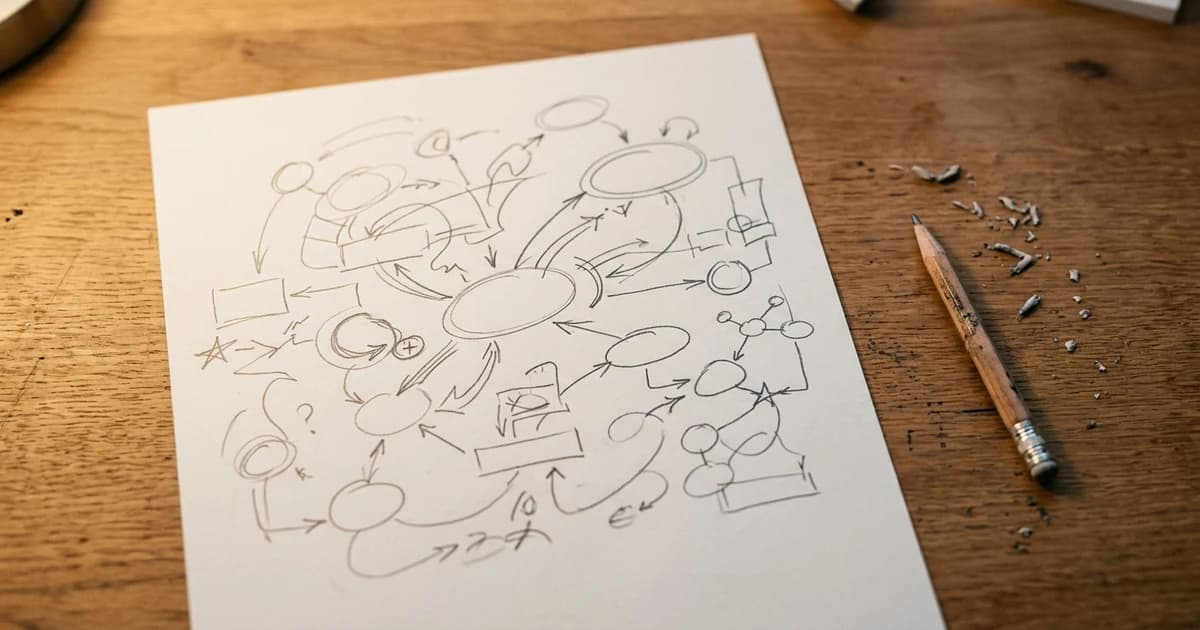
The Feynman Technique is a four-step method for learning anything by explaining it. Pick one concept. Explain it in plain words from memory, as if to a 12-year-old. Mark every spot where you stall or reach for jargon. Go back to the source, fix those gaps, and explain it again, shorter. A single session takes roughly 20 to 40 minutes per concept, and the only materials you need are a blank sheet of paper and a pencil.
Key Takeaways
- Four steps: choose one concept, explain it from memory, identify the gaps, then simplify and re-explain.
- Each step maps to a studied learning mechanism: retrieval practice, self-explanation, and the testing effect.
- Teaching only helps when you do it without notes. Open-book explaining produces no measurable benefit over passive reading.
- The method is effortful recall, so it falls apart when you are sleep-deprived. Do Feynman sessions early in a study block.
The Feynman Technique in 4 Steps
| Step | What you do | What it exposes | Suggested time |
|---|---|---|---|
| 1. Choose one concept | Write the topic at the top of a blank page. One idea, not a chapter. | Whether you actually know what you are trying to learn | 2 min |
| 2. Explain it from memory | Close the book. Write or speak the explanation in plain language, as if teaching a smart 12-year-old. No jargon, no peeking. | Every gap, every hand-wave, every sentence where you stall | 10 min |
| 3. Find the gaps | Circle or highlight every spot where you got stuck, used a technical term without defining it, or skipped a link in the chain. Go back to the source material and fill those holes. | The difference between recognition ("I've seen this") and recall ("I can rebuild this") | 10 min |
| 4. Simplify and re-explain | Rewrite the explanation. Make it shorter. Add one analogy. If a sentence still needs jargon, you still have a gap. | Whether the concept now holds together without scaffolding | 10 min |
The whole cycle runs about 30 minutes. If step 2 produces almost no gaps, pick a harder sub-topic. If you cannot get through step 2 at all, the concept is too large. Break it down.
How to Use the Feynman Technique: A Worked Example
Concept: What is a p-value?
Step 1. Write "p-value" at the top of a blank page.
Step 2 (first attempt, book closed). "A p-value is the probability that your result happened by chance. If it's below 0.05, the result is significant and your hypothesis is probably correct."
Two problems. The p-value is not "the probability your result happened by chance." And "significant" does not mean "your hypothesis is probably correct."
Step 3. Back to the textbook. A p-value is the probability of observing data at least as extreme as yours, assuming the null hypothesis is true. It says nothing about whether your hypothesis is correct, and 0.05 is a convention, not a magic threshold.
Step 4 (second attempt). "You run an experiment. The p-value asks: if nothing interesting were actually going on, how often would you see a result this extreme just from random noise? A p-value of 0.03 means about 3 times in 100. It does not tell you your theory is right."
Shorter, plainer, and the two errors are gone.
Did Richard Feynman Actually Invent the Feynman Technique?
Not exactly. Richard Feynman (1918 to 1988) shared the 1965 Nobel Prize in Physics with Sin-Itiro Tomonaga and Julian Schwinger for their work in quantum electrodynamics. He was famous for explaining hard physics plainly. But he never published a four-step study method.
The habits are real. In James Gleick's biography Genius (1992), Gleick describes Feynman preparing for his Princeton oral exams by opening a fresh notebook titled "NOTEBOOK OF THINGS I DON'T KNOW ABOUT" and spending weeks reorganizing his knowledge from the ground up. Caltech physicist David Goodstein told a complementary story: Feynman agreed to prepare a freshman lecture on why spin one-half particles obey Fermi-Dirac statistics, then came back and said he couldn't reduce it to the freshman level, meaning the topic wasn't truly understood. In his 1966 talk "What Is Science?", Feynman recounted how his father taught him that knowing a bird's name in every language tells you nothing about the bird.
The four-step package came later. The name appears to date to a September 2011 post by Scott Young, and Farnam Street published its widely copied version in April 2012. The quote "If you can't explain it simply, you don't understand it well enough" is often credited to Feynman or Einstein. No reliable primary source supports either attribution.
Why the Feynman Technique Works: What the Research Says
No randomized trial has tested the four-step Feynman Technique as a named package. But each step maps to a mechanism that has been studied independently.
The illusion of explanatory depth
Across twelve studies, Rozenblit and Keil (2002) found that people overestimate how well they understand how things work. The illusion is stronger for causal knowledge than for facts or procedures. Try it: rate how well you understand a zipper, then write the full explanation. Your confidence drops. Step 2 is that demonstration, applied on purpose.
Self-explanation
Chi et al. (1994) prompted 14 eighth-graders to self-explain after each line of a passage on the circulatory system; 10 controls read the same text twice. The prompted group showed greater gains from pretest to posttest. Small sample (n = 24), but the finding has been replicated: generating an explanation forces you to integrate new information with what you already know. Re-reading does not.
Retrieval practice
Roediger and Karpicke (2006) tested students on prose passages. After five minutes, repeated studying beat testing. But at two days and one week, prior testing produced substantially greater retention, even though students who only re-read felt more confident. Step 2 is a retrieval trial: you pull the explanation out of memory, not off a page.
Learning by teaching, but only from memory
Koh, Lee, and Lim (2018) assigned 124 undergraduates to four conditions. One week later, the group that taught without notes and the retrieval-only group both outperformed the group that taught with notes and the control. Teaching helps because it forces retrieval. Explain with the textbook open and you lose the benefit.
Fiorella and Mayer (2013) found a related effect: students who studied a Doppler-effect lesson expecting to teach it outperformed those expecting a test on an immediate comprehension measure, though the advantage did not reach significance on a delayed test. Even the anticipation of teaching may change how you encode material.
Feynman Technique vs. Active Recall, Blurting, and Rubber Ducking
| Method | What it is | Key mechanism | Best for |
|---|---|---|---|
| Feynman Technique | Explain a concept from memory in plain words, find gaps, simplify, re-explain | Retrieval + simplification + gap identification | Deep conceptual understanding (science, economics, programming logic) |
| Active recall | Any method that retrieves information from memory (flashcards, practice tests, free recall) | Retrieval practice | Broad category; Feynman is one form of it |
| Blurting | Write everything you remember about a topic, then check | Retrieval only, no simplification pass | Fast self-test before an exam |
| Rubber duck debugging | Explain your code line by line to an inanimate object | Verbalization forces sequential logic check | Finding bugs in code |
The Feynman Technique is active recall plus a simplification constraint. Blurting skips the plain-language filter. Rubber duck debugging is the programmer's version of step 2.
Common Mistakes
Explaining with the book open. The Koh et al. (2018) study found that teaching from notes produced no benefit over passive reading. Close the book.
Choosing a whole chapter. "Explain organic chemistry" is not a concept. "Explain why SN1 reactions favor tertiary substrates" is. One concept per session.
Keeping the jargon. If your explanation says "mitochondria are the powerhouse of the cell" without explaining what that means, you have not simplified.
Skipping the second pass. Step 4 is where real learning happens. The first explanation exposes gaps; the second closes them.
Using it for pure memorization. This is a comprehension tool. For lists of dates or vocabulary, spaced-repetition flashcards are faster. For more on retention, see the science of retaining what you study.
Using AI or a Friend as Your "Student"
You do not need a literal 12-year-old. Three alternatives:
- A study partner. Explain the concept; their follow-up questions are your gap map.
- A voice memo. Record yourself explaining, then play it back. Pauses and filler mark the gaps.
- A chatbot told to ask naive questions. You must explain first, from memory, before asking the chatbot anything. Typing "explain p-values to me" turns the exercise backward.
In every case, the learner does the explaining. The "student" only asks questions.
Why It Fails When You Are Tired
Step 2 is the hardest cognitive moment: you sit with a blank page and reconstruct an idea from nothing. That is the first thing to collapse under fatigue. The CDC recommends adults 18 to 60 get seven or more hours of sleep per day, and as NIOSH states, stimulants do not replace the alertness and decision-making ability that come from adequate sleep.
Practical fixes:
- Do Feynman sessions early in a study block, before your attention runs out.
- Two or three concepts per evening is productive. Seven is diminishing returns.
- If the exam is tomorrow and you haven't slept, sleep first, then review. See whether cramming works and what short sleep does to thinking.
The Short Version
Choose one concept. Explain it from memory. Find the gaps. Simplify and explain again. The components are backed by research on retrieval practice, self-explanation, and learning by teaching. Feynman didn't invent the four-step method, but the intellectual habits behind it were genuinely his. It works best when you are rested enough for the hard part: rebuilding an idea from scratch, with the book closed.
Frequently Asked Questions
What are the 4 steps of the Feynman Technique?
- Choose one concept. 2. Explain it from memory in plain language, as if to a 12-year-old. 3. Identify every gap or unexplained term, then return to the source. 4. Simplify, add an analogy, explain again. The cycle takes roughly 30 minutes.
Is the Feynman Technique scientifically proven?
The four-step package has not been tested in a randomized trial as a whole. Its individual components (retrieval practice, self-explanation, learning by teaching from memory) each have published experimental support. The honest summary: the parts are evidence-based, and the combination is a reasonable assembly of them.
How long does the Feynman Technique take?
About 20 to 40 minutes per concept. Two minutes to pick the topic, ten to explain from memory, ten to fix gaps, and ten to simplify. For a full session, plan two or three concepts across 60 to 90 minutes.
Does the Feynman Technique work for math?
Yes. Instead of memorizing a formula, explain why it works and when it applies. If you can walk through a derivation on a blank page without notes, you understand it. If you stall, you have found your gap.
Is the Feynman Technique the same as active recall?
Active recall is the broad category: any method that pulls information from memory rather than re-reading it. The Feynman Technique is one form that adds a simplification requirement. Flashcards, practice tests, and blurting are others. They share the retrieval mechanism; the Feynman version adds forced simplification and gap identification.
Did Einstein say "If you can't explain it simply, you don't understand it well enough"?
No reliable primary source attributes this quote to Einstein or Feynman. It circulates under both names, but neither said it in any documented lecture, paper, or interview. The idea is sound; the attribution is not.
For the Ten Minutes Where You Explain It From Memory
The technique lives or dies in step 2, the ten minutes where you sit with a blank page and rebuild a concept from nothing. That takes sustained attention, and attention is the first thing to go when you are tired.
Nothing replaces sleep. But for the hours when you are awake and working, the combination of caffeine and L-theanine has support. A 2025 Nutrition Reviews meta-analysis (49 randomized trials reviewed) found the pairing improved attention-switching accuracy, alertness, and reduced tiredness. Not a memory claim. An attention claim, which is what step 2 demands.
Roon delivers that pairing at a fixed dose (80 mg caffeine, 60 mg L-theanine) in a zero-nicotine sublingual pouch, with 25 mg methylliberine (Dynamine) and 5 mg theacrine (TeaCrine). The methylliberine is there for duration: a randomized crossover PK study (n = 12) found co-administration with caffeine cut oral clearance from 41.9 to 17.1 L/hr and extended half-life from 7.2 to 15 hours, with no increase in peak concentration. That study used 100 mg methylliberine and 150 mg caffeine (roughly 4x and 1.9x Roon's doses), so the direction is the same but the magnitude may differ. Roon's felt window is 6 to 8 hours, not 15. A longer half-life also means you should stop at least 8 hours before bed.
Roon is not a study drug and does not improve memory. It is a way to keep attention steady for the kind of focused work step 2 requires. From $9.16 per tin on subscription, $15.00 one-time. Try it before your next study session.
Related from Roon
- How to Remember What You Study: The Science of Focus and Retention
- How to Focus While Studying
- How to Stay Awake While Studying Without Wrecking Sleep
- Does Cramming Actually Work?
Written by Roon Team