Dry Mouth When Nervous: What Stops Saliva Before a Speech
Roon Team
Dry Mouth When Nervous: What Stops Saliva Before a Speech
Dry mouth when nervous is rarely about running out of saliva. Stress thickens what your glands produce, coffee's tannins strip the slippery proteins that coat your tongue, and talking with an open mouth evaporates whatever is left. The result feels like cotton, but the fix is more specific than "drink water." Here is what the research actually shows, and the order of moves that works fastest before you step to the mic.
Key Takeaways
- Stress changes saliva composition (thicker, stickier) more reliably than it reduces volume. One trial found no flow drop at all after a public speech, just a near-doubling of salivary protein.
- Coffee dries your mouth through astringency, not dehydration. Its tannins bind salivary proteins and precipitate them off the tongue.
- Talking amplifies the problem: mouth breathing during speech evaporates the saliva film faster than your glands can replace it.
- The fix order matters: room-temperature water in sips, sugar-free gum before you go on, nose breathing between sentences, and a lower caffeine dose rather than zero.
Why Does Your Mouth Get Dry When You Are Nervous?
The standard explanation: fight-or-flight kicks in, your sympathetic nervous system shuts off saliva, your mouth dries up. Clean story. Also incomplete.
A 2025 review in Advances in Physiology Education traced the "sympathetic nerves shut saliva off" claim back to Walter Cannon, who proposed it on a purely theoretical basis in the early 1900s. Subsequent researchers could not find unequivocal evidence that sympathetic activation reduces salivary flow. Yet the assumption persists in some textbooks.
A 2024 crossover study (n=40) using the Trier Social Stress Test arithmetic task found that heart rate rose and unstimulated whole saliva flow fell during the stress condition (P < .001). So flow can drop under acute stress.
But a 2012 trial told a different story. Sixty-four students gave a 2-minute unprepared public speech, which is closer to the real scenario you are worried about. Salivary flow rate did not change at any time point. What changed was composition: salivary protein concentration rose to 1.03 mg/ml versus 0.61 mg/ml in controls. Thicker, stickier saliva, same volume.
| What the research found | Study | n | Stressor | Flow change? | Composition change? |
|---|---|---|---|---|---|
| Flow dropped during stress task | Frederiksen 2024 | 40 | Trier arithmetic task | Yes (P < .001) | Not measured |
| Flow unchanged, protein nearly doubled | Naumova 2012 | 64 | 2-min public speech | No | Protein 1.03 vs 0.61 mg/ml |
| "Sympathetic shutdown" was Cannon's assumption | Zagvazdin 2025 | Review | N/A | Contested | N/A |
The bottom line: sometimes less saliva, usually thicker saliva, always drier-feeling once you start talking. The sensation of cotton mouth when nervous does not require your glands to stop. It just requires the composition to shift.
Talking Is the Second Cause
Speaking forces your mouth open for extended periods. Air passes over the tongue and palate continuously, evaporating the thin saliva film faster than your glands replenish it. If your saliva is already thicker from stress, evaporation accelerates the problem.
Speakers who breathe through their mouth between sentences compound the effect. Every inhale pulls dry air across oral tissue that is already working with a reduced lubricating layer. This is also why shaking hands and dry mouth so often arrive together before a talk: both are downstream of the same sympathetic activation, but the talking itself makes the mouth symptom worse.
Does Coffee Cause Dry Mouth?
Yes, but not for the reason most people assume.
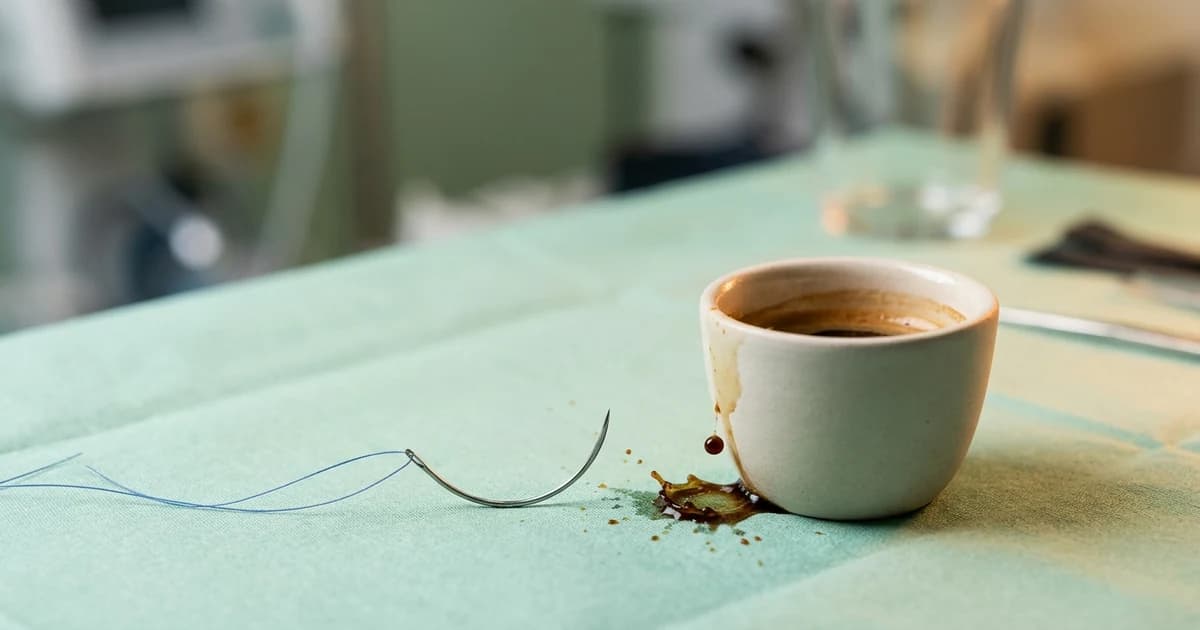
Coffee contains tannins and pseudo-tannins that bind to salivary proteins and precipitate them onto the tongue, removing their lubricating effect. Same mechanism behind the sandy, astringent feeling from red wine or unripe fruit. Chlorogenic acids and volatile phenols contribute to astringency and are described as reducing salivary secretion. Brewed coffee sits at a pH of 4.85 to 5.10 (Rao and Fuller, Scientific Reports 2018), acidic enough to further alter the protein environment in your mouth.
The correction worth knowing: coffee does not dehydrate you. A counterbalanced crossover trial (n=50, habitual male coffee drinkers, 4 x 200 ml coffee per day vs. water for 3 days) found no differences across hydration markers. Coffee dries your mouth, not your body. The dryness is astringency, not fluid loss. The reason coffee also carries breath consequences is related: proteins and bacteria in a low-pH, sugar-laden environment.
The Fix Order for the Hour Before You Speak
Order matters here. Start with the biggest lever.
-
Room-temperature water in small sips. Not a large glass all at once. A big gulp fills your bladder on a timeline that peaks mid-presentation. Small sips keep the oral mucosa wet without creating urgency.
-
Sugar-free gum, 10 to 15 minutes before you go on. Chewing stimulates saliva flow through mechanical and taste receptors, as recommended by the ADA. Remove it before you speak. The flow increase lingers.
-
Nose breathing between sentences. This is the single biggest mid-speech change most speakers skip. It reduces evaporative loss and lets saliva re-coat oral surfaces during natural pauses.
-
Skip milk-heavy or sugary coffee drinks. Sugar and dairy feed oral bacteria and thicken the mouth feel. If you drink coffee, keep it black and moderate.
-
Lower the caffeine dose rather than cutting it. Going to zero the morning of a speech invites caffeine withdrawal symptoms: headache, irritability, fatigue. A lower dose preserves alertness while reducing tannin exposure. The FDA notes that up to 400 mg of caffeine a day is not generally associated with dangerous negative effects in healthy adults, but your pre-speech dose does not need to be near that ceiling.
What to Do Mid-Speech
If your mouth dries up after you are already talking, three techniques help:
The deliberate pause with a sip. Audiences do not notice a 3-second water break. What they notice is a speaker rushing through sticky consonants and clicking sounds. A calm sip reads as confidence.
Tongue-to-palate press. Pressing your tongue firmly against the roof of your mouth between sentences is a common speaker technique for stimulating saliva. It is not studied in controlled settings, but speaking coaches use it widely.
Slow the pace. Fast speech keeps the mouth open longer per minute. Slowing down by even 10 to 15% reduces evaporative loss and tends to sound more authoritative anyway.
L-Theanine and the Stress Markers in Your Saliva
L-theanine, an amino acid in tea, has been studied for its effects on stress biomarkers, including markers that show up in saliva itself.
A 2013 single-blind trial (n=20) found that 200 mg of L-theanine twice daily produced lower salivary alpha-amylase (a sympathetic stress marker, p=0.032) and lower subjective stress (p=0.020) versus placebo. A 2007 double-blind crossover (n=12) found 200 mg of L-theanine reduced heart rate and salivary IgA responses during a mental arithmetic stressor.
Those results are real, but small. A 2004 trial (n=16) comparing 200 mg L-theanine against 1 mg alprazolam and placebo found no anxiolytic effect for either under induced anticipatory anxiety. L-theanine is studied for calm alertness. It is not a fix for dry mouth, and it is not an anti-anxiety agent. For deeper reading on the trial data, there is more to the picture.
When Dry Mouth Is Not Nerves
Dry mouth that persists at rest, wakes you at night, or started when you began a new medication is worth discussing with a dentist or clinician. That is a different category from the situational dryness that shows up before a speech and resolves afterward.
Conclusion: Putting the Moisture Problem in Perspective
Dry mouth before a presentation is common, predictable, and manageable. The sensation comes from stress-altered saliva composition, evaporative loss from open-mouth speaking, and tannin-driven astringency from coffee. The fix is a sequence, not a single trick: small sips, gum, nose breathing between sentences, and a moderate caffeine dose. The folklore about stress "shutting off" your salivary glands is, at best, only part of the story.
Frequently Asked Questions
Why does my mouth get dry when I am nervous?
Stress activates the sympathetic nervous system, which changes saliva composition and may reduce flow. A 2012 trial found that a public-speech stressor did not change flow rate but nearly doubled salivary protein concentration. The result is thicker, stickier saliva that feels dry even if volume has not dropped. Mouth breathing during the speech evaporates whatever moisture remains.
Does coffee cause dry mouth?
Coffee causes a dry-mouth sensation through astringency, not dehydration. Tannins in coffee bind salivary proteins and pull them off the tongue, removing lubrication. A 2014 crossover study (n=50) confirmed that moderate daily coffee intake does not dehydrate you compared to water. The dryness is in your mouth, not your body.
How do I stop dry mouth before a speech?
Start with room-temperature water in small sips, not a large glass. Chew sugar-free gum for 10 to 15 minutes before your slot to stimulate saliva, then remove it. Between sentences, close your mouth and breathe through your nose to reduce evaporation. Lower your caffeine dose that morning rather than cutting it entirely, which can trigger withdrawal symptoms.
Should I drink coffee before public speaking?
You can, but moderating the dose helps. Coffee's tannins cause oral astringency regardless of hydration, and a large cup delivers more tannin exposure. A smaller serving preserves alertness while reducing the dry-mouth effect. Going caffeine-free on the morning of a talk may cause headache or fatigue, which is worse than a dry mouth.
Does chewing gum help dry mouth when nervous?
Yes. The ADA notes that chewing sugarless gum stimulates saliva flow through mechanical and taste receptors. Chew it in the 10 to 15 minutes before you speak, then remove it. The saliva flow increase persists briefly after you stop chewing, giving you a head start for the opening minutes of your talk.
Does L-theanine help with dry mouth?
L-theanine has not been studied as a dry-mouth treatment. It has been studied for effects on stress biomarkers: a 2013 trial found lower salivary alpha-amylase on 200 mg L-theanine versus placebo. But a 2004 trial found no anxiolytic effect under anticipatory anxiety conditions. It is studied for calm alertness, not oral hydration.
Caffeine Without the Cup You Have to Sip Between Sentences
Every dry-mouth guide for speakers lands on the same tension: skip the coffee, then grab a glass of water to sip between sentences. The coffee brings tannins, a pH near 4.9, and a cup you have to hold. The water means pausing to reach for a glass on a lectern while fifty people watch.
Roon is a zero-nicotine, zero-sugar sublingual pouch that delivers 80 mg of caffeine, 60 mg of L-theanine, 25 mg of methylliberine (Dynamine), and 5 mg of theacrine (TeaCrine). No liquid. No tannins crossing your tongue. No cup to juggle.
The caffeine dose is deliberate. Methylliberine slows caffeine's clearance: in a randomized, double-blind, crossover PK study (n=12), co-administration cut caffeine's oral clearance from 41.9 to 17.1 L/hr and extended its half-life from 7.2 to 15 hours, with no increase in peak concentration. That study used 100 mg methylliberine and 100 mg caffeine, roughly 4x the methylliberine and 1.25x the caffeine in a Roon pouch, so the magnitude will differ at Roon's doses. The direction is the same: same peak, longer tail, which is why the felt window is 6 to 8 hours instead of coffee's 3 to 4. One pouch 30 to 60 minutes before a 2 pm slot, placed that morning, can still be working when you take questions. The trade-off: do not use it within 8 hours of bedtime.
Roon is not a dry-mouth fix, and it is not a substitute for the sip-and-gum sequence above. It is caffeine without the astringency problem. From $9.16 per tin on a 12-tin subscription, or $15.00 per tin one-time.
Related from Roon
- How to Calm Nerves and Stay Sharp Before a Big Presentation
- Why Your Hands Shake When Nervous
- Coffee Breath: Why It Happens and How to Get Rid of It
- Dehydration and Cognitive Function
Written by Roon Team