Do Caffeine Patches Work? Absorption, Onset, Duration, and 5 Brands Compared
Do Caffeine Patches Work? Absorption, Onset, Duration, and 5 Brands Compared
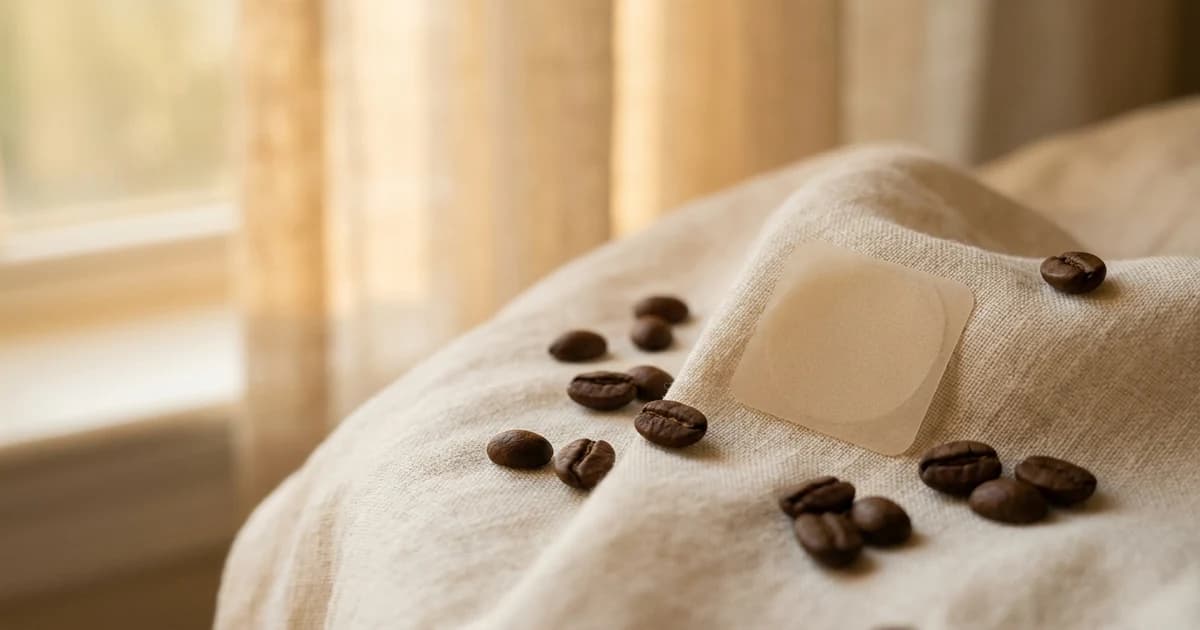
Caffeine patches promise steady energy through the skin, but do they actually work? The honest answer: the evidence is thin, and the doses are surprisingly low. Most commercial caffeine patches contain 10 to 25 mg of caffeine per patch. A standard cup of coffee delivers 80 to 100 mg. The human pharmacokinetic data proving skin-absorbed caffeine reliably raises blood levels to a meaningful concentration barely exists. That gap between marketing and science is worth understanding before you stick one on your wrist.
Key Takeaways
- Most caffeine patches contain 10 to 25 mg caffeine, a fraction of a cup of coffee's 80 to 100 mg.
- Only one controlled human trial has tested a caffeine patch for performance, using a 74 mg patch, and it found no ergogenic effect (Dragoo et al., 2011).
- Transdermal caffeine research is otherwise limited to in vitro skin models and animal studies, not human blood-level validation.
- Buccal and sublingual caffeine delivery (gum, pouches) reaches peak plasma levels roughly 44 to 80 minutes after use, versus 84 to 120 minutes for capsules (Kamimori et al., 2002). Transdermal onset has not been reliably measured in humans.
5 Caffeine Patch Brands Compared
Before getting into the science, here is what five commercial caffeine patches actually contain. Every number below comes from brand product pages or verified retail listings.
| Brand | Caffeine per Patch | Other Key Actives | Claimed Wear Time | Approx. Price per Patch |
|---|---|---|---|---|
| The Patch Brand | 10 mg | Taurine (1 mg), Green Tea (500 mcg), B3/B5/B6 | Up to 24 hrs | ~$0.80 (15-pack at $12) |
| The Good Patch (B12 Awake) | 15 mg (per Amazon; the brand's own site lists 15 mg hemp extract as a key active, so formulations may vary) | Vitamin B12, Green Tea Extract | Up to 12 hrs | ~$3.00 (4-pack at $12) |
| Kind Patches (Energy) | 10 mg | B1, B2, B3, B5, B6, B12 | Up to 8 hrs | ~$0.57 (30-pack) |
| Kind Patches (Extra Strong) | 12 mg | Beta Alanine (5.6 mg), Red Ginseng, B vitamins | Up to 8 hrs | ~$0.93 (30-pack) |
| The Patch Remedy | 25 mg (guarana) | Taurine (2.5 mg), Green Tea (1.3 mg), Glucuronolactone (2.5 mg), B3/B5/B6 | All day | ~$0.67 (30-pack) |
The highest-dosed patch in this group, The Patch Remedy, contains 25 mg of caffeine. That is less than a third of a small cup of coffee. The lowest, Kind Patches' standard Energy patch, contains 10 mg.
How a Transdermal Caffeine Patch Is Supposed to Work
Transdermal patches diffuse active ingredients through the outer layer of skin (the stratum corneum) into the capillary bed below, where they enter systemic circulation. This model works well for certain drugs. Nicotine patches and hormone patches have decades of validated pharmacokinetic data.
Caffeine is a different molecule. It is hydrophilic, small (194 Da), and can permeate skin in lab settings. A 2025 study using electrospun nanofiber patches achieved permeation rates up to 0.73 mg/cm² over 24 hours in Franz-cell (in vitro) testing. Do the math: a typical wellness patch covers 5 to 10 cm² of skin, delivering roughly 3.7 to 7.3 mg over an entire day under ideal lab conditions. Less in the real world, where sweat, skin oils, and adhesion vary.
Caffeine's oral half-life is roughly 3 to 5 hours, as noted in the ISSN position stand on caffeine, and its blood levels spike and crash with oral dosing. A transdermal patch could, in principle, provide a flatter plasma curve. But "could in principle" is where the data stalls.
What the Research on Transdermal Caffeine Actually Shows
The best-known human trial on caffeine patches is Dragoo et al. (2011), published in the International Journal of Exercise Science. The study tested a 74 mg transdermal energy patch against a placebo on college-aged participants across four exercise tests: cycle time-to-exhaustion, Wingate anaerobic power, repeated sprints, and one-rep-max bench press.
The result: no statistical differences between the caffeine patch and placebo on any test. The authors concluded that "the dose of caffeine topically applied via an EnP may not have been enough to elicit an ergogenic effect." They did measure venous plasma caffeine, but the study's own conclusion called for further research on transdermal caffeine delivery kinetics.
Beyond that single trial, the transdermal caffeine literature is preclinical. The electrospun nanofiber study mentioned above was Franz-cell (synthetic membrane) testing, not a human blood-level trial. A separate proniosomal caffeine formulation was designed for migraine delivery and tested in animal and in vitro models. Neither establishes that a commercial wellness patch reliably raises human blood caffeine to a concentration you would actually feel.
This is the core problem: there is no published, randomized, controlled human bioavailability trial showing that a commercial caffeine patch raises blood caffeine to a meaningful level. The marketing language ("transdermal delivery," "steady-state energy") borrows credibility from nicotine and hormone patches without the pharmacokinetic evidence to back it up.
What about the dose gap?
Even if transdermal delivery worked perfectly, absorbing 100% of the patch's caffeine content, most of these patches contain 10 to 25 mg. The FDA's general guidance notes that up to 400 mg/day is not generally associated with negative effects for most healthy adults. An 80 to 100 mg cup of coffee produces a noticeable effect because that dose raises plasma caffeine above the threshold most people perceive. Ten milligrams through the skin, with unknown and likely incomplete absorption, is a different proposition entirely.
Do Caffeine Patches Work as Well as Coffee or a Pouch?
No, and the routes are not comparable.
Oral caffeine (coffee, capsules) is absorbed through the GI tract and reaches peak blood levels in roughly 30 to 60 minutes. It is the most-studied caffeine delivery route, with well-characterized pharmacokinetics.
Buccal and sublingual caffeine (gum, oral pouches) bypasses the GI tract and enters the bloodstream through the oral mucosa. Kamimori et al. (2002) showed that caffeine gum reached peak plasma concentration in 44 to 80 minutes, while capsules took 84 to 120 minutes. The absorption rate constant for gum was roughly double that of capsules. This data has been replicated and extended; buccal delivery is a validated, well-studied route. You can read more about how mucosal caffeine absorption actually works.
Transdermal caffeine (patches) has no equivalent human pharmacokinetic benchmark. We do not have a reliable Tmax, Cmax, or bioavailability figure from a human trial using a commercial wellness patch. The onset is claimed at 30 to 90 minutes by various brands, but those numbers are not sourced from published PK data.
| Delivery Route | Onset to Peak | Human PK Evidence | Typical Dose |
|---|---|---|---|
| Oral (coffee, capsule) | 30-60 min | Extensive | 80-200 mg |
| Buccal/Sublingual (gum, pouch) | 44-80 min (gum) | Strong (Kamimori et al.) | 40-100 mg |
| Transdermal (patch) | Unknown in humans | One negative trial (Dragoo et al.) | 10-25 mg (commercial) |
For a deeper look at delivery methods, see every caffeine format side by side. For the patch-versus-pouch head-to-head, see caffeine patch vs focus pouch, and to add any dose to the rest of your day, use the caffeine calculator.
What Is Folklore vs. What the Evidence Supports
Supported by evidence:
- Caffeine permeates skin in laboratory models. This is real chemistry.
- Oral and buccal caffeine reliably raise blood levels and improve alertness and performance at doses above roughly 40 mg.
- The one human patch trial (74 mg, transdermal) found no performance benefit.
Not supported by evidence (but commonly claimed):
- That commercial caffeine patches at 10 to 25 mg produce a perceptible energy boost. No human trial validates this.
- That transdermal delivery provides "steady-state" or "crash-free" energy. Without PK data, this is speculation dressed as a mechanism.
- That patches are "better absorbed" than oral caffeine. Oral bioavailability for caffeine is already near 99%. Skin absorption is almost certainly lower.
Some users report feeling an effect from caffeine patches. That may be real, placebo, or driven by other ingredients like B vitamins. Without blinded human data at commercial doses, there is no way to separate these.
Making Sense of Caffeine Patches in 2026
Caffeine patches are a real product category with a real pharmacological premise: slow, sustained transdermal delivery. But the premise has outrun the proof. The human evidence consists of one negative exercise trial at 74 mg, and the commercial products on shelves contain far less than that. Until someone publishes a well-powered, randomized, placebo-controlled trial measuring blood caffeine levels from a commercial patch, the "do they work" question does not have a confident yes.
If you want caffeine to be effective, the dose and the delivery route need to be proven. Oral and buccal routes are both well-validated. Transdermal is not, at least not yet.
Frequently Asked Questions
How long does a caffeine patch last?
Most brands claim 8 to 24 hours of wear time. The Patch Brand claims up to 24 hours; The Good Patch claims up to 12 hours; Kind Patches claims up to 8 hours. These are wear-time claims, not pharmacokinetic duration. No published study has measured how long a commercial caffeine patch sustains blood caffeine above a perceptible threshold.
Are caffeine patches safe?
At the low doses found in commercial patches (10 to 25 mg), the caffeine itself is unlikely to cause harm for most healthy adults. The FDA's general guidance identifies up to 400 mg/day as not generally associated with negative effects. Skin irritation from the adhesive is the more common complaint in user reviews. If you have a medical condition or take medications, talk to your clinician before adding any new supplement.
Can you feel a caffeine patch working?
Some users report subtle energy improvement. Without a blinded human trial at commercial patch doses, it is impossible to say whether the perceived effect comes from the caffeine itself, from other ingredients like B vitamins, or from placebo. A 10 mg dose with incomplete transdermal absorption would produce a very small blood-level change.
How much caffeine is in a caffeine patch?
Commercial patches range from about 10 mg (Kind Patches standard) to 25 mg (The Patch Remedy). Even the highest end is less than a third of a typical cup of coffee. The research trial by Dragoo et al. used a 74 mg patch and still found no performance effect.
Are caffeine patches better than coffee?
There is no evidence that they are. Coffee delivers 80 to 200 mg of caffeine orally with near-complete bioavailability and decades of pharmacokinetic data. Caffeine patches deliver far less caffeine through a route that has not been validated for blood-level efficacy in humans. Coffee is the better-studied, higher-dose option.
Do caffeine patches work for studying or focus?
No human study has demonstrated that a transdermal caffeine patch improves cognitive performance or focus. Caffeine itself is well-established as a cognitive aid at oral doses of roughly 3 to 6 mg per kg of body weight, but those doses are far above what commercial patches deliver, and the transdermal delivery route remains unvalidated.
How do caffeine patches compare to caffeine pouches?
Caffeine pouches use sublingual or buccal absorption, delivering caffeine through the lining of the mouth directly into the bloodstream. This route has published human PK data showing faster absorption than capsules. Patches rely on transdermal absorption through skin, which lacks equivalent human validation. For a detailed comparison, see caffeine patch vs pouch, what the science says.
Where Mucosal Delivery Picks Up Where Patches Stall
If the appeal of a caffeine patch is convenience and no liquid to swallow, the delivery-route question still matters. Transdermal caffeine lacks human PK validation. Buccal and sublingual caffeine does not.
Roon is a zero-nicotine sublingual pouch that delivers 80 mg caffeine, 60 mg L-theanine, 25 mg methylliberine (Dynamine), and 5 mg theacrine (TeaCrine) through the lining of the mouth. Onset is 5 to 10 minutes. The felt duration runs 6 to 8 hours, driven in part by methylliberine's effect on caffeine clearance: a randomized, double-blind, crossover PK study (n=12) found that co-administering 100 mg methylliberine with 150 mg caffeine cut caffeine's oral clearance from 41.9 to 17.1 L/hr and extended its half-life from 7.2 to 15 hours, with no increase in peak concentration. Roon uses 25 mg methylliberine with 80 mg caffeine, roughly one-quarter the methylliberine dose and half the caffeine dose tested, so the study's exact numbers do not map directly. The mechanism is directionally the same; the magnitude at Roon's dose has not been independently measured.
That longer tail also means you should stop at least 8 hours before bed. Roon is not a patch, not a pill, and not a coffee replacement for everyone. It is zero sugar (the formula contains sucralose and natural-and-artificial flavor) and starts from $9.16 per tin on a 12-tin subscription ($0.61 per pouch). If you want a pocketable caffeine format with a delivery route that actually has published human data behind it, Roon is worth a look.
Related from Roon
- Caffeine Patch vs Focus Pouch: What the Science Says
- Sublingual Caffeine Absorption: How Mucosal Delivery Actually Works
- How Fast Do Caffeine Pouches Work?
- Caffeine Forms Compared
Written by Roon Team