Everyday Dose Review: The Label, Caffeine and Real Cost
Everyday Dose Review: The Label, Caffeine and Real Cost
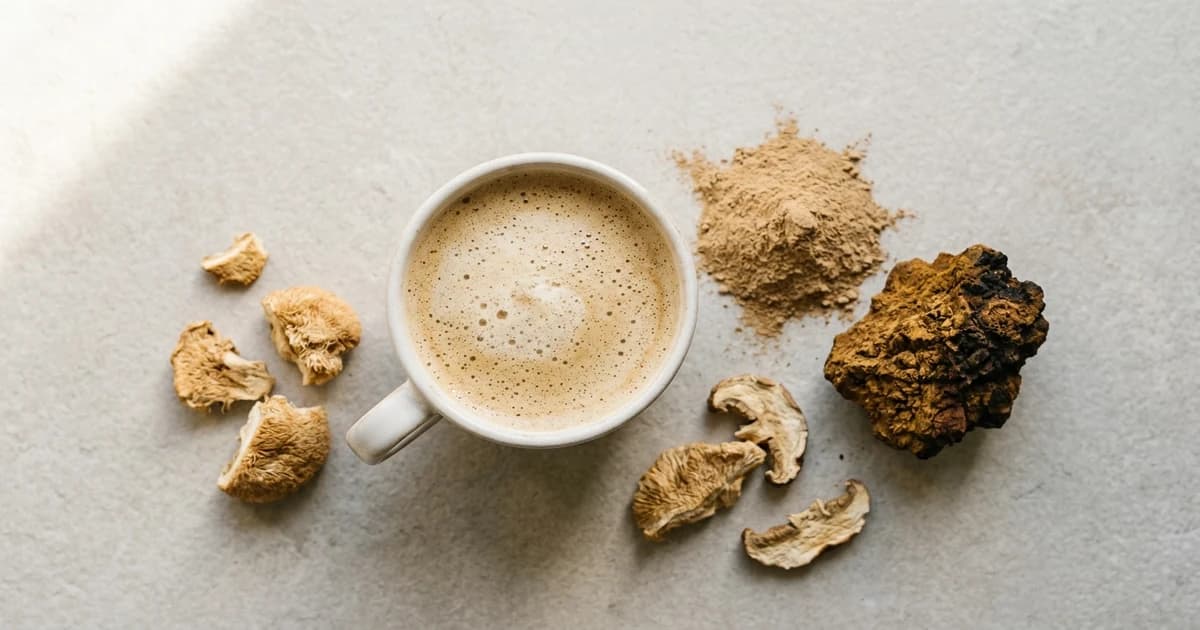
This Everyday Dose review covers Coffee+, an instant coffee extract blended with collagen peptides, L-theanine, chaga and lion's mane mushroom extracts. Mild has 45 mg of caffeine per serving, Medium has 90 mg. The Supplement Facts panel prints one proprietary blend weight (7,300 mg for Mild) and zero per-ingredient doses. List price is $45 for 30 servings. Subscribers pay under $30 the first month, then $36 on refills. It is a decent lower-caffeine, creamier cup, but the disclosure is thin.
Key Takeaways
- The active formula sits inside a single proprietary blend. You know the total weight but not how much collagen, L-theanine, chaga or lion's mane you get per scoop.
- First-order pricing ($29 for 30 servings) is not the ongoing price. Refills are $36 per 30 servings, or $1.20 per cup.
- The "clinically proven" stats on the product page come from a customer survey (N=1,145), not a controlled trial.
- Reviews from Garage Gym Reviews, Illuminate Labs, and Thingtesting are favorable on taste but mixed on whether you feel anything beyond lighter caffeine.
Everyday Dose vs. the Obvious Alternatives
For a full three-way comparison with Ryze, see Ryze vs Everyday Dose vs MUD\WTR. The table below focuses on what each option actually delivers per serving (brand sites, checked October 7, 2026).
| Product | Caffeine / serving | What else is in it | Doses disclosed? | Price / serving (after first order) | Best for |
|---|---|---|---|---|---|
| Everyday Dose Coffee+ Mild | 45 mg | Collagen, L-theanine, chaga, lion's mane | Blend total only (7,300 mg) | $1.20 (30-serving sub refill) | People cutting caffeine roughly in half without giving up a coffee-tasting cup |
| Everyday Dose Coffee+ Medium | 90 mg | Same as Mild | Blend total only | $1.20 (30-serving sub refill) | A full-cup caffeine dose with collagen added |
| Everyday Dose Matcha+ | 40 mg | Ceremonial-grade matcha | Not verified | List $1.67 | Lower caffeine with a matcha base |
| MUD\WTR Original | ~35 mg | Mushroom blend (2,240 mg), cacao, chai spices | Mushroom total only | ~$1.33 (sub) | The lowest caffeine of the set and a chai-cacao flavor |
| Brewed coffee (12 oz) | Roughly 130 to 200 mg | Nothing else (black) | N/A | Varies | The cheapest caffeine, with the widest dose range |
| Roon | 80 mg | 60 mg L-theanine, 25 mg methylliberine (Dynamine), 5 mg theacrine (TeaCrine) | Yes, every ingredient | From $0.61/pouch (12-tin sub) | Adults who want a measured caffeine dose with no cup to make |
Sources: Everyday Dose product page, MUD\WTR product page, FDA caffeine data, Roon product page.
What Is Actually in Everyday Dose?
The Supplement Facts panel on Coffee+ Mild lists a serving size of about 1 tablespoon (7.3 g), 25 calories, 5 g of protein, and a "Proprietary Blend" weighing 7,300 mg. Medium is about 1 tablespoon (8.7 g). Inside both, the ingredients appear in the same order: Hydrolyzed Bovine Collagen Peptides, Coffee, L-Theanine, Organic Chaga Fruiting Body Extract, Organic Lion's Mane Fruiting Body Extract.
That order matters. Under 21 CFR 101.36, ingredients inside a proprietary blend must be listed in descending order of predominance by weight. Collagen is the largest ingredient. Lion's mane is the smallest.
The 5 g of protein per serving narrows it further. Since collagen peptides are almost entirely protein, the collagen can be at most about 5 g. If most of that protein is collagen, the other four ingredients share what is left of Mild's 7.3 g blend, with coffee extract the largest of them and lion's mane the smallest. The amino acid panel confirms it: glycine at 1,096 mg, L-proline at 660 mg, L-hydroxyproline at 546 mg. That is a textbook collagen signature.
For more on whether mushroom coffee delivers a meaningful dose, the question always comes down to per-ingredient milligrams. Here, the label does not give them. Third-party reviews have printed specific figures for collagen, L-theanine and mushroom amounts, but those numbers disagree with each other across sources.
Everyday Dose uses fruiting body extracts for both chaga and lion's mane and publishes a Certificate of Analysis for potency and contaminant testing. Those are positives. The gap: you cannot verify the dose of anything except calories, protein and caffeine.
How Much Caffeine Is in Everyday Dose?
Mild has 45 mg per serving. Medium has 90 mg. Matcha+ has 40 mg. For reference, a 12-ounce cup of brewed coffee has roughly 130 to 200 mg of caffeine, based on the FDA's estimate of 400 mg across two to three 12-ounce cups. So one Mild serving is roughly a third to half of a typical brewed cup. One Medium serving is roughly equivalent to a lighter brew.
The brand recommends one to four cups a day. Four cups of Medium = 360 mg, approaching the FDA's 400 mg general-adult reference. Worth knowing if you pick the stronger roast and pour freely. For more context, see how much caffeine is in a cup of coffee.
The caffeine comes from coffee extract, paired with L-theanine. A 2025 systematic review in Nutrition Reviews (50 RCTs, 15 eligible for meta-analysis) found that L-theanine with caffeine favored attention-switching accuracy at hour two (SMD 0.33), though confidence intervals were wide. The catch: Everyday Dose does not disclose its L-theanine dose, so you cannot map its formula to the doses those trials used.
Is Everyday Dose Worth the Price?
The product page shows $29 for 30 servings. That is the first-order subscription price. The $45 list price is what you pay one-time, without a subscription. Neither is the number you should budget around.
The real number is the refill price:
- 30 servings, subscription refill: $36/month = $1.20 per cup
- 60 servings, subscription refill: $66/month = $1.10 per cup
- 30 servings, one-time: $45 = $1.50 per cup
The first order also ships with a frother, tumbler, spoon, creamer and booklet. Those starter-kit items are first-order gifts. They do not repeat. Your ongoing cost is $1.10 to $1.20 per serving, depending on the plan, which is more than home-brewed coffee by any reasonable bean math.
The guarantee: Everyday Dose offers a 45-day money-back guarantee on the first subscription order. Opened product is not returnable outside of that first order.
What the "Clinically Proven" Claims Rest On
The Everyday Dose product page includes a block labeled "CLINICALLY PROVEN RESULTS" with stats like "85% felt more energy" and "94% love the taste." Read the footnote: "M7 survey, N=1,145, NPS 9.21/10."
That is a customer survey, not a randomized controlled trial. Self-selected sample, no placebo arm, no blinding, no independent measurement. This does not mean the product is bad. It means the word "clinically" is doing heavy lifting. A survey of your own customers is marketing research, not clinical evidence.
The ingredient-level evidence that does exist for L-theanine plus caffeine is real, but cannot be linked to Everyday Dose's formula because the L-theanine dose is not disclosed.
Everyday Dose Complaints: What Reviewers Flag
No product page tells the full story. Here is what third-party reviewers report:
- Garage Gym Reviews (Sep 2024) scored it 3.78 out of 5. Their tester noticed no change in energy or focus.
- Illuminate Labs (Feb 2026) recommended it for caffeine-sensitive buyers but noted weaker focus than stronger blends and flagged unsolicited marketing emails.
- Thingtesting (summary) shows a 4.6 rating, 91% would recommend. Downsides: bags running short of 30 servings, polarizing taste, limited felt effect for some, and subscription/return friction.
The pattern: reviewers mostly like the taste, some report no noticeable effect, and the subscription experience draws complaints.
Who Everyday Dose Fits, and Who It Does Not
Good fit:- You like a morning coffee ritual and want to cut your per-cup caffeine roughly in half (Mild) or keep it moderate (Medium).
- You want collagen in your coffee without buying a separate supplement.
- You prefer a creamier cup and do not mind a proprietary blend.
Not a fit:
- You are vegan or avoid bovine products. The collagen is bovine.
- You want to know the exact milligrams of each active. The label does not tell you.
- You need portable, fixed-dose caffeine without making a drink. Everyday Dose has to be mixed into water, ideally with a frother.
- You are pregnant or nursing. The brand says to check with your doctor, and that is the only responsible answer here.
A Decent Cup With a Label You Cannot Fully Audit
Everyday Dose Coffee+ rates well on taste in the reviews above, delivers less caffeine than standard brewed coffee, and adds collagen plus mushroom extracts. Real positives for the right buyer.
The weaknesses are structural. A 7,300 mg proprietary blend with no per-ingredient doses means you are trusting the brand on faith. The "clinically proven" framing rests on a customer survey. And the price to plan around is $1.20 per cup, not the $0.96 the first-order math implies. If those trade-offs sit fine with you, it is a solid lower-caffeine coffee substitute. If disclosure matters, keep looking.
Frequently Asked Questions
How much caffeine is in Everyday Dose?
Mild Coffee+ has 45 mg per serving, Medium has 90 mg, and Matcha+ has 40 mg. The FDA puts 400 mg at about two to three 12-ounce cups, roughly 130 to 200 mg per cup, so one Mild is roughly a third to half of a standard cup. The brand says one to four cups per day, but four Medium servings reach 360 mg, near the FDA's 400 mg general-adult reference.
Does Everyday Dose list how much L-theanine and collagen it contains?
No. The Supplement Facts panel shows a single proprietary blend weight (7,300 mg for Mild) with ingredients in descending order. The 5 g of protein per serving suggests collagen is the largest component, but individual doses for L-theanine, chaga and lion's mane are not printed. Third-party reviews have published figures that conflict with each other.
Is Everyday Dose cheaper than regular coffee?
Typically not. A 30-serving subscription refills at $36 ($1.20/cup). The 60-serving plan refills at $66/month ($1.10/cup). Most home-brewed coffee costs less, though the gap depends on your beans.
Can I cancel Everyday Dose and get a refund?
Everyday Dose offers a 45-day money-back guarantee on the first subscription order only. Opened product is not returnable outside of that first order. You can cancel future shipments, but refunds beyond the first order are not guaranteed.
Is Everyday Dose vegan?
No. Coffee+ contains hydrolyzed bovine collagen peptides from grass-fed, grass-finished cattle. Not compatible with a vegan diet.
How does Everyday Dose compare with Ryze and MUD\WTR?
Ryze has caffeine roughly comparable to Everyday Dose Mild (see how much caffeine Ryze has). MUD\WTR Original sits lower at roughly 35 mg with a chai-cacao flavor profile. For a detailed cost and caffeine comparison, see Ryze vs Everyday Dose vs MUD\WTR. All three are lower-caffeine mushroom blends; they differ on collagen, caffeine level, taste and price.
If You Want the Caffeine Without the Mug
The thread running through this review is format: a lighter caffeine dose inside a proprietary blend that requires water, a frother and a mug. If what you want is a measured dose with full label transparency and nothing to prepare, that is a different product category.
Roon is a zero-nicotine oral pouch with 80 mg caffeine, 60 mg L-theanine, 25 mg methylliberine (Dynamine) and 5 mg theacrine (TeaCrine). Every milligram is on the label. Methylliberine slows caffeine's clearance: in a randomized, double-blind crossover study (n=12), co-administration with caffeine cut oral clearance from 41.9 to 17.1 L/hr and extended half-life from 7.2 to 15 hours with no increase in peak concentration. That study used 100 mg methylliberine with 150 mg caffeine, roughly 4x the methylliberine and 1.9x the caffeine in a Roon pouch, so the effect at Roon's dose is directional, not identical. Felt window: 6 to 8 hours. Same peak, longer tail.
Roon has no collagen, no mushrooms and is not a coffee. From $9.16 per tin ($0.61 per pouch) on a 12-tin subscription. Because the half-life extends, stop at least 8 hours before bed. If you want a cup with collagen and lower caffeine, Everyday Dose does that. If you want portable, fully disclosed caffeine that lasts into the afternoon, try Roon.
Related from Roon
- Ryze vs Everyday Dose vs MUD\WTR
- Does Ryze Coffee Have Caffeine?
- Mushroom Coffee Science: Cognitive Dose
- Matcha vs Mushroom Coffee Comparison
Written by Roon Team