Social Media and Attention Span
Social Media and Attention Span: What the Science Actually Says
The link between social media and attention span is no longer a matter of debate. Your attention span is shrinking, not because you're lazy or undisciplined, but because social media has quietly rewired the way your brain processes information. The relationship between social media and attention span is one of the most studied topics in modern neuroscience, and the data paints a clear picture: the more you scroll, the harder it gets to focus.
The average time a person can stay locked on a single task online has dropped to 8.25 seconds. That's shorter than the commonly cited attention span of a goldfish. And the trend isn't slowing down.
Key Takeaways
- The average digital attention span has declined by 33% since 2015, driven largely by social media habits.
- Social media triggers dopamine loops that train your brain to seek novelty over depth.
- Your prefrontal cortex, the brain's focus center, physically changes with heavy screen use.
- The damage to social media and attention span is reversible, but it requires deliberate changes to how you consume information.
How Social Media and Attention Span Are Connected
The numbers are stark. Marketing reports claim focus on a single post fell from about 12 seconds in 2015 to 8.25 seconds by 2025, but those figures descend from the unsourced Microsoft "8 seconds" statistic, so treat them as folklore rather than measurement. Teens toggle between apps every 44 seconds, compared to 2.5 minutes a decade ago.
This isn't just about willpower. It's structural.
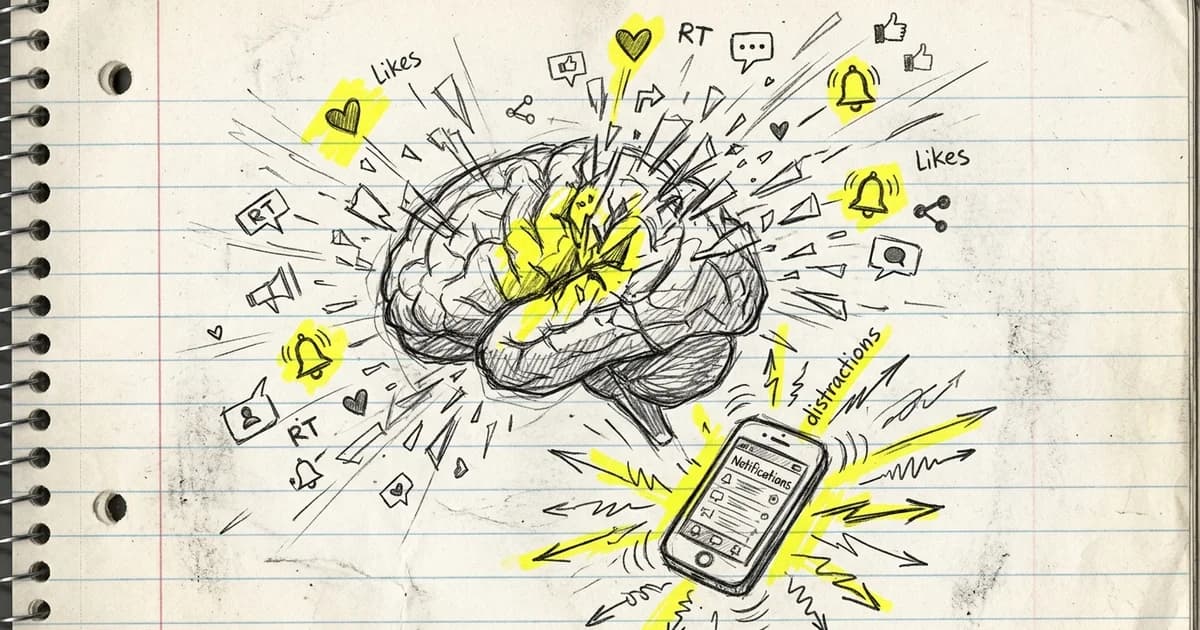
Social media platforms are engineered to capture and hold your attention in micro-bursts. Autoplay videos, infinite scroll, push notifications: every feature is designed to keep you swiping. According to SQ Magazine, the rise of autoplay and infinite scroll contributed to a 39% decrease in deep reading habits between 2014 and 2024.
The result? Social media and attention span work against each other. You get very good at processing surface-level information quickly, and very bad at sustaining focus on anything that requires more than a few seconds of thought.
The 23-Minute Recovery Problem
Here's the part most people miss about social media and attention span. Every time you check your phone, open a notification, or glance at a new tab, you're not just losing those few seconds. Research from the University of California, Irvine shows it takes roughly 23 minutes to fully regain focus after a single interruption. If you check your phone 50 times a day (the average for most adults), you're bleeding hours of productive focus without realizing it.
Studies from 2024 show that media multitaskers underperform by 20% on attention-based tasks compared to people who focus on one thing at a time. That gap compounds over weeks, months, years.
Your Brain on Social Media: The Dopamine Loop
To understand why social media and attention span are so tightly linked, you need to understand dopamine.
Most people think dopamine is a "pleasure chemical." It's not. It's a prediction and motivation chemical. Your brain releases it when it anticipates a reward, not when it receives one. That distinction matters, because social media doesn't just deliver pleasure. It creates an endless cycle of anticipation. And that cycle is the most efficient dopamine-triggering machine ever built.
Every notification, every like, every new post in your feed creates a small dopamine spike. According to Stanford Medicine, social media apps can flood the brain's reward pathway with dopamine in a pattern similar to addictive substances. The novelty factor is key: dopamine fires when your brain detects something new, and algorithms ensure there's always something new.
A 2025 review published in PMC found that frequent social media use alters dopamine pathways in the brain, fostering dependency patterns that mirror substance addiction. The same review noted changes in the prefrontal cortex and amygdala, the regions responsible for decision-making, emotional regulation, and sustained attention.
This is the loop: scroll, dopamine hit, scroll again. Over time, your brain's baseline for stimulation rises. Normal tasks (reading a book, sitting through a meeting, writing an email) feel unbearably boring because they can't compete with the dopamine density of your feed. That's the core mechanism behind social media and attention span decline.
What This Looks Like in Practice
This is what a short attention span in practice looks like: you sit down to work, and within three minutes you reach for your phone, tell yourself it'll be quick, and fifteen minutes later you're watching a video you don't even care about. You put the phone down, try to refocus, and the cycle repeats.
Sound familiar? That's not a personality flaw. That's a trained neurochemical response. Your brain has learned that the phone delivers faster, more reliable dopamine than whatever task is in front of you. And every time you give in, the pattern connecting social media and attention span loss strengthens.
The Numbers Are Worse for Younger Brains
The effects of social media and attention span erosion are amplified in children and teenagers, whose brains are still developing.
A child's ability to focus scales with age. The general guideline is about two to three minutes of sustained attention per year of age. So the attention span of a 4 year old falls somewhere around 8 to 12 minutes, depending on the task and environment. A six-year-old can manage about 12 to 18 minutes.
But those numbers assume a brain that isn't being constantly bombarded by digital stimulation. When you compare the attention span of a 4 year old raised with minimal screen time to one with heavy tablet exposure, the differences are measurable.
Research published in SHS Conferences found that children with high screen exposure showed measurably thinner prefrontal cortex tissue compared to controls. The prefrontal cortex is the brain region most responsible for sustained attention and impulse control. Thinner cortex means weaker infrastructure for focus. Even the natural attention span of a 4 year old can be shortened by early, heavy exposure to fast-paced digital content.
According to High Focus Centers, heavy use of digital devices can reduce both the duration and depth of focus in teens. Teachers are already adapting, shortening lessons and adding technology-driven engagement to compensate for students who can't sustain attention long enough to absorb material.
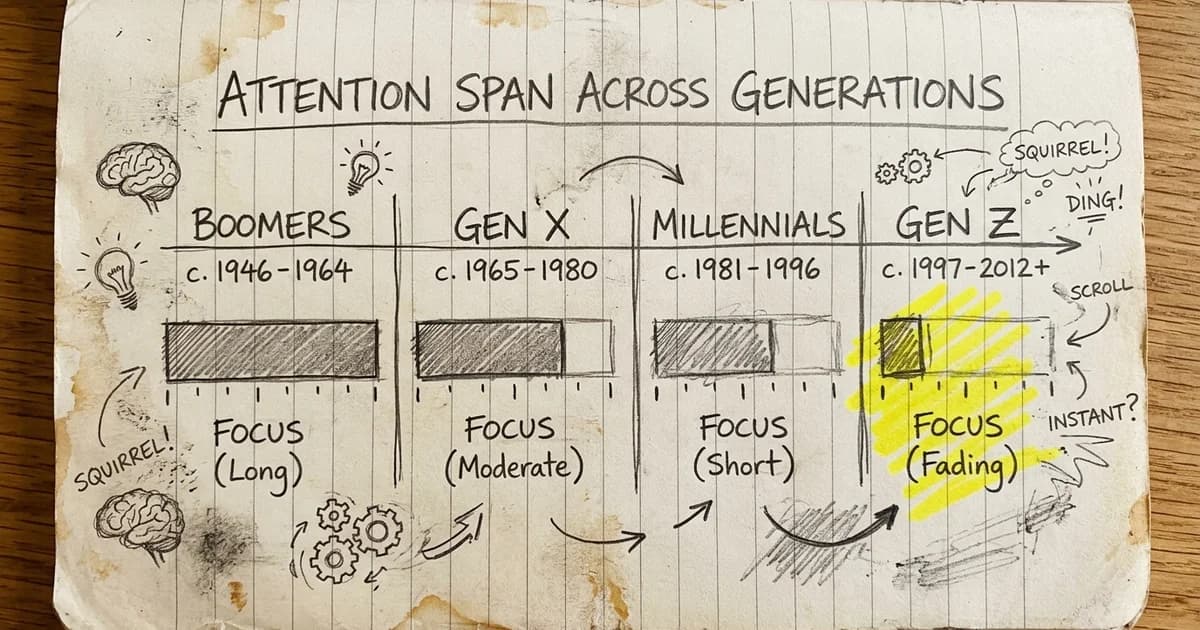
The generational data tells the same story. ProfileTree reports that millennials average about 12 seconds of sustained attention, while Gen Z averages around 8 seconds. For social media ads specifically, Gen Z loses focus after roughly 1.3 seconds.
What Social Media and Attention Span Decline Actually Costs You
This isn't just about feeling scatterbrained. The cognitive cost of fragmented attention shows up in real, measurable ways.
At work: Constant task-switching from social media notifications reduces productivity by roughly 20%. If you work an 8-hour day, that's 1.6 hours lost to attention fragmentation. Every week. Every month.
In learning: Deep reading habits have dropped by 39% over the last decade. The ability to sit with complex material, to hold an argument in your head long enough to evaluate it, is eroding. The tension between social media and attention span shows up clearly in academic settings.
In relationships: When your brain is wired for constant novelty, conversations feel slow. You find yourself reaching for your phone mid-sentence. Present-moment engagement becomes harder because your brain is always scanning for the next stimulus.
In sleep: The dopamine-driven alertness that social media creates doesn't shut off when you close the app. Elevated neural arousal before bed disrupts sleep architecture, which further degrades attention the next day. It's a feedback loop that compounds quietly over months.
In mental clarity: This is where "brain fog" enters the picture. That persistent sense of mental haziness, what many call brain fog and fractured focus, often traces back to chronic attention fragmentation caused by social media and attention span erosion. When your brain never gets a sustained period of focused processing, it starts to feel like it can't think clearly at all. Because, in a real neurochemical sense, it can't.
How to Reclaim Your Focus from Social Media and Attention Span Loss
The good news: your brain is plastic. The same neuroplasticity that allowed social media to reshape your attention patterns can work in reverse. But it requires intention.
1. Batch Your Social Media Use
Instead of checking feeds throughout the day, set two or three specific windows. This reduces the total number of attention interruptions and gives your prefrontal cortex time to recover between sessions. Batching is one of the simplest ways to break the cycle between social media and attention span decline.
2. Protect Your First Hour
The first 60 minutes after waking set the neurochemical tone for your day. If you start with social media, you're priming your brain for distraction. Start with something that requires sustained focus instead: reading, writing, planning.
3. Practice Sustained Attention
Like any skill, focus improves with training. Start small. Read for 10 minutes without checking your phone. Then 15. Then 20. You're rebuilding the neural pathways that social media has weakened.
This works because of the same neuroplasticity that created the problem. Repeated bouts of sustained focus strengthen the prefrontal cortex circuits responsible for attention control. It feels uncomfortable at first. That discomfort is your brain adapting. To get a baseline first, the attention span test times seconds on task before you switch and gives you a seven-day log to retest against.
4. Reduce Notification Load
Every notification is an interruption, and every interruption costs you 23 minutes of recovery. Turn off everything that isn't essential. Your brain will thank you within days. This single step can meaningfully shift the balance between social media and attention span in your favor.
5. Support Your Neurochemistry
The attention drain from social media operates on specific neurochemical pathways: adenosine buildup creates brain fog, disrupted GABA activity increases mental noise, and dopamine dysregulation makes sustained focus feel impossible. Addressing these pathways directly can give your brain the support it needs while you rebuild better habits.
Cut Through the Fog
If you're reading this and recognizing yourself in every paragraph, you're not broken. You're dealing with a brain that's been trained, over thousands of hours of scrolling, to prioritize novelty over depth. The research on social media and attention span makes one thing clear: reversing that training takes time.
But you can also give your brain better raw materials to work with right now.
Roon is a zero-nicotine sublingual pouch built around four compounds that target the exact neurochemical pathways behind brain fog and fractured focus: Caffeine (80 mg), L-Theanine (60 mg), Methylliberine (25 mg), and Theacrine (5 mg). A study published on PubMed found that the combination of L-Theanine and 40 mg of caffeine improved accuracy during task-switching and increased self-reported alertness. Roon delivers 80 mg of caffeine, comparable to a cup of coffee, but L-Theanine smooths the lift while Theacrine and Methylliberine extend it to six to eight hours of sustained focus without the jitters, the crash, or the tolerance buildup that coffee creates.
It won't fix your relationship with social media and attention span on its own. Only you can do that. But it can help you think clearly while you do.