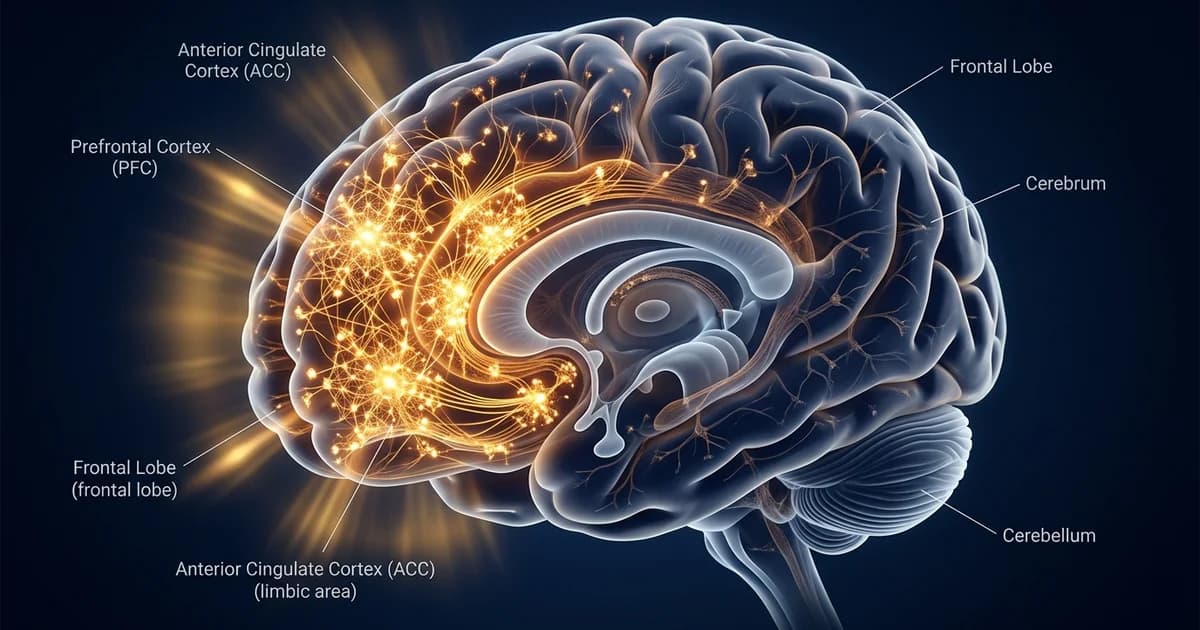
Meditation and the Brain: What Mindfulness Actually Does to Attention
Your mind is somewhere else right now. Maybe it drifted while you read that first sentence. According to research popularized by Harvard psychologists Killingsworth and Gilbert, the mind wanders nearly half of waking life, roughly 47% of the time. That wandering has a cost, and it is the exact thing meditation trains you to interrupt.
This is the part of meditation and the brain that gets lost under the wellness marketing. Mindfulness is not a vibe. It is repeated, measurable practice that changes how your attention systems fire, recover, and hold a target.
Below is what the neuroscience actually shows, what it does not, and how to read the studies without overselling them.
Key Takeaways
- Meditation works on attention by training the brain's separate alerting, orienting, and executive control networks.
- Even short sessions help. One study found 10 minutes a day improved working memory and concentration.
- Long-term practice is linked to structural and functional brain changes, including how efficiently attention regions fire.
- Meditation improves focus by reducing wasted neural effort, not by adding raw horsepower.
- The effect is real but modest, and it compounds with consistency.
Meditation and the Brain: The Three Attention Networks
Attention is not one thing. Neuroscientists divide it into three systems, and meditation appears to touch each one differently.
The model comes from Posner and Petersen. The alerting network maintains a state of vigilance or alertness and is measured as a readiness to attend to important or relevant stimuli when they arise. The orienting network is responsible for attending selectively to a sense modality or a location in space by prioritizing attention to a subset of possible inputs. The third system handles conflict. The executive control network is responsible for deciding between competing inputs, and therefore plays an important role in conflict detection.
Why does this matter? Because "mindfulness attention" is not a single skill you upgrade all at once. Different practices, and different amounts of practice, move different networks.
The research bears this out. In the Attention Network Task, mindfulness training has previously shown to improve modes of orienting and executive control but not alerting, and also improve overall reaction times. That is a precise finding, not a blanket "meditation makes you sharper" claim. It tells you which gears the practice actually turns.
Does Meditation Improve Focus? What the Studies Found
Yes, meditation improves focus, and you do not need a decade on a cushion to see it. The clearest evidence comes from short, controlled trials.
A team studied a simple breath-awareness practice. Practising mindfulness meditation for ten minutes a day improves concentration and the ability to keep information active in one's mind, a function known as working memory. The interesting part is the mechanism. The brain achieves this by becoming more efficient, literally requiring fewer brain resources to do these tasks.
That efficiency point is the whole story. Meditation does not bolt a bigger engine onto your attention. It tunes the engine so it burns less fuel for the same output.
Beginners show gains too. In one experiment, participants randomly assigned to listen to a 10-min meditation tape had better accuracy on incongruent trials on a Flanker task, with no detriment in reaction times, indicating better allocation of resources. Better resource allocation, again. The pattern repeats across the literature.
There are limits worth respecting. Effects in novices are often small, sometimes fragile, and they fade without practice. Treat the early gains as a signal that the system responds, not as a finished result.
Meditation Brain Changes: Structure and Function
Sustained practice is linked to changes you can measure on a scanner, both in how the brain is wired and how it behaves at rest. This is where meditation neuroscience moves from "I feel calmer" to observable biology.
Functional changes in how the brain fires
Practice appears to make attention-related regions more economical. In the breath-awareness work above, the meditation group held attention better while showing a reduction in the brain's attentional engagement signal, which the authors read as a gain in neural efficiency. Doing more with less is a recurring theme in meditation brain changes.
Long-term meditators also show different baseline brain activity. A case study has suggested that mindfulness meditation has the potential to reconfigure functional network architecture, revealing differences in community affiliation of various brain regions from the frontoparietal network to other networks, primarily to the default mode network. The default mode network is the system that runs your mind-wandering and self-referential chatter, and it sits at the center of why focused practice feels hard. If you want the deeper version of that story, see our breakdown of the default mode network and why your brain wanders.
Structural changes and meditation cortical thickness
Structure shifts too, though slower. Pretest-training-posttest mindfulness meditation intervention protocols affect the structure and function of neural networks modulating executive functions. Researchers have also linked meditation to physical changes deep in the brainstem. Meditation has been shown to increase gray matter concentration in the brainstem and the locus ceruleus.
Meditation cortical thickness is the most cited version of this idea. The locus coeruleus is the brain's main noradrenaline source and a key driver of alertness. Thicker, denser, or better-connected tissue in attention-relevant regions is the structural fingerprint researchers keep looking for.
One more recent study tracked novices over a month and measured the wiring directly. The study used diffusion tensor imaging to assess microstructural neuronal changes and the attention network test to assess functional and behavioural attentional changes, exploring the relationship between mindfulness training, stress reduction, attention, and modified states of mind such as flow. That last word matters. The line between deep focus and meditation is thinner than people assume, which we explore in our piece on reaching flow state on demand.
How Mindfulness Attention Compares to Other Focus Tools
Meditation is one lever for attention, not the only one. Here is an honest comparison of common approaches, including where a caffeine-based formula fits and where it does not.
| Approach | What it trains | Onset | Best for |
|---|---|---|---|
| Mindfulness meditation | Executive control, orienting, mind-wandering recovery | Weeks to months for durable change | Building the underlying skill of returning attention |
| Brief breath-awareness session | Working memory, in-the-moment focus | Same session | A quick reset before deep work |
| Sleep and exercise | Baseline attention, recovery | Days to weeks | The foundation everything else sits on |
| Caffeine alone | Raw alertness | 30 to 45 minutes | Short bursts, with jitters and a crash risk |
| Caffeine plus L-theanine (Roon) | Calm, sustained alertness | 5 to 10 minutes | Holding a focused state long enough to practice or work |
Notice the table does not name a winner. Meditation builds the skill. The other tools support the state in which you practice it. They are not interchangeable.
What Meditation Does Not Do
It does not rewire your brain overnight, and it does not treat or cure any medical condition. The trustworthy studies show modest, specific gains that grow with consistency.
It also will not fix attention if the basics are broken. Poor sleep, chronic stress, and zero recovery will swamp any meditation benefit. Mindfulness is a multiplier on a healthy baseline, not a replacement for one.
And the gains are skill-specific. Training breath focus sharpens executive attention more than it sharpens pure alerting. Match the practice to the outcome you want.
Conclusion
Meditation changes attention by training the brain's separate control systems and making them more efficient, so you spend less neural effort holding focus and recover faster when your mind drifts. The evidence runs from 10-minute beginner sessions improving working memory to long-term practice reshaping how resting networks fire.
The honest read is this: the effects are real, measurable, and modest, and they compound with consistency. Mindfulness is not a shortcut to a sharper brain. It is a slow, repeatable way to take back some of the 47% of your day your mind otherwise spends elsewhere.
Frequently Asked Questions
How long until meditation changes the brain?
Functional changes can appear fast. Studies show 10 minutes a day improving concentration and working memory within weeks, partly because the brain starts using fewer resources for the same task. Structural changes, like shifts in gray matter, generally take longer and depend on sustained practice over months. Treat early focus gains as proof the system responds, then keep going to build something durable.
Does meditation actually improve focus, or is it placebo?
It improves focus, and controlled trials with active control groups support that. In Flanker and Attention Network tasks, meditators show better accuracy and reaction times without trade-offs, which points to genuinely better resource allocation rather than expectation alone. The gains are real but modest, especially in beginners, and they fade without continued practice. The mechanism is efficiency, not raw mental horsepower.
What is meditation cortical thickness?
It refers to research linking meditation practice to denser or thicker tissue in brain regions tied to attention and self-regulation. Studies have also reported increased gray matter concentration in deeper structures like the brainstem and locus coeruleus, the brain's main alertness hub. These structural findings sit alongside functional ones showing attention regions fire more efficiently. Together they form the biological case for meditation brain changes.
Which type of meditation is best for attention?
Focused-attention practices, such as breath-awareness meditation, map most directly onto attention training. They ask you to hold a single target, notice when you drift, and return, which is the exact loop that strengthens executive control. Open-monitoring styles train a different mode. For pure focus and working memory, the breath-focus approach has the cleanest supporting evidence in meditation neuroscience.
Can meditation help with mind-wandering specifically?
Yes, and that is arguably its core skill. Mind-wandering is driven by the default mode network, and meditation practice is essentially repeated training in catching that drift and redirecting attention. Long-term meditators show reconfigured resting brain activity involving the default mode network. You are not eliminating wandering, which is normal and useful. You are getting faster at noticing it and choosing to return.
Is mindfulness attention the same as concentration?
Not exactly. Mindfulness attention includes concentration but adds the meta-skill of noticing where your attention went and bringing it back without judgment. Concentration is holding the target. Mindfulness is the full loop of holding, losing, catching, and returning. That recovery step is what trains the executive control network and makes the skill transfer to everyday focus.
Does meditation work better than caffeine for focus?
They do different jobs, so the comparison is not head-to-head. Meditation builds the underlying attention skill over time. Caffeine, ideally paired with L-theanine to soften the jitters, raises alertness in the moment so you have a calm, awake state to practice or work in. The strongest approach uses both: the state to show up, and the practice to improve.
The State That Makes Focused Practice Easier to Sustain
Meditation trains the attention network. It is the long game, and nothing replaces sitting down and doing the reps. But the reps are far easier when you are alert and calm instead of foggy or wired, and that is the specific gap Roon is built to fill.
Roon is a sublingual pouch with a four-ingredient stack: 80 mg caffeine, 60 mg L-theanine, 25 mg methylliberine (Dynamine), and 5 mg theacrine (TeaCrine). It is designed for a 5 to 10 minute onset and a 6 to 8 hour window of steady focus with no jitters, no crash, and no tolerance buildup. The L-theanine is there to keep the alertness smooth rather than spiky.
To be clear, Roon does not meditate for you and makes no claim to change your brain the way practice does. It supports the alert, settled state that makes a focus session, or a meditation session, easier to begin and easier to hold. If you want a clean base to practice from, try Roon.
Written by Roon Team