Are Energy Drinks Bad for You? Heart, Sugar and Alcohol
Are Energy Drinks Bad for You? Heart, Sugar and Alcohol
One energy drink now and then is unlikely to harm a healthy adult. The risks are real but specific: large amounts consumed quickly raised blood pressure and lengthened the heart's QT interval in two randomized trials, a 16 oz can can hold 54 to 62 g of added sugar, and mixing with alcohol raises binge-drinking risk. Children, teens, and people with heart conditions should skip them entirely.
What Is in a Typical Energy Drink
Caffeine content alone ranges from 54 to 328 mg per 16 fl oz according to the FDA. The NIH's NCCIH reports 70 to 240 mg from a different product survey. Both are shown below.
| What | Range | Source |
|---|---|---|
| Caffeine per 16 fl oz energy drink | 54 to 328 mg | FDA |
| Caffeine per 16 oz drink (NIH summary) | 70 to 240 mg | NIH NCCIH |
| Caffeine per energy shot | 113 to 200 mg | NIH NCCIH |
| Added sugar per 16 oz container | 54 to 62 g | NIH NCCIH |
| For comparison: 8 oz coffee | about 100 mg | NIH NCCIH |
| For comparison: 12 oz cola | about 35 mg | NIH NCCIH |
Source: FDA and NIH NCCIH; ranges, not one brand. The FDA and NIH ranges differ because they surveyed different products at different times; both are shown.
Beyond caffeine, labels commonly list guarana (itself a source of caffeine), taurine, ginseng, B vitamins, glucuronolactone, yohimbe, and carnitine, per NCCIH. The FDA has no regulation specific to energy drinks, and NCCIH notes there is no requirement to declare the amount of caffeine on the label. For brand-by-brand labels, see our breakdowns for Red Bull, Monster, Celsius, and Ghost.
Are Energy Drinks Bad for Your Heart?
Two randomized trials measured what happens when healthy volunteers drink 32 oz of an energy drink within an hour.
Shah et al. (2019): 34 volunteers, placebo-controlled crossover. Maximum QTc change: +17.9 ms and +19.6 ms for two energy drinks versus +11.9 ms for placebo (P = 0.005). Blood pressure was also higher (P < 0.001) (JAHA 2019).
Fletcher et al. (2017): 18 volunteers, double-blind crossover. Both arms contained 320 mg caffeine; one was an energy drink, the other a caffeinated control without the other ingredients. At 2 hours, QTc: +0.44 ms (energy drink) versus -10.4 ms (caffeine alone), P = 0.02. At 6 hours, systolic BP: +4.72 mm Hg versus +0.83 mm Hg, P = 0.01 (JAHA 2017).
| Study | n | Dose | Comparator | Primary result |
|---|---|---|---|---|
| Shah 2019 | 34 | 32 oz energy drink, 60 min | Placebo | QTc +17.9 / +19.6 ms vs +11.9 ms placebo |
| Fletcher 2017 | 18 | 32 oz energy drink (320 mg caffeine) | 32 oz caffeinated control (same 320 mg) | QTc +0.44 vs -10.4 ms; SBP +4.72 vs +0.83 mm Hg at 6 h |
Both trials tested 32 oz in an hour, roughly four 8 oz servings. Neither trial tested a single small can. Fletcher's team called for larger trials.
A Mayo Clinic case series (Martinez et al., Heart Rhythm 2024) found that 7 of 144 SCA survivors (5%) had their arrest temporally associated with energy drinks. Most had underlying genetic heart conditions (2 long QT syndrome, 2 CPVT, 3 idiopathic VF). A case series cannot show that energy drinks caused the arrests. The authors called for larger studies but judged it "prudent to sound an early warning."
Is It the Caffeine or the Other Ingredients?
Fletcher's trial is the cleanest test: same caffeine, different cardiovascular outcomes. The authors pointed to the non-caffeine ingredients and called for more research. NCCIH notes that guarana contains caffeine and adds to the total, and labels are not required to state the caffeine amount. Harvard Health adds that herbs and "energy boosters" have not been shown to increase energy unless caffeine is present. No single non-caffeine ingredient has been shown to be the cause, and none is proven harmful.
How Much Sugar Is in an Energy Drink?
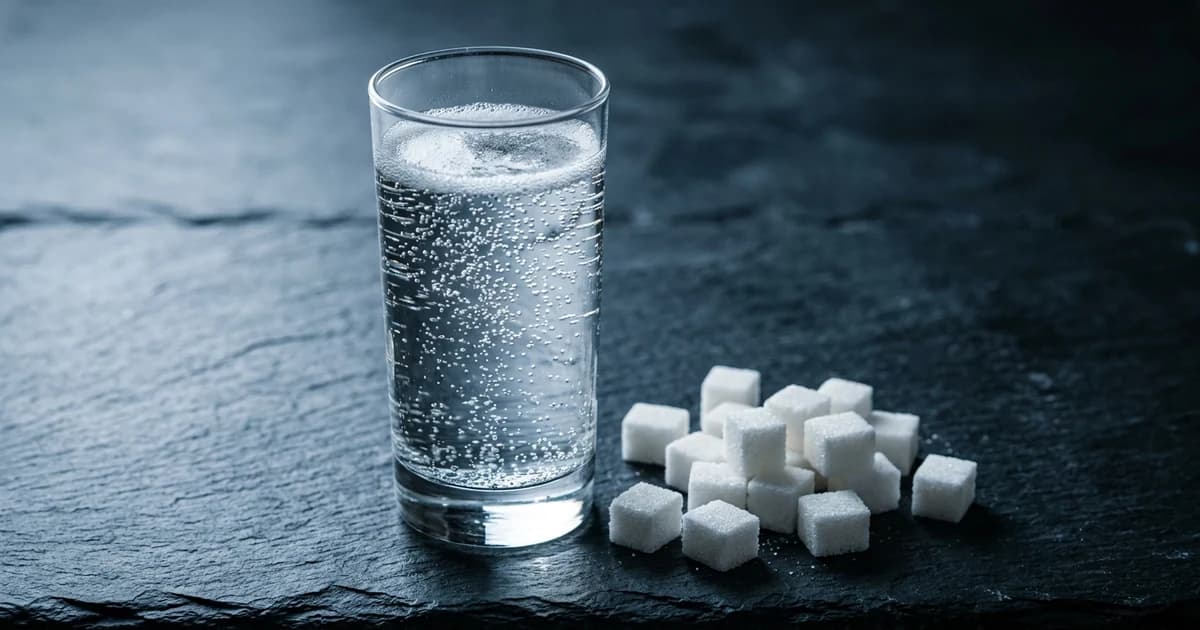
A 16 oz energy drink can contain 54 to 62 g of added sugar, per NCCIH. That exceeds the recommended daily maximum in a single container. Sugar-free versions replace the sugar with artificial or other sweeteners but carry the same caffeine and non-caffeine ingredients that Fletcher's trial flagged. "Sugar-free" solves one problem, not all of them. For more on what drives the post-drink crash, see why energy drinks make you crash.
Why Mixing Energy Drinks with Alcohol Is Riskier
About 25% of college students mix alcohol with energy drinks, per NCCIH. CDC data cited by NCCIH show that drinkers aged 15 to 23 who mix are four times more likely to binge drink at high intensity (six or more drinks per episode) than those who do not. In 2011, 42% of energy-drink-related ER visits involved alcohol or drugs (NIH data from 2011). Caffeine can mask how drunk a person feels. In November 2010, the FDA declared caffeine in caffeinated alcoholic beverages an "unsafe food additive" and warned four companies, including Phusion Projects (maker of Four Loko).
How Many Energy Drinks a Day Is Too Many?
For most adults, the FDA cites 400 mg of caffeine a day as an amount not generally linked to negative effects. At up to 328 mg per 16 oz, a single large can could deliver most of that. Harvard Health's advice: no more than one a day for healthy adults, and not as a daily habit. See how many energy drinks a day is too many and is caffeine bad for you for more.
Who Should Not Drink Energy Drinks
Children and teens. The FDA and AAP advise against energy drinks for minors. Harvard Health, citing the American Academy of Child and Adolescent Psychiatry, says teens should stay at 100 mg of caffeine a day or less. NCCIH adds that energy drinks may harm developing cardiovascular and nervous systems. Harvard Health also reported that pediatric exposures (under age 20) rose 24.2% from 2022 to 2023, per America's Poison Centers, with roughly 78% unintentional.
People with heart conditions. Harvard Health's advice is to avoid energy drinks if you have heart problems or high blood pressure, and that includes rhythm conditions such as long QT syndrome.
Pregnant or breastfeeding individuals. Talk to your clinician before consuming any high-caffeine product.
Anyone mixing with alcohol or taking stimulant/heart medications. Ask a pharmacist before combining.
If you experience chest pain, rapid or irregular heartbeat, or dizziness after an energy drink, seek medical attention. For signs of overconsumption, see caffeine overdose symptoms.
Related from Roon
Frequently Asked Questions
Are sugar-free energy drinks bad for you?
Sugar-free versions eliminate the 54 to 62 g of added sugar. They still contain the same caffeine and non-caffeine ingredients. Fletcher's 2017 trial used a full energy drink and showed QTc and blood pressure effects caffeine alone did not explain. Removing the sugar addresses one risk factor, not all of them.
Are energy drinks bad for your kidneys?
The strongest evidence on this page concerns heart, sugar, and alcohol. The sources reviewed here do not address kidneys, so this page makes no kidney claim either way. If you have kidney disease or reduced kidney function, ask your doctor before consuming any high-caffeine product.
Is one energy drink a day bad?
Harvard Health's advice for healthy adults is no more than one a day, and not as a daily habit. The caffeine math matters too: a 16 oz can can hold up to 328 mg (FDA range), which leaves little room for coffee or tea under the FDA's 400 mg daily figure.
Are energy drinks worse than coffee?
Coffee delivers roughly 100 mg caffeine per 8 oz (NCCIH) with no added sugar, taurine, or guarana. A 16 oz energy drink can carry up to 328 mg of caffeine (FDA) and 54 to 62 g of added sugar (NCCIH). Fletcher's trial suggests something besides the caffeine may add to the blood pressure effect. See energy drink vs coffee for the full comparison.
Can energy drinks cause a heart attack?
Case reports and the Martinez 2024 case series document cardiac events temporally linked to energy drinks, mostly in people with underlying genetic heart conditions. No trial has shown energy drinks directly cause cardiac arrest in a healthy person. Seek medical care for chest pain after consuming any energy drink.
The Caffeine Without the Can
Most of the measurable risk on this page traces back to volume, speed, and sugar layered on the caffeine. Drinking 32 oz in an hour, as both heart trials did, is as much about volume and speed as about caffeine.
Roon is an 80 mg caffeine pouch: zero sugar (it uses sucralose), zero nicotine, nothing to chug. It pairs caffeine with 60 mg L-theanine, 25 mg methylliberine (Dynamine), and 5 mg theacrine (TeaCrine). Methylliberine slows caffeine clearance: a randomized, double-blind, crossover PK study (n = 12) found co-administration cut oral clearance from 41.9 to 17.1 L/hr and extended caffeine's half-life from 7.2 to 15 hours with no higher peak. That study used 100 mg methylliberine and 150 mg caffeine (about 4x and 1.9x Roon's doses), so the mechanism applies directionally, not as a direct replication. A 15-hour half-life is a clearance measurement, not 15 hours of perceived energy. People typically feel one pouch for 6 to 8 hours, with no jitters and no crash.
Stay at or under four pouches and 400 mg of caffeine a day from all sources, and leave at least 8 hours between your last pouch and bedtime. Roon costs from $9.16 per tin on subscription.
Sources
- FDA, "Spilling the Beans: How Much Caffeine is Too Much?" (updated Aug 2024)
- NIH NCCIH, "Energy Drinks" (updated July 2018)
- Harvard Health, "Are energy drinks bad for you?" (Aug 2025)
- Shah SA et al., JAHA 2019: QTc and BP after high-volume energy drink consumption
- Fletcher EA et al., JAHA 2017: Energy drink vs caffeine-matched control
- Martinez KA et al., Heart Rhythm 2024: SCA and energy drink consumption
- FDA, "Caffeinated Alcoholic Beverages" (Nov 2010)
Written by Roon Team