Zyn vs Nicotine Free Pouches: Ultra vs Mojo vs Zyn Compared
Roon Team
Zyn vs Nicotine Free Pouches: Ultra vs Mojo vs Zyn Compared
Short answer: Zyn delivers focus through nicotine, which builds tolerance and dependence; nicotine-free pouches reach a similar goal through different stimulants. Ultra runs on 100mg paraxanthine (caffeine-free), Mojo on 50mg green-tea caffeine plus adaptogens, and Roon on a zero-nicotine stack of 80mg caffeine, 60mg L-theanine, 25mg methylliberine (Dynamine), and 5mg theacrine (TeaCrine). None of the nicotine-free options contain nicotine, so none carry the dependence that surveyed pouch users show on a standardized scale. The right pick depends on whether you want raw drive, clean energy, or sustained dopaminergic support without the escalating-dose cycle.
| Pouch | Caffeine | L-Theanine | Other Actives | Nicotine |
|---|---|---|---|---|
| Zyn | 0 | 0 | Nicotine | 3-6 mg |
| Ultra | 0 | Yes (mg not disclosed) | Paraxanthine 100mg, Alpha-GPC | 0 |
| Mojo | 50 mg | Yes (mg not disclosed) | Adaptogens (ginseng, rhodiola, eleuthero) | 0 |
| Roon | 80 mg | 60 mg | Methylliberine 25mg, Theacrine 5mg | 0 |
You're using Zyn for focus. You know it works, you know why it works, and you also know, somewhere in the back of your mind, that you're building a dependency you didn't sign up for. So you start looking at alternatives. That search for Zyn vs nicotine free pouches pulls up two names over and over: Ultra and Mojo. Both promise cognitive performance without the nicotine. But do they actually deliver what Zyn gives you, minus the addiction?
This is the nicotine free pouch comparison you need before you switch, including a closer look at nicotine-free pouches for mental clarity.
Key Takeaways
- Zyn delivers real focus through nicotine's dopamine hit, but tolerance builds fast and dependency is the trade-off.
- Ultra uses paraxanthine (a caffeine metabolite) as its primary stimulant, with no nicotine or caffeine, plus nootropic support from Alpha-GPC and L-Theanine.
- Mojo runs on 50mg of green tea-derived caffeine combined with adaptogens like ginseng and rhodiola.
- All three products use a sublingual pouch format, but the Zyn vs nicotine free pouches debate reveals they differ wildly in mechanism, duration, and long-term viability.
Why People Use Zyn for Focus (And Why It Stops Working)
Let's be honest about what Zyn actually is. It's a nicotine delivery system. Available in 3mg and 6mg strengths across ten flavors, Zyn pouches contain nicotine extracted from tobacco leaves in a plant-fiber pouch you tuck between your lip and gum. The nicotine hits your bloodstream through the oral mucosa within minutes. Zyn has become a massive category: Philip Morris International reported 384.8 million cans sold worldwide in 2023, and the numbers have only grown since.
The reason so many professionals, students, and creators reach for Zyn isn't the nicotine buzz. It's the focus. Nicotine binds to nicotinic acetylcholine receptors in the brain, triggering a downstream release of dopamine, norepinephrine, and acetylcholine. That neurochemical cascade sharpens attention, improves working memory, and makes tedious tasks feel manageable.
For about 20 to 30 minutes.
Here's the problem: your brain adapts. Research published on ScienceDirect has shown that chronic nicotine exposure leads to receptor desensitization, where the very receptors nicotine targets become less responsive over time. The study demonstrated dose-dependent tolerance in subjects chronically exposed to nicotine, alongside the expected upregulation of nicotine binding sites. In plain terms: your brain grows more receptors but makes each one less sensitive. You need more nicotine to get the same effect.
That's tolerance. And it gets worse. This is exactly why the Zyn vs nicotine free pouches question matters so much.
A study from Wake Forest School of Medicine published in PMC found that long-term nicotine exposure actually depresses dopamine release in the nucleus accumbens, the brain's reward center. The researchers specifically identified changes in the α6β2 nicotinic receptor subtype that reduced dopamine signaling over time. Translation: the thing you're using for focus eventually makes your baseline focus worse than it was before you started.
A review published in late 2024 on PubMed put it plainly: nicotine pouches "can deliver nicotine at levels sufficient to cause dependence." The cycle is predictable. You start at 3mg. You move to 6mg. You use more cans per week. The focus benefit shrinks while the dependency grows.
At $5 to $6 per can for 15 pouches, the financial cost is manageable. The neurochemical cost is not.
This is why the search for a Zyn alternative without nicotine keeps growing, and why so many people want to quit nicotine pouches for good.
Ultra Focus Pouches: Paraxanthine Takes the Lead
In any Zyn vs nicotine free pouches breakdown, the Ultra Focus Pouches review shows it deserves serious attention. Instead of nicotine or even caffeine, it uses enfinity paraxanthine as its primary stimulant.
Paraxanthine is actually what your liver converts caffeine into, and it is the foundation of Ultra's paraxanthine pouch formula. It's the metabolite responsible for most of caffeine's cognitive benefits, without the anxiety, jitters, or sleep disruption that caffeine itself can cause. Ultra's updated formula delivers 100mg of enfinity paraxanthine per pouch, upgraded from the original 75mg.
The full ingredient stack, according to their Amazon listing, includes:
- Enfinity Paraxanthine (100mg)
- L-Theanine
- Alpha-GPC
- Vitamin B6 and B12
- Ginseng Extract
Ultra positions itself as both nicotine-free and caffeine-free. The paraxanthine provides alertness and focus, L-Theanine smooths out the stimulant edge, and Alpha-GPC supports acetylcholine production (the same neurotransmitter system nicotine hijacks, but through a different, non-addictive pathway). As a Zyn alternative without nicotine, Ultra's approach is genuinely distinct.
The strengths: Clean stimulation without dependency. The paraxanthine angle is genuinely interesting science, and the inclusion of Alpha-GPC shows they're thinking about the acetylcholine system, not just throwing stimulants at the wall. Alpha-GPC is a choline donor, meaning it supports the production of acetylcholine, the same neurotransmitter that nicotine mimics. That's a smart design choice. The ginseng and B-vitamin support round out the formula for general cognitive function.
The limitations: Paraxanthine is a single-mechanism stimulant. It works primarily through adenosine receptor antagonism, similar to caffeine but without some of caffeine's side effects. It doesn't directly support dopamine signaling the way nicotine does, which means the "reward" component of focus, the part that makes you actually want to sit down and do the work, may feel absent.
If you're coming off Zyn specifically for the motivational drive, Ultra vs Zyn is going to feel like trading horsepower for efficiency. You get cleaner energy, but the raw motivational push isn't there. The Ultra vs Zyn gap is most noticeable during deep work sessions where sustained drive matters. Ultra is also a newer product, so long-term data on paraxanthine tolerance (or lack thereof) in pouch format is still limited.
Mojo Energy Pouches: Caffeine Plus Adaptogens
Mojo is the most accessible entry point in the Zyn vs nicotine free pouches market. It's built around a simpler premise: put caffeine in a pouch, add some adaptogens, and give people a cleaner energy drink alternative.
Each Mojo pouch contains 50mg of caffeine derived from green tea, roughly half a cup of coffee. The supporting cast includes:
- L-Theanine
- N-Acetyl-L-Tyrosine
- Panax Ginseng Extract
- Yerba Mate Extract
- Rhodiola Extract
- Eleuthero Root Extract
- Vitamins B3, B6, and B12
Mojo comes in 15 pouches per can and is available in flavors like Lemon Lime and Blue Raspberry.
The strengths: The ingredient list is solid for general energy. L-Theanine paired with caffeine is one of the most well-studied nootropic combinations in existence. The adaptogens (rhodiola, ginseng, eleuthero) add stress-resilience support that neither Zyn nor Ultra offer. And at 50mg of caffeine, you're unlikely to get the jitters. For anyone exploring a Zyn alternative without nicotine, Mojo's adaptogen profile is a real differentiator. It is also just one of several nicotine-free alternatives worth trying if you are mapping out the full field before switching.
The limitations: 50mg of caffeine is modest. For someone coming off nicotine pouches, that's a noticeable step down in perceived stimulation. Caffeine also builds tolerance, just like nicotine does, albeit through a different mechanism (adenosine receptor upregulation). If you're using Mojo multiple times a day, you'll eventually need more to feel the same effect. The adaptogens help with stress resilience, but their effects are subtle and cumulative, not the kind of thing you feel in 10 minutes.
Ultra vs Zyn vs Mojo: The Nicotine-Free Pouch Head-to-Head
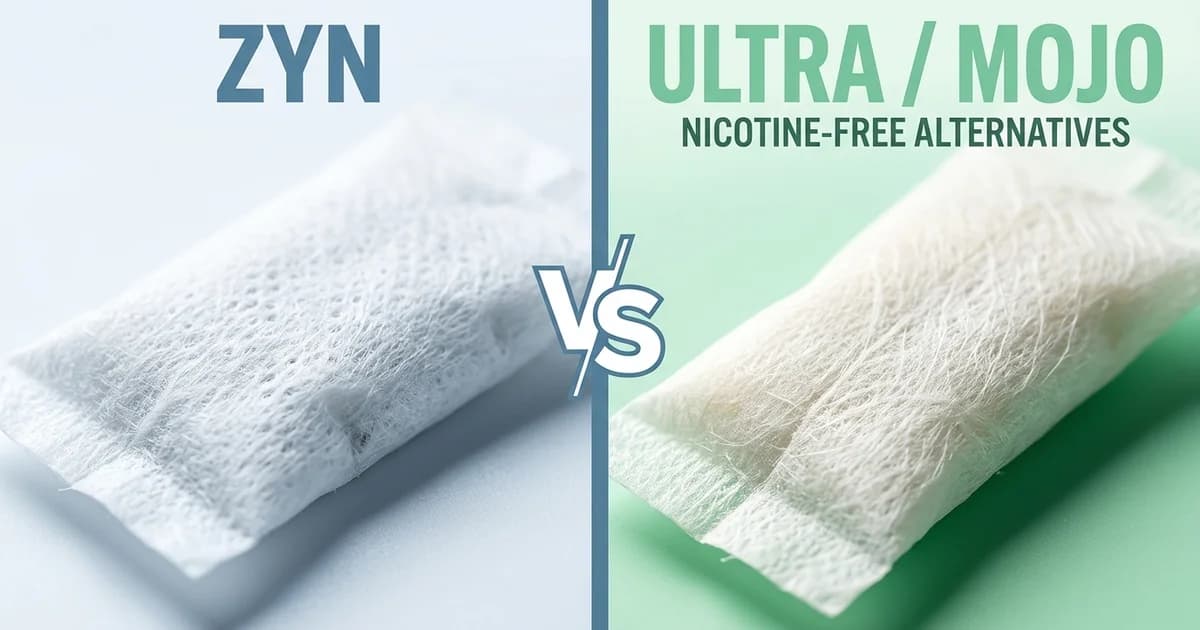
Ultra vs Zyn, in one line: Ultra is a nicotine-free, caffeine-free focus pouch built on 100mg paraxanthine, while Zyn is a nicotine pouch (3mg or 6mg, plus the newer ZYN Ultra at 9mg) that works through addictive nicotine. If you want the focus without the dependence, Ultra and the other nicotine-free options below do the job; if you specifically want nicotine, no nicotine-free pouch will replace that craving. Here's how the three stack up across the metrics that actually matter in the Zyn vs nicotine free pouches debate:
| Feature | Zyn | Ultra | Mojo |
|---|---|---|---|
| Active Stimulant | Nicotine (3mg or 6mg) | Paraxanthine (100mg) | Caffeine (50mg) |
| Nicotine | Yes | No | No |
| Caffeine | No | No | Yes (50mg) |
| L-Theanine | No | Yes | Yes |
| Acetylcholine Support | Indirect (via nicotine) | Alpha-GPC | No |
| Adaptogens | No | Ginseng | Ginseng, Rhodiola, Eleuthero, Yerba Mate |
| Tolerance Buildup | High (receptor desensitization) | Low (paraxanthine data still emerging) | Moderate (caffeine tolerance is well-documented) |
| Dependency Risk | High | Low | Low |
| Dopamine Pathway Support | Direct (but unsustainable) | Minimal | Indirect (via L-Tyrosine) |
| Onset Speed | Fast (minutes) | Moderate | Moderate |
| Duration | 20-30 min per pouch | 2-4 hours (estimated) | 1-3 hours |
| Pouches Per Can | 15 | 20 | 15 |
| Price Per Can | ~$5-6 | ~$8-10 (3-can bundles) | ~$7-9 (5-can bundles) |
The Nicotine Free Pouch Comparison: What's Actually Missing
Here's where the nicotine free pouch comparison gets interesting. All three products solve part of the equation, but none of them solve the whole thing. Looking at Zyn vs nicotine free pouches through a neurochemistry lens reveals specific gaps in each option.
Zyn's Gap: Dependency Is the Product
Zyn works. Nobody is arguing that. But the mechanism that makes it work, direct nicotine-driven dopamine release, is the same mechanism that creates dependency. You can't separate the focus from the addiction with nicotine. The tolerance curve means you're always chasing a moving target, needing more input for less output. Anyone trying to quit nicotine pouches runs headfirst into this reality.
Ultra's Gap: Clean Stimulation, Missing Motivation
Ultra made a smart bet on paraxanthine. As a Zyn alternative without nicotine, it's a cleaner stimulant than caffeine, and the nootropic stack is well-designed. But paraxanthine primarily works through adenosine antagonism. It keeps you awake and alert. What it doesn't do is directly support the dopaminergic signaling that drives motivation, the "I want to do this" feeling that makes nicotine so effective for focus-heavy work.
If you've been relying on Zyn, switching to Ultra might leave you feeling alert but unmotivated. Awake, but not locked in. The Ultra vs Zyn tradeoff comes down to clean energy versus raw drive.
Mojo's Gap: Familiar Caffeine, Familiar Ceiling
Mojo is essentially a well-formulated caffeine pouch with adaptogens. That's not a criticism. It's a good product for what it is. But caffeine tolerance is real, well-documented, and inevitable with daily use. The adaptogens help with stress resilience, but they don't address the core issue: sustained dopaminergic support without dependency.
If you're trying to quit nicotine pouches, Mojo gives you something to put in your lip. It doesn't give you the sustained neurochemical support that made nicotine feel productive in the first place. This nicotine free pouch comparison reveals that Mojo works best for light stimulation, not as a true Zyn replacement.
The Common Gap Across All Three
The pattern across this Zyn vs nicotine free pouches analysis is clear, and it holds up in the Roon vs NZE comparison as well. Zyn gives you dopamine support but creates dependency. Ultra gives you clean stimulation but skips the dopamine pathway. Mojo gives you familiar caffeine energy but hits the same tolerance wall.
What's missing from the nicotine-free options is a way to support dopamine signaling, the actual neurochemical driver behind sustained focus and motivation, without relying on nicotine's addictive mechanism to do it. That gap is what makes the Zyn vs nicotine free pouches decision so frustrating for people who want to quit nicotine pouches without losing performance.
Frequently Asked Questions
Are nicotine-free pouches as effective as Zyn for focus?
It depends on what you wanted from Zyn. If you used it purely for alertness, a caffeine or paraxanthine pouch can match that without nicotine. If you used it for the motivational drive that nicotine's dopamine release creates, only a stack that supports dopamine signaling, such as one built on theacrine and methylliberine, comes close. The trade-off is that nicotine-free options skip the dependence nicotine builds, so you keep the focus without the escalating dose.
Does Roon contain nicotine?
No. Roon is a zero-nicotine sublingual pouch. Each pouch contains 80mg caffeine, 60mg L-theanine, 25mg methylliberine (Dynamine), and 5mg theacrine (TeaCrine), with no nicotine and no tobacco. The formula is built to support sustained focus through caffeine and dopaminergic compounds rather than through nicotine's addictive pathway. You can review the full ingredient stack on the product page.
Do nicotine-free focus pouches cause dependence?
They do not carry nicotine's dependence risk, because they contain no nicotine. Surveyed oral nicotine pouch users show measurable dependence on a standardized nicotine-dependence scale, a pattern driven by nicotine itself. Caffeine can build a mild tolerance with daily use, and paraxanthine data is still emerging. Theacrine, by contrast, showed no habituation over eight weeks of daily use, which is why it sits at the center of the nicotine-free approach.
Is paraxanthine better than caffeine?
Paraxanthine is the metabolite your liver produces from caffeine, and it drives much of caffeine's alertness through adenosine receptor antagonism. Ultra uses 100mg of it, so you get stimulation with fewer of caffeine's jitters and less sleep disruption. The limitation is that paraxanthine works mainly on alertness, not on the dopamine signaling that drives motivation. For raw drive, a caffeine-plus-dopaminergic stack tends to feel different from paraxanthine alone.
Does theacrine build tolerance like nicotine?
No. In an eight-week trial of daily use, theacrine (TeaCrine) showed no habituation and no tachyphylactic response, the dose-creep pattern seen with caffeine and other stimulants. That property is the reason it pairs well with caffeine in a nicotine-free pouch: it supports dopaminergic focus without the escalating dose that defines nicotine use. Methylliberine works on a similar pathway with faster onset, so the two are often combined.
How much caffeine is in a Roon pouch versus Mojo?
Roon contains 80mg of caffeine per pouch, roughly a cup of coffee, paired with 60mg of L-theanine to smooth the stimulation. Mojo contains 50mg of green-tea caffeine, closer to half a cup. The caffeine and L-theanine pairing in both is one of the most studied nootropic combinations, associated with improvements in attention. Zyn and Ultra contain no caffeine at all; Zyn runs on nicotine and Ultra on paraxanthine.
Can I switch from Zyn straight to a nicotine-free pouch?
You can use a nicotine-free pouch in the same sublingual format, but it will not satisfy a nicotine craving, since it contains no nicotine. Many people who want to step away from nicotine keep the familiar ritual, the pouch tucked under the lip, while the active ingredients shift to caffeine and dopaminergic compounds. Expect the experience to feel like clean, sustained focus rather than a sharp nicotine hit. If you are managing heavy nicotine dependence, talk with a clinician.
A Different Approach: Sustained Dopaminergic Support Without Nicotine
This is the specific problem Roon was designed to address, and why it stands apart in any Zyn vs nicotine free pouches evaluation.
Roon is a zero-nicotine sublingual pouch built on a four-ingredient stack: Caffeine (80mg), L-Theanine, Theacrine, and Methylliberine. The first two ingredients will look familiar. The last two are what fill the gap identified above.
Theacrine is a purine alkaloid structurally similar to caffeine, found naturally in kucha tea. It activates dopamine receptors (specifically D1 and D2) and, according to published research, does not produce tolerance or habituation with repeated use. That last part is the key differentiator. It provides the dopaminergic support that makes focus feel like motivation, not just alertness, without the escalating-dose trap that defines nicotine use. For anyone weighing Zyn vs nicotine free pouches, theacrine directly addresses the missing piece.
Methylliberine works on a similar pathway but with a faster onset. It complements theacrine by providing an initial lift that transitions into theacrine's longer-lasting effects. Together, they create a sustained focus window of 6 to 8 hours.
The 80mg of caffeine is comparable to a cup of coffee, providing a familiar baseline of alertness, and L-Theanine smooths the entire experience, promoting alpha brain wave activity without sedation. Put together, those four ingredients are what make up Roon, a zero-nicotine focus pouch.
Here's what this means in practice: Roon addresses the dopamine gap that Ultra and Mojo leave open, without touching nicotine's addictive pathway. It's not a nicotine replacement. It's a different architecture for the same outcome, sustained cognitive performance, built on compounds that don't force you into a tolerance cycle. As a Zyn alternative without nicotine, Roon is the only option in this nicotine free pouch comparison that targets dopamine signaling directly.
If you're looking for the focus without the dependency, and the Zyn vs nicotine free pouches question brought you here, Roon is worth a look.
By Roon Team