Why Doesn't Caffeine Affect Me? Which of Six Reasons Is Yours
Why Doesn't Caffeine Affect Me? Which of Six Reasons Is Yours
If you are asking why doesn't caffeine affect me, you are probably not immune. True genetic non-response is vanishingly rare. What feels like "caffeine doesn't work for me" is almost always one of six identifiable problems: built tolerance, an unmeasured dose, fast-clearance genetics, accumulated sleep debt, bad timing, or a shifted baseline. Each one leaves a different fingerprint, and each has a different fix. Work down the six branches below and stop when one fits.
Key Takeaways
- Tolerance to caffeine's alerting effect builds in two to three weeks of daily use. A weekend off does not reset it.
- The "cup of coffee" you think you know may contain anywhere from 259 to 564 mg, so you cannot evaluate caffeine without knowing the milligrams.
- Two genes do two different jobs: CYP1A2 controls clearance speed, ADORA2A controls receptor sensitivity.
- If you drink caffeine every day, a large share of the morning lift is simply reversing overnight withdrawal, not a net gain.
One-Minute Triage
- You drink caffeine daily and it used to hit harder. Branch 1 (tolerance).
- You have no idea how many milligrams you consume. Branch 2 (dose).
- You can drink espresso at 10 PM and sleep fine. Branch 3 (genetics).
- You sleep five or six hours most nights and coffee does not fix it. Branch 4 (sleep debt).
- You judge your coffee ten minutes after drinking it. Branch 5 (timing).
- Coffee gets you to "normal" but never past it. Branch 6 (baseline shift).
Branch 1: You Built Tolerance
A 2019 crossover trial by Lara et al. gave 11 subjects 3 mg/kg/day of caffeine (roughly 200 mg for a 70 kg person) for 20 days. The performance boost persisted through about day 15, then progressively shrank. By day 20, the effect was measurably smaller than day 1. Even roughly 100 mg/day, taken daily for three to four weeks, blunted caffeine's acute effect in Beaumont et al. (2017).
The popular claim that "three days off resets tolerance" has no support. A randomized crossover trial in cyclists found that four days of caffeine did not even induce tolerance, which means it takes weeks to build and more than a long weekend to undo. The literature points to 7 to 14 days of genuine abstinence as the minimum for a meaningful reset.
Your check: Count the days since your last real break. If it has been months of daily caffeine with no gap longer than three days, tolerance is your leading candidate.
Branch 2: The Dose Is Wilder Than You Think
A "cup of coffee" is not a dose. It is a guess. Researchers at the University of Florida (McCusker et al., 2003) bought the same 16 oz Starbucks Breakfast Blend from the same store on six consecutive days. The caffeine ranged from 259 to 564 mg. Same store, same order, more than a twofold spread. Franchise coffees broadly show a three to fourfold range.
| Source | Typical caffeine (mg) | Notes |
|---|---|---|
| Drip coffee, 16 oz | 150 to 350+ | Highly variable by brew |
| Espresso, single shot | 60 to 80 | Smaller than most assume |
| Cold brew, 16 oz | 150 to 300 | Steeping time drives the range |
| Energy drink, 16 oz | 140 to 300 | Label usually accurate |
| Labeled pouch or capsule | Fixed per unit | What is actually in a cup varies far more |
Your check: For three days, log actual milligrams using labeled sources. Rate how you feel at 45 minutes. If the effect suddenly becomes consistent, the variable was always the dose.
Branch 3: Your Genes Clear It Fast, or Your Receptors Don't Care
Two genes do two separate jobs, and most articles muddle them.
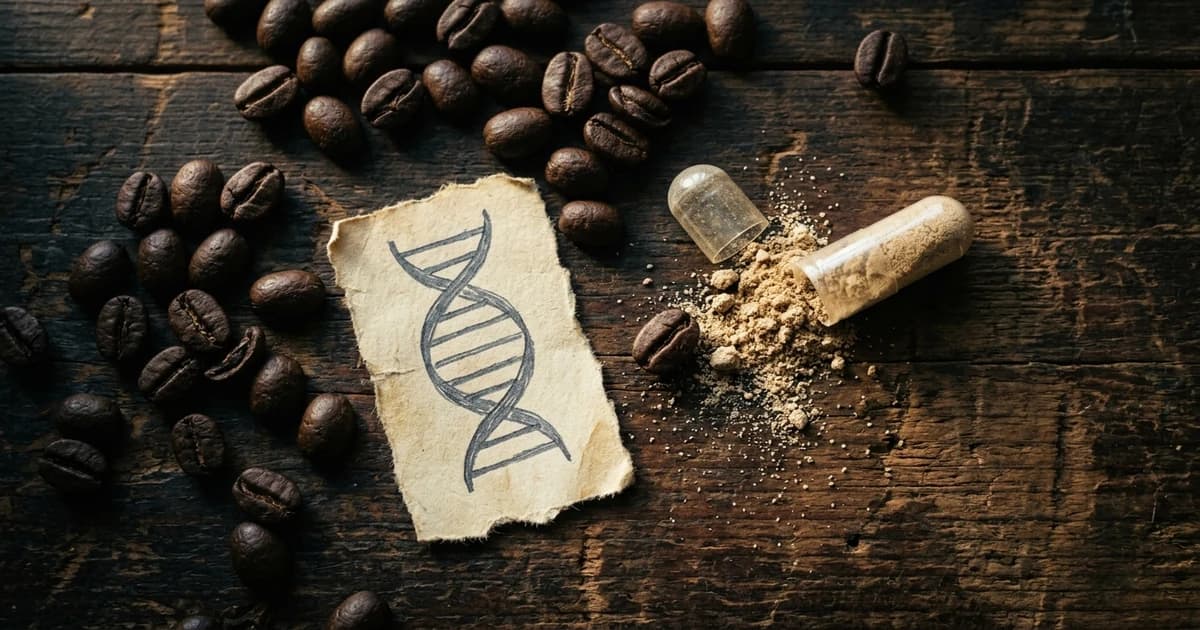
CYP1A2 (rs762551) encodes the liver enzyme responsible for up to 95% of caffeine metabolism. The AA genotype clears caffeine faster. If you are a fast metabolizer, the drug is in and out before it has time to feel like much.
ADORA2A (rs5751876) encodes the adenosine A2A receptor, linked to anxiety and sleep sensitivity to caffeine, not to its alerting benefit. Research suggests CYP1A2 may modulate the cognitive response to caffeine more than ADORA2A does, though neither gene reliably changed exercise performance. The gene that determines whether you "feel" caffeine mentally is CYP1A2, and the two do very different things.
You do not need a DNA test. The bedtime test is a free proxy: take 100 mg of labeled caffeine at 6 PM on a night you can afford poor sleep. If you fall asleep at your normal time, you are likely a fast metabolizer. If you are staring at the ceiling, you are not. If caffeine lingers too long, slow clearance has its own implications.
Your check: Try the bedtime test once. It costs one night, not $200.
Branch 4: Sleep Debt Is Bigger Than the Blockade
Caffeine is an adenosine receptor antagonist. It hides the sleep signal; it does not erase the adenosine that builds during waking hours. If you have been sleeping five hours a night for a week, 80 to 200 mg of caffeine is simply outmatched. The blockade is partial. The debt is real.
Your check: Compare the same measured dose after a night of seven-plus hours versus a night of five. If caffeine behaves differently on good sleep, the variable was sleep.
Branch 5: Timing, Both Ends
Caffeine's onset is 15 to 60 minutes, with peak plasma concentration at 30 to 70 minutes. Judging your coffee at the ten-minute mark is evaluating a drug that has not arrived.
On the back end, the average half-life is about five hours, but the range is 1.5 to 9.5 hours. Smoking roughly halves it. Oral contraceptives extend it 25 to 50%. If you smoke, a morning coffee may genuinely be gone by lunch. Why half-life varies so much is mostly CYP1A2 activity, with hormonal factors stacked on top.
Even habitual users who "feel nothing" still show disrupted sleep when they dose too close to bedtime. Tolerance to the alerting effect is partial, not total, so timing matters even if you think you are immune.
Your check: Set a timer for 45 minutes after your next dose. Rate it then, not before.
Branch 6: You Are Measuring Against the Wrong Baseline
Research on withdrawal reversal, including Sigmon et al. (2009) and Rogers (2014), supports a specific conclusion: in habitual daily users, a large share of the morning alertness boost from caffeine is undoing overnight withdrawal, not a net gain over a non-user. That is why daily drinkers describe the first cup as "getting to normal."
There is also the memory piece. What you remember from your first few coffees was the response of a caffeine-naive brain. At steady-state daily use, the compound does not produce that jolt anymore. It cannot.
Your check: The only way to see your true baseline is a 7 to 14 day break. Withdrawal onset is 12 to 24 hours, peaks at 20 to 51 hours, and headache hits about 50% of people. You will feel worse before the test becomes informative.
When "Nothing Happens" Is Two Branches at Once
The most common real-world case is three stacked: daily tolerance, chronic short sleep, and an unmeasured dose that varies by 200 mg from morning to morning. Fix the measurable one first: dose. Switch to a labeled, fixed-milligram source for a week and control that variable before you try a tolerance reset or sleep overhaul. You cannot diagnose a problem you have not isolated.
A 7-Day Self-Check
- Days 1 to 3: Switch to a labeled caffeine source. Log milligrams. Rate how you feel at 45 minutes, 1 to 10.
- Day 4: The bedtime test. 100 mg labeled caffeine at 6 PM. Track whether you fall asleep at your normal time.
- Days 5 to 7: Hold dose constant, track sleep hours, note whether the caffeine rating changes with sleep duration.
By day 7 you should be able to say: "My dose is X mg, it peaks around Y minutes, and the effect changes with sleep." That sentence is worth more than any article.
Caffeine "Immunity" Is Usually a Solvable Problem
Almost nobody is pharmacologically immune to caffeine. What masquerades as immunity is nearly always a measurable variable: a dose you have not quantified, a tolerance you have not reset, a sleep debt that outweighs the drug, or a baseline that shifted months ago. The six branches above are a diagnostic sequence, not a menu. Work through them starting with the one you can measure this week.
Frequently Asked Questions
Can you actually be immune to caffeine?
Effectively, no. Genetic variation in CYP1A2 can make you a very fast metabolizer, meaning caffeine clears your system before it builds up. But that is fast clearance, not immunity. True pharmacological non-response has not been documented. If caffeine "does nothing," one of the six branches above is more likely than a biological inability to respond.
Why does caffeine make me sleepy instead of alert?
This usually points to Branch 4 or 6. If sleep debt is large enough, blocking adenosine receptors cannot overcome the deficit, and the brief sympathetic bump fades into the fatigue underneath. In chronic daily users, withdrawal reversal can mean the first dose barely gets you to baseline, which feels like tiredness rather than energy.
How long does it take to reset caffeine tolerance?
The evidence points to 7 to 14 days of complete abstinence. Withdrawal onset is 12 to 24 hours, with symptoms peaking at 20 to 51 hours and lasting 2 to 9 days. A three-day weekend off does not meaningfully reset tolerance; four days of supplementation did not even induce it in a controlled trial.
Does a weekend off reset anything?
Not much. A Friday-to-Monday break is roughly 72 hours. Tolerance in the Lara 2019 trial took two to three weeks to develop, and the pharmacological basis for resetting it runs the same process in reverse. A 72-hour gap may ease the worst withdrawal symptoms, but it is not long enough to restore caffeine-naive sensitivity.
Should I get a CYP1A2 test?
Probably not. The bedtime test in Branch 3 gives you a functional answer for free. A genetic test tells you your genotype, but your actual clearance rate also depends on smoking, oral contraceptives, age, and liver health. The bedtime test captures all of those at once.
How much caffeine is too much per day?
The FDA's general guidance is up to 400 mg per day for healthy adults, a ceiling, not a target. And the Gardiner et al. 2023 meta-analysis found that even 107 mg should be consumed at least 8.8 hours before bed to avoid reductions in total sleep time.
The Branch You Can Fix Today: Know the Number
Most branches above take days or weeks to resolve. One takes minutes. If you do not know your dose in milligrams, every other diagnosis is guesswork. A coffee-shop cup ran 259 to 564 mg on consecutive days from the same store. That is not a dose. It is a coin flip.
Roon is 80 mg caffeine, 60 mg L-theanine, 25 mg methylliberine (Dynamine), and 5 mg theacrine (TeaCrine) per pouch. Cool Mint, zero nicotine, zero sugar, 15 pouches per tin, from $9.16 per tin. A fixed, labeled number every time.
To be clear: 80 mg of caffeine builds tolerance like any caffeine does (Lara 2019 applies here too). Roon does not exempt you from Branch 1. But it removes Branch 2 entirely, and that is where the diagnosis starts.
Related from Roon
- Caffeine Tolerance: Why You Need More Coffee for the Same Effect, and How a Reset Works
- CYP1A2 and ADORA2A: How Your Genes Shape Your Caffeine Response
- Why Caffeine Half-Life Varies 5-Fold in Your Body
- Adenosine and Sleep Pressure
Written by Roon Team