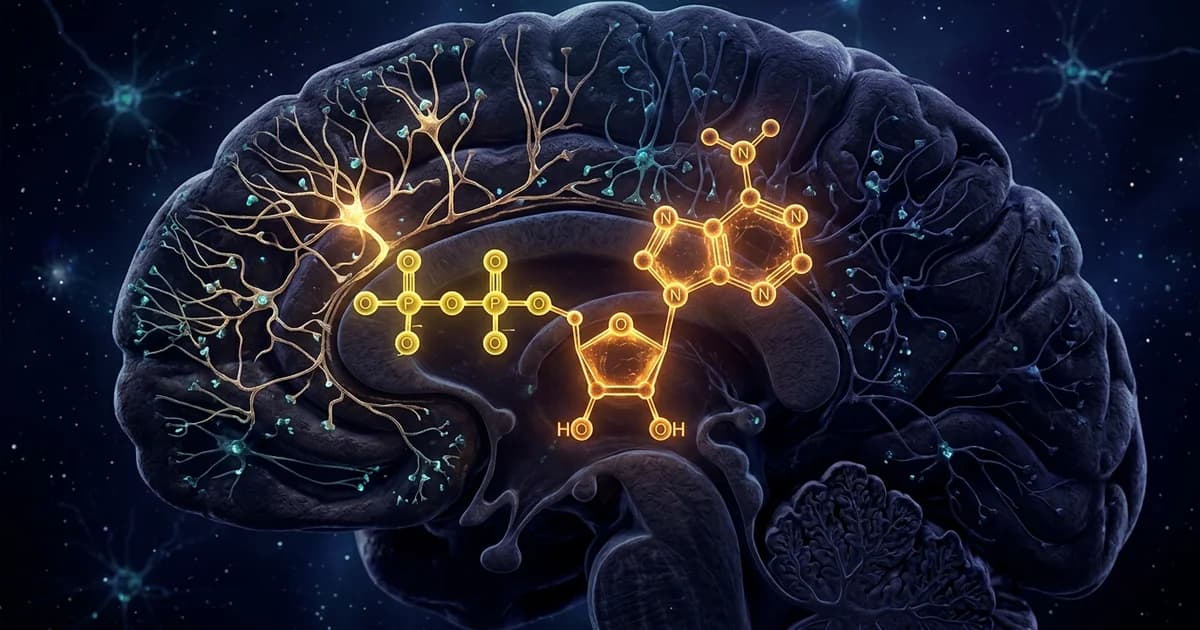
Adenosine and Sleep Pressure: The Molecule That Builds Your Need for Sleep
You wake up sharp. By 9 p.m. your eyelids feel heavy and your thoughts go soft. The reason for that slide has a name, and the relationship between adenosine and sleep is one of the cleanest cause-and-effect stories in neuroscience.
Adenosine is a small molecule that accumulates in your brain the entire time you are awake. The longer you stay up, the more of it builds, and the heavier the pull toward sleep becomes. Scientists call that pull sleep pressure, and it is the single biggest reason you feel tired at night and not at noon.
Here is the part most people miss. Caffeine does not remove adenosine. It hides it. Understanding that distinction changes how you think about coffee, energy drinks, and every late-afternoon pick-me-up you have ever reached for.
Key Takeaways
- Adenosine is a byproduct of your brain burning energy. It climbs while you are awake and clears while you sleep.
- This rising tide of adenosine is the molecular basis of sleep pressure, also called Process S in sleep science.
- Caffeine blocks adenosine receptors, so the signal still exists, you just stop feeling it for a few hours.
- Caffeine has a long half-life, which is why an afternoon cup can quietly cost you sleep that night.
- Blocking the tired signal is not the same as paying down sleep debt.
What Is Adenosine, Exactly?
Adenosine is a chemical your brain produces as a direct consequence of being active. Every time a neuron uses energy, it burns a molecule called ATP (adenosine triphosphate). Adenosine is one of the leftovers.
So the more your brain works during waking hours, the more adenosine pools in the spaces around your neurons. It binds to receptors, mainly the A1 and A2A subtypes, and that binding slows neural activity and nudges you toward rest. This is the basic pharmacology behind caffeine and tiredness that researchers have mapped in detail, including work published in the British Journal of Pharmacology on adenosine receptors and the compounds that block them.
Think of adenosine as a runtime counter. It does not track the clock on your wall. It tracks how long your brain has been switched on.
Sleep Pressure and Process S: Why You Get Tired
Sleep pressure is the mounting drive to sleep that grows the longer you stay awake, and adenosine is its chemical signature. The more hours you log, the stronger the pressure, until sleep wins.
Sleep scientists describe this using the two-process model of sleep regulation, first proposed by Alexander Borbély. According to a breakdown of the two-process model from ScienceInsights, your sleep is governed by two systems working at once.
The first is Process S, the homeostatic sleep drive. This is your adenosine sleep pressure, building steadily across the day. The second is Process C, your circadian rhythm, the roughly 24-hour internal clock that sets when you feel alert and when you feel sleepy regardless of how long you have been awake.
When Process S (high adenosine) and Process C (your body clock saying "night") line up, you fall asleep fast. When they fight, say, you pulled an all-nighter and the sun comes up, you can feel wired and exhausted at the same time. That tension is exactly why you get tired at 11 p.m. but catch a strange second wind at 2 a.m.
What happens to adenosine while you sleep
Sleep is when the counter resets. As you move through deep, slow-wave sleep, your brain clears accumulated adenosine, and sleep pressure drops back toward baseline. You wake with the counter low, which is why a good night leaves you sharp and a short night does not.
Miss enough sleep and the clearance never fully happens. Adenosine stays raised, sleep pressure stays high, and you carry that deficit forward. That carried-forward deficit is what most people mean by sleep debt.
How Caffeine Interrupts the Adenosine Signal
Caffeine works by blocking adenosine receptors, not by lowering adenosine itself. It is a structural mimic that slots into the same A1 and A2A receptor sites, so adenosine can no longer dock and deliver its "slow down" message.
Researchers studying how caffeine binds the human adenosine A2A receptor in Frontiers in Molecular Biosciences describe caffeine as a competitive antagonist at these sites. The receptor is occupied, the doorway is jammed, and the tired signal goes unheard.
Notice the catch. The adenosine is still there. Its level keeps climbing while caffeine is on board. You have muted the alarm, not stopped the fire. When the caffeine clears, the backlog of adenosine floods the now-open receptors at once, which is a large part of why a crash can feel so sudden.
Why timing matters more than dose
Caffeine sticks around far longer than its effects suggest. It has a half-life of roughly five to six hours in most adults, meaning a 2 p.m. coffee can still have a meaningful share of its caffeine in your system at bedtime.
A 2023 systematic review and meta-analysis of caffeine and sleep, published in Sleep Medicine Reviews via ScienceDirect, examined how caffeine affects subsequent sleep and supports cutting off intake hours before bed. Coverage of that review by AJMC summarized practical timing guidance drawn from the data. The takeaway is simple: caffeine late in the day blocks the very receptors that are supposed to be reading your peak sleep pressure at night.
Adenosine vs. Caffeine: A Side-by-Side
| Factor | Adenosine | Caffeine |
|---|---|---|
| What it is | Natural neuromodulator from energy use | Plant-derived stimulant |
| Effect on you | Builds sleep pressure, promotes rest | Blocks the sleep-pressure signal |
| Direction over the day | Rises while awake, clears in sleep | Peaks ~45 min after intake, fades over hours |
| Acts on | A1 and A2A receptors | The same A1 and A2A receptors |
| Net result | You feel tired | You stop feeling tired, temporarily |
The two are locked in a direct competition at the same receptors. Whoever occupies more sites wins the moment. But only sleep clears the adenosine itself.
The Honest Truth About Masking Sleep Pressure
Caffeine buys alert hours. It does not buy rest. That is the most useful thing to understand about adenosine sleep pressure, and it reframes how you should use any stimulant.
When you drink coffee on four hours of sleep, you feel functional because the receptors are blocked. The underlying sleep debt has not moved. The instant caffeine fades, the full weight of accumulated adenosine returns, often with interest.
This is why stimulants are best treated as a tool for sharpening the hours you are already going to be awake, not as a way to skip sleep. Used with that mindset, and with smart timing, caffeine supports focus without quietly stealing from the night ahead. Used to paper over chronic sleep loss, it just delays the bill. If you want the broader picture, our explainers on how caffeine affects focus and energy and the science of sustained mental performance go deeper.
Conclusion
Adenosine is the body's honest accountant. It tracks every waking hour, builds sleep pressure through Process S, and only settles the account when you actually sleep. Caffeine can silence the bookkeeper for a while by occupying the same receptors, but the ledger keeps growing underneath.
That single fact, that you can mask sleep pressure but not erase it, is the whole game. The smart move is not to fight adenosine indefinitely. It is to time your caffeine well, protect your sleep so the molecule can clear, and use stimulants to raise the hours you already have rather than to borrow against the ones you don't.
Frequently Asked Questions
What is adenosine in simple terms?
Adenosine is a molecule your brain produces while it uses energy. The longer you stay awake, the more of it accumulates around your neurons. As it binds to its receptors, it slows brain activity and makes you feel sleepy. It is essentially a chemical timer that tracks how long you have been awake, and it clears out again while you sleep.
Why do I get tired even when I am not bored?
Tiredness is not really about boredom. It is about sleep pressure, the rising level of adenosine in your brain. The longer you have been awake, the more adenosine has built up and the stronger the pull toward sleep becomes. That pressure exists regardless of how interesting your day is, which is why a fascinating evening still ends with heavy eyelids.
Does caffeine remove adenosine from my brain?
No. Caffeine does not lower adenosine or clear it. It blocks the receptors that adenosine normally binds to, so you stop feeling the tired signal even though the molecule is still present and still rising. Only sleep, especially deep slow-wave sleep, actually clears accumulated adenosine and resets your sleep pressure.
What is Process S in sleep science?
Process S is the homeostatic sleep drive in the two-process model of sleep regulation. It represents the build-up of sleep pressure across your waking hours, driven largely by adenosine. It works alongside Process C, your circadian rhythm. When both align, you fall asleep easily. When they conflict, like during jet lag or an all-nighter, sleep becomes fragmented and harder to time.
How long before bed should I stop drinking caffeine?
Because caffeine has a half-life of about five to six hours, a meaningful amount can remain in your system at bedtime if you drink it late. A 2023 meta-analysis in Sleep Medicine Reviews supports cutting off caffeine several hours before sleep to limit its effect on sleep quality. A common practical rule is to stop by early afternoon if you are sensitive.
Can I use caffeine to skip sleep?
Caffeine can make you feel alert on too little sleep, but it cannot replace sleep. It blocks the tired signal without paying down the underlying sleep debt. The moment caffeine clears, accumulated adenosine returns and the fatigue comes back, often sharply. Stimulants are best used to sharpen hours you are already awake, not to avoid rest you actually need.
Mask the Signal, Respect the Debt
If you have read this far, you understand the trade. Adenosine builds sleep pressure, caffeine blocks the receptors that read it, and only sleep clears the molecule itself. That framing is exactly how Roon is designed to be used.
Roon is a zero-nicotine sublingual pouch with a focused four-ingredient stack: 80 mg caffeine, 60 mg L-theanine, 25 mg methylliberine (Dynamine), and 5 mg theacrine (TeaCrine). The sublingual format means onset in about 5 to 10 minutes, and the stack is built for 6 to 8 hours of steady focus with no jitters and no hard crash. It is a tool for making your waking hours sharp.
It is not a sleep substitute, and it does not erase sleep debt. Nothing does except sleep. Use Roon to raise the hours you already have, mind your timing so the caffeine clears before bed, and let your brain do its overnight cleanup.
Written by Roon Team