A Time Blocking Template With an Energy Lane (and Where the Caffeine Goes)
A Time Blocking Template With an Energy Lane (and Where the Caffeine Goes)
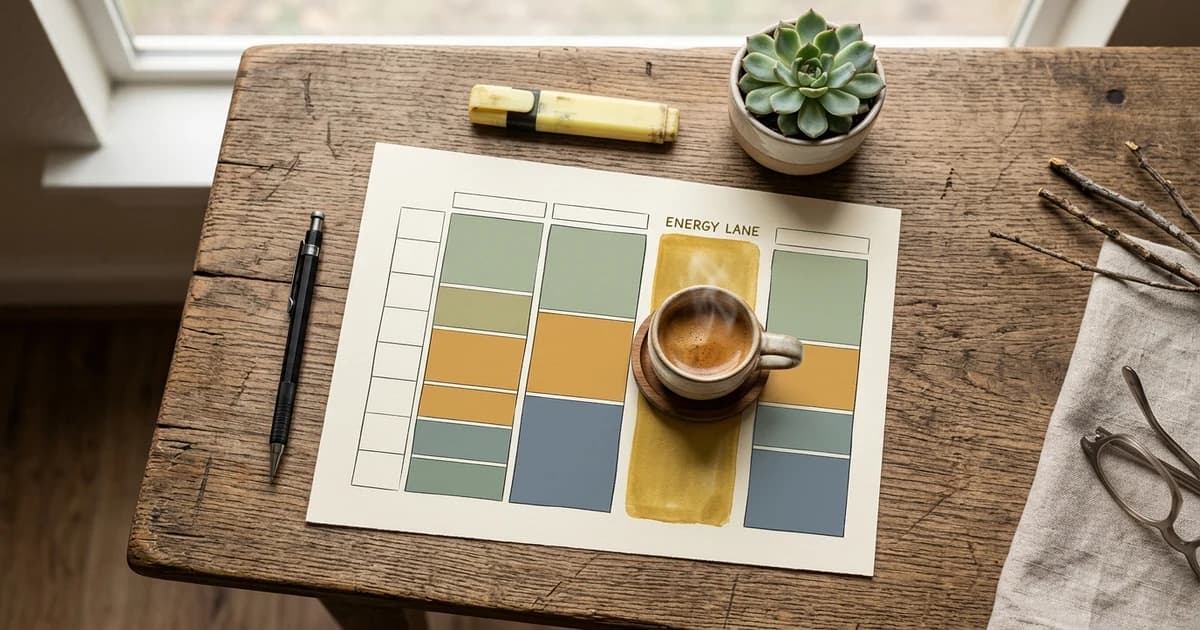
Most time blocking templates give you an hour column, a task column, and nothing else. Here is one with two additions that change how well the plan actually works: an energy lane that marks when your brain is strong, soft, or dipping, and a dose row that tracks caffeine timing against a hard deadline set by your bedtime. Copy the grid below, fill in five inputs, and you have a daily planner template with energy levels baked in.
Key Takeaways
- A time blocking template only works if it accounts for when you can think, not just when you are free.
- Your afternoon dip is circadian, not caused by lunch. Place shallow work inside it, not deep work.
- Your last caffeine dose has a deadline: roughly 8.8 hours before bed for a coffee-sized serving.
- The grid below is free, printable, and takes about ten minutes to fill in the first time.
The Blank Time Blocking Template
Copy this into a doc, a spreadsheet, or print it. The five columns are: time slot, block type, energy lane, dose row, and notes. You will fill the energy and dose columns in steps 1 through 4 below.
| Time | Block | Energy Lane | Dose Row | Notes |
|---|---|---|---|---|
| 6:00 AM | ||||
| 7:00 AM | ||||
| 8:00 AM | ||||
| 9:00 AM | ||||
| 10:00 AM | ||||
| 11:00 AM | ||||
| 12:00 PM | ||||
| 1:00 PM | ||||
| 2:00 PM | ||||
| 3:00 PM | ||||
| 4:00 PM | ||||
| 5:00 PM | ||||
| 6:00 PM | ||||
| 7:00 PM | ||||
| 8:00 PM | ||||
| 9:00 PM |
Block labels: Deep, Shallow, Break, Meeting (optional). Energy labels: Strong, Soft, Dip, Recovering. Dose row: milligrams and source, plus a "last dose by" marker at the deadline hour.
Before You Start: Five Inputs
- Wake time. When you actually get up, not the alarm.
- Bedtime. When you intend to be asleep, not when you get in bed.
- Work window. First and last working hours.
- Earlier or later type. Sharpest in the first few hours after waking, or does your brain take until late morning to peak? No quiz, just an honest answer.
- Caffeine sources and milligrams. A standard coffee is roughly 95 to 100 mg. Write down what you actually consume on a workday.
Step 1: Fill the Energy Lane With Your Strong Hours
A 2018 study by Facer-Childs, Boiling, and Balanos tested 56 healthy adults categorized as earlier or later chronotypes. Measured against time since waking, whole-group peak performance occurred roughly 5 to 6 hours after wake-up. But the split between chronotypes was dramatic: earlier types peaked within a few hours of waking, while later types did not hit their stride until roughly 11 to 13 hours after wake-up, depending on the measure.
If you wake at 7:00 AM and run earlier, your strongest cognitive window may be 7:00 to 11:00 AM. If you run later, it may not start until early afternoon.
Mark your two strongest bands as Strong and the flanking hours as Soft. Leave the dip blank for now. If you are not sure whether you run early or late, start with the hours you already know feel productive and adjust after a week.
Step 2: Fill the Energy Lane With Your Dip Band
The afternoon dip is real, and it is not your sandwich. A review by Monk (2005) in Clinics in Sports Medicine confirmed that the post-lunch dip occurs even when subjects have had no lunch and are unaware of the time of day. It is circadian, not digestive. Bes, Jobert, and Schulz (2009) modeled the post-lunch dip as a biological rhythm independent of meal timing.
Shade a two-hour band as Dip. For an earlier type waking at 7:00 AM, try 1:30 to 3:30 PM. For a later type, try 2:30 to 4:30 PM. Adjust after a few days. The rows right after the dip get Recovering. For more on what is happening during that window, see the guides on why you crash after lunch and how to get through the 3 PM crash.
Step 3: Fill the Dose Row, Deadline First
Work backwards from bedtime. A 2023 systematic review and meta-analysis by Gardiner et al. (24 studies, published in Sleep Medicine Reviews) found that to avoid reductions in total sleep time, a caffeine dose of approximately 107 mg (the median dose across included studies) should be consumed at least 8.8 hours before bed.
Here is the deadline table:
| Bedtime | Last Caffeine Dose By |
|---|---|
| 10:00 PM | ~1:10 PM |
| 10:30 PM | ~1:40 PM |
| 11:00 PM | ~2:10 PM |
| 11:30 PM | ~2:40 PM |
| 12:00 AM | ~3:10 PM |
Mark the "last dose by" row on the grid at the hour closest to your deadline. Then work forward from the morning: place each caffeine dose 30 to 60 minutes before the block it is meant to serve, because that is roughly how long oral caffeine takes to reach peak plasma levels.
Two servings stack: the deadline applies to the later dose, and the combined total matters. Individual metabolism varies widely, so treat this as a starting point. For the factors that shift caffeine's half-life, see this guide.
Step 4: Place Your Blocks
One rule organizes the whole template: deep work goes in the Strong bands, shallow work goes in the Dip band.
Sort your tasks into Deep and Shallow before placing them. Deep: writing, coding, analysis, strategy. Shallow: email, scheduling, expense reports, Slack triage. Meetings go wherever they must, but keep them out of the peak Strong band if you have any say. For the full system behind locking in for a multi-hour deep block, see the focus guide.
What Block Length Should You Actually Use?
You have probably heard of the 52/17 rule: 52 minutes of work, 17 minutes of break. That number came from DeskTime's 2014 analysis of its top 10% most productive users. It was observational, not causal. When DeskTime re-ran the analysis in 2021, the numbers were 112 minutes of work and 26-minute breaks. The pattern shifted; the principle did not.
The 90-minute "ultradian" block is popular, too, but a 1995 study by Neubauer and Freudenthaler that tested 60 people every 10 minutes for 9 hours found no 90-minute periodicity in cognitive performance. Longer cycles drove the variance.
Pick a block length and keep it. The number matters less than the boundary.
A Filled Example Day
Wake 7:00 AM. Bed 11:00 PM. Work 9:00 AM to 5:30 PM. Earlier-leaning type. Last caffeine by ~2:10 PM.
| Time | Block | Energy Lane | Dose Row | Notes |
|---|---|---|---|---|
| 7:00 AM | Soft | Wake, morning routine | ||
| 8:00 AM | Strong | |||
| 8:30 AM | Strong | ☕ 95 mg coffee | Dose 30 min before deep block | |
| 9:00 AM | Deep | Strong | Writing / coding / hardest task | |
| 10:00 AM | Deep | Strong | Continue deep block | |
| 11:00 AM | Shallow | Soft | Email, Slack, admin | |
| 12:00 PM | Break | Soft | Lunch, walk | |
| 1:00 PM | Shallow | Soft | Light admin, scheduling | |
| 1:30 PM | Shallow | Dip | ☕ 80 mg (second dose) | Last dose before deadline |
| 2:00 PM | Shallow | Dip | ⛔ Last dose by ~2:10 PM | Expense reports, data entry |
| 3:00 PM | Shallow | Dip | Low-demand tasks | |
| 4:00 PM | Deep | Recovering | Second deep block, lighter task | |
| 5:00 PM | Deep | Recovering | Wrap up deep work | |
| 5:30 PM | Soft | End of work | ||
| 7:00 PM | Soft | Personal time | ||
| 9:00 PM | Soft | Wind down |
This is the version that gets screenshotted and taped to the monitor. Yours will look different, and it should.
Adapting the Template
Shift workers. Anchor the energy lane to time since waking, not to clock time. The dip lands about 6 to 8 hours into wakefulness regardless of the hour.
Parents. Use 30-minute rows. Plan two short Deep blocks instead of one long one, both in the Strong band, so at least one survives an interruption.
Meeting-heavy calendars. Block the Strong band first, then let meetings fill around it. A protected 90 minutes in a Recovering band beats zero minutes of deep work.
To print: paste the blank grid into Google Docs or a spreadsheet, adjust the rows to your wake-to-bed range, and export as a one-page landscape PDF. For a digital version, create recurring calendar events color-coded by energy lane (green for Strong, yellow for Soft, red for Dip). After a week, the only column you change daily is the Block column.
Putting It All Together
A time blocking template without an energy lane is a to-do list with time stamps. Adding the energy lane turns it into a plan that respects biology: strong hours for hard thinking, dip hours for the shallow pile, and a caffeine deadline that protects sleep. Five inputs, ten minutes, and a day that runs with your body instead of against it.
Frequently Asked Questions
How long should a time block be?
There is no biologically optimal length. DeskTime's data has landed on both 52 minutes (2014) and 112 minutes (2021), and neither number is causal. Pick a duration you can protect consistently, whether that is 60, 90, or 120 minutes, and keep the boundaries firm. The boundary matters more than the number.
What do I do when a meeting cancels a block?
Move the block, do not delete it. If a meeting lands in your Strong band, shift the Deep block to the next available Strong or Recovering slot. If nothing is left, shorten the block rather than relocating Deep work into the Dip band. Thirty focused minutes in a Strong window beats ninety scattered minutes in a Dip.
Should I time-block my whole day or just mornings?
Block at least from your first working hour through the end of the Dip band. That covers the two transitions that matter most: Strong to Dip and Dip to Recovering. If you stop blocking after lunch, the afternoon defaults to reactive work and the Dip band fills with whatever interrupts you first.
Where does caffeine go on a time blocking template?
In the dose row. Place each dose 30 to 60 minutes before the block it supports, and mark a "last dose by" deadline computed from your bedtime (bedtime minus roughly 8.8 hours for a coffee-sized serving). The dose row turns caffeine from a reflex into a timed input.
What if my energy dip moves around?
Track it for five days. Write down the hour you first notice sluggishness or reduced focus, then average those times. Most people find the dip window is consistent to within about 30 minutes once sleep timing is stable. If it shifts by more than an hour day to day, inconsistent sleep or meal timing is the more likely cause.
Is there a free PDF version of this time blocking template?
The grid above is free to copy. Paste it into Google Docs or any word processor, adjust the rows to your wake-to-bed range, and export as PDF. Landscape orientation at standard margins fits all five columns on one page.
What Goes in the Dose Row
The dose row works because the input is predictable. A cup of coffee varies from 80 to 200 mg depending on the brew, the beans, and whoever is pouring. That makes the row an estimate.
Roon is 80 mg of caffeine per pouch, every time, paired with 60 mg L-theanine, 25 mg methylliberine (Dynamine), and 5 mg theacrine (TeaCrine). It is a zero-nicotine, zero-sugar oral pouch with a felt duration of 6 to 8 hours. The fixed dose is what makes it useful for a planning grid: one pouch is one row, and the math does not change from Tuesday to Thursday.
The same 8.8-hour deadline applies. An 80 mg pouch is below the approximately 107 mg median dose in the Gardiner et al. meta-analysis, but caffeine stacks across servings, so total daily intake still matters. Roon is not a substitute for sleep, and it is not a productivity system. It is a consistent caffeine input that fits a dose row cleanly. Tins start at as little as $0.61 per pouch on the 12-tin subscription.
Related from Roon
- How to Beat the 3 PM Crash at Work
- Deep Work vs. Shallow Work: How to Tell the Difference
- The Great Lock-In Guide
- Caffeine Half-Life Factors
Written by Roon Team