4 Synergistic Nootropic Ingredients That Make This Pouch Work (And Why They Beat Caffeine Alone)
Roon Team
4 Synergistic Nootropic Ingredients That Make This Pouch Work (And Why They Beat Caffeine Alone)
Most nootropic products are just caffeine with better branding. A pill, a powder, or a gummy that delivers the same spike-and-crash cycle you already get from coffee, except now it costs $3 a serving. The reason so many of these products fail is simple: caffeine by itself is an incomplete tool. It boosts alertness but tanks precision. It speeds you up but makes you jittery. The real question isn't whether to use caffeine for cognitive performance. It's whether caffeine alone is the best you can do. The answer, backed by a growing body of peer-reviewed research on synergistic nootropic ingredients, is no.
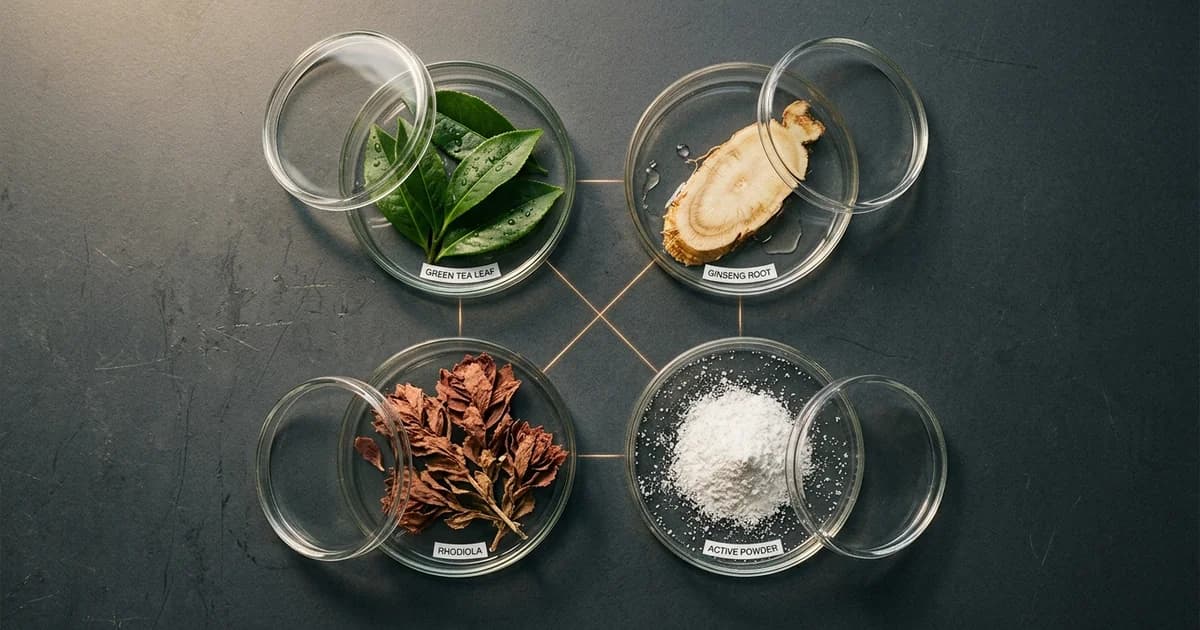
Roon's formula uses four compounds, caffeine, L-theanine, theacrine, and methylliberine, that operate through overlapping but distinct neurochemical pathways. Each one does something the others can't. Together, they produce a cognitive effect that none of them achieve solo. Here's what each ingredient actually does, what the science says, and why the combination matters more than any single compound.
Key Takeaways:
- Caffeine alone improves alertness but worsens inhibitory control and raises blood pressure; pairing it with L-theanine fixes both problems.
- Methylliberine (Dynamine) kicks in fast and improves mood and energy without spiking heart rate or blood pressure.
- Theacrine (TeaCrine) extends the duration of the effect and shows no tolerance buildup, even after 8 weeks of daily use.
- A 4-ingredient nootropic stack delivered sublingually hits faster and avoids the first-pass metabolism that degrades oral supplements.
1. Caffeine: The Foundation (That Isn't Enough on Its Own)
Caffeine is the most studied psychoactive compound on the planet. It works by blocking adenosine receptors, which reduces the "sleepy" signal your brain relies on to wind you down. The result: faster reaction times, higher alertness, and a temporary boost in sustained attention.
But caffeine has real limits. A systematic review published in Cureus found that caffeine alone actually worsened inhibitory control, shown by longer reaction times on stop-signal tasks (p = 0.031). That's the part of your brain responsible for not doing something impulsive. So caffeine makes you faster but less precise. It also raises blood pressure and cortisol, which is why high doses leave you wired but unable to think clearly.
The fix isn't to remove caffeine. It's to surround it with compounds that compensate for its weaknesses. Roon uses 80 mg of caffeine per pouch, roughly the amount in a small cup of coffee, enough to activate the adenosine-blocking effect without pushing you into jitter territory.
Typical dose: 50–200 mg. Roon uses 80 mg. Best for: Baseline alertness and reaction speed.
2. L-Theanine: The Compound That Makes Caffeine Smarter
L-theanine is an amino acid found naturally in tea leaves. On its own, it promotes alpha brain wave activity, the same pattern associated with calm, focused attention. But L-theanine's real value shows up when you pair it with caffeine. The two compounds together produce effects that neither achieves alone, a textbook example of complementary nootropic action.
That same systematic review in Cureus found that while caffeine and L-theanine each worsened inhibitory control individually, the combination improved it (p = 0.080). The combination also improved total cognition composite scores (p = 0.041) and signal detection in Go/NoGo tasks (p = 0.033). In plain terms: caffeine plus L-theanine made people both faster and more accurate, while each ingredient alone made them faster but sloppier.
A 2025 study on elite wrestlers confirmed this pattern under real-world stress. The caffeine-plus-L-theanine condition outperformed both placebo and single-supplement conditions on physical performance measures and cognitive performance under fatigue, including faster reaction times and higher accuracy.
Roon delivers 60 mg of L-theanine per pouch, paired directly with the 80 mg caffeine dose. This 4:3 caffeine-to-theanine ratio keeps the stimulation clean without sedating you.
Typical dose: 50–200 mg (commonly paired 1:1 or 2:1 with caffeine). Best for: Smoothing caffeine's edge; improving accuracy under pressure.
3. Methylliberine (Dynamine): The Fast-Acting Accelerator
Methylliberine is a purine alkaloid structurally related to caffeine, but with a faster onset and shorter half-life. Where caffeine takes 30–45 minutes to peak when swallowed as a pill, methylliberine hits quicker and clears sooner. Think of it as the compound that gets the stack moving while caffeine is still warming up.
A 2023 study published in Nutrients (MDPI) tested 100 mg of methylliberine in a double-blind crossover trial with 25 healthy adults. The results: methylliberine improved multiple indices of mood and affect, including energy and alertness, without raising heart rate or blood pressure. That last part matters. Caffeine reliably spikes both.
Where methylliberine really earns its place is in combination. A randomized crossover study on 50 male esports players tested caffeine alone (125 mg) against a combination of caffeine (125 mg), Dynamine (75 mg), and TeaCrine (50 mg). The combination improved cognitive performance and reaction time beyond what caffeine alone achieved, without negatively affecting mood. A separate double-blind trial with tactical personnel found that a caffeine-methylliberine-theacrine combination matched the vigilance reaction time benefits of double the caffeine dose (300 mg), but without the blood pressure spike.
Roon includes 25 mg of methylliberine (Dynamine) per pouch. That's a lower dose than the studies above, but it's paired with three other active compounds in a sublingual format designed for faster absorption.
Typical dose: 25–100 mg. Best for: Rapid onset energy and mood support; bridging the gap before caffeine peaks.
4. Theacrine (TeaCrine): The Ingredient That Keeps It Going
Theacrine is another purine alkaloid, this one with a longer half-life than caffeine and a unique property: it doesn't build tolerance. That's not marketing copy. An 8-week clinical trial published in the Journal of the International Society of Sports Nutrition gave 60 healthy adults up to 300 mg of theacrine daily and found no evidence of habituation. The participants' responses on day 56 were as strong as on day 1. Caffeine, by contrast, starts losing its punch within a week of consistent use.
A 2025 study on tactical personnel tested a caffeine-theacrine combination (150 mg caffeine + 150 mg theacrine) against caffeine alone (300 mg) and placebo. Both active conditions enhanced cognitive performance compared to placebo, but the caffeine-theacrine combination showed higher total accuracy on the Two-Back working memory task, a demanding test of how well you can hold and manipulate information in real time.
Theacrine also appears to extend caffeine's effective window. As a review in the Journal of the International Society of Sports Nutrition noted, theacrine has a longer onset of action (approximately 2 hours) and has been shown to support mood and cognitive function without adverse side effects or habituation. This staggered timing is what gives a well-designed nootropic stack its "long tail" of focus instead of a single peak followed by a crash.
Roon uses 5 mg of theacrine (from material standardized to 40% TeaCrine) per pouch. Combined with the other three compounds, it's the ingredient responsible for extending the duration of the cognitive effect.
Typical dose: 50–300 mg (lower doses effective in combination stacks). Best for: Sustained duration; preventing tolerance buildup.
5. The Fifth "Ingredient": Synergistic Nootropic Ingredients in a Sublingual Format
The four compounds above are effective because they target different mechanisms at different speeds. Caffeine blocks adenosine. L-theanine modulates glutamate and boosts alpha waves. Methylliberine hits fast and clears fast. Theacrine extends the curve and resists tolerance. But the delivery method matters almost as much as the ingredients themselves.
Most nootropic supplements come as capsules or powders that pass through your stomach and liver before reaching your bloodstream. This is called first-pass metabolism, and it degrades a portion of the active compounds before they ever reach your brain. Sublingual delivery bypasses this entirely. A 2025 review in Expert Opinion on Drug Delivery noted that sublingual nanofiber formulations demonstrated drug release of more than 85% within 15 minutes, with higher bioavailability than standard oral administration. The sublingual mucosa is thin, highly vascularized, and allows compounds to enter the bloodstream directly.
This is why the best nootropic stack ingredients aren't just about what you take. They're about how you take it. A sublingual pouch puts the active compounds directly against the oral mucosa, where absorption begins in minutes rather than the 30–60 minutes typical of capsules.
Quick Comparison: Roon's 4-Ingredient Stack vs. Common Alternatives
| Feature | Coffee | Caffeine Pill | Typical Nootropic Capsule | Roon Pouch |
|---|---|---|---|---|
| Caffeine | ~95 mg | 100–200 mg | Varies | 80 mg |
| L-Theanine | Trace | None | Sometimes included | 60 mg |
| Methylliberine | None | None | Rare | 25 mg (Dynamine) |
| Theacrine | None | None | Rare | 5 mg (TeaCrine) |
| Delivery | Oral (liquid) | Oral (swallowed) | Oral (swallowed) | Sublingual |
| Onset | 30–45 min | 30–60 min | 30–60 min | Minutes |
| Tolerance Buildup | Yes (within days) | Yes | Depends on formula | Designed to resist it |
| Jitters/Crash | Common at higher doses | Common | Depends on formula | Engineered out |
How to Get the Most Out of a Synergistic Nootropic Stack
Timing matters. Place a pouch between your lip and gum 15–20 minutes before you need to be locked in, whether that's a deep work block, a training session, or a competitive match. The sublingual format means absorption starts almost immediately, so you don't need to plan around a 45-minute lead time the way you would with a capsule.
Consistency also matters, but not in the way you'd expect. Because theacrine resists tolerance, you don't need to cycle this stack the way you would with caffeine alone. That said, keep your total daily caffeine intake under 400 mg from all sources. If you drink coffee in the morning and use a Roon pouch in the afternoon, you're still well within that range.
One more thing: don't stack a nootropic pouch on top of a poor foundation. Sleep, hydration, and nutrition do more for your cognitive baseline than any supplement. A good stack amplifies a good baseline. It doesn't replace one.
Why Roon Built the Stack This Way
Most focus products pick one lane. Caffeine pills give you speed. L-theanine supplements give you calm. Neither gives you both. And almost none of them include methylliberine or theacrine, the two compounds that extend the effect and prevent the tolerance curve that makes caffeine less useful over time.
Roon built a 4-ingredient nootropic stack specifically because these four compounds cover each other's gaps. Caffeine provides the foundation. L-theanine sharpens it. Methylliberine accelerates the onset. Theacrine extends the duration. And sublingual delivery gets the whole formula into your system faster than any pill or powder.
Internal testing showed an 11.5% improvement in reaction time and complete elimination of attention lapses, which tracks with the published research on these ingredients in combination. If you've been relying on caffeine alone and wondering why it stops working, the answer isn't more caffeine. It's a better stack.
Ready to feel the difference a real nootropic stack makes? Give Roon a try.