The Neuroscience of Motivation: How Dopamine Powers Drive
Roon Team
The Neuroscience of Motivation: How Dopamine Powers Drive and Focus
You already know the feeling. Two tasks sit in front of you. One feels effortless, almost magnetic. The other feels like dragging a couch up a flight of stairs. The work hasn't changed. Your brain chemistry has.
The relationship between dopamine and motivation is the reason. Dopamine is the molecule that decides whether a goal feels worth the effort it takes to chase it. It doesn't make you happy. It makes you go.
For decades, people called dopamine the "pleasure chemical." That label was wrong, and the science that corrected it explains a lot about why some days you grind and other days you scroll.
Key Takeaways
- Dopamine drives the willingness to work, not the pleasure of the reward itself.
- The mesolimbic dopamine pathway, running from the midbrain to the nucleus accumbens, is the core circuit behind effort and drive.
- Low dopamine doesn't kill desire for a reward; it makes you unwilling to pay the effort cost to get it.
- Caffeine raises dopamine efficiency indirectly, by blocking adenosine, the molecule that puts the brakes on the system.
How Dopamine Affects Motivation: It's About Effort, Not Pleasure
Dopamine controls how hard you're willing to work for something, not how good that something feels once you get it. This is the single most important correction in motivation neuroscience over the last 30 years.
The old story said dopamine spiked when you experienced a reward. Then Kent Berridge ran experiments that broke that idea. His lab showed the mesolimbic dopamine system tracks "wanting" rather than "liking." Dopamine-deprived rats still appear to enjoy the same substances, and raised dopamine levels do not appear to increase liking. The pleasure stayed intact. The drive to pursue it did not.
So what does dopamine actually do? It assigns value to a goal and fuels the push toward it.
Researcher John Salamone spent years mapping this with effort-based choice tasks. The setup is simple. A rat can press a lever many times for a preferred food, or eat a freely available but less appealing food with no work. Low and high doses of a dopamine blocking agent had effects on lever pressing for intravenous amphetamine reward which resembled the effects of reward reduction and reward termination, respectively.
When you lower dopamine, the animal doesn't lose its appetite. It loses its willingness to work. It takes the easy, low-value option. The reward still matters. Paying for it no longer does.
Mesolimbic Dopamine: The Circuit Behind Drive
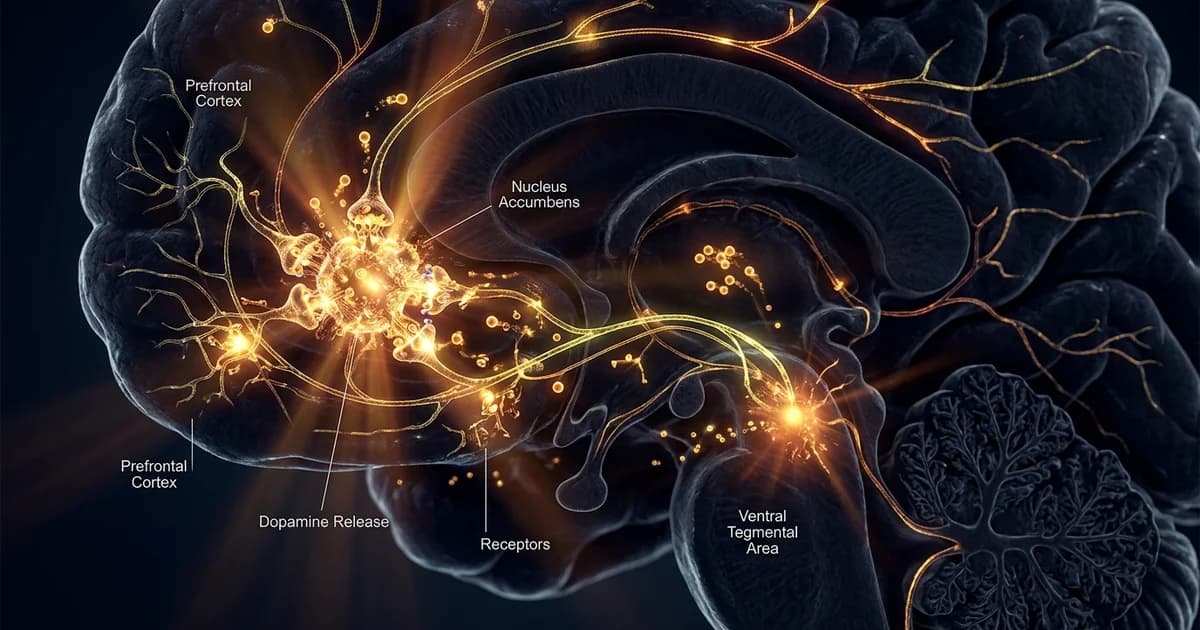
The mesolimbic dopamine pathway is the main engine of motivated behavior. It starts in the ventral tegmental area (VTA) in the midbrain and projects to the nucleus accumbens in the ventral striatum.
Think of the VTA as the ignition. The ventral tegmental area is a midbrain region known for the involvement of its dopaminergic neurons in encoding reward-related features, value and motivational states. When your brain anticipates a worthwhile outcome, VTA neurons fire and flood the accumbens with dopamine. That release is the physical basis of "I want to do this."
The nucleus accumbens then translates that signal into action. Decades of work point to this region as central to effort allocation. Considerable evidence indicates that nucleus accumbens DA, along with other transmitters and structures, participates in the neural circuitry that regulates effort-based choice behavior.
Dopamine also reaches the prefrontal cortex, the part of the brain that holds a goal in mind and filters distraction. That projection is where motivation and focus overlap. A goal you're motivated to pursue is a goal your attention keeps returning to.
Dopamine Drive and Effort-Based Decision Making
Every choice you make is a quiet cost-benefit calculation, and dopamine sets the exchange rate. This is the heart of effort based decision making.
Your brain constantly asks one question: is the payoff worth the energy? Dopamine drive tilts the answer. High signaling makes effort feel cheap and rewards feel close. Low signaling makes the same effort feel expensive, so you default to whatever is easiest right now.
Studies have separated this into physical and cognitive effort. Dopamine antagonism decreases willingness to expend physical, but not cognitive, effort. Dopamine is especially tied to the activational side of motivation, the raw vigor that gets you moving and keeps you going.
This reframes a problem most people misdiagnose. When you can't start a task, you usually call it laziness or a lack of discipline. More often, it's a temporary shortfall in the system that prices effort. The reward looks fine on paper. Your brain just isn't valuing the work to reach it.
The Dopamine Focus Science: Where Drive Becomes Attention
Motivation and attention share hardware, which is why dopamine focus science keeps pointing back to the same circuits. When dopamine assigns high value to a goal, the prefrontal cortex stays locked on it. That is what focus feels like from the inside.
Lose the dopamine signal and attention scatters. The goal stops feeling urgent, so the brain stops protecting it from distraction. You open a new tab without deciding to.
This is also why stimulants that touch the dopamine system affect concentration so directly. Anything that supports healthy dopamine signaling tends to support sustained attention, because the two run on the same wiring.
How Caffeine Fits Into the Dopamine System
Caffeine doesn't pour dopamine into your brain. It removes a brake on the dopamine you already have.
That brake is adenosine. Through the day, adenosine builds up and binds to its receptors, which dampens dopamine activity and produces the heavy feeling of mental fatigue. Adenosine binds to adenosine receptors and inhibits dopamine activity.
Caffeine is shaped enough like adenosine to sit in those receptors without activating them. Caffeine acts as an antagonist where it blocks adenosine binding to adenosine receptors, enhancing dopamine activity. Lift the brake and the dopamine system runs more freely.
There is real overlap between these receptor systems. Research on fatigue resistance describes how adenosine A2A and dopamine D2 receptor interaction controls fatigue resistance. The two are physically coupled, which is why a molecule acting on one changes the output of the other.
The behavioral result is well documented. A 2020 meta-analysis summarized by Coffee and Health found that caffeine intake was associated with improvements in a variety of test situations, including decreased response times and increased accuracy.
The Problem With Caffeine Alone
Caffeine has a cost. Block adenosine too aggressively and you get the jittery, wired edge that makes focus harder, not easier. Then adenosine floods back as the caffeine clears, and you crash.
This is where pairing caffeine with L-theanine matters. L-theanine is an amino acid from tea that smooths the stimulation without dulling the alertness. A high-dose combination study published in the British Journal of Nutrition found the pairing improved measures of selective attention even in sleep-deprived adults.
If you want the deeper breakdown, see our guides on how caffeine and L-theanine work together and why the caffeine crash happens.
Caffeine vs. Common Focus Inputs: A Dopamine-System View
Not every focus input touches the dopamine circuit the same way. Here's how common options compare on the mechanism that matters for drive.
| Input | Primary mechanism | Onset | Crash risk | Effect on dopamine drive |
|---|---|---|---|---|
| Plain coffee | Blocks adenosine | 30–45 min | Moderate to high | Indirect lift, often uneven |
| Energy drinks | Caffeine + sugar | 15–30 min | High (sugar drop) | Lift then sharp fall |
| Caffeine + L-theanine | Adenosine block, smoothed | 20–40 min | Low | Steadier lift, less jitter |
| Sublingual pouch (e.g., Roon) | Caffeine + L-theanine + methylliberine + theacrine, absorbed under the tongue | 5–10 min | Low | Fast, sustained lift |
The differences come down to two things: how fast the input reaches the system, and how cleanly it leaves.
What This Means for Your Actual Workday
You can't will yourself into high dopamine. But you can stop fighting your own biology.
Protect sleep, because adenosine pressure resets overnight and a tired brain prices effort higher. Break large goals into smaller wins, since each completed step delivers a real signal that keeps the system engaged. And time your stimulants so the lift lands when the work does, not two hours later when motivation has already drained.
Small structural changes beat motivation hacks. The circuit responds to inputs, not pep talks.
Conclusion
Motivation isn't a personality trait. It's a measurable signal in a specific circuit, and dopamine is the currency that circuit runs on.
The science settled an old myth. Dopamine doesn't deliver pleasure. It funds the pursuit, setting the price your brain charges for effort and deciding whether a goal feels worth chasing. When the signal is strong, work feels light and attention holds. When it dips, the same task turns into that couch on the stairs.
Caffeine works on this system by lifting the adenosine brake, which lets your existing dopamine do more. The catch is doing that without the jitters and crash that pull the signal right back down.
Frequently Asked Questions
Is dopamine the "pleasure chemical"?
No. That label is outdated. Dopamine mainly drives "wanting," the motivation to pursue a goal, rather than "liking," the pleasure of getting it. Research separating the two found that lowering dopamine reduces the drive to work for a reward while leaving the enjoyment of that reward largely intact. Dopamine sets your willingness to spend effort, not the size of the payoff you feel.
How does dopamine affect motivation day to day?
Dopamine prices effort. When signaling is strong, tasks feel approachable and your attention stays on the goal. When it dips, the same task feels expensive, so you default to the easiest available option. This is why motivation can swing even when the work, the deadline, and the reward have not changed at all.
What is the mesolimbic dopamine pathway?
It's the brain's main motivation circuit. It runs from the ventral tegmental area in the midbrain to the nucleus accumbens, with a branch to the prefrontal cortex. The ventral tegmental area releases dopamine when a worthwhile outcome is anticipated, and the nucleus accumbens turns that signal into the push to act.
Does caffeine increase dopamine?
Indirectly. Caffeine blocks adenosine, the molecule that dampens dopamine activity as fatigue builds. By occupying adenosine receptors without activating them, caffeine lets your existing dopamine signaling run more freely. The result is improved alertness and faster reaction times, though the effect is a release of the brake rather than a flood of new dopamine.
Why do I crash after coffee?
Adenosine doesn't disappear while caffeine blocks its receptors. It keeps accumulating. When the caffeine clears, that backed-up adenosine binds all at once, which dampens dopamine activity and produces the sudden fatigue you feel as a crash. Pairing caffeine with L-theanine and using slower-clearing compounds can soften that drop.
Can I raise dopamine naturally?
You can support healthy signaling. Consistent sleep lowers adenosine pressure, regular exercise supports dopamine function, and breaking goals into smaller completed steps keeps the circuit engaged. These habits won't spike dopamine like a drug, but they keep the system working the way it's built to.
When Drive Runs on Dopamine, Protect the Signal
This article makes one argument: motivation is a dopamine signal, and effort feels cheap or expensive depending on how freely that signal runs. Caffeine helps by lifting the adenosine brake. The trouble is that caffeine alone often brings jitters and a crash that pull the signal back down within hours.
Roon is built for that exact gap. It's a zero-nicotine sublingual pouch with a four-ingredient stack: 80 mg caffeine, 60 mg L-theanine, 25 mg methylliberine (Dynamine), and 5 mg theacrine (TeaCrine). Because it absorbs under the tongue, it reaches the system in 5 to 10 minutes and supports 6 to 8 hours of steady focus with no jitters, no crash, and no tolerance buildup.
Roon isn't a replacement for sleep, food, or the work itself. Nothing prices effort lower than a goal you actually care about. But on the days your circuit needs a clean lift to match the task in front of you, try Roon and keep the signal steady while you work.
Written by Roon Team