How Much Caffeine Is in Yerba Mate? Cup, Gourd, Can
Roon Team
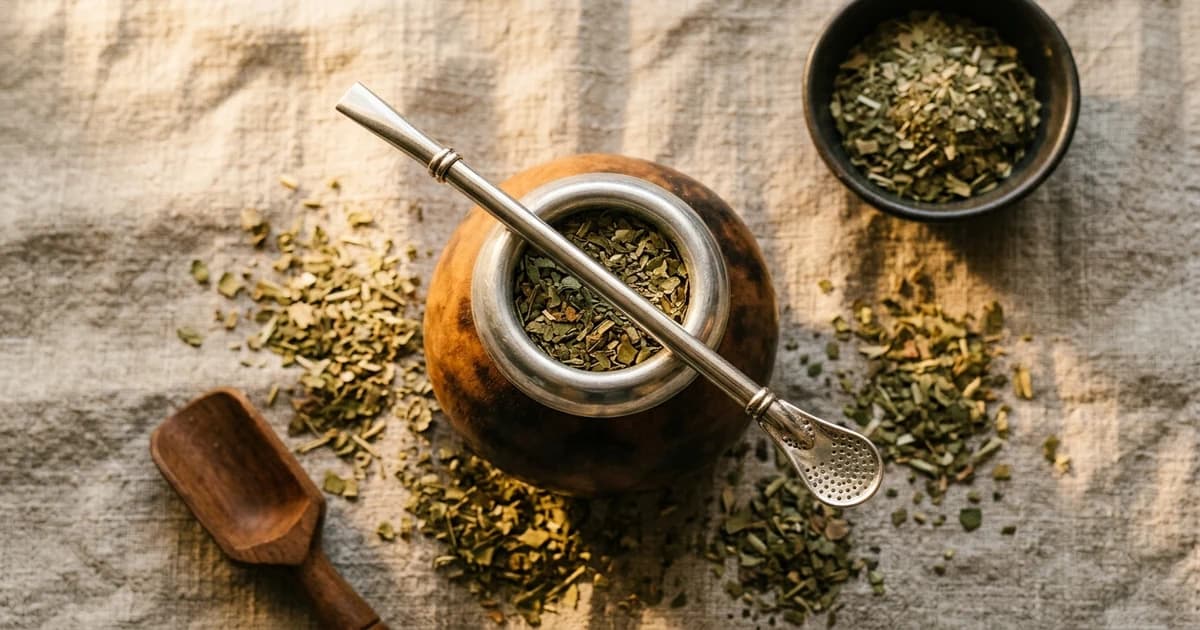
How Much Caffeine Is in Yerba Mate? Cup, Gourd, Can
Yerba mate caffeine content depends on grams of leaf, not on the plant itself. A mate tea bag holds about 30 mg of caffeine. An 8 oz cup brewed from a tablespoon of loose leaf lands near coffee territory. A traditional gourd session with 25 g of leaf delivers 172 to 342 mg. And a 15.5 oz Yerba Madre (formerly Guayakí) can is 150 mg. The range is enormous because you control how much leaf goes in and how much water passes through it.
Yerba Mate Caffeine Content by Format
Every number below ties to a specific format and serving size. If someone tells you "mate has 85 mg," ask them: bag, cup, or gourd?
| Format | Serving size | Caffeine (mg) | Source |
|---|---|---|---|
| Yerba Madre mate bag | 1 bag, 5-10 min steep | ~30 | Yerba Madre |
| ECOTEAS mate bag | 1 bag | ~25 | ECOTEAS |
| Loose-leaf cup (1 tbsp / ~5 g) | 8 oz | ~50-70 | Estimated from per-gram data |
| Traditional gourd (25 g leaf) | Multiple pours | 172-342 | Panzl et al. 2022 |
| Yerba Madre 12 oz sparkling | 12 fl oz | 115 | Yerba Madre |
| Yerba Madre 15.5 oz still | 15.5 fl oz | 150 | Yerba Madre |
| CLEAN Cause sparkling | 16 fl oz | 160 | CLEAN Cause |
| Yerbaé | 12 fl oz / 16 fl oz | 100 / 160 | Yerbaé |
| Brewed coffee | 8 fl oz | ~95 | USDA via Roon |
| Roon pouch | 1 pouch | 80 | Roon |
A single can of mate holds about as much caffeine as five tea bags. A gourd session can hold as much as three and a half cups of coffee. These are not rounding differences.
Why the Numbers Disagree: the Per-Gram Fact
Every conflicting figure on the internet traces back to one variable: how many grams of leaf went into the water.
A 2022 study in Applied Food Research (Panzl et al.) analyzed 26 commercial yerba mate samples from 17 brands across Uruguay, Argentina, and Brazil using UHPLC. The caffeine per gram of dry leaf broke down like this:
- Green mate: 7.4 to 13.7 mg/g
- Aged mate: 7.6 to 13.5 mg/g
- Mate with herbs: 9.1 to 11.8 mg/g
- Roasted mate: 5.7 mg/g
A tea bag with 3 g of leaf at 10 mg/g gives you 30 mg. A gourd packed with 25 g of the same leaf gives you 250 mg. Same plant, same brand, 8x the dose. The plant does not change. You do.
How Much Caffeine Is in a Cup of Yerba Mate
Tea bags are the simplest case. Yerba Madre's mate bags contain about 30 mg of caffeine per bag when steeped 5 to 10 minutes. ECOTEAS lists 25 mg per bag. Both use roughly 2.5 to 3 g of leaf, so the per-gram math checks out: 3 g times 10 mg/g equals 30 mg.
Loose-leaf cups run higher because you use more leaf. A level tablespoon of yerba mate weighs about 5 g. At the same 10 mg/g midpoint, that is 50 mg. Use a heaping tablespoon (7 to 8 g) and you approach coffee's 95 mg per 8 oz. Steep time, water temperature, and leaf grind all shift extraction, but grams of leaf is the biggest lever.
How Much Caffeine Is in a Gourd of Mate
The traditional method is a different animal. You pack 30 to 50 g of leaf into a gourd, insert a bombilla (metal filter straw), and pour small amounts of hot water over the leaf repeatedly, drinking each pour before adding more.
Panzl et al. estimated that a 25 g serving delivers 172 to 342 mg of caffeine across the session, depending on the product. That is one to two cups of strong coffee, consumed in sips over 30 to 90 minutes.
The first pours carry the most caffeine. Later refills extract progressively less as the soluble compounds wash out. This is why the gourd gets "washed" (lavado) and eventually tastes flat.
One wrinkle: tereré, the cold-water version popular in Paraguay, may extract even more. A 2010 study by Meinhart et al. found that tereré preparation yielded xanthine levels 2.5 times higher than hot chimarrão from coarse-ground mate. The authors attributed this to the longer total contact time in tereré preparation, though the extraction mechanism may involve multiple factors.
How Much Caffeine Is in a Yerba Mate Can
Canned mate is standardized, so these numbers are reliable.
Yerba Madre (formerly Guayakí) rebranded in May 2025. The 15.5 oz still cans carry 150 mg of caffeine alongside roughly 120 calories and 28 g of sugar (Enlighten Mint). The 12 oz sparkling line lists 115 mg per can on the current label. Compared to energy drinks like Celsius, a mate can delivers less caffeine per ounce but more sugar (unless you pick a zero-sugar brand).
CLEAN Cause 16 oz sparkling cans contain 160 mg of caffeine and 70 calories. Yerbaé offers a zero-sugar option: 100 mg in the 12 oz can and 160 mg in the 16 oz.
A single 15.5 oz can is roughly five tea bags' worth of caffeine. That reframing alone makes the label more useful than the number.
Yerba Mate vs Coffee Caffeine
An 8 oz cup of brewed coffee contains about 95 mg of caffeine. Here is how mate stacks up by format:
| Format | Caffeine (mg) | vs 8 oz coffee |
|---|---|---|
| Mate tea bag | 25-30 | About 1/3 |
| Loose-leaf cup (5 g) | ~50-70 | About 1/2 to 3/4 |
| Loose-leaf cup (8 g) | ~80-110 | Roughly equal |
| Gourd session (25 g) | 172-342 | 1.8x to 3.6x |
| 15.5 oz can | 150 | 1.6x |
Mate also contains theobromine, about 2.2 to 2.5 mg per gram of leaf in Panzl's samples. Sellers often describe the combination as producing "smoother" energy than coffee. That is their marketing language, not a clinical conclusion. For a broader look at coffee alternatives, including mate, the comparison is worth reading.
How Long the Caffeine Lasts and How Much Is Too Much
Caffeine from any source, mate included, reaches peak blood levels in 30 to 120 minutes (EFSA, 2015). Its plasma half-life ranges from about 2 to 8 hours in adults, meaning half the dose is still circulating hours later. For a deeper look at how long caffeine stays in your system, we wrote a full breakdown.
The FDA's guidance sets 400 mg per day as the amount not generally associated with negative effects for most healthy adults. One traditional gourd session at the high end (342 mg) consumes 85% of that ceiling before you count anything else, including any afternoon energy drink or 5-Hour Energy shot.
If you drink mate from a gourd, treat it the way you would a triple espresso: budget it against the rest of your day.
Reading Yerba Mate Caffeine Correctly
The reason every website gives you a different number is that "yerba mate" is not one drink. It is a leaf. The caffeine lives in the leaf at 7 to 14 mg per gram, and the dose you actually consume is a function of how many grams you steep and how much water passes through them. A tea bag is a mild cup of tea. A gourd is a very strong coffee session. A can is whatever the brand decided to standardize. Know the format, know the grams, and the number stops being confusing.
Frequently Asked Questions
How much caffeine is in yerba mate compared to coffee?
It depends on how you prepare the mate. A tea bag (25 to 30 mg) has about a third of the caffeine in an 8 oz coffee (~95 mg). A traditional gourd session with 25 g of leaf delivers 172 to 342 mg, which is nearly double to triple a standard cup of coffee.
Does yerba mate have more caffeine than green tea?
Yes, gram for gram. Yerba mate leaf contains 7 to 14 mg of caffeine per gram (Panzl et al. 2022), while green tea leaf typically contains 2 to 4 mg per gram (Komes et al. 2010). Even a single mate tea bag (25 to 30 mg) outpaces most green tea and matcha servings at comparable weights.
How much caffeine is in a Yerba Madre (Guayakí) can?
The 15.5 oz still can has 150 mg. The 12 oz sparkling can has 115 mg per the current label. Guayakí rebranded as Yerba Madre in May 2025.
How much caffeine is in a yerba mate tea bag?
About 25 to 30 mg. Yerba Madre states approximately 30 mg per bag steeped 5 to 10 minutes. ECOTEAS lists 25 mg. Both contain roughly 3 g of leaf.
Does the caffeine in yerba mate feel different from coffee?
Some drinkers report a less jittery experience. Mate sellers attribute this to the presence of theobromine (~2.2 to 2.5 mg/g of leaf) alongside caffeine. That is a common claim in the category, not a clinically established difference. For a review of what the health research actually shows, see our dedicated post.
Is yerba mate a good coffee replacement for the afternoon?
A tea bag (25 to 30 mg) is a reasonable afternoon option given caffeine's 2 to 8 hour half-life. A gourd session (172 to 342 mg) is not, for the same reason a triple espresso at 3 PM is not. Stick to formats with lower total leaf if you plan to sleep before midnight.
When You Want the 80 mg Without the Gourd
The core tension with mate is variance. The same plant hands you 30 mg from a bag and 342 mg from a gourd, and your only feedback is whether you can fall asleep that night. If what you want is a fixed, repeatable caffeine dose without boiling water, a thermos, or 28 g of sugar in a can, that is what Roon was built for.
Each Roon pouch delivers 80 mg of caffeine, roughly the same as a strong loose-leaf cup, combined with 60 mg L-theanine, 25 mg methylliberine (Dynamine), and 5 mg theacrine (TeaCrine). The methylliberine matters for duration: in a randomized, double-blind, crossover PK study (n=12), co-administration of methylliberine with caffeine extended caffeine's half-life from 7.2 to 15 hours with no increase in peak concentration. That study used 100 mg methylliberine and 150 mg caffeine, roughly 4x and 1.9x what Roon contains, so the effect at Roon's dose is directionally the same but not identical to the published numbers. The felt window is 6 to 8 hours, with onset in 5 to 10 minutes. Because the half-life extends, stop at least 8 hours before bed.
Pricing starts at $9.16 per tin on a 12-tin subscription ($0.61 per pouch), or $15.00 per tin one-time (4-tin minimum, $1.00 per pouch). Zero sugar, zero nicotine, zero guesswork on dose. Roon is not mate and does not replace what you like about the ritual. But if the ritual is not the point and the milligrams are, try Roon.
Related from Roon
- How Much Caffeine Is in a Cup of Coffee?
- Health Benefits of Yerba Mate Tea
- Best Coffee Alternatives Beyond Matcha
- How Long Does Caffeine Stay in Your System?
Written by Roon Team