L-Theanine with Caffeine: The Perfect Nootropic Stack
Roon Team
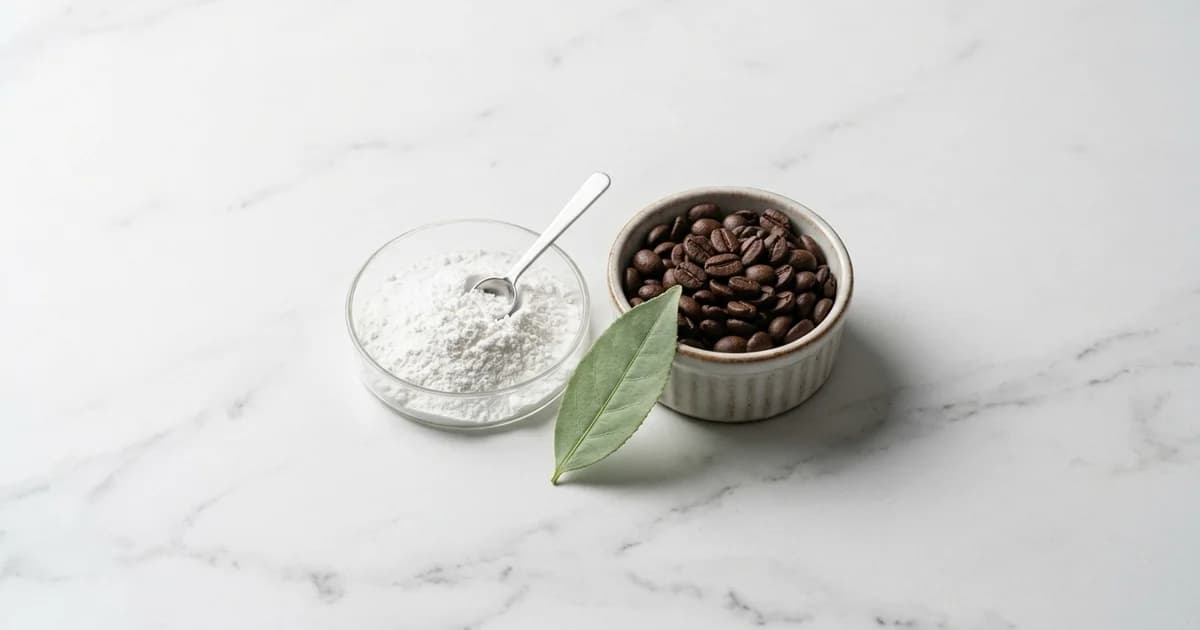
L-Theanine with Caffeine: The Perfect Nootropic Stack
Caffeine makes you alert. It also makes you anxious, jittery, and prone to a 2 p.m. crash that sends you crawling back to the coffee machine. But what if there were a way to keep the focus and ditch the side effects? That's the premise behind combining l theanine with caffeine, a two-ingredient nootropic stack that researchers have been studying for over a decade and that the internet (Reddit especially) won't stop talking about.
The science is surprisingly clear on this one. And the best part: you don't need a prescription, a fancy protocol, or a degree in biochemistry to use l theanine with caffeine.
Key Takeaways
- L theanine with caffeine together improve attention, reaction time, and task-switching accuracy better than either compound alone.
- The optimal l theanine with caffeine ratio is 2:1 (e.g., 200 mg L-theanine to 100 mg caffeine), though lower doses also show strong effects.
- L-theanine smooths out caffeine's rough edges by promoting alpha brain wave activity and raising GABA, serotonin, and dopamine levels.
- A 2025 study in the British Journal of Nutrition found l theanine with caffeine improved selective attention even in sleep-deprived adults.
What L-Theanine Actually Does to Your Brain
L-theanine (γ-glutamylethylamide) is a non-protein amino acid found in tea leaves (Camellia sinensis), and it's the amino acid found in tea leaves behind the calm focus that sets tea apart from coffee. It crosses the blood-brain barrier within about 30 minutes of ingestion and gets to work on several neurotransmitter systems at once.
According to Psychology Today, L-theanine elevates levels of GABA, serotonin, and dopamine, three neurotransmitters that regulate mood, concentration, and emotional balance. That's why tea drinkers often describe a calm alertness that coffee alone doesn't deliver.
There's also the alpha wave effect. A study published in Brain Topography found that a 250 mg dose of L-theanine influenced alpha-band oscillatory brain activity (the 8–14 Hz range associated with relaxed focus) during attention tasks. Alpha waves are the brain's "flow state" frequency. More alpha activity means you're focused without being tense.
This is the key distinction. Caffeine is a stimulant. L-theanine is not a sedative. It's a modulator. It doesn't slow you down. It smooths you out.
What Happens When You Combine L Theanine with Caffeine
Here's where things get interesting. Each compound is useful on its own. Together, they produce effects that neither achieves alone.
The Attention-Switching Study
A 2010 study published in Nutritional Neuroscience tested 97 mg of L-theanine combined with 40 mg of caffeine against a placebo in 44 young adults. The l theanine with caffeine combination improved accuracy during task switching (P < 0.01), increased self-reported alertness (P < 0.01), and reduced tiredness (P < 0.05). Neither compound alone at those doses produced the same results.
Think about what task switching actually means in your daily life. It's toggling between Slack and a spreadsheet. It's jumping from a meeting back into deep work. It's the cognitive cost of context switching, which most knowledge workers do dozens of times per day. L theanine with caffeine directly targets that weakness.
The Memory and Focus Study
Owen et al. (2008) compared 50 mg caffeine alone to 50 mg caffeine plus 100 mg L-theanine in 27 healthy volunteers. The l theanine with caffeine combination improved both speed and accuracy on an attention-switching task at 60 minutes post-dose and reduced susceptibility to distracting information in a memory task at both 60 and 90 minutes.
Read that again: reduced susceptibility to distracting information. In a world of push notifications and open-plan offices, that's not a trivial benefit.
The 2025 Sleep Deprivation Study
The most recent evidence is a 2025 study published in the British Journal of Nutrition, a double-blind, placebo-controlled crossover trial in 37 sleep-deprived young adults. The researchers used a higher dose: 200 mg L-theanine with 160 mg caffeine. L theanine with caffeine improved hit rate (P = 0.02) and target-distractor discriminability (P = 0.047) on a driving hazard perception task. Reaction time improvements were also stronger for the combo group compared to placebo.
As the lead researcher told PsyPost: "Our results suggest that a high dose of L-theanine (200 mg) combined with caffeine (160 mg) can enhance attention when a person is acutely sleep-deprived."
This matters because most people don't use nootropics when they're well-rested and operating at peak capacity. They use them on the days they need them most.
The Optimal L Theanine with Caffeine Ratio
If you search "l theanine with caffeine ratio" on Reddit or any nootropics forum, you'll see the same number repeated over and over: 2:1.
That means 2 parts L-theanine to 1 part caffeine. According to Legion Athletics, most studies showing benefits use a ratio between 1:1 and 2:1. A common starting point is 200 mg L-theanine paired with 100 mg caffeine.
Here's a quick reference:
| Caffeine Dose | L-Theanine (1:1) | L-Theanine (2:1) |
|---|---|---|
| 40 mg | 40 mg | 80 mg |
| 100 mg | 100 mg | 200 mg |
| 160 mg | 160 mg | 320 mg |
The 2:1 ratio isn't a rigid rule. The Giesbrecht et al. study used roughly a 2.4:1 ratio (97 mg L-theanine to 40 mg caffeine) and still found strong effects. The Owen et al. study used exactly 2:1 (100 mg to 50 mg). Both worked. We collect the rest of that ratio research in our broader guide to how l-theanine pairs with caffeine.
The principle is simple: use at least as much L-theanine as caffeine, and ideally twice as much. This gives L-theanine enough room to counterbalance caffeine's stimulatory effects while preserving the alertness and focus benefits.
What Reddit Users Actually Report About L Theanine with Caffeine
The l theanine with caffeine Reddit community is one of the more evidence-grounded corners of the nootropics world. Most users describe the combination as producing "calm focus" or "clean energy," terms that align with what the clinical data shows.
Common themes across Reddit threads:
- Reduced jitters compared to caffeine alone
- Smoother energy curve without a hard crash
- Better ability to concentrate on single tasks for extended periods
- L-theanine reducing anxiety during high-pressure work (presentations, deadlines, exams)
The typical recommended starting dose mirrors the research: 100 mg caffeine with 200 mg L-theanine. Some users go lower, especially if they're caffeine-sensitive. The consensus is to start at the 2:1 ratio and adjust from there.
Why L Theanine with Caffeine Works: The Neuroscience
Caffeine blocks adenosine receptors. Adenosine is the molecule that accumulates throughout the day and makes you feel sleepy. By blocking it, caffeine keeps you alert. But it also raises cortisol and adrenaline, which is where the jitters and anxiety come from.
L-theanine works on a different set of pathways. It boosts GABA (the brain's primary inhibitory neurotransmitter), raises serotonin and dopamine, and promotes alpha wave activity. These effects counteract caffeine's tendency to push you into an overstimulated state.
The result is a neurochemical balance: caffeine provides the drive, L-theanine provides the control. You get arousal without agitation. Focus without tunnel vision.
A 2025 study in the Journal of the International Society of Sports Nutrition put it directly: L-theanine's calming, nootropic effects may work with caffeine's stimulatory benefits, "enhancing cognitive performance while mitigating side effects such as jitters or anxiety."
L Theanine with Caffeine vs. Coffee Alone
Coffee is fine. Nobody's arguing you should stop drinking it. But coffee delivers caffeine in a blunt, uncontrolled way. A standard cup contains roughly 95 mg of caffeine with minimal L-theanine (green tea has some, but not enough to hit the 2:1 ratio at typical serving sizes).
Here's how the two approaches compare:
| Factor | Coffee Alone | L Theanine with Caffeine Stack |
|---|---|---|
| Onset | 15–45 min | 15–30 min |
| Peak alertness | Sharp spike | Smooth rise |
| Jitters/anxiety | Common at higher doses | Reduced or absent |
| Crash | Often within 3–4 hours | Minimal to none |
| Focus quality | Scattered energy | Directed attention |
| Dose control | Variable by brew | Precise and repeatable |
The stack doesn't replace coffee for people who love the ritual. It replaces the strategy of relying on caffeine alone for cognitive performance.
How to Build Your Own L Theanine with Caffeine Stack
You have a few options:
- Capsules: Buy L-theanine and caffeine separately. This gives you full control over the ratio. Start with 100 mg caffeine and 200 mg L-theanine.
- Pre-made supplements: Several products combine both ingredients in a single capsule or pouch, often with additional nootropic compounds.
- Green tea + supplemental L-theanine: A cup of green tea provides roughly 25–50 mg of caffeine and 20–30 mg of L-theanine. You'd need supplemental L-theanine to hit the 2:1 ratio.
The delivery method matters too. Sublingual pouch delivery format bypasses the digestive system and delivers compounds to the bloodstream faster than capsules. This means quicker onset and more predictable timing.
Beyond the L Theanine with Caffeine Stack
L theanine with caffeine forms the foundation. But the best nootropic stacks build on that foundation with complementary compounds.
Theacrine (found in kucha tea) acts on similar pathways as caffeine but without the tolerance buildup. A study on PubMed found that a combination of caffeine, theacrine, and methylliberine improved cognitive performance and reaction time in esports athletes without increasing self-reported anxiety or headaches.
That's the direction nootropic science is heading: not single ingredients, but carefully designed stacks where each compound addresses a specific limitation of the others.
Get Your L Theanine with Caffeine the Easy Way
You now know the research. L theanine with caffeine together outperform caffeine alone on nearly every measure of cognitive performance, from attention switching to memory recall to reaction time under fatigue.
The question is how you want to get it.
Roon is a zero-nicotine sublingual pouch that contains L-theanine, caffeine (80 mg), theacrine, and methylliberine in a single, precisely dosed format. It absorbs under the tongue for fast onset, lasts 6–8 hours without a crash, and doesn't build tolerance the way caffeine alone does.
No brewing. No capsule timing. No guessing your ratio. Just l theanine with caffeine, delivered the way the science says it works best.