Does Tiramisu Have Caffeine? How Much Is in a Slice
Roon Team
Does Tiramisu Have Caffeine? How Much Is in a Slice
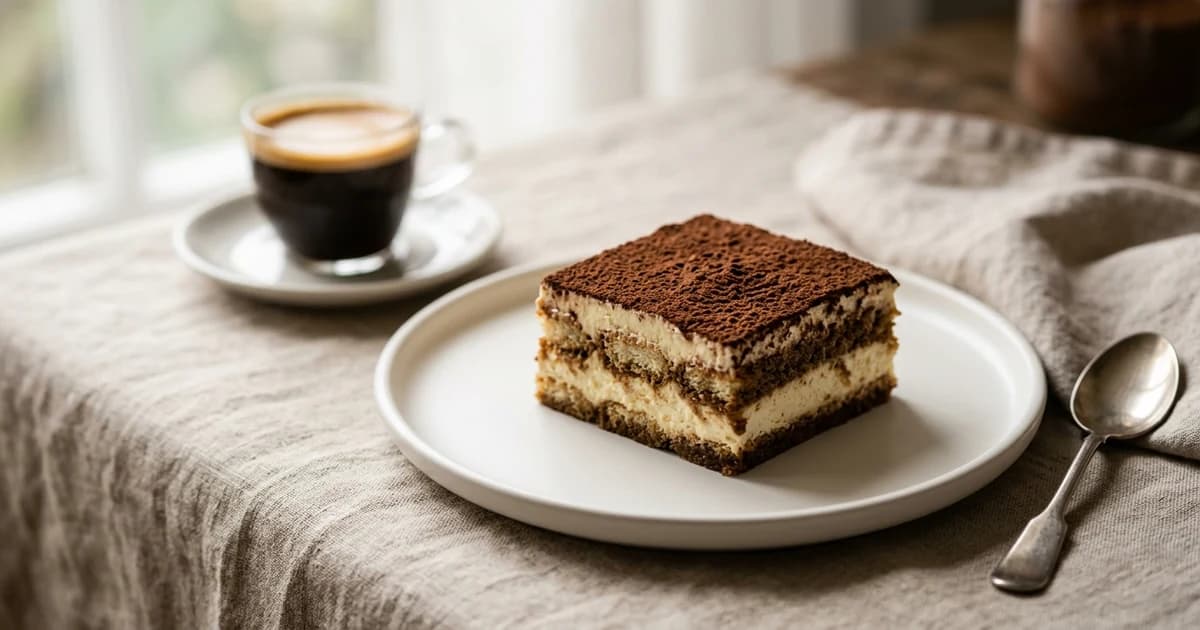
Yes. Tiramisu has caffeine because the ladyfingers are soaked in espresso or strong coffee and the top is dusted with cocoa powder. USDA FoodData Central lists tiramisu at 34 mg of caffeine per 100 g (checked 2026-09-19), which puts a typical 3 to 6 oz slice at roughly 30 to 60 mg, about a third to two-thirds of an 8 oz cup of coffee.
The exact number depends on the recipe and your slice size. Below: the arithmetic, the ingredient breakdown, and what it means for sleep, pregnancy, and kids.
How Much Caffeine Is in a Slice of Tiramisu?
A single USDA figure, 34 mg per 100 g, does all the work. Multiply by your slice weight.
| Slice size | Weight | Approximate caffeine (arithmetic from USDA 34 mg/100 g) |
|---|---|---|
| Small square | 1 oz (28 g) | ~10 mg |
| Modest slice | 3 oz (85 g) | ~29 mg |
| Standard slice | 4 oz (113 g) | ~38 mg |
| Generous portion | 150 g (~5.3 oz) | ~51 mg |
| Large restaurant slice | 175 g (~6.2 oz) | ~60 mg |
| Very large serving | 200 g (~7 oz) | ~68 mg |
Restaurant portions tend to run large. If you are not weighing the slice, assume the higher end of the range. A 4 oz piece is a reasonable middle estimate at about 38 mg.
Where the Caffeine in Tiramisu Comes From
Two ingredients carry virtually all of it: the espresso soak and the cocoa dusting. Mascarpone, eggs, sugar, and ladyfingers contribute zero.
| Ingredient | Caffeine (USDA) | Source |
|---|---|---|
| Espresso, 1 fl oz shot | ~63 mg | USDA FDC 171891 |
| Brewed coffee, 8 fl oz | ~95 mg | USDA FDC 171890 |
| Natural unsweetened cocoa, 1 tbsp | ~12 mg | USDA FDC 169593 |
| Dutch-process cocoa, 1 tbsp | ~4 mg | USDA FDC 169594 |
| Decaf espresso, 1 fl oz | ~0.3 mg | USDA FDC 174125 |
The espresso soak accounts for the vast majority. A classic recipe calls for two to four shots of espresso (roughly 126 to 252 mg total), split across six to eight servings. The cocoa dusting adds another few milligrams per slice, more if you use natural unsweetened cocoa versus Dutch-process.
One caveat: ladyfingers do not absorb every drop of coffee in the pan, so recipe math gives you a ceiling, not a measurement. The USDA's 34 mg per 100 g figure, drawn from actual food samples, is the better anchor. Cocoa also carries theobromine, a milder relative of caffeine, at about 21 mg per 100 g of tiramisu per the same USDA record.
Why Some Tiramisu Has Far More (The Trader Joe's Question)
In November 2025, The Takeout reported that a customer who contacted Trader Joe's was told their Italian Tiramisu contains 170 mg of caffeine per serving. The customer shared the reply on Reddit's r/traderjoes community. That number is not printed on the package, and the Trader Joe's product page does not list caffeine content.
If accurate, 170 mg is roughly five times the USDA average for 100 g of tiramisu. Concentrated espresso or coffee extract in a factory recipe can push the number well above what a home cook achieves with a few shots.
The lesson: tiramisu caffeine content varies wildly by recipe. No major restaurant chain (Olive Garden, The Cheesecake Factory, Costco bakery) publishes a caffeine figure for its tiramisu. If the brand does not disclose, you cannot know.
Tiramisu vs. Coffee, Tea, Cola, and Other Sources
| Source | Serving | Caffeine | Reference |
|---|---|---|---|
| Tiramisu, standard slice | ~4 oz (113 g) | ~38 mg | Arithmetic from USDA FDC 2705702 |
| Brewed coffee | 8 fl oz | ~95 mg | USDA FDC 171890 |
| Espresso | 1 fl oz | ~63 mg | USDA FDC 171891 |
| Brewed black tea | 8 fl oz | ~47 mg | USDA FDC 173227 |
| Coca-Cola | 12 fl oz can | 34 mg | Coca-Cola |
| Roon pouch | 1 pouch | 80 mg | Label (pouch, not a food or drink) |
A standard slice sits between a can of Coca-Cola and a cup of black tea, roughly 40% of a cup of brewed coffee. Not nothing, but not a double espresso either.
Will Tiramisu Keep You Awake?
Probably not, with a timing caveat. Thirty to 60 mg is a modest dose for most adults (the FDA considers up to 400 mg per day generally safe). The issue is when it arrives.
Tiramisu is a dessert. You eat it after dinner, often at 8 or 9 pm. Caffeine's average half-life in a healthy adult is about 5 hours, meaning half the dose is still circulating at 2 am. Drake et al. (2013), studying 12 healthy sleepers, found that 400 mg of caffeine taken 6 hours before bed still reduced total sleep time by more than an hour. That was 400 mg, roughly seven to ten slices, so the study is about timing, not dessert specifically.
The honest read: one slice alone is unlikely to wreck sleep for most adults. It can matter if you are caffeine-sensitive, or if the slice stacks on top of an after-dinner espresso. That combination turns a small dose into a medium one at the worst possible hour. Even modest evening caffeine can reduce deep sleep without making you feel "awake," and caffeine's duration varies by genetics, medications, and pregnancy.
Can You Eat Tiramisu While Pregnant? What About Kids?
On caffeine alone: ACOG (Committee Opinion 462) states that moderate caffeine intake, less than 200 mg per day, does not appear to be a major contributing factor in miscarriage or preterm birth. A single slice at 30 to 60 mg fits within that line, assuming the rest of your day's caffeine is accounted for. For children, the American Academy of Pediatrics advises that avoiding caffeine is the best choice.
Caffeine is only one piece. Traditional tiramisu recipes also use raw or lightly cooked egg and often include Marsala wine, rum, or coffee liqueur like Kahlua. Talk to your clinician about tiramisu during pregnancy, while breastfeeding, with a heart condition, on medication, or for anyone under 18.
How to Make or Order a Low-Caffeine Tiramisu
You do not have to skip the dessert. A few swaps bring the number close to zero.
- Use decaf espresso for the soak. USDA data puts decaf espresso at about 0.3 mg per fluid ounce, so a four-shot soak drops from ~252 mg to ~1.2 mg.
- Switch to Dutch-process cocoa for the dusting. At ~4 mg per tablespoon versus ~12 mg for natural cocoa, it cuts the cocoa contribution by two-thirds.
- Take a smaller slice. Cutting from 175 g to 85 g nearly halves the caffeine.
- Ask the restaurant. Find out whether the recipe uses espresso, brewed coffee, or coffee liqueur. Liqueur-based recipes carry additional caffeine (and alcohol).
With decaf espresso and Dutch-process cocoa, a generous slice lands under 5 mg.
The Slice, Sized Up
Tiramisu has caffeine: roughly 30 to 60 mg per slice based on USDA data, with outliers like the reported Trader Joe's version reaching 170 mg. For most adults, a single slice is a small dose. The variable that matters most is the hour, not the milligrams. Late-evening caffeine, even modest amounts stacked on other sources, can erode sleep quality. Eat the tiramisu. Just count it.
Frequently Asked Questions
Does tiramisu have caffeine?
Yes. The espresso or coffee soak and the cocoa powder dusting both contain caffeine. USDA FoodData Central lists tiramisu at 34 mg of caffeine per 100 g. A typical slice falls between 30 and 60 mg depending on size and recipe.
How much caffeine is in a slice of tiramisu?
Based on USDA data (34 mg per 100 g), a small 3 oz slice has about 29 mg and a large 6 oz slice has about 60 mg. The actual number depends on how much espresso the recipe uses and your portion size.
Does tiramisu have more caffeine than coffee?
No. A standard 4 oz slice has roughly 38 mg, compared to about 95 mg in an 8 oz cup of brewed coffee. Even a large slice at 60 mg is still less. The exception: some commercial recipes, like the reported 170 mg in Trader Joe's version, can approach or exceed a cup of coffee.
Will tiramisu keep me awake at night?
For most adults, a single slice is unlikely to cause noticeable sleep disruption on its own. The risk increases if you are caffeine-sensitive or if it stacks on other evening caffeine. Caffeine's half-life averages about 5 hours, so a 9 pm slice still has half its caffeine active around 2 am.
Is there caffeine in Trader Joe's tiramisu?
A customer-service reply reported by The Takeout in November 2025 cited 170 mg per serving. That figure is not on the package and has not been independently confirmed. It is roughly five times the USDA average for tiramisu.
Can you make tiramisu without caffeine?
Nearly. Using decaf espresso (~0.3 mg per ounce) and Dutch-process cocoa (~4 mg per tablespoon) brings a full recipe's caffeine to single digits. True zero is nearly impossible because decaf is not caffeine-free, but you can get close enough that it is negligible.
Count the Caffeine You Choose, Not the Caffeine in Dessert
The problem with tiramisu caffeine is not the milligrams. It is the accounting. Thirty to 60 mg from a dessert you did not plan for, arriving at 9 pm, on top of whatever you drank earlier. Nobody logs a slice of cake.
One fix: make your intentional caffeine early, dosed, and known. Roon is an 80 mg caffeine pouch with L-theanine, methylliberine (Dynamine), and theacrine (TeaCrine). Methylliberine slows caffeine's clearance. In a randomized, double-blind crossover study (Mondal et al. 2022, n=12), co-administration with caffeine extended caffeine's half-life from 7.2 to 15 hours with no increase in peak concentration. That study used 100 mg methylliberine and 150 mg caffeine, roughly 4x and 1.9x Roon's doses (25 mg and 80 mg), so the effect at Roon's dose is directionally the same, not identical. The felt window is 6 to 8 hours from a small-coffee dose taken in the morning.
The trade-off: a longer tail means stop at least 8 hours before bed. You get labeled caffeine on your terms early in the day, so the only unknown left is dessert. From $9.16 per tin on a 12-tin subscription (15 pouches, zero sugar, zero nicotine), or $15.00 per tin one-time. Try Roon.
Related from Roon
- How Much Caffeine Is in a Shot of Espresso?
- Does Hot Chocolate Have Caffeine?
- Coffee Before Bed: What It Does to Your Sleep
- Does Kahlua Have Caffeine?
Written by Roon Team