Does Oolong Tea Have Caffeine? How Much per Cup
Roon Team
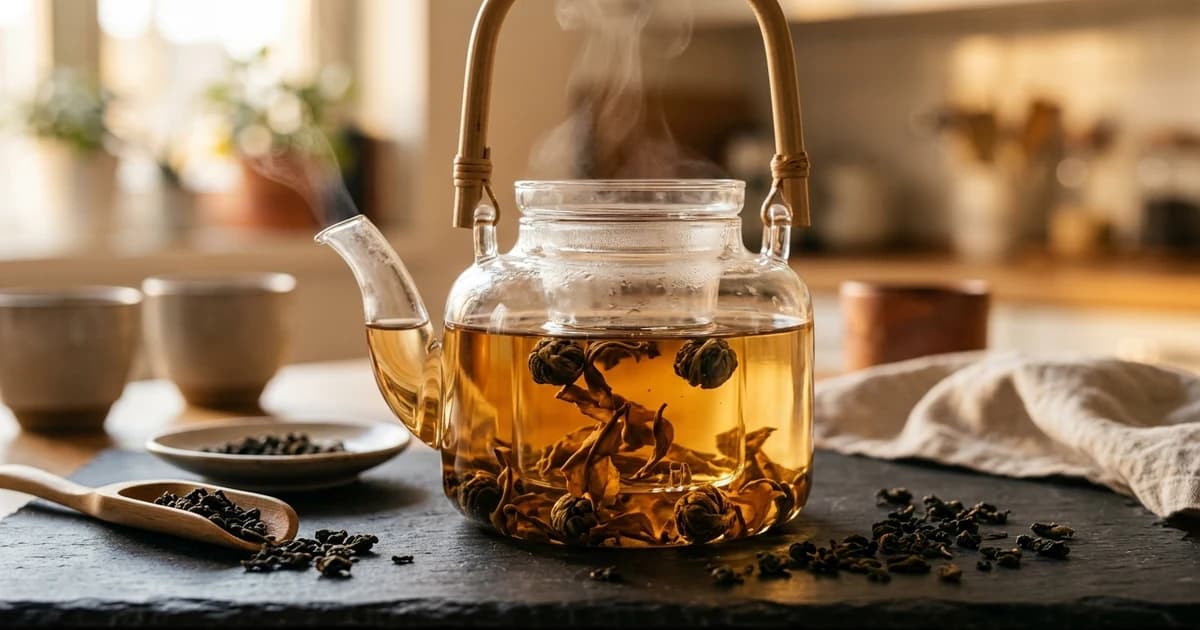
Does Oolong Tea Have Caffeine? How Much per Cup
Yes, oolong tea has caffeine: about 38 mg in an 8 oz cup, based on the USDA's figure of 16 mg per 100 g of brewed oolong. That puts it between green tea (about 28 mg per 8 oz) and black tea (about 47 mg), and at well under half of brewed coffee (about 95 mg). Figures checked September 19, 2026.
The real answer, though, is that 38 mg is a laboratory midpoint. What you actually drink depends on the brand, the leaf, how hot you make the water, and how long you let it steep. Below you will find the USDA numbers at every common cup size, what the major brands publish, and the two variables that swing the caffeine count the most.
How Much Caffeine Is in Oolong Tea?
An 8 oz cup of brewed oolong contains roughly 38 mg of caffeine. That number comes from the USDA's lab-tested figure of 16 mg per 100 g, scaled to the weight of water at each serving size. Brand labels tell a wider story.
Oolong tea caffeine by source and serving size
| Source | Serving | Caffeine (mg) | mg per fl oz | Where the number comes from |
|---|---|---|---|---|
| USDA brewed oolong | 6 fl oz (178 g) | ~28 | ~4.7 | Calculated from USDA FDC 174120, 16 mg/100 g |
| USDA brewed oolong | 8 fl oz (237 g) | ~38 | ~4.7 | Same calculation |
| USDA brewed oolong | 12 fl oz (355 g) | ~57 | ~4.7 | Same calculation |
| USDA brewed oolong | 16 fl oz (474 g) | ~76 | ~4.7 | Same calculation |
| Twinings | 1 bag in ~7 oz (200 mL) | 19-45 | ~2.8-6.6 | Twinings North America FAQ |
| Bigelow | 1 bag in 8 oz | 30-60 | ~3.8-7.5 | Bigelow product page |
| The Republic of Tea | 6 oz cup | 30-40 | ~5.0-6.7 | Republic of Tea caffeine guide |
| Ito En Teas' Tea Golden Oolong | 16.9 fl oz bottle | Not published | N/A | Brand states only "~1/3 the caffeine of coffee" |
Notice the ranges. Twinings says 19 to 45 mg, Bigelow says 30 to 60 mg, and the Republic of Tea says 30 to 40 mg, each using a different cup size. No single number captures every oolong you will encounter, but 38 mg per standard 8 oz cup is a solid USDA-backed starting point.
Oolong Tea Caffeine vs Green Tea, Black Tea, and Coffee
At the USDA averages, oolong lands between green and black tea and at roughly 40% of brewed coffee. Here is the side-by-side for an 8 oz serving (or equivalent).
| Beverage | Serving | Caffeine (mg) | Source |
|---|---|---|---|
| Green tea | 8 fl oz | ~28 | USDA FDC 171917 |
| Oolong tea | 8 fl oz | ~38 | USDA FDC 174120 |
| Black tea | 8 fl oz | ~47 | USDA FDC 173227 |
| Brewed coffee | 8 fl oz | ~95 | USDA FDC 171890 |
| Cola (Coca-Cola) | 12 fl oz | 34 | Coca-Cola |
| Chamomile tea | 8 fl oz | 0 | USDA FDC 174156 |
| Roon pouch | 1 pouch | 80 | Roon |
The takeaway: oolong tea caffeine vs coffee is not close. You would need roughly two and a half cups of oolong to match one cup of drip coffee. Oolong tea caffeine vs green tea is tighter, a gap of about 10 mg per cup at the USDA averages. And caffeine in oolong tea vs black tea is only about 9 mg apart, which most people will not feel.
Why Does the Caffeine in Oolong Tea Vary So Much?
Three things the drinker controls explain most of the swing: leaf quantity, water temperature, and steep time.
A 2025 study in Foods (Ayakdas and Agagunduz) brewed six tea types at 80°C and 100°C for 2, 5, and 10 minutes, then measured caffeine by HPLC. Their oolong samples went from 4.4 mg per 200 mL at 80°C to 13.5 mg at 100°C, a threefold increase from temperature alone. Longer steeps raised caffeine across all teas in the study. This was a single lab with a small number of samples, so treat it as directional, not as the universal oolong figure. The point holds: hotter water and more time on the leaves pull more caffeine into your cup.
A separate 2008 study in the Journal of Analytical Toxicology (Chin et al.) tested 20 commercial teas and found steep time was a clear driver. White, green, and black teas ranged from 14 to 61 mg per serving, and the researchers reported "no observable trend in caffeine concentration due to the variety of tea."
So when a box says "30 to 60 mg," that range is real. The low end is a quick, cooler steep; the high end is boiling water left to sit.
Does Darker Oolong Have More Caffeine Than Light Oolong?
No reliable rule connects color to caffeine. Oolong spans a wide oxidation range (roughly 10% to 80%), and the intuition that darker means more caffeinated is not supported by the data. The Chin et al. (2008) study found no observable caffeine trend across tea varieties, even comparing white, green, and black teas. Brewing method mattered. Tea type did not predict the number.
If someone tells you a darker, more oxidized oolong will always have more caffeine, ask for the study. It does not exist.
Will Oolong Tea Keep You Awake?
At ~38 mg, a single cup of oolong delivers less than half the caffeine of a cup of coffee. For context: in a sleep-lab study (Drake et al., 2013), 400 mg of caffeine taken six hours before bed cut total sleep by more than an hour. A cup of oolong is roughly one-tenth of that dose.
Still, caffeine's half-life is 5 to 6 hours per NIOSH, and it can linger much longer in some people. If you are sensitive to caffeine, an afternoon oolong is still caffeine. Treat it accordingly.
How Many Cups of Oolong Fit Under 400 mg?
The FDA considers 400 mg per day an amount "not generally associated with negative effects" for most healthy adults. At the USDA's 38 mg per cup, that is roughly 10 cups of oolong. At the top of Bigelow's range (60 mg), it is about 6 cups.
For pregnancy, ACOG sets the line at under 200 mg per day, which is about 5 cups at the USDA average. Talk to your clinician if you are pregnant, under 18, or managing a heart condition or medication.
Does Oolong Tea Have L-Theanine?
Yes. Oolong comes from Camellia sinensis, the same plant that yields green and black tea, and tea is the main dietary source of L-theanine. The amino acid is present in all true teas; the amount in any given cup of oolong depends on the cultivar, growing conditions, and processing, and no single mg figure is reliable enough to generalize.
One thing is consistent: when you drink oolong, you are getting some L-theanine alongside the caffeine. That pairing is part of why tea feels different from coffee for many people.
Is There Decaf Oolong, and Do Herbal Teas Count?
Decaf oolong exists, but "decaf" does not mean zero caffeine. The Chin et al. (2008) study found decaf teas still contained less than 12 mg per serving. If you are avoiding caffeine entirely, decaf oolong is not the safest bet.
Herbal infusions like chamomile, rooibos, and peppermint are not true teas. They come from different plants and contain 0 mg of caffeine per the USDA. If you want something hot in the evening with zero caffeine, herbal is the move. Kombucha, another tea-based drink, does carry a small amount.
The Short Version
Oolong tea contains caffeine. The USDA puts it at about 38 mg per 8 oz cup, brand labels range from 19 to 60 mg depending on the bag and brew, and lab studies show water temperature and steep time are the biggest variables. It sits below coffee, slightly above green tea, and slightly below black tea at their respective USDA averages. Ten cups will bump most adults against the FDA's 400 mg daily guideline. If you are counting caffeine for sleep, pregnancy, or a health condition, the number to use is the one on your brand's label, not a generic average.
Frequently Asked Questions
Does oolong tea have more caffeine than green tea?
At the USDA averages, yes. Brewed oolong has about 38 mg per 8 oz cup versus about 28 mg for green tea. But the Chin et al. (2008) study showed real-world teas of all types ranged 14 to 61 mg per serving, so a strong green tea can easily outpace a light oolong. Brewing variables matter more than tea type.
Does oolong tea have more caffeine than coffee?
No. Brewed coffee has about 95 mg per 8 oz cup per the USDA, roughly 2.5 times the caffeine in the same size oolong. Oolong is not a coffee replacement if your goal is a high caffeine dose.
Does oolong milk tea or boba have caffeine?
Yes, if the drink is brewed from actual oolong leaf, it contains caffeine. Bubble tea shops do not publish per-drink milligram figures, so there is no way to estimate reliably. Ask the shop whether the base is brewed tea or a flavored powder, which may contain less or none.
Can I drink oolong tea at night?
About 38 mg of caffeine is a low dose, but caffeine's half-life is 5 to 6 hours and runs longer for some people. A cup at 4 PM means roughly 19 mg is still circulating at 10 PM. Sensitive individuals should treat late-afternoon oolong the same as any other caffeinated drink.
Is oolong tea safe during pregnancy?
ACOG sets an upper limit of 200 mg of caffeine per day during pregnancy, which allows about 5 cups of oolong at the USDA average. That said, talk to your clinician. Caffeine tolerance varies, and your provider knows your full picture.
Does bottled oolong tea have caffeine?
Yes. Any drink brewed from Camellia sinensis leaf contains caffeine. Ito En's Teas' Tea Golden Oolong, one of the most common bottled oolongs, does not publish a milligram figure, stating only that tea has roughly one-third the caffeine of coffee. Without a number on the label, you cannot count it precisely.
When You Want the Tea Pairing at a Fixed Dose
The thread running through this article is unpredictability. A cup of oolong might be 19 mg or 60 mg, and you will not know which until after you have already decided whether it is safe for the afternoon. What most people like about tea is that caffeine and L-theanine arrive together. What most people do not like is the guesswork.
Roon is a zero-nicotine oral pouch that delivers the same pairing at a printed dose: 80 mg caffeine with 60 mg L-theanine, plus 25 mg methylliberine (Dynamine) and 5 mg theacrine (TeaCrine). It is not tea. It contains zero sugar and uses sucralose.
A 2025 Nutrition Reviews meta-analysis (PMID 40314930) found that caffeine plus L-theanine improved accuracy on attention-switching and vigilance tasks versus placebo. Separately, the duration argument: methylliberine slows caffeine's clearance. In a randomized, double-blind, crossover PK study (n=12), co-administration with caffeine cut oral clearance from 41.9 to 17.1 L/hr and extended half-life from 7.2 to 15 hours, with no increase in peak concentration (study). That study used 100 mg methylliberine and 150 mg caffeine, roughly 4x and 1.9x Roon's doses, so the effect at Roon's lower dose is directionally the same, not identical. The felt window is 6 to 8 hours. A longer tail also means you should stop at least 8 hours before bed.
Subscriptions start from $9.16 per tin (as little as $0.61 per pouch); one-time 4-tin packs are $15.00 per tin ($1.00 per pouch). If predictable caffeine-plus-theanine dosing sounds better than steeping and guessing, try Roon.
Related from Roon
- L-Theanine in Tea, Matcha, and Foods
- Does Matcha Have Caffeine?
- Does Chai Have Caffeine?
- How Long Does Caffeine Stay in Your System?
Written by Roon Team