Does Chai Have Caffeine? Chai vs Chai Latte, by the Numbers
Does Chai Have Caffeine? Chai vs Chai Latte, by the Numbers
Yes, chai has caffeine. A standard 8-ounce cup of brewed masala chai contains roughly 47 mg of caffeine, sourced entirely from its black tea base, not from the spices. That puts it below coffee's caffeine (about 95 mg per 8 oz) but well above zero. The exact number shifts depending on whether you're brewing loose-leaf chai at home, ordering a Starbucks Chai Tea Latte, or adding an espresso shot to make a dirty chai.
The confusion is real: "chai" can mean five different drinks with five different caffeine counts. This page breaks all of them down, side by side, with sourced numbers.
The Full Chai Caffeine Table
Every version of chai you're likely to encounter, with caffeine per serving and the source of that caffeine.
| Drink | Serving size | Caffeine (mg) | Caffeine source |
|---|---|---|---|
| Brewed masala chai (black tea base) | 8 oz | ~47 | Black tea (USDA) |
| Starbucks Chai Tea Latte, Short | 8 oz (2 pumps) | ~50 | Chai concentrate (black tea) |
| Starbucks Chai Tea Latte, Tall | 12 oz (3 pumps) | ~70 | Chai concentrate (black tea) |
| Starbucks Chai Tea Latte, Grande | 16 oz (4 pumps) | ~95 | Chai concentrate (black tea) |
| Starbucks Chai Tea Latte, Venti (hot) | 20 oz (5 pumps) | ~120 | Chai concentrate (black tea) |
| Starbucks Chai Tea Latte, Venti (iced) | 24 oz (6 pumps) | ~145 | Chai concentrate (black tea) |
| Dirty chai (Grande + 1 espresso shot) | 16 oz | ~170 | Black tea + espresso |
| Rooibos "chai spice" (herbal) | 8 oz | 0 | None (caffeine-free) |
Starbucks pump counts and caffeine estimates are based on reported standard recipes and published nutrition data, with each pump of chai concentrate contributing approximately 23 to 25 mg of caffeine. Starbucks periodically reformulates its concentrate, so check your local store's nutrition info for the latest figures.
How Chai Compares to Coffee, Green Tea, and an 80 mg Pouch
For context, here's brewed chai stacked against common caffeine benchmarks.
| Drink | Serving | Caffeine (mg) | Source |
|---|---|---|---|
| Brewed masala chai | 8 oz | ~47 | USDA |
| Green tea, brewed | 8 oz | ~28 | USDA |
| Drip coffee | 8 oz | ~95 | USDA |
| Single espresso shot | 1 oz | ~63 (USDA avg) / ~75 (Starbucks) | USDA, Starbucks |
| Standard energy drink (Red Bull) | 8.4 oz | ~80 | Manufacturer label |
| Roon focus pouch | 1 pouch | 80 | Roon |
| Cola | 12 oz | ~34 | Manufacturer label |
A cup of chai sits roughly in the middle of this spectrum: about half the caffeine of drip coffee, almost double green tea, and just under the 80 mg in a focus pouch.
Chai vs Chai Latte: Why the Caffeine Differs
"Chai" and "chai latte" are not the same drink, and the caffeine gap matters.
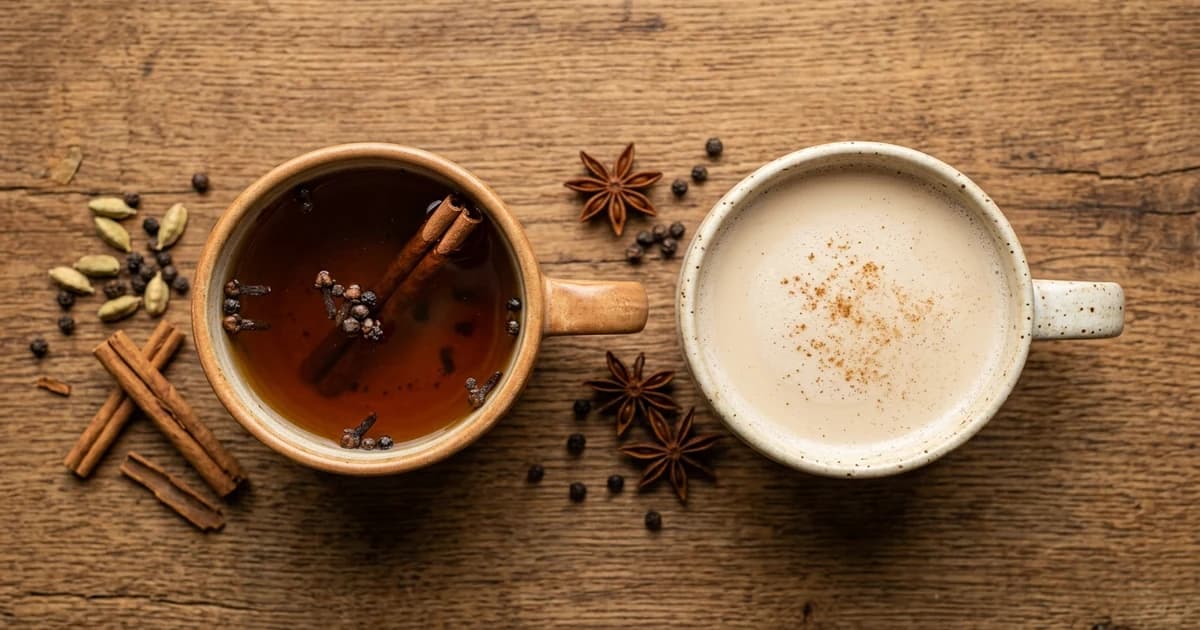
Brewed chai (sometimes labeled "chai tea" in Western markets) is black tea steeped with whole spices: cinnamon, cardamom, ginger, cloves, black pepper. You're drinking straight brewed tea, just spiced. Caffeine comes entirely from the tea leaves. None of the spices contain caffeine.
A chai latte dilutes chai concentrate with steamed milk. At Starbucks and most cafes, the concentrate is a pre-sweetened, pre-brewed syrup pumped from a bottle. The caffeine per ounce of liquid is lower than straight brewed chai because milk takes up most of the cup. But the total caffeine climbs with cup size because more pumps go in. A Grande Starbucks Chai Latte ends up at roughly 95 mg, double what you'd get from an 8 oz home brew, simply because of volume.
If you're comparing chai vs chai latte caffeine, the variable is always volume and concentration, not some difference in the tea itself.
How Much Caffeine Is in a Starbucks Chai Latte?
A Grande (16 oz) Starbucks Chai Tea Latte contains approximately 95 mg of caffeine, based on Starbucks nutrition data and consistent third-party reporting. The number scales linearly with pump count:
- Short (8 oz): 2 pumps, ~50 mg
- Tall (12 oz): 3 pumps, ~70 mg
- Grande (16 oz): 4 pumps, ~95 mg
- Venti hot (20 oz): 5 pumps, ~120 mg
- Venti iced (24 oz): 6 pumps, ~145 mg
Each pump of Starbucks chai concentrate adds roughly 23 to 25 mg. Ordering fewer pumps is the simplest way to cut the caffeine (and the sugar) without switching drinks. Two pumps in a Grande gets you closer to 48 mg.
Iced versions get an extra pump to compensate for dilution from ice, which is why a Venti Iced at 145 mg outpaces a Venti Hot at 120 mg.
Is Dirty Chai High in Caffeine?
Yes. A dirty chai adds a shot of espresso to a standard chai latte, and that changes the math fast.
A Starbucks single espresso shot contains about 75 mg of caffeine. Add that to a Grande Chai Latte's ~95 mg and you're looking at roughly 170 mg in one drink. That's more caffeine than a standard 8 oz cup of drip coffee and nearly half the FDA's 400 mg daily guideline for healthy adults.
A "double dirty" chai (two espresso shots) pushes the total to around 245 mg. At that point you're well into strong-coffee territory.
If you're wondering whether dirty chai is "high in caffeine," the answer is relative: it's moderate compared to a large cold brew (200+ mg) but high compared to plain brewed tea. For anyone tracking intake, it's the kind of drink that deserves a line on the daily tally.
Is Chai Tea Caffeine Free?
Standard chai, brewed from black tea, is never caffeine-free. The only version of "chai" that truly contains zero caffeine is a rooibos-based chai spice blend, which replaces the black tea with rooibos, a naturally caffeine-free herb from South Africa. The spices stay the same. The tea base changes.
Several brands sell rooibos chai: Harney & Sons, Farmhouse Teas, Blue Lotus Chai, and others. If a box says "caffeine-free chai," check the ingredients for rooibos or honeybush as the base. If the base is black tea, green tea, or yerba mate, it contains caffeine regardless of what the front label implies.
Decaf black tea chai also exists but isn't truly zero: decaffeination removes most caffeine, not all. Expect 2 to 5 mg per cup in a decaf version.
Will Chai Keep You Awake?
It can. At ~47 mg per 8 oz cup, brewed chai carries enough caffeine to affect sleep if consumed too close to bedtime, especially if you're caffeine-sensitive. Caffeine's half-life in the body averages about 5 hours, according to the FDA, though individual variation ranges from roughly 3 to 7 hours. A cup of chai at 6 PM leaves roughly 24 mg still circulating at midnight.
A Starbucks Grande Chai Latte at 95 mg is a different story. That's closer to coffee-level caffeine, and drinking one after mid-afternoon will likely interfere with sleep quality for most people.
General guidance: keep all caffeine sources, chai included, at least 8 hours before your target bedtime if you sleep lightly. Black tea also contains L-theanine, an amino acid associated with relaxation, but its presence doesn't cancel the stimulant effect of caffeine.
Know Your Chai, Know Your Caffeine
Chai is not one drink. It's a spectrum. A mug of home-brewed masala chai at 47 mg sits in mild-stimulant territory. A Venti Iced Dirty Chai at 220 mg sits closer to a double espresso. The spices contribute flavor, not caffeine, so the only variables that move the number are tea base, concentration, volume, and whether espresso enters the picture. Check the pump count, check the size, and track the total against the FDA's 400 mg daily guideline for healthy adults.
Frequently Asked Questions
Does chai have more caffeine than green tea?
Yes. An 8 oz cup of brewed chai (black tea base) contains roughly 47 mg of caffeine, compared to about 28 mg in the same volume of brewed green tea. Chai's caffeine advantage comes from its black tea base, which is more oxidized and generally higher in extractable caffeine than green tea leaves. Both are well below drip coffee's ~95 mg per cup.
How much caffeine is in a Starbucks Chai Tea Latte?
A Grande (16 oz) contains approximately 95 mg. Starbucks uses a liquid chai concentrate pumped by size: 2 pumps for a Short (~50 mg), 3 for a Tall (~70 mg), 4 for a Grande (~95 mg), 5 for a Venti Hot (~120 mg), and 6 for a Venti Iced (~145 mg). You can ask for fewer pumps to lower the caffeine.
Is dirty chai high in caffeine?
Relative to regular chai, yes. Adding a single espresso shot (about 75 mg at Starbucks) to a Grande Chai Latte brings the total to roughly 170 mg. That exceeds an 8 oz cup of drip coffee. A double dirty chai pushes past 245 mg, approaching the caffeine of a large cold brew.
Can I drink chai at night?
An 8 oz brewed chai at 47 mg is mild but not negligible. Caffeine's half-life is about 5 hours, though individual variation ranges from roughly 3 to 7 hours, so a cup at 7 PM could leave over 20 mg active at midnight. If you're sensitive to caffeine, switch to rooibos chai (zero caffeine) for evening cups.
Is any chai completely caffeine-free?
Only rooibos-based or honeybush-based "chai spice" blends are truly caffeine-free. These swap the black tea for an herbal base while keeping the traditional spice blend. Decaf chai still contains 2 to 5 mg per cup.
Does the milk in a chai latte reduce caffeine?
No. Milk dilutes the concentration of caffeine per sip, but it does not remove or neutralize caffeine. The total milligrams in the cup remain the same regardless of whether you use whole milk, oat milk, or no milk at all.
How does chai compare to matcha and kombucha?
A standard 8 oz chai has about 47 mg. An 8 oz serving of matcha typically ranges from 38 to 176 mg depending on preparation. Most kombucha contains very little caffeine, usually under 15 mg per serving, since fermentation degrades some of the tea's original caffeine content.
A Predictable 80 mg, Without the Pump Math
If the caffeine variability in chai drinks is the part that bothers you, consider a fixed-dose alternative. Roon is a zero-nicotine oral pouch that delivers exactly 80 mg of caffeine per pouch, paired with 60 mg L-theanine, 25 mg methylliberine (Dynamine), and 5 mg theacrine (TeaCrine). The onset is 5 to 10 minutes, and the felt duration runs 6 to 8 hours.
Roon is not chai. It's not a tea ritual or a warm morning drink. It won't give you cardamom and cinnamon. What it does give you is a consistent caffeine dose that doesn't change based on who's working the espresso machine or how many pumps went into the cup. Zero sugar, zero calories, Cool Mint flavor. Tins start at $15.00 for a one-time 4-pack ($1.00/pouch) or as little as $9.16 per tin on a 12-tin subscription ($0.61/pouch).
It's a different tool for a different problem. If you like chai, drink chai. If you also want a precise caffeine source that fits in a pocket for the afternoon, Roon is worth a look.
Related from Roon
- How Much Caffeine Is in a Cup of Coffee?
- How Much Caffeine Is in a Focus Pouch? Is 80 mg Too Much?
- L-Theanine in Tea, Matcha, and Foods
- Does Matcha Have Caffeine?
Written by Roon Team