L-Theanine in Tea, Matcha & Foods: Where to Find It
Roon Team
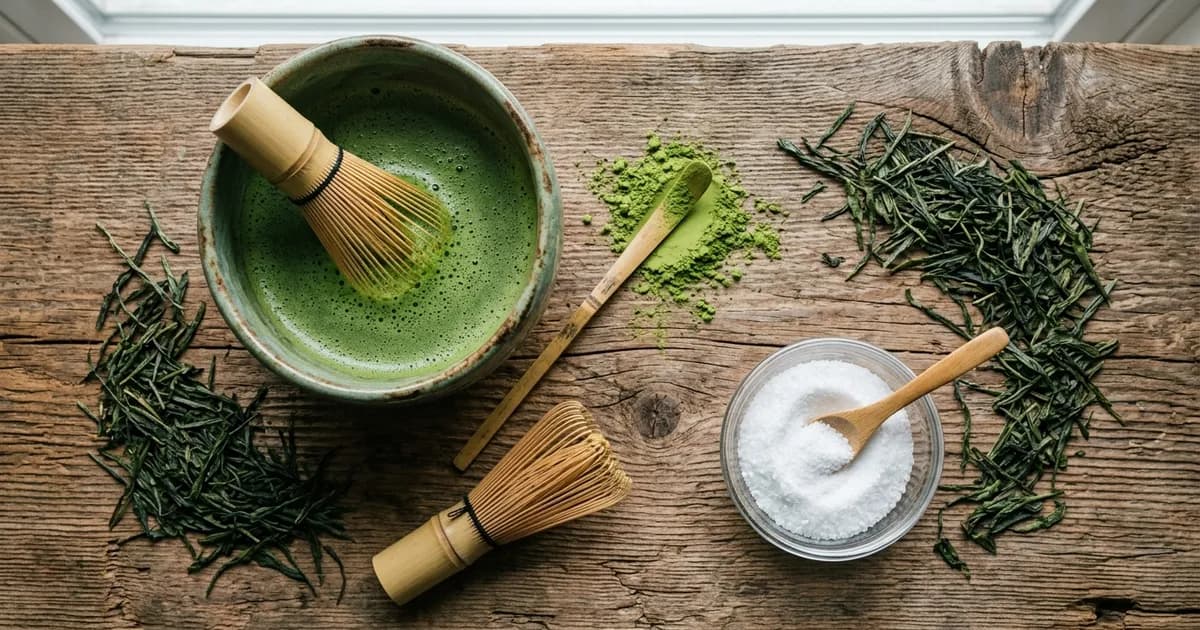
L-Theanine in Tea, Matcha & Foods: Where to Find It and How Much You Actually Get
Your green tea habit is doing more for your brain than you think. The amino acid responsible for that calm, focused feeling after a cup of tea is L-theanine, and it shows up in wildly different amounts depending on what you're drinking. Most people assume all tea is created equal on this front. It isn't. The l theanine in tea varies by a factor of 10x or more between a cheap grocery store green tea bag and a premium shade-grown Japanese matcha.
This guide breaks down exactly how much l theanine in tea you're getting from matcha, green tea, black tea, and the handful of non-tea foods that contain it. More importantly, it covers how much you actually need to feel the cognitive effects.
Key Takeaways:
- Matcha contains roughly five times more L-theanine than standard green tea because you consume the whole leaf.
- A typical cup of brewed green tea delivers only about 7 to 25 mg of l theanine in tea, well below the 100 to 200 mg range used in clinical studies.
- Shade-grown teas like gyokuro and matcha produce more L-theanine because reduced sunlight prevents the amino acid from converting to catechins.
- Outside of tea, L-theanine natural sources are extremely limited: one species of mushroom and that's about it.
What Is L-Theanine and Why Does Tea Have It?
L-theanine (technically γ-glutamylethylamide) is a non-protein amino acid found almost exclusively in the Camellia sinensis plant. That's the tea plant. Every type of "true" tea, whether green, black, white, or oolong, comes from this single species.
The tea plant synthesizes L-theanine in its roots and transports it to the leaves. Here's where it gets interesting: when the leaves are exposed to sunlight, L-theanine converts into catechins (the antioxidants tea is famous for). Block the sunlight, and L-theanine accumulates instead. This is the entire scientific basis behind shade-grown teas, and it's why matcha and gyokuro contain so much more l theanine in tea than sun-grown varieties like sencha.
Once you drink it, L-theanine crosses the blood-brain barrier and gets to work. A 2024 review published on ScienceDirect found that L-theanine may increase alpha brain waves associated with relaxation and selective attention. A randomized, triple-blind, placebo-controlled study on PubMed confirmed that a single 200 mg dose of L-theanine increased frontal region alpha power compared to placebo during an acute stress challenge, indicating a calming response in the brain.
That's the "relaxed but alert" state tea drinkers describe. Coffee doesn't do this. L theanine in tea does.
How Much L-Theanine Is in Tea? A Type-by-Type Breakdown
Not all tea delivers the same dose. The amount of l theanine in tea depends on the tea type, how it was grown, and how you brew it.
A study published in the journal Pharmacognosy Magazine (PMC) analyzed 37 commercial tea samples and found these average L-theanine concentrations per gram of dry leaf:
| Tea Type | L-Theanine (mg per gram of dry leaf) |
|---|---|
| White Tea | 6.26 mg/g |
| Green Tea | 6.56 mg/g |
| Oolong Tea | 6.09 mg/g |
| Black Tea | 5.13 mg/g |
Those numbers are per gram of dry leaf, not per cup. How much ends up in your cup depends on how much leaf you use and how well l theanine in tea extracts into the water.
Green Tea
A standard cup of brewed green tea (200 ml) contains roughly 7 to 25 mg of L-theanine, depending on the source. A study on ScienceDirect found that a standard 200 ml cup of green tea contained an average of 7.9 ± 3.8 mg. Other estimates run higher, around 25 mg, depending on leaf quality and steep time.
That's a meaningful amount for general relaxation. But it's a fraction of the 100 to 200 mg doses used in clinical research on focus and cognition.
Black Tea
Black tea actually surprised researchers. That same ScienceDirect study found that a standard cup of black tea contained 24.2 ± 5.7 mg of L-theanine, making it the highest among the brewed teas tested. This runs counter to the common assumption that green tea always wins on l theanine in tea content.
The reason likely comes down to processing. Black tea leaves are fully oxidized, but L-theanine, being water-soluble, extracts efficiently during brewing. The higher brewing temperatures used for black tea (near boiling) also pull more l theanine in tea into the water compared to the lower temperatures used for green tea.
White and Oolong Tea
White and oolong teas fall in the middle of the range. Per gram of dry leaf, they're comparable to green tea. But brewing methods vary so much (white tea is often brewed at very low temperatures) that the actual l theanine in tea you consume can be unpredictable.
L-Theanine in Matcha: Why It's the Standout
Matcha is where the numbers change. Because you're consuming the entire ground tea leaf rather than steeping and discarding it, you absorb everything the leaf contains.
According to AIYA America, 1 gram of matcha contains approximately 19.5 mg of L-theanine. A typical serving uses about 2 grams of powder, putting a single cup of matcha at roughly 39 mg of L-theanine. That's already 2 to 5 times what you'd get from a standard cup of brewed green tea.
But l theanine in tea goes even higher with premium matcha grades. Ceremonial-grade matcha uses younger leaves from heavily shaded plants, which pushes L-theanine content up. According to matcha.com, matcha has roughly five times more L-theanine than generic green tea (around 20 mg versus 4 mg per gram, depending on quality).
Gyokuro: The Other Shade-Grown Contender
Gyokuro is Japan's other premium shade-grown green tea. Unlike matcha, it's brewed as whole leaves rather than consumed as powder. According to matcha.com, gyokuro contains an average of 85 mg of L-theanine per cup when properly prepared. That's the highest l theanine in tea of any brewed (non-powdered) variety.
The catch: gyokuro is brewed at a very low temperature (around 60°C / 140°F) with a high leaf-to-water ratio. It's a deliberate, slow brewing process. Most people don't prepare it this way, which means the actual L-theanine yield varies.
L-Theanine Rich Foods Beyond Tea
If you're looking for L-theanine sources outside of Camellia sinensis, your options are thin.
Bay Bolete Mushrooms
The bay bolete (Imleria badia, formerly Boletus badius) is the only well-documented non-tea source of L-theanine. According to Healing Mushrooms, L-theanine was first identified in this species back in 1960. It's a wild-foraged mushroom found across European forests.
The problem: the amount of L-theanine in bay boletes is small compared to l theanine in tea, and you can't exactly pick them up at your local grocery store. They're a curiosity, not a reliable dietary source.
What About Other Foods?
Some sources mention trace amounts of L-theanine in certain legumes and other mushroom species. But the concentrations are negligible. Longevity Technology confirms that green tea, black tea, white tea, and certain mushrooms like Boletus badius are the primary dietary sources. There's no vegetable, fruit, or grain that delivers a meaningful dose.
This is why L-theanine supplements exist. The gap between what l theanine in tea provides and what research suggests is effective is simply too wide.
The Dosage Problem: L Theanine in Tea vs. Clinical Research
Here's the honest math. Most clinical studies on L-theanine use doses between 100 and 400 mg.
A study indexed on PubMed found that a combination of 97 mg L-theanine and 40 mg caffeine improved accuracy during task switching and self-reported alertness while reducing tiredness. Research from the Alzheimer's Drug Discovery Foundation reported that single doses of 100 and 200 mg of L-theanine improved reaction time in a visual reaction time task.
Now look at the l theanine in tea numbers again. A cup of green tea gives you 7 to 25 mg. Even matcha tops out around 39 mg per serving. To hit 200 mg from green tea alone, you'd need to drink 8 to 25 cups. From matcha, roughly 5 servings.
That's a lot of tea.
| Source | L-Theanine Per Serving | Cups to Reach 200 mg |
|---|---|---|
| Green Tea (brewed) | ~7–25 mg | 8–28 cups |
| Black Tea (brewed) | ~24 mg | ~8 cups |
| Matcha | ~39 mg | ~5 cups |
| Gyokuro (brewed) | ~85 mg | ~2–3 cups |
| L-Theanine Supplement (e.g., NOW Foods 200 mg) | 200 mg | 1 capsule |
Products like NOW Foods L-Theanine 200 mg capsules offer a straightforward way to hit clinical doses. Each capsule delivers 200 mg of L-theanine, which is the dose range most commonly associated with measurable cognitive effects in research.
L-Theanine and Caffeine in Tea: Better Together
L-theanine and caffeine occur naturally together in tea. That's not a coincidence, and the research on this combination is strong.
A PubMed-indexed study tested 97 mg of L-theanine with 40 mg of caffeine and found the combination improved both accuracy and alertness better than placebo. A 2023 study published in the Journal of the International Society of Sports Nutrition (PMC) examined the effects of combined caffeine and L-theanine on attention performance in elite athletes.
The pattern across the literature is consistent: caffeine provides the drive, L-theanine smooths out the edges. You get focus without the jittery, anxious feeling that caffeine alone can produce. L theanine in tea delivers this combination naturally, but at relatively low doses of both compounds.
Getting Enough L-Theanine Without Drinking Tea All Day
Drinking tea is a good start. Matcha is a better one. But if you want the L-theanine doses that actually show up in clinical research, l theanine in tea alone won't get you there without serious volume.
The practical options: drink high-quality shade-grown tea (matcha or gyokuro) for a baseline of L-theanine, and supplement the rest. Or find a product that combines L-theanine with caffeine at doses that match what the research supports.
Roon takes the second approach. It's a zero-nicotine sublingual pouch that pairs L-theanine with 80 mg of caffeine, theacrine, and methylliberine. The L-theanine and caffeine combination mirrors the pairing found naturally as l theanine in tea, but at doses designed to produce the sustained, jitter-free focus that clinical studies describe. No brewing required, no guessing about how much you're actually getting.
If you want your L-theanine to do what the science says it can, the dose matters. Whether that comes from five cups of matcha or a single pouch is up to you.