Does Decaf Tea Have Caffeine? How Much Is Left in a Cup
Does Decaf Tea Have Caffeine? How Much Is Left in a Cup
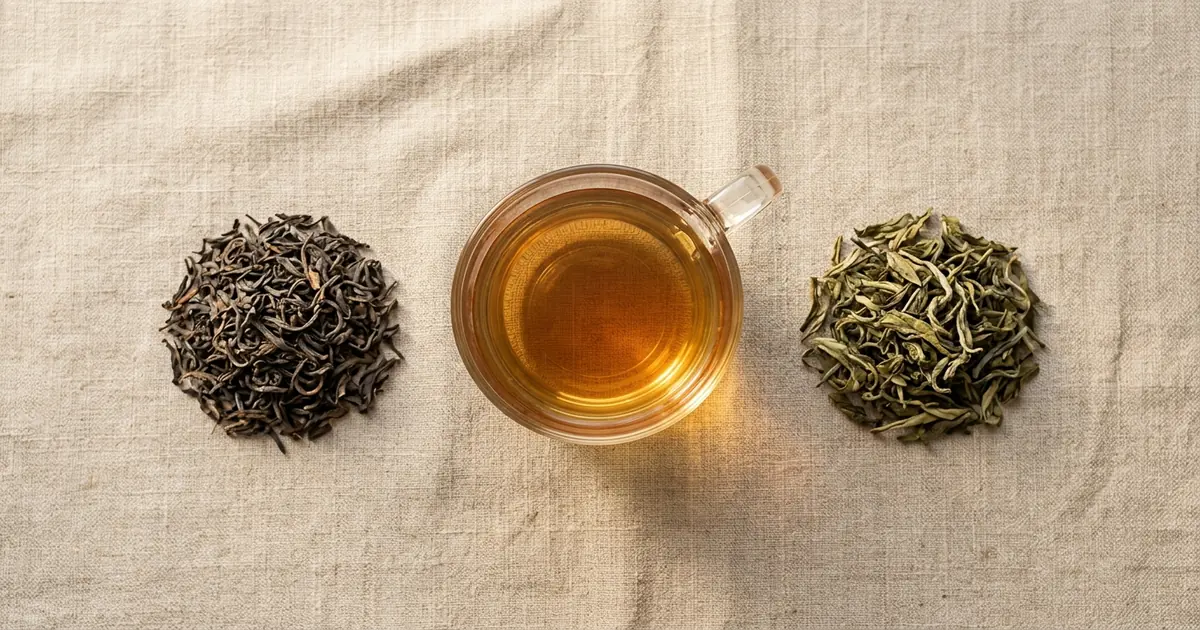
Yes, decaf tea still contains a small amount of caffeine. USDA FoodData Central lists about 2 mg in an 8 oz cup of brewed decaf black tea, compared to roughly 47 mg in a regular cup. A lab study of 20 commercial teas found every decaf sample came in under 12 mg per serving. Only herbal teas, made from plants other than Camellia sinensis, register at 0 mg.
Caffeine in Decaf Tea vs Regular Tea, per Cup
| Tea (USDA FDC description) | FDC ID | Caffeine per 100 g | Per 8 fl oz (237 g) |
|---|---|---|---|
| Black tea, brewed, decaffeinated | 174871 | 1 mg | about 2.4 mg |
| Black tea, ready to drink, decaffeinated | 173212 | 1 mg | about 2.4 mg |
| Green tea, brewed, decaffeinated | 171910 | 0 mg (rounds to 0) | under 1 mg |
| Black tea, brewed, regular | 173227 | 20 mg | about 47 mg |
| Green tea, brewed, regular | 171917 | 12 mg | about 28 mg |
| Oolong tea, brewed | 174120 | 16 mg | about 38 mg |
| Chamomile tea, brewed | 174156 | 0 mg | 0 mg |
| Herb tea other than chamomile, brewed | 173232 | 0 mg | 0 mg |
Source: USDA FoodData Central (values per 100 g, converted to 8 fl oz = 237 g), checked Nov 14, 2026.
Is Decaf Tea Caffeine Free?
No. The FDA states that decaffeinated coffees and teas "still contain some caffeine." For coffee, the FDA puts that residual at 2 to 15 mg per 8 oz cup. Tea sits at the low end of that scale: Bigelow Tea publishes 1 to 8 mg for its decaf blends, and USDA data show about 2.4 mg for a standard brewed decaf black tea.
The word "decaffeinated" means most of the caffeine has been removed. It does not mean all. Bigelow's own education page puts it plainly: "decaffeinated tea is not completely caffeine-free."
What the Lab Measured
The most-cited study on brewed-tea caffeine is Chin et al. 2008 from the University of Florida College of Medicine, published in the Journal of Analytical Toxicology. The researchers brewed 20 commercial tea products under varying serving sizes and steep times.
| Detail | Value |
|---|---|
| Sample size | 20 commercial teas |
| Tea types in the study | White, green, black, decaf, herbal |
| Regular tea caffeine | 14 to 61 mg per serving (6 or 8 oz) |
| Decaf tea caffeine | Less than 12 mg per serving |
| Herbal tea caffeine | Not detected |
| Notable finding | Steep time affected caffeine concentration |
Every decaf sample stayed under 12 mg, below the 14 mg floor of the regular teas, and caffeine was not detected in any herbal variety. The authors also report that steep time changed the caffeine concentration, so how long you brew matters. Keep in mind the study is from 2008 and its abstract does not name every brand it used.
Decaf Green vs Decaf Black Tea
USDA records decaf green tea at 0 mg per 100 g and decaf black tea at 1 mg per 100 g. That does not mean decaf green tea is literally caffeine-free. USDA rounds to whole milligrams per 100 g, so a value of "0" means the true concentration fell below about 0.5 mg per 100 g, not that none was present.
Brand figures fill in the picture. The Republic of Tea reports about 2 mg per cup for its naturally decaffeinated green tea. Bigelow gives 1 to 8 mg for both decaf black and decaf green without distinguishing between them.
On every source above, the gap between decaf black and decaf green is a few milligrams per cup at most, so taste is a reasonable way to choose between them.
How Tea Is Decaffeinated
Two processes dominate commercial tea, and Bigelow's own page (published May 8, 2026) explains both:
- CO2 (carbon dioxide) process, used for green tea. Bigelow says the CO2 "binds to the caffeine molecules," and "No CO2 remains in the tea leaves after processing."
- Ethyl acetate (EA) process, used for black tea. Tea leaves are moistened with water and EA, then heated. Bigelow notes that EA occurs naturally in tea leaves, as well as in beer, wine and bananas. Bigelow describes the result as removing "the majority of the caffeine."
Neither method strips every molecule, which is why residual caffeine persists in both decaf black and decaf green tea. For the coffee side, including its decaf methods, see how much caffeine is in decaf coffee.
How Many Cups of Decaf Tea Equal One Regular Cup?
A regular brewed black tea has about 47 mg of caffeine per 8 oz (USDA). Decaf black tea has about 2.4 mg.
47 mg ÷ 2.4 mg = about 20 cups of decaf black tea to match one regular cup.
That is the USDA-basis figure. Using the Chin et al. study's upper ceiling of under 12 mg, the math tightens:
47 mg ÷ 12 mg ≈ 4 cups.
So depending on the brand and brew time, somewhere between 4 and 20 cups of decaf tea would deliver the same caffeine as a single regular cup. One or two cups of decaf adds only a few milligrams to your day on either basis.
Decaf Tea vs Herbal Tea
This distinction trips people up more than any caffeine number does.
Decaf tea starts as real tea, meaning leaves from the Camellia sinensis plant (the same plant that gives us black, green, white, and oolong tea). The caffeine is then mostly removed during processing. A trace remains.
Herbal tea is not tea at all in the botanical sense. Chamomile, peppermint, rooibos, and hibiscus are infusions of other plants. They never contained Camellia sinensis caffeine to begin with, so USDA records them at 0 mg.
One exception to watch: blends that mix decaf green tea with herbs. Read the ingredient list, because the decaf tea leaf brings its residual caffeine along even when the box leads with an herb. The chamomile tea caffeine guide covers Sleepytime Decaf and similar blends.
When Even Decaf Tea's Caffeine Matters
A cup of decaf tea holds a few milligrams, far below the FDA's 400 mg daily figure for most healthy adults. Some groups should still pay closer attention:
- Pregnancy and breastfeeding. Talk to your clinician about total daily caffeine from all sources, including decaf tea.
- Caffeine sensitivity. If even small amounts trigger jitteriness, heart pounding, or disrupted sleep, herbal tea is the safer choice.
- Medical conditions. Anyone managing a heart rhythm condition or another issue where a prescriber has advised avoiding caffeine should not assume decaf tea is harmless.
- Children. Pediatric caffeine guidance is best discussed with a pediatrician.
If you react strongly to caffeine, the FDA recommends you "may want to avoid these beverages altogether."
Related from Roon
- How Much Caffeine Is in Decaf Coffee?
- Does Chamomile Tea Have Caffeine?
- Does Peppermint Tea Have Caffeine?
- How Much Caffeine Is in White Tea?
Frequently Asked Questions
Does decaf green tea have caffeine?
Yes, though less than decaf black tea. USDA rounds brewed decaf green tea to 0 mg per 100 g, meaning it falls under about 0.5 mg per 100 g, not literally zero. The Republic of Tea reports about 2 mg per cup for its decaffeinated green blend. If you need a genuine 0 mg option, choose an herbal tea like peppermint or chamomile instead.
Is decaf tea OK at night?
A cup holds only a few milligrams of caffeine (about 2.4 mg on the USDA basis, up to 8 mg on Bigelow's range). People who are sensitive to caffeine may still notice it, and the FDA suggests they may want to avoid decaf altogether. Herbal teas like chamomile or rooibos remove the question entirely.
Does steeping decaf tea longer add more caffeine?
It can. The Chin et al. study found that steep time affected caffeine concentration across all tea types, including decaf. The abstract does not give a per-minute figure for decaf, but the direction is clear: a longer brew pulls more caffeine from the leaves, so a shorter steep keeps the number lower. Every decaf sample in the study still stayed under 12 mg.
Is decaf tea the same as caffeine-free tea?
No. Decaf tea is made from Camellia sinensis leaves that have had most, but not all, caffeine removed. Caffeine-free tea (herbal tea) comes from plants that never produced caffeine. Chamomile, peppermint, hibiscus, and rooibos are caffeine-free. A box labeled "decaf" still has roughly 1 to 8 mg per cup.
When You Do Want the Caffeine
Keeping decaf for the evening is a sensible choice. Earlier in the day, some readers want a dose they can count. For scale, one Roon pouch holds 80 mg, about what 33 cups of USDA-basis decaf black tea would add up to.
Roon prints its dose on the tin: each pouch has 80 mg of caffeine paired with 60 mg L-theanine, 25 mg methylliberine (Dynamine), and 5 mg theacrine (TeaCrine). Methylliberine slows how quickly your body clears caffeine. A randomized, double-blind crossover PK study (n=12) found it extended caffeine's half-life from 7.2 to 15 hours without raising the peak; that study used 100 mg methylliberine and 150 mg caffeine, roughly 4x and 1.9x the amounts in a Roon pouch, so only the direction carries over to Roon's dose. A longer half-life is not the same as 15 hours of feeling alert; most people feel a Roon pouch for roughly 6 to 8 hours.
The practical pairing: Roon in the morning, placed under the lip, with your last pouch finishing at least 8 hours before bed. Decaf or herbal tea in the evening. It has zero nicotine and zero sugar (it is sweetened with sucralose), from $9.16 per tin on a 12-tin subscription.
Sources
- USDA FoodData Central: Black tea, brewed, decaffeinated (FDC 174871); Green tea, brewed, decaffeinated (FDC 171910); Black tea, brewed (FDC 173227); Green tea, brewed (FDC 171917)
- Chin JM, Merves ML, Goldberger BA, Sampson-Cone A, Cone EJ. Caffeine content of brewed teas. J Anal Toxicol. 2008;32(8):702-4.
- U.S. Food and Drug Administration consumer update on caffeine limits and decaf ("Spilling the Beans")
- Bigelow Tea. How Much Caffeine Is in Tea?
- Bigelow Tea. How Does Bigelow Tea Decaffeinate Tea. Published May 8, 2026.
- The Republic of Tea. How Many Milligrams of Caffeine Is in Decaffeinated Green Tea?
- Mondal G, Wang YH, Yates R, Bloomer RJ, Butawan M, et al. Caffeine and Methylliberine: A Human Pharmacokinetic Interaction Study. J Exerc Nutr. 2022;5(3).
Written by Roon Team