The Best Coffee Alternatives Caffeine Free Worth Trying in 2026
Roon Team
The Best Coffee Alternatives Caffeine Free Worth Trying in 2026
You love the ritual. The warm mug, the first sip, the signal to your brain that the day has started. But if you're exploring coffee alternatives caffeine free, you already know the math stopped working somewhere between your second and third cup. More coffee, less focus. More caffeine, worse sleep. A cycle you know too well.
Millions of people are doing that same math right now. The global coffee substitutes market hit an estimated $14.6 billion in 2025 and is projected to reach $22 billion by 2035. The demand for healthy caffeine alternatives to coffee isn't a fad. It's a correction.
This guide breaks down the best coffee alternatives caffeine free that are actually worth your time in 2026, what the science says about each one, and how to pick the right fit for your brain and body.
Key Takeaways:
- Several coffee alternatives caffeine free closely replicate the taste and ritual of coffee without the downsides of caffeine dependency.
- Ingredients like chicory root, lion's mane mushroom, and rooibos carry real, studied health benefits.
- The best choice depends on what you're optimizing for: gut health, cognitive support, relaxation, or just a warm drink that doesn't wreck your sleep.
Why People Are Choosing Coffee Alternatives Caffeine Free
The problem was never the mug. It was what's inside it.
Regular coffee delivers anywhere from 80 to 200mg of caffeine per cup. That's fine at 7 a.m. It's less fine when it's still circulating in your bloodstream at midnight, because caffeine's half-life sits around five to six hours. You drink a cup at 2 p.m., and half that caffeine is still active at 8 p.m.
Then there's tolerance. Your adenosine receptors adapt. The same cup that once felt like rocket fuel now barely gets you to baseline. So you drink more. The jitters start. The afternoon crash hits harder. Sleep quality drops, which makes you need more caffeine the next morning. It's a feedback loop with diminishing returns.
Switching to coffee alternatives caffeine free doesn't mean giving up the ritual. It means replacing the active ingredient with something that doesn't fight your own biology.
The 7 Best Coffee Alternatives Caffeine Free for 2026
1. Chicory Root Coffee
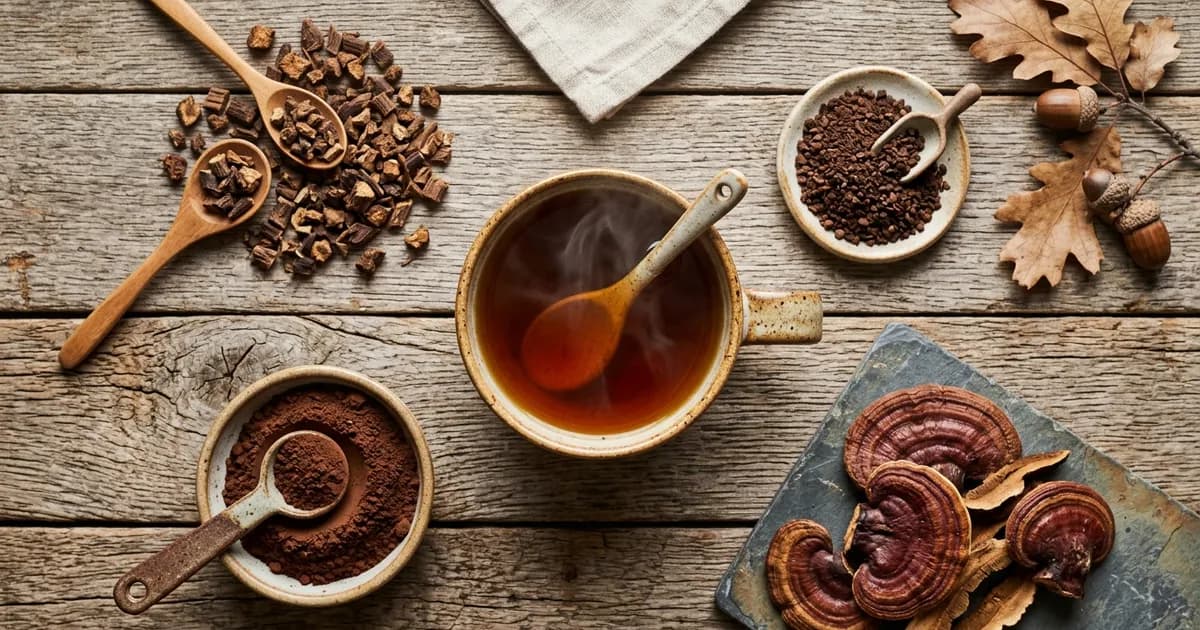
If you want the closest thing to actual coffee among coffee alternatives caffeine free, chicory root is the gold standard. Roasted and brewed, it produces a dark, slightly bitter liquid that genuinely tastes like coffee. New Orleans has been blending chicory with coffee for over a century.
The real story here is inulin, a prebiotic fiber found in high concentrations in chicory root. According to Healthline, several studies have shown that supplementing with inulin can increase the concentration of beneficial bacterial strains in the colon. A review on GoodRx also notes that inulin fiber may help lower blood sugar levels in people with diabetes.
Best for: People who want a true coffee taste swap with gut health benefits.
How to brew it: Treat it like ground coffee. French press, pour-over, or drip all work. Start with a 2:1 ratio of water to chicory grounds and adjust to taste.
2. Mushroom "Coffee" Blends (Caffeine-Free Versions)
Not all mushroom coffees are caffeine-free. Many popular brands blend functional mushrooms with actual coffee beans. But a growing number of products now offer pure mushroom blends with zero caffeine, built around lion's mane, reishi, chaga, and cordyceps. These rank among the most popular coffee alternatives caffeine free for a reason.
Lion's mane is the one getting the most research attention for cognitive function. As Medichecks reports, adaptogenic mushrooms have been used for centuries in Traditional Chinese and Ayurvedic medicine, and modern research is starting to validate some of those traditional uses. Reishi, meanwhile, has been associated with cortisol regulation and improved sleep, according to reporting from Vice.
Best for: People who want cognitive and stress-management support without caffeine.
What to look for: Check the label. If it lists "coffee" or "coffee extract" in the ingredients, it contains caffeine. Look for blends that use roasted chicory or cacao as the base instead.
3. Roasted Dandelion Root Tea
Dandelion root, when roasted, brews into a rich, earthy drink that sits somewhere between coffee and a dark herbal tea. As a caffeine free option, it has a slight bitterness that coffee drinkers tend to appreciate, making it one of the more satisfying coffee alternatives caffeine free.
The traditional use case for dandelion root centers on liver support. Tea-and-Coffee.com notes that dandelion root is caffeine-free and packed with vitamins and minerals, and it might support liver health. The evidence is mostly preclinical at this point, but it's a solid option if you want a warm, bitter brew with zero caffeine and some nutritional upside.
Best for: Evening drinkers who want a coffee-like ritual without any stimulant effects.
4. Rooibos "Red Espresso"
Rooibos comes from a plant native to South Africa, and when it's finely ground and brewed under pressure (like espresso), it produces a reddish, full-bodied shot with a naturally sweet, nutty flavor. No caffeine. No tannins, either, which means it won't taste astringent or dry out your mouth the way over-steeped black tea does. Among coffee alternatives caffeine free, rooibos stands out for its versatility.
Healthline reports that rooibos tea is rich in antioxidants, and research has found that antioxidants may help reduce the risk of certain chronic conditions. A 2023 review cited by the same source found that rooibos contains several minerals, especially flavonoids such as aspalathin, which is unique to the rooibos plant.
Best for: People who want a caffeine-free option that works with milk and can be used in lattes.
5. Golden Milk (Turmeric Latte)
Golden milk is warm milk (dairy or plant-based) blended with turmeric, black pepper, cinnamon, and sometimes ginger. It's become a staple among coffee alternatives caffeine free, and the active compound doing the heavy lifting is curcumin.
The black pepper matters. As Profusion Curry explains, piperine in black pepper enhances the bioavailability of curcumin. Without it, your body absorbs very little of the turmeric's active compound.
Golden milk won't give you a coffee-like flavor profile. It's warm, slightly spicy, and creamy. Think of it as a replacement for the ritual of a warm morning drink rather than a direct coffee substitute.
Best for: People who want an anti-inflammatory evening drink and don't need a coffee-like taste.
6. Peppermint Tea
This one surprises people. Peppermint tea is zero caffeine, easy to find, cheap, and backed by more cognitive research than you'd expect. It's one of the most underrated coffee alternatives caffeine free.
A 2025 study published in Human Psychopharmacology: Clinical and Experimental found that consuming just 200 mL of peppermint tea improved performance in several cognitive areas, especially memory and attention. An earlier study on PubMed found that peppermint enhanced memory and increased alertness, while also improving processing speed.
No caffeine needed. Just menthol and rosmarinic acid doing quiet, reliable work.
Best for: Afternoon focus sessions when you want mental clarity without any stimulant.
7. Roasted Barley Tea (Mugicha)
Popular across Japan and Korea, mugicha is made from roasted barley and served hot or cold. It has a toasty, slightly nutty flavor that's more approachable than chicory for people who don't love bitterness. Zero caffeine, zero calories. For anyone building a rotation of lesser-known coffee alternatives caffeine free, mugicha deserves a spot.
Kitchen Treaty's guide to caffeine-free coffee alternatives lists barley among the top herbal coffee substitutes, alongside chicory and figs. It's been a daily staple in East Asian households for generations, often served cold during summer months.
Best for: People who want a light, refreshing caffeine-free drink that works both hot and iced.
How to Choose the Right Coffee Alternatives Caffeine Free
The "best" option depends entirely on what you're solving for. Here's a quick comparison:
| Alternative | Tastes Like Coffee? | Key Benefit | Best Time of Day |
|---|---|---|---|
| Chicory Root | Yes | Gut health (inulin) | Morning |
| Mushroom Blends | Somewhat | Cognitive support | Morning/Afternoon |
| Dandelion Root | Close | Liver support | Evening |
| Rooibos Espresso | No (sweeter) | Antioxidants | Any time |
| Golden Milk | No | Anti-inflammatory | Evening |
| Peppermint Tea | No | Memory and attention | Afternoon |
| Roasted Barley | Slightly | Hydration, low-calorie | Any time |
If the taste of coffee is non-negotiable, start with chicory root or dandelion root. If you care more about cognitive function, mushroom blends and peppermint tea are the stronger plays. The best coffee alternatives caffeine free are the ones that match your specific goals.
The Case for Low-Dose Caffeine Instead of Zero
Here's the thing most "quit caffeine" articles won't tell you: caffeine itself isn't the problem. The dose is. Not everyone needs to go fully caffeine free; some people just need to go lower.
A randomized placebo-controlled study published in the Journal of Clinical Biochemistry and Nutrition found that L-theanine improved working memory and executive function by enhancing attention. When L-theanine is paired with a low dose of caffeine, the combination tends to produce calm, sustained focus without the spike-and-crash pattern of a full coffee.
The Alzheimer's Drug Discovery Foundation notes that L-theanine has positive effects on cognitive function when combined with caffeine, though its effects alone appear more modest.
The sweet spot, based on the research, seems to land around a moderate dose of caffeine paired with L-theanine. That's enough to activate your adenosine system without overwhelming it. Enough to feel alert without feeling wired. For people who've tried coffee alternatives caffeine free and miss that slight edge, this overview of low-dose caffeine worth trying is worth considering.
Clean Energy Without the Compromise
If you've read this far, you're probably in one of two camps: you want caffeine gone entirely, or you want it dialed way down to a level that actually works with your brain instead of against it.
For the first camp, the coffee alternatives caffeine free listed above are real, studied, and worth experimenting with. Chicory root and peppermint tea are the two with the strongest combination of taste and science behind them.
For the second camp, Roon was built for exactly this. It's a sublingual pouch that delivers 80mg of caffeine alongside L-theanine, theacrine, and methylliberine. No coffee. No jitters. No crash. Just six to eight hours of clean, even focus.
Whether you go with coffee alternatives caffeine free or a smarter low-dose approach, you don't have to choose between wired and tired. You just need a better dose.