Why Can't Nurses Have Drinks at the Nurses' Station? OSHA 1910.1030, Explained
Why Can't Nurses Have Drinks at the Nurses' Station? OSHA 1910.1030, Explained
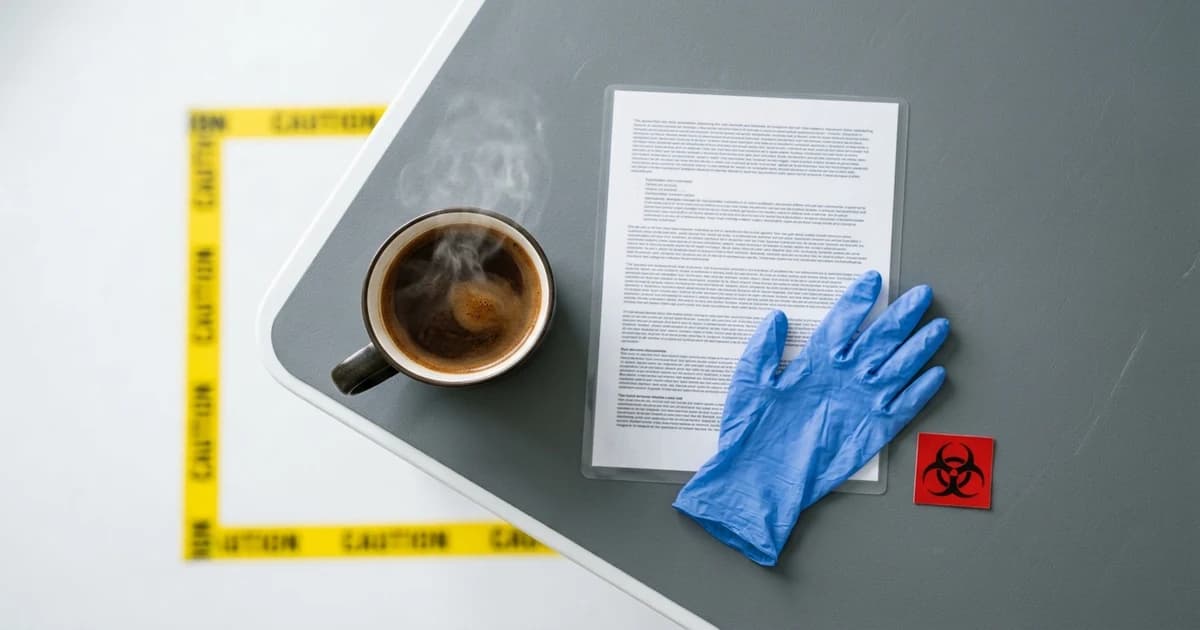
If you have ever asked why can't nurses have drinks at the nurses' station, the short answer is not a blanket federal ban. The rule your manager is citing comes from OSHA's Bloodborne Pathogens standard, 29 CFR 1910.1030(d)(2)(ix), which prohibits eating and drinking in work areas where there is a reasonable likelihood of occupational exposure. OSHA has addressed this exact question in writing and said a lid does not fix it. Your employer, not OSHA, decides which areas on your unit that standard covers.
The longer answer involves one federal regulation, one interpretation letter, your facility's exposure control plan, and a question nobody bothers to ask: what counts as a "work area" on your floor?
Key Takeaways
- OSHA does not ban drinks at all nurses' stations. It bans them in areas with a reasonable likelihood of exposure to blood or infectious materials.
- A lid or cover does not make a drink compliant. OSHA's concern is what gets on the outside of the container, then onto your hands.
- Your employer draws the line, unit by unit, through a required exposure control plan. That is why the rule looks different across two floors of the same hospital.
- An OSHA interpretation letter is not a regulation. It explains how OSHA reads an existing standard.
The Actual Regulation: 29 CFR 1910.1030(d)(2)(ix)
The standard is part of OSHA's Bloodborne Pathogens rule, and the text is short enough to read in full:
"Eating, drinking, smoking, applying cosmetics or lip balm, and handling contact lenses are prohibited in work areas where there is a reasonable likelihood of occupational exposure."
A companion provision at (d)(2)(x) adds that food and drink cannot be kept in refrigerators, freezers, shelves, cabinets, or on countertops and benchtops where blood or other potentially infectious materials are present or where there is a reasonable likelihood of occupational exposure.
That is the entire regulatory text behind the "no drinks" rule. Notice what it does and does not say. It does not mention nurses' stations by name. It does not mention hospitals specifically. It applies wherever there is a reasonable likelihood of occupational exposure to blood or other potentially infectious materials. Whether your nurses' station qualifies is a fact question about your unit, not a blanket federal decree.
| Source | What it says | What it does not say |
|---|---|---|
| 29 CFR 1910.1030(d)(2)(ix) | No eating or drinking in work areas with a reasonable likelihood of occupational exposure | That all nurses' stations are banned areas |
| 29 CFR 1910.141(g)(2) | No consuming beverages in areas exposed to toxic materials | That a lid resolves contamination risk |
| OSHA Interpretation Letter, May 17, 2006 | OSHA has no general prohibition on beverages at hospital nursing stations; the employer must evaluate each area | That any specific station is or is not compliant |
The 2006 Interpretation Letter: Why a Lid Does Not Settle It
In May 2006, a registered nurse named Barbara Caporusso of Coram, New York, wrote to OSHA with a direct question: is it against OSHA regulation to keep a covered beverage at a nurse's station in a hospital?
OSHA's response opened with the line most people get wrong in both directions: "OSHA does not have a general prohibition against the consumption of beverages at hospital nursing stations."
That is not a green light. The letter goes on to cite 1910.1030(d)(2)(ix) and 1910.141(g)(2), then addresses the lid question. OSHA has noted in its guidance on this topic that even when a beverage has a lid or cover, the container itself may become contaminated, resulting in unsuspected contamination of the hands when the worker picks it up.
Read that twice. The concern is not what falls into the cup. It is what gets on the outside of the cup, and then onto your hands when you pick it up. A lid protects the liquid inside the container. It does nothing about the surface you touch.
One clarification worth stating plainly: an OSHA interpretation letter is not itself a regulation. It explains how OSHA reads an existing standard as applied to a specific set of facts. It carries weight in enforcement, but it is not a new rule.
Who Actually Draws the Line on Your Unit
The same letter spells out the mechanism: "The employer must evaluate the workplace to determine in which locations food or beverages may potentially become contaminated and must prohibit employees from eating or drinking in those areas."
This is why the OSHA drinks at nurses' station question has a different answer on a med-surg floor than in a radiology reading room. Three scenarios play out in practice:
Physically separated station. If a nurses' station is enclosed, separated from patient-care and specimen-handling areas, and your employer determines that contamination risk in that specific location is low, they may permit drinks there. OSHA's letter acknowledges this: the employer may allow food and beverages in areas it has evaluated and found sufficiently separated.
Station inside the treatment area. If the desk sits in the middle of a unit where blood draws, wound care, or specimen handling happen within arm's reach, the standard applies and your employer must prohibit eating and drinking there.
The enforcement drift. On some units, the policy exists on paper but enforcement is inconsistent. Charge nurses look the other way. Someone puts a mug behind the monitor. This does not mean the rule is optional. It means your facility's exposure control plan says one thing and the floor culture says another. If a surveyor or OSHA compliance officer walks in, the plan is what matters.
Where to look: your facility's exposure control plan, which 1910.1030 requires every employer to maintain and make available to employees. If your manager says "OSHA says no coffee" and cannot point you to the plan, ask for it. The standard gives you the right to see it.
What the Research Says About Caffeine on Shift (and What It Does Not)
A Cochrane systematic review (Ker et al., 2010) included 13 trials and found that caffeine "can reduce the number of errors" compared to placebo in trials that measured errors. But two limits matter. None of the trials collected outcome data on the occurrence of injuries. And the authors noted methodological limitations including the use of simulated shift-work settings and a lack of confirmed shift work disorder diagnoses among participants.
Caffeine reduces errors in lab settings. Whether that finding extends to clinical outcomes on a hospital unit is a question nobody has tested. Do not let anyone, including a supplement company, tell you otherwise.
The FDA cites 400 mg per day as the amount not generally associated with negative effects for most adults, roughly two to three 12-ounce cups of brewed coffee.
What Nurses Do Instead
The practical question behind the regulation is simple: how do you get caffeine into your system during a 12-hour shift when you cannot bring a container to the desk?
Break room, break time. The most common answer. Coffee, tea, energy drinks, whatever you want, consumed in a designated area away from patient care. NIOSH's shift-work training for nurses notes that caffeine takes about 15 to 45 minutes to take effect, with a half-life of roughly 5 hours (FDA). If you drink a cup of coffee near the end of a night shift, there can still be enough caffeine in your system to cause restlessness while you are trying to sleep the next morning.
Container-free formats. Caffeinated gum, the kind included in U.S. military rations, contains 100 mg of caffeine per piece and is absorbed through the oral mucosa faster than beverages. Caffeine pouches (often around 50 to 100 mg depending on brand) work the same way: no cup, no lid, no hands. A format comparison can help if you are weighing the two.
A hands-free format changes the container problem. It changes nothing about the exposure rule itself. Whether something may be in the mouth in a clinical area is a separate question that your facility's policy governs, not OSHA's Bloodborne Pathogens standard. Check before you assume.
NIOSH also makes a point worth repeating: caffeine is a tool. It is not a substitute for rest, a proper night-shift strategy, or staffing levels that let you take a break.
Conclusion: The Rule Is Real, the Myth Is in the Details
The nurses' station no-drinks rule is not a myth. It is a real OSHA standard with a specific scope. The myth is the version where someone says "OSHA bans all drinks for nurses," because that is not what the regulation says, and it is not what OSHA wrote in 2006. The standard bans eating and drinking in areas with a reasonable likelihood of occupational exposure. Your employer determines which areas those are. A lid does not change the analysis.
If the rule on your unit feels arbitrary, the answer is not to argue with your charge nurse about federal law. The answer is to read the exposure control plan, understand what it covers, and know where the designated areas are. The regulation protects you. The inconvenience is real. Both of those things are true at the same time.
Frequently Asked Questions
Is it an OSHA violation to have coffee at the nurses' station?
It depends on the station. 29 CFR 1910.1030(d)(2)(ix) prohibits drinking in work areas where there is a reasonable likelihood of occupational exposure to blood or infectious materials. If your employer has determined that your nurses' station is such an area, then yes, having coffee there puts the facility out of compliance. If the station is physically separated from exposure risk and your employer permits it, it is not a violation.
Does a lid make it OSHA-compliant?
No. OSHA's 2006 interpretation letter specifically addressed this: the container itself may become contaminated, and picking it up transfers that contamination to your hands. A lid protects the liquid. It does not protect the surface you touch.
Can my employer ban drinks even if OSHA does not require it?
Yes. OSHA sets minimum requirements. The interpretation letter states that OSHA standards "do not prohibit employers from adopting more stringent requirements." Your facility can ban drinks in any area it chooses, for any reason, including survey readiness, infection control policy, or institutional preference.
Where can nurses drink on shift?
In areas your employer has designated as safe for food and drink consumption, typically break rooms, staff lounges, or other spaces physically separated from patient-care and specimen-handling areas. Your facility's exposure control plan should identify these locations. If it does not, that is a question for your manager or your safety officer.
Does the no-drinks rule cover water?
The regulation says "drinking." It does not carve out an exception for water. If drinking is prohibited in a given work area under 1910.1030(d)(2)(ix), water is included. Some facilities create separate hydration policies, but that is an employer decision, not an OSHA exception.
Is chewing gum or using an oral pouch allowed in patient-care areas?
The Bloodborne Pathogens standard specifically prohibits "eating, drinking, smoking, applying cosmetics or lip balm, and handling contact lenses." It does not mention gum or oral pouches by name. Whether your facility permits them in a given area is governed by your employer's policy, not by this standard. Ask before assuming.
A Caffeine Format Built for No-Container Rules
If the container is the problem, a format that removes the container is worth knowing about. Roon is a zero-nicotine oral pouch with 80 mg caffeine, 60 mg L-theanine, 25 mg Dynamine, and 5 mg TeaCrine per pouch. No cup, no lid, no hands. Roon is not a fatigue treatment and is not a substitute for sleep or adequate staffing. Whether your facility allows it in a clinical area is your facility's call, not ours.
Written by Roon Team