What Can I Take to Stay Awake on a Night Shift? Pills, Drinks, and Pouches Compared
What Can I Take to Stay Awake on a Night Shift? Pills, Drinks, and Pouches Compared
The 3 to 4 a.m. Wall is real. It is the lull where the coffee you drank at midnight has already failed, your eyes feel sandpapered, and you are hunting for the one thing that keeps you sharp without wrecking tomorrow's sleep. That wall is not weakness. It is your circadian clock pushing hard for sleep at the exact hour your body expects to be unconscious, and no amount of willpower argues with a 24-hour biological rhythm.
The honest answer is a timed, capped dose of a stimulant taken early in the shift, paired with light, movement, and a pre-shift nap. What matters is not the size of the dose but the clock. Take something in the first half of the shift so it clears before you try to sleep. Take it too late, or pile on more as the shift drags, and you will still be wired at 8 a.m. when you need to be unconscious. The options that fail night workers share a common flaw: they spike you when you are already running low and drop you when you can least afford it.
This article is informational and is not medical advice. If night-shift fatigue is chronic or affecting your safety, talk to a clinician.
What's the Best Thing to Take to Stay Awake on a Night Shift?
The best thing to take to stay awake on a night shift is a measured dose of caffeine, ideally paired with L-theanine, taken in the first half of your shift so it clears before you try to sleep in the morning. This single rule answers most of the question. Stimulant timing matters more than stimulant strength.
The U.S. National Institute for Occupational Safety and Health, in its training for nurses, notes that caffeine can promote alertness and performance during night work, but the agency is equally clear that it works best in modest, well-timed amounts rather than large late-shift doses. Caffeine has a half-life of roughly five to six hours in most healthy adults, which means a 2 a.m. Dose still has meaningful blood levels at 8 a.m. When you are trying to fall asleep. Front-load it, then stop.
Key Takeaways
- Time it, do not just dose it. Take caffeine in the first half of the shift so it clears before daytime sleep.
- Cap the total. Most health authorities place a safe ceiling near 400 mg of caffeine per day for healthy adults.
- Pair caffeine with L-theanine to smooth the jitter and edge without dulling the alertness.
- Energy drinks and high-dose pills backfire through sugar crashes and overstimulation.
- No supplement replaces sleep. A pre-shift nap and a dark, consistent daytime sleep routine are the foundation.
The Half-Shift Caffeine-Timing Rule
Stop your last caffeine at the halfway point of your shift. That is the single most useful rule for night workers, and it follows directly from how long caffeine lingers in the body.
Caffeine clears slowly. With a half-life of about five to six hours, half of what you drink at 1 a.m. Is still circulating around 7 a.m. The NIOSH nurse training is explicit that caffeine should be avoided toward the end of a shift so it does not interfere with sleep after work. For a standard eight-hour overnight from 11 p.m. To 7 a.m., that means your last dose should land before 3 a.m. Take it earlier, hit the wall with reserves already in your system, and let the back half of the shift coast on what you already have on board.
The math is simple. If you plan to sleep at 8 a.m. And you want your caffeine substantially cleared, the front half of the shift is your window. The back half is for tapering off, not topping up.
Option Comparison: Pills, Drinks, Coffee, L-Theanine Stack, Pouch
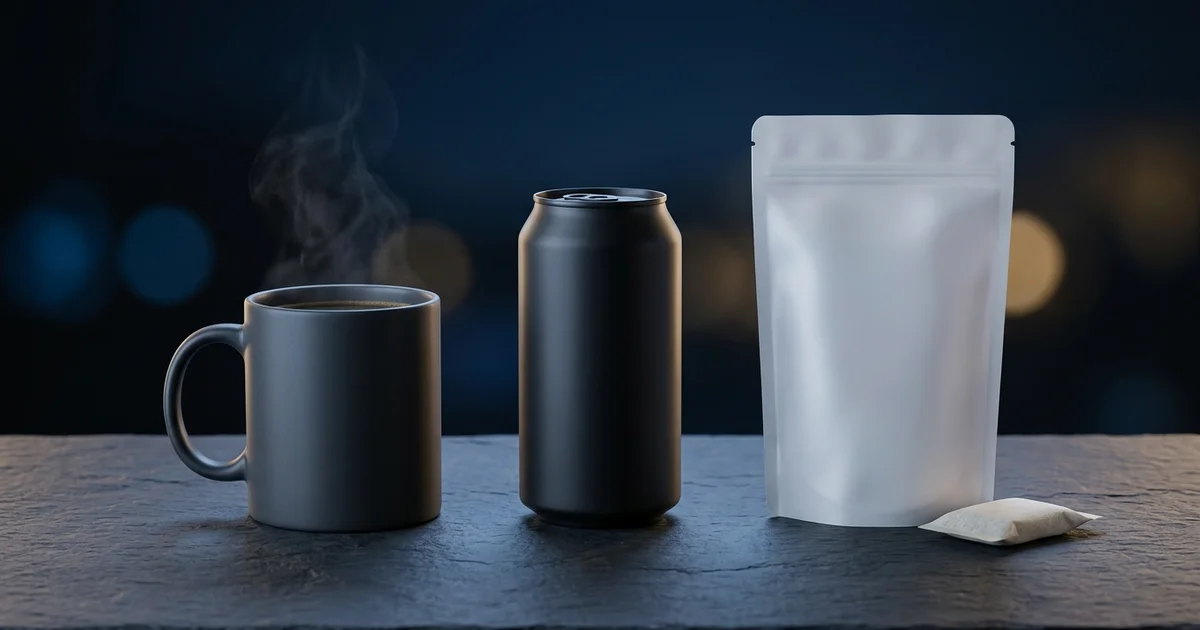
No single format wins on every axis, but the formats differ sharply on crash risk, dose control, and how badly they sabotage your morning sleep. The table below compares the common options night workers actually reach for.
| Option | Onset | Duration | Crash risk | Dose control | Daytime sleep impact | Discreetness |
|---|---|---|---|---|---|---|
| Black coffee | 30-45 min | 4-6 hr | Low to moderate | Poor (varies by cup, 80-200 mg) | Moderate if timed late | Low (smell, bathroom trips) |
| Energy drinks | 15-30 min | 3-5 hr | High (sugar + caffeine spike) | Poor (often 160-300 mg plus sugar) | High | Low (bulky cans) |
| High-dose caffeine pills | 30-60 min | 5-7 hr | High (jitters, overshoot) | Moderate but easy to overshoot (200 mg tablets) | High | High |
| Caffeine + L-theanine capsule stack | 30-45 min | 4-6 hr | Low | Good | Moderate if timed late | High |
| Sublingual pouch (e.g., Roon) | 5-10 min | Sustained | Low (capped, balanced dose) | Strong (fixed 80 mg per pouch) | Lower if used first-half only | High (no liquid, no smell) |
A few honest notes. Coffee is fine and familiar, but a venti drip can hide far more caffeine than you think, which wrecks the timing rule. Energy drinks are the worst offenders because the sugar load delivers a fast lift and a faster fall. The capsule stack of caffeine plus L-theanine is genuinely good chemistry, just slower to act. A zero-nicotine sublingual pouch like Roon sits in the no-crash, dose-controlled column: a fixed 80 mg of caffeine and 60 mg of L-theanine per pouch, absorbed quickly under the tongue, which makes it easy to use early and then stop on schedule. It is a delivery format, not a magic answer, and it does not exempt you from the timing rule.
Why Energy Drinks and Mega-Dose Pills Backfire
Energy drinks and high-dose caffeine pills fail night workers for the same reason: they trade a steep peak for a steep fall. The lift feels great for an hour. The descent lands you below where you started.
Energy drinks pair caffeine with large amounts of sugar. Blood glucose rises fast, insulin chases it, and the rebound drop leaves you groggier than before, often right at the 4 a.m. Trough you were trying to avoid. Stack a few cans across a shift and you also blow past the caffeine ceiling. The FDA and most health authorities place that ceiling near 400 mg per day for healthy adults, an amount many night workers exceed without counting.
Mega-dose pills cause a different problem. A single 200 mg tablet, doubled out of desperation, pushes you into jitter, racing heart, and anxiety, which feels like alertness but degrades the fine attention and judgment a night shift actually demands. More caffeine past your personal threshold does not buy more focus. It buys tremor. This is the case for L-theanine, an amino acid that pairs well with caffeine. In a controlled crossover study, researchers found that the combination of L-theanine and caffeine improved attention and accuracy on demanding cognitive tasks compared to caffeine alone, with less of the overstimulated edge.
The Behavioral Stack Underneath
No pill, drink, or pouch works without the behavioral foundation under it. Stimulants buy you a sharper few hours. Sleep, light, movement, and water decide whether you have anything to sharpen.
- Nap before the shift. A 20 to 90 minute nap in the early evening, before you clock in, is the single best move a night worker can make. It directly reduces the depth of the 4 a.m. Trough.
- Use light strategically. Bright light during the first half of the shift supports alertness. On the drive home, wear sunglasses so morning sun does not signal "wake up" right before you try to sleep.
- Move every couple of hours. A brisk five-minute walk raises core temperature and alertness more reliably than another cup of coffee at hour seven.
- Protect daytime sleep. A dark, cool, quiet room with the phone silenced is non-negotiable. The Sleep Foundation notes that shift work disorder is characterized by insomnia and excessive sleepiness associated with a work schedule that overlaps the normal sleep period, and the fix starts with guarding the hours you do sleep.
Treat the supplement as the top layer, not the base. Caffeine on no sleep is a loan against tomorrow, and the interest rate is steep.
When Night-Shift Fatigue Needs a Doctor
See a clinician when fatigue stops responding to good sleep habits, or when sleepiness threatens your safety on the road or the job. Persistent night-shift exhaustion is not just a coffee problem.
The Sleep Foundation describes shift work disorder as a recognized circadian rhythm sleep disorder, and notes that people with the condition experience insomnia, excessive sleepiness, or both, tied to their work schedule. If you are sleeping during the day and still cannot stay awake at work, falling asleep at the wheel, or relying on escalating caffeine just to function, that warrants a medical conversation, not a stronger energy drink.
A few firm boundaries. Do not exceed roughly 400 mg of caffeine per day. Do not self-prescribe wakefulness medications or borrow anyone's prescription stimulants; those are decisions for a physician who knows your history. And if you have a heart condition, are pregnant, or take medications that interact with stimulants, get personalized advice before relying on any caffeine product.
The Real Answer Is Timing, Not Brute Force
Staying awake through the 4 a.m. Wall is not about finding the strongest stimulant. It is about a measured dose of caffeine, taken early enough to clear before you sleep, paired with L-theanine to keep the edge off, and built on top of a pre-shift nap and disciplined daytime sleep.
The options that fail share a common flaw: they spike you when you are already tired and drop you when you can least afford it. The options that work respect two numbers, a daily caffeine ceiling near 400 mg and a half-life near five to six hours, and they front-load the dose. Get the timing right and the format becomes a matter of preference. Get it wrong and no format saves you.
Frequently Asked Questions
How much caffeine is safe on a night shift?
Most health authorities, including the FDA, consider up to about 400 mg of caffeine per day safe for healthy adults. On a night shift, the bigger issue is timing. Front-load that allowance in the first half of your shift and stop several hours before your morning sleep, since caffeine's five-to-six-hour half-life means a late dose still circulates when you are trying to rest.
When should I stop drinking caffeine before sleeping after a night shift?
Stop at roughly the halfway point of your shift. NIOSH advises avoiding caffeine toward the end of a shift so it does not interfere with post-work sleep. Because caffeine has a half-life of about five to six hours, a dose taken six hours before bed still leaves meaningful levels in your system. For a shift ending at 7 a.m., your last dose should land before 3 a.m.
Are energy drinks good for staying awake at night?
No. Energy drinks pair caffeine with large amounts of sugar, which produces a fast lift followed by a blood-sugar crash that can leave you groggier than before. They also make it easy to overshoot the 400 mg daily caffeine ceiling without realizing it. A measured caffeine dose, ideally with L-theanine, gives steadier alertness without the sugar rollercoaster.
Does L-theanine help with night-shift focus?
L-theanine is an amino acid found in tea that pairs well with caffeine. In controlled studies, the combination improved attention and task accuracy compared to caffeine alone, with less of the jittery, overstimulated feeling. It does not make you drowsy. It smooths the rough edges of caffeine so you get alertness without the tremor, which is exactly what fine night-shift tasks demand.
Can I just take a caffeine pill to power through?
You can, but high-dose pills are easy to overshoot. A single 200 mg tablet doubled out of desperation pushes many people into jitters, racing heart, and anxiety, which degrades the careful attention a night shift needs. More caffeine past your personal threshold does not buy more focus. Use a smaller, capped dose and pair it with L-theanine if you want the edge without the overstimulation.
What's better than caffeine for staying awake overnight?
A pre-shift nap. A 20 to 90 minute nap before you clock in reduces the depth of the 4 a.m. Alertness trough more reliably than any drink. Bright light early in the shift, movement every couple of hours, and hydration round out the foundation. Caffeine is the top layer on that base, not a replacement for it.
When should night-shift fatigue prompt a doctor visit?
When good sleep habits stop working. If you sleep during the day and still cannot stay awake at work, fall asleep driving home, or need escalating caffeine just to function, see a clinician. The Sleep Foundation classifies shift work disorder as a circadian rhythm sleep disorder marked by insomnia, excessive sleepiness, or both. Do not self-prescribe wakefulness medications.
Why a Dose-Controlled Pouch Fits the First Half of a Shift
This article comes down to two numbers: a caffeine ceiling near 400 mg and a half-life near five to six hours. The hard part is not the science. It is hitting a precise, capped dose early in the shift and then actually stopping. Coffee cups vary wildly, energy drinks hide sugar and overshoot, and pills are easy to double.
Roon was built for that exact control problem. Each zero-nicotine sublingual pouch delivers a fixed 80 mg of caffeine and 60 mg of L-theanine, plus 25 mg of methylliberine and 5 mg of theacrine, absorbed under the tongue in about five to ten minutes. The fixed dose makes the half-shift timing rule easy to follow: use one early, know exactly what you took, and stop before your morning sleep.
To be clear about what Roon is and is not. It is a dose-controlled, no-crash, zero-nicotine option for the first half of a shift. It is not a sleep aid, not a substitute for a pre-shift nap, and not a fix for chronic shift work disorder, which belongs in a clinician's hands. Try it as the top layer on a real sleep routine, not as a replacement for one.
By Roon Team