Study Breakdown: Rhodiola and the Night-Shift Physicians Fatigue Trial
Roon Team
Study Breakdown: Rhodiola and the Night-Shift Physicians Fatigue Trial
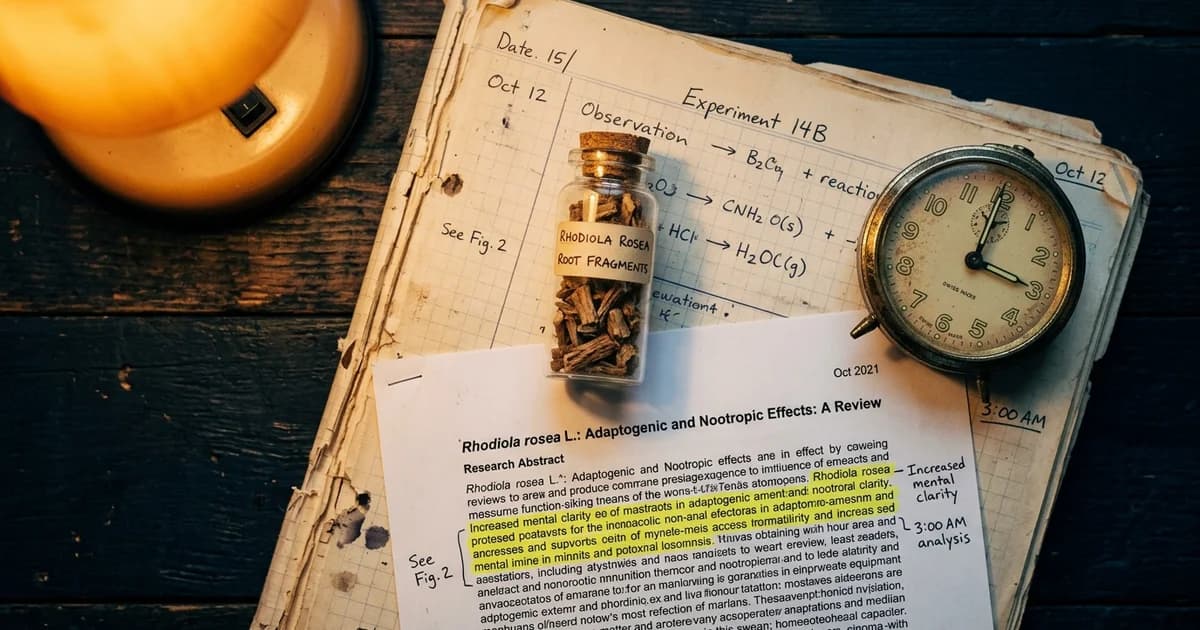
A small group of doctors stayed up all night, took a herbal extract, and solved math problems at 2 a.m. That sentence sounds like a setup for a punchline. It is actually the design of one of the most cited human trials on adaptogens ever run.
The rhodiola night shift study has been driving supplement marketing copy for more than two decades. Most of that copy gets the details wrong. The trial was real, the design was clever, and the results were genuinely interesting, but the effect size was modest and the follow-up was thin.
This is the honest version. What the researchers did, what they found, and what it actually means if you work nights or push through long cognitive shifts.
Key Takeaways
- The trial tested SHR-5 rhodiola extract on healthy young physicians working overnight hospital shifts, using a low repeated dose.
- Researchers measured mental performance with a Total Fatigue Index, and the rhodiola group scored better than placebo after two weeks.
- The benefit faded by the end of the study, hinting at a wash-out or adaptation effect rather than a permanent boost.
- Rhodiola works through a gentle, monoamine-mediated pathway (MAO inhibition), not through stimulation. It nudges, it does not push.
- One small trial does not settle the science. It opened a door that later research has only partly walked through.
The Rhodiola Night Shift Study That Started Everything
The study most people mean when they say "rhodiola for shift work" is Darbinyan and colleagues, published in Phytomedicine in 2000. You can find the original in the ScienceDirect archive.
The full title is a mouthful. It describes a double-blind, placebo-controlled, crossover study of a standardized rhodiola extract called SHR-5, using a repeated low-dose schedule, measuring the mental performance of healthy physicians during night duty.
That last detail matters. The subjects were not sick. They were not depressed. They were young, healthy doctors doing the same exhausting thing millions of shift workers do every night: trying to think clearly when their body wants to sleep.
Why Physicians On Night Duty?
Night-shift medicine is a near-perfect stress test for the brain. You need sustained attention, fast calculation, and short-term memory, all while your circadian clock screams at you to shut down.
The darbinyan rhodiola team picked this population on purpose. If an adaptogen could hold up cognition under real fatigue, an overnight hospital shift would expose it. No artificial sleep-deprivation lab, just the genuine grind of clinical work.
What the Researchers Actually Measured
The headline metric was a Total Fatigue Index, a composite score built from several cognitive tests run before and during night shifts. Lower scores meant less fatigue-related decline.
The test battery probed the kinds of thinking that fall apart first when you are tired. Associative thinking, short-term memory, calculation, concentration, and speed of audio-visual perception. These are the everyday mental functions, not abstract IQ puzzles.
Subjects took either SHR-5 rhodiola or an identical placebo, then crossed over to the other condition after a wash-out period. Because it was double-blind, neither the doctors nor the testers knew who got what.
The Dosing Detail Everyone Skips
The trial used a repeated low-dose regimen, not a single big pill. This is the part of the rhodiola fatigue trial that supplement labels rarely mention.
A low, repeated dose is a different beast from the high one-off doses sold today. If you are reading a product page that cites this study to justify a 500 mg capsule, the citation does not match the protocol.
The Results, Without the Hype
Here is the direct answer. The rhodiola group showed a statistically meaningful improvement in mental performance versus placebo during the first two weeks of night duty, reflected in a lower Total Fatigue Index.
In plain terms, the doctors on rhodiola made fewer fatigue-driven mental errors and held their concentration better through the overnight hours. That is a real, measurable result on a real-world task.
But read the next part carefully. The advantage was modest in size, and it appeared to fade as the study went on. The benefit was not a permanent upgrade. It looked more like a temporary cushion against acute fatigue that the body partly adjusted to.
How Big Was the Effect, Really?
Small sample. Short duration. A composite score rather than a single hard outcome like reaction time in milliseconds.
The trial enrolled only a few dozen physicians, which is fine for a pilot and weak for a definitive claim. A handful of subjects can show a real signal, but they cannot tell you how reliable that signal is across thousands of different people and shift patterns.
So the correct read is: promising, suggestive, worth following up. Not proof that rhodiola is a fatigue eraser.
How Rhodiola Works In the Brain
Rhodiola's anti-fatigue effect runs through your monoamine system, the same chemical family that includes serotonin, dopamine, and norepinephrine.
The active compounds, mainly rosavin and salidroside, appear to inhibit monoamine oxidase, the enzyme that breaks those neurotransmitters down. One 2009 ScienceDirect analysis found rhodiola extracts produced strong inhibition of both MAO-A and MAO-B in lab conditions.
Slow the breakdown, and slightly more of those signaling molecules stay available. That is the proposed reason rhodiola supports rhodiola mental performance under stress without acting like a stimulant.
Gentle, Not Fast
This is the key contrast for anyone weighing their options. Rhodiola does not flood your system with energy. It subtly shifts the chemistry that governs mood, drive, and fatigue resistance over hours and days.
That mechanism explains both its appeal and its limits. The effect is smooth and low-jitter. It is also slow to arrive and easy to miss if you expect a noticeable lift.
Where the Night-Shift Study Fits Today
One trial from 2000 is a starting point, not a verdict. Later research on rhodiola for stress and fatigue has been mixed, with some positive signals and several studies showing little separation from placebo.
The pattern across the literature is consistent with the original night-duty finding. Rhodiola seems to help most with stress-related and fatigue-related decline, and least when you are already rested and sharp.
If you grind through overnight shifts, founder hours, or rotating schedules, the science gives you a reasonable case to try it, with realistic expectations. A gentle edge against fatigue, not a switch that turns sleep deprivation off.
How Rhodiola Compares to Common Focus Aids
Different tools solve different problems. Here is an honest side-by-side for the rhodiola for shift work crowd weighing what to reach for.
| Option | Onset | Duration | Crash Risk | Best Use |
|---|---|---|---|---|
| SHR-5 Rhodiola | Slow, builds over days | Long, subtle | Very low | Sustained stress and fatigue resistance |
| Plain caffeine | 30-45 min | 3-5 hrs | Moderate to high | Quick acute alertness |
| Caffeine + L-theanine | 20-40 min | 4-6 hrs | Lower than caffeine alone | Smooth focus with fewer jitters |
| Roon sublingual pouch (80 mg caffeine, 60 mg L-theanine, 25 mg Dynamine, 5 mg TeaCrine) | 5-10 min | 6-8 hrs | Low, no-crash window | Fast, sustained focus on demand |
| Energy drinks | 15-30 min | 2-4 hrs | High | Short bursts only |
Rhodiola plays a different game than the caffeine-based options. It works in the background over time. The others work in the foreground, right now.
Conclusion
The night-shift physicians trial earned its place as a landmark for a simple reason. It tested an adaptogen on real people doing a genuinely hard cognitive job, and it found a modest, measurable benefit against fatigue.
The honest summary is smaller than the marketing. Rhodiola supported mental performance under overnight stress through a gentle monoamine pathway, the effect was moderate, and it faded over time. It is a slow, steady tool, not a fast one.
If you handle demanding shifts, that distinction is the whole point. Know what you are reaching for, match the tool to the moment, and judge any supplement by the actual protocol behind its claims, not the headline.
Frequently Asked Questions
What did the rhodiola night shift study actually prove?
It showed that healthy physicians taking a low repeated dose of SHR-5 rhodiola scored better on a Total Fatigue Index than those on placebo during the first two weeks of night duty. The benefit was modest and appeared to fade over time. It is best read as a promising pilot result on real-world cognitive fatigue, not as definitive proof that rhodiola eliminates the effects of sleep loss.
Who ran the trial and where was it published?
The study was led by Darbinyan and colleagues and published in the journal Phytomedicine in 2000. It used a double-blind, placebo-controlled crossover design, which is a strong structure for a small trial. The full record is archived on ScienceDirect. Many supplement pages cite it, though they often misstate the dose and the size of the effect.
How does rhodiola fight fatigue?
Rhodiola's active compounds, mainly rosavin and salidroside, appear to inhibit monoamine oxidase. That enzyme breaks down serotonin, dopamine, and norepinephrine. By slowing that breakdown, rhodiola may keep slightly more of these mood and drive chemicals available, which supports fatigue resistance. The pathway is gentle and gradual, which is why rhodiola feels nothing like a stimulant.
Is rhodiola good for shift work?
The night-duty trial gives shift workers a reasonable, science-based case to try rhodiola, with realistic expectations. It seems to help most with stress and fatigue-related cognitive decline. Set expectations for a subtle edge that builds over days, not an immediate lift. It does not replace sleep, and it will not undo the health costs of chronic sleep deprivation.
How is rhodiola different from caffeine?
Caffeine is a fast, direct stimulant that blocks adenosine and produces alertness within 30 to 45 minutes, often with a crash later. Rhodiola is a slow-acting adaptogen that shifts monoamine chemistry over days with very low jitter risk. They solve different problems. Caffeine handles acute, right-now alertness. Rhodiola supports background resistance to ongoing stress and fatigue.
What dose did the study use?
The trial used a standardized SHR-5 extract on a repeated low-dose schedule rather than a single large dose. This matters because many modern products sell high one-off capsules while citing this low-dose protocol as evidence. If a product page references the night-shift study, check whether its dose actually matches the one tested.
Does the rhodiola benefit last?
In the original trial, the advantage over placebo was clearest in the first two weeks and appeared to weaken afterward. That pattern suggests the body partly adapts, or that the effect is strongest against acute, novel fatigue. It points to rhodiola as a tool for specific stressful stretches rather than a permanent cognitive upgrade you take forever.
The Shift-Worker's Real Choice: Slow Background Support vs. Fast Focus
Rhodiola earns its reputation as a slow, steady adaptogen. The night-shift trial showed it can soften fatigue under genuine cognitive load, working quietly through your monoamine system over days. That is a real strength, and it is also a real limit. When you need clear thinking in the next ten minutes, a gradual herbal extract is the wrong tool.
That gap is exactly what Roon was built to fill. It is a sublingual pouch with a focused 4-ingredient formula: 80 mg caffeine, 60 mg L-theanine, 25 mg methylliberine (Dynamine), and 5 mg theacrine (TeaCrine). It hits in 5 to 10 minutes and holds for 6 to 8 hours with no jitters, no crash, and no tolerance buildup.
To be clear, Roon is not an adaptogen and not a substitute for sleep or recovery. It is a fast, on-demand focus tool for the moment you actually need to perform. If your shifts demand sharp thinking right now, not three days from now, try Roon and feel the difference in onset for yourself.
Written by Roon Team