Maca (Lepidium meyenii): What the Mood
Roon Team
Maca (Lepidium meyenii): What the Mood and Energy Trials Really Found
Maca gets sold as a clean, plant-based answer to low energy, flat mood, and a sluggish libido. The marketing is louder than the data. When you read the actual human trials on maca mood energy benefits, you find a smaller, messier, more interesting story than the supplement aisle suggests.
The short version: maca shows real promise for subjective energy and mood, especially in specific populations. The evidence is thin, the sample sizes are tiny, and the cognition claims are the weakest part of the whole pitch.
Here is what the research actually says, color by color, trial by trial.
Key Takeaways
- Maca (Lepidium meyenii) is a Peruvian root with early human evidence for energy and mood, mostly in small trials.
- The strongest mood signals come from studies in menopausal and postmenopausal women, not the general population.
- Endurance studies are mixed: maca often beats your own baseline but rarely beats placebo.
- Red maca and black maca behave differently, and most consumer powders do not tell you which you are getting.
- There is no solid human evidence that maca sharpens attention or working memory.
What Maca Actually Is
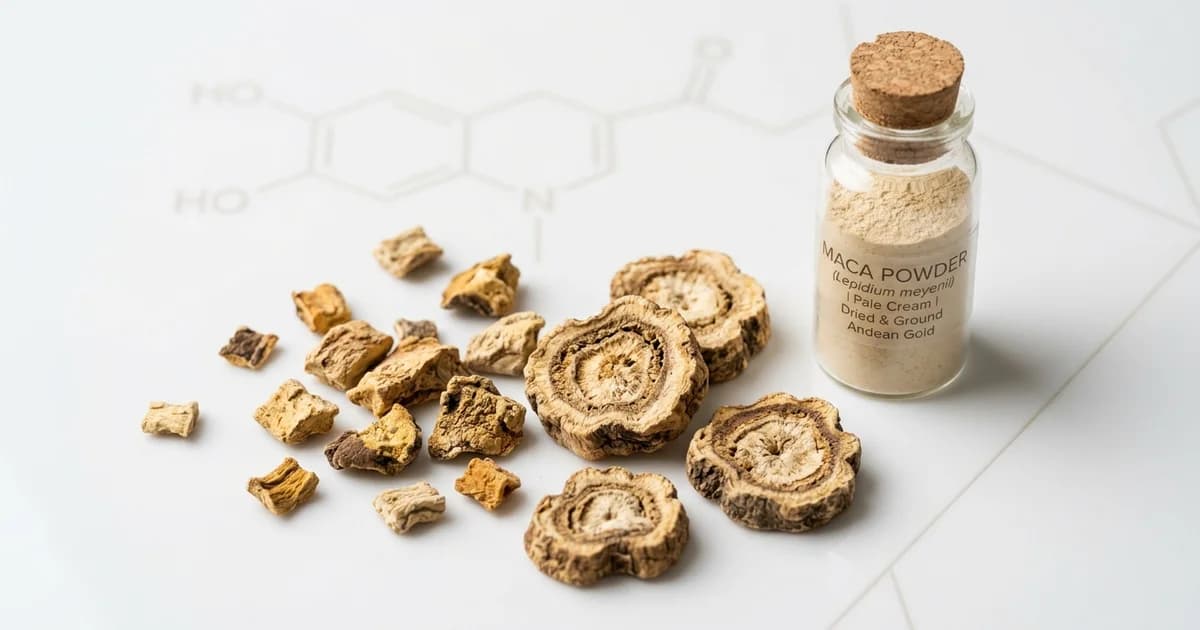
Maca is the root of Lepidium meyenii, a cruciferous plant grown high in the Peruvian Andes. It sits in the same botanical family as broccoli and cabbage. Locals have eaten it as food and used it as a stimulant for centuries.
The active compounds people care about are macamides and glucosinolates, plus a dense nutritional profile of carbs, fiber, and minerals. Most proposed mechanisms, like adrenal support and better cellular oxygen use, come from animal work, not controlled human trials.
Maca is often labeled an adaptogen. That word does a lot of heavy lifting in marketing and very little in the clinic. Treat "maca adaptogen" as a category claim, not a proven effect.
Maca for Energy: The Trials Are Mixed
Maca's energy reputation rests largely on endurance studies, and those results are inconsistent. The most cited human work is a pilot trial in trained cyclists.
Eight participants each completed a 40 km cycling time trial before and after 14 days supplementation with both maca extract and placebo, in a randomised cross-over design. The study set out to test endurance and sexual desire in trained male cyclists.
Here is the catch most blogs skip. In a separate cycling analysis, although maca markedly improved cycling time when compared to the baseline test, it did not markedly improve time when compared to the placebo. The researchers also noted that heart rate and perceived exertion were recorded at 5 km intervals throughout the trial, and there were no changes in either.
That distinction matters. Beating your own starting point is not the same as beating a sugar pill. When a supplement only outperforms baseline, expectation and training can explain the gain.
Some shorter-term work is more encouraging on the subjective side. A 2025 systematic review and meta-analysis of maca and physical performance found the human evidence limited and mixed, with some trials reporting reduced subjective fatigue rather than measured performance gains. Note the wording: reported feelings, not measured output.
So maca for energy is best read as a possible nudge to perceived stamina and post-exercise fatigue, with weak evidence for raw performance. If you want hard wattage gains, the cycling data does not back you up.
Maca and Mood: The Strongest Signal Is in Women
The mood evidence is more compelling than the energy evidence, but it is concentrated. Most positive mood findings come from trials in perimenopausal and postmenopausal women, where maca has been studied as a non-hormonal option for symptoms like low mood and anxiety.
This is where red maca mood claims come from. Red maca is the color most often studied for hormonal and psychological symptoms in women, while researchers have leaned on different colors for different outcomes.
The honest framing: maca may support mood in specific hormonal contexts, and the data outside those contexts is sparse. A healthy 30-year-old man with normal hormones should not assume the menopause trials apply to him. Mood research in the general population is thin enough that no one should promise a lift.
And the legal line matters. Maca is a food and supplement. It does not treat, cure, or prevent depression or anxiety, and any product that says otherwise is overselling the science.
Red Maca vs Black Maca vs Yellow Maca
The three main maca colors are not interchangeable, and the color you buy may matter more than the dose. Yellow is the most common and cheapest. Red and black are rarer and command higher prices.
In animal and early human work, the colors split along different lines. Black maca tends to be studied for cognition, stamina, and male fertility. Red maca shows up most in research on hormonal and prostate-related outcomes. Yellow sits in the middle as the everyday food-grade option.
Here is a clean comparison of how the colors are typically positioned in the literature.
| Maca Color | Most-Studied Use | Relative Availability | Notes |
|---|---|---|---|
| Yellow maca | General energy, everyday use | Most common | Cheapest, least specialized research |
| Red maca | Mood, hormonal and prostate outcomes | Less common | Often cited for "red maca mood" claims |
| Black maca | Stamina, fertility, cognition (animal models) | Rarest | Most expensive, most studied for the brain |
The practical problem: many retail powders blend colors or do not specify. If you bought maca for a black-maca cognition effect and got a yellow blend, you are not running the same experiment the studies ran.
Does Maca Help Cognition? Read This Before You Believe the Hype
There is no strong human evidence that maca improves attention, focus, or working memory. This is the gap between the marketing and the science.
The cognition story is built on rodents. In animal models, black maca has been linked to better memory after induced impairment and to preserved cognitive function tied to mitochondrial activity in aging mouse brains. Those are real findings. They are also mice.
Turning mouse cortex data into a promise that a maca latte will sharpen your 3 p.m. focus is a leap the human trials have not earned. Until controlled cognitive studies in healthy adults exist, "maca for focus" stays a hypothesis. If your actual goal is sustained attention, the evidence points toward ingredients studied directly for focus, not a root tested mostly for stamina and hormones.
How to Read Maca Research Without Getting Fooled
A few habits will keep you grounded when you read maca claims.
- Check baseline vs placebo. A result that only beats baseline is weak. The cycling data is the textbook example.
- Check the population. Mood wins in menopausal women do not automatically transfer to you.
- Check the color and dose. Red, black, and yellow are different inputs.
- Separate subjective from objective. "Felt less tired" is not the same as "produced more power."
- Discount animal-only claims. Mouse cognition studies are a starting point, not a verdict.
The Honest Verdict on Maca
Maca is a legitimate food with early, uneven evidence for energy and mood. The mood signal is real but concentrated in hormonal contexts, especially women navigating menopause. The energy signal is softer, leaning on subjective fatigue rather than measured output.
The cognition claims are the weakest link. They run on animal data and optimism, not human trials. If you try maca, try it for what the research actually supports, and keep your expectations sized to the evidence.
That gap between "marketed for the brain" and "tested for the brain" is the single most useful thing to remember about this root.
Frequently Asked Questions
Does maca give you energy right away?
No. Maca is not a fast stimulant like caffeine. Most maca research uses daily dosing over one to several weeks, and the energy effects reported are usually about reduced subjective fatigue rather than an immediate jolt. If you take it expecting a quick lift, you will likely be disappointed. Treat it as a slow, cumulative supplement and judge it after consistent use, not after a single serving.
Is red maca or black maca better for mood?
Red maca is the color most associated with mood and hormonal research, so "red maca mood" is the more grounded pairing. Black maca shows up more in stamina, fertility, and animal cognition studies. That said, the human mood evidence is concentrated in menopausal and postmenopausal women, so the right color matters less than whether you fit the population the studies actually tested.
Is maca a proven adaptogen?
"Adaptogen" is a marketing category more than a clinical one. Maca is often called an adaptogen because of proposed effects on stress hormones and fatigue, but most of that mechanism comes from animal work. The human evidence for stress resilience is limited. It is fair to call maca a traditional tonic with early supportive data, and unfair to claim it reliably blunts your stress response.
Can maca improve focus or memory?
There is no solid human evidence that maca improves focus, attention, or working memory. The cognition claims come from rodent studies, including black maca research in mice, where memory was preserved or improved after induced impairment. Those findings are promising for future research, but they have not been confirmed in healthy people. If sharper focus is your goal, maca is not the evidence-backed choice.
How much maca do studies use?
Human trials vary widely, but many use roughly 1.5 to 3 grams of maca powder or extract per day over several weeks. Dosing depends heavily on the form, the color, and whether it is a concentrated extract or raw powder. Because products differ so much, the label dose on one brand may not match the dose used in any published trial, which makes self-experimentation unreliable.
Does maca work for men's energy and performance?
The most cited men's study is a small pilot in trained cyclists that tested endurance and sexual desire. Maca improved cycling time versus baseline but not versus placebo, and heart rate and perceived exertion did not change. So the performance case is weak. Maca may support subjective stamina, but the controlled data does not show it makes men measurably faster or stronger.
Is maca safe to take daily?
Maca has a long history of dietary use and is generally well tolerated in the short-term trials that exist. Long-term safety data in large populations is limited, and quality varies between products. As with any supplement, talk to a clinician if you are pregnant, managing a hormone-sensitive condition, or taking medication. Maca is food-derived, but "natural" does not automatically mean risk-free for everyone.
Why the Cognition Gap Is the Whole Point
Maca's story is a clean lesson in how to read a supplement: energy and mood show early, population-specific promise, while the brain claims run on mice and hope. That distinction is the most valuable thing you can take from the research.
At Roon, we build around the opposite philosophy. We only claim what cognition-specific human trials support. Roon is not a maca product, and it is not a general wellness tonic. It is a sublingual pouch built for focus, using four studied ingredients: 80 mg caffeine, 60 mg L-theanine, 25 mg methylliberine (Dynamine), and 5 mg theacrine (TeaCrine).
The format is the point. You get a 5 to 10 minute onset and a 6 to 8 hour window of steady focus, without the jitters, crash, or tolerance creep. If you want an honest look at what the focus research actually supports, Roon is built on that standard.
Written by Roon Team