Pickleball Snacks and Drinks, From Open Play to Tournaments
Pickleball Snacks and Drinks, From Open Play to Tournaments
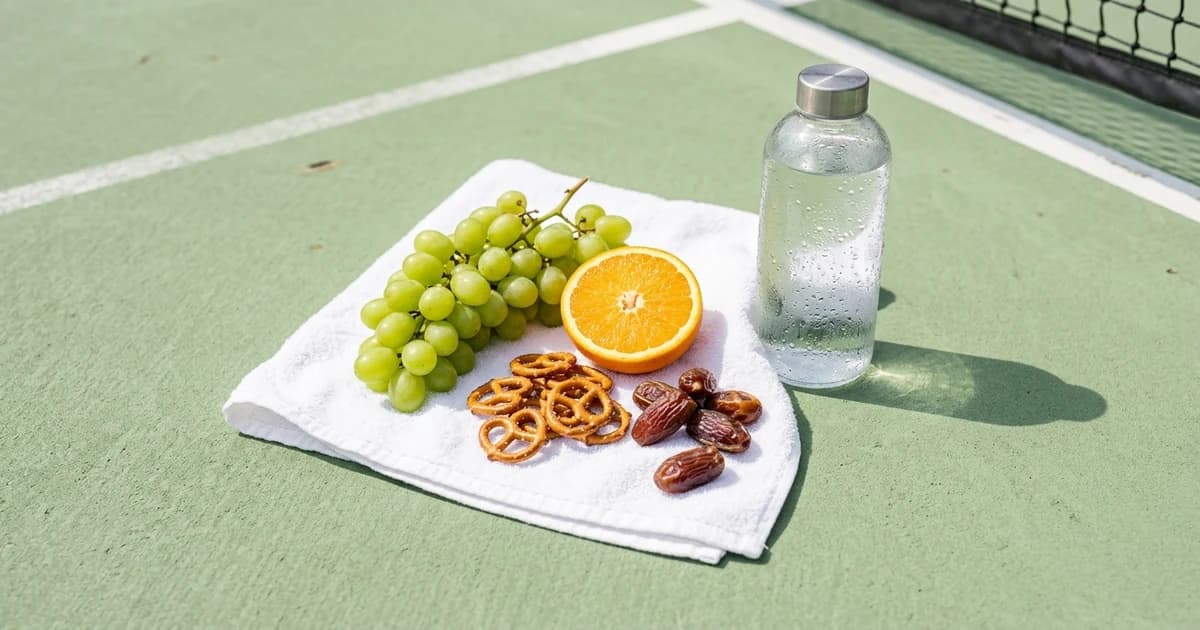
For pickleball, eat a carb-based meal two to four hours before play, then pack small, fast-digesting snacks for between games: fruit, pretzels, dates or a granola bar. If you are on court for under an hour, water is usually enough. Past an hour, aim for roughly 30 to 60 g of carbohydrate per hour and add an electrolyte drink, especially in heat.
Pickleball Snack Plan by Session Length
| Session | Before | During | Fluid | Caffeine (optional) |
|---|---|---|---|---|
| One open-play block (under 60 min) | Normal meal 2 to 4 h before | Usually nothing; a few grapes or orange segments if hungry | Water; aim to lose under 2% of body weight | Not needed |
| Open-play morning (1 to 3 h) | Carb-based breakfast 2 to 4 h before | About 30 to 60 g carbohydrate per hour from fruit, pretzels, dates or a bar | Water plus an electrolyte drink in heat | If used, early in the session and counted toward 400 mg/day |
| Tournament day (several matches) | Familiar carb-based meal; nothing new | Small snack after each match; a light half-sandwich only in long gaps | Drink steadily between matches; weigh before and after to learn your sweat rate | Smallest effective dose; none in the last 8 h before bed |
Carb guidance adapted from Jeukendrup 2014 (a review from a Gatorade-affiliated scientist); fluid goals from the ACSM 2007 position stand. Adjust for heat and your own sweat rate.
Before You Start
Three variables shape what and how much you need to eat and drink on a pickleball day:
- Session length. A single 30-minute open-play block barely needs a snack. A three-hour morning or a full tournament day is a different problem entirely.
- Heat and humidity. Sweat rates vary widely between people, and outdoor summer courts accelerate both fluid and electrolyte losses. The ACSM position stand on exercise and fluid replacement recommends customized hydration plans because individual sweat rates differ so much.
- The 400 mg caffeine ceiling. If you plan to use caffeine on a long day, count every source (coffee, energy drinks, pouches, pre-workout) toward the FDA's 400 mg daily figure for healthy adults, and leave at least eight hours between your last dose and bedtime.
What to Eat Before Pickleball
Eat a familiar, carb-based meal two to four hours before play so it has time to settle. Baptist Health notes that many players find this window works best, and suggests eating less if your meal is under two hours before the match. Keep fat and fiber low close to game time, since both slow digestion.
Good pre-match options: oatmeal with banana, a turkey sandwich on white bread, rice with a small portion of chicken, or toast with jam and a glass of water.
Best Pickleball Snacks Between Games
The best pickleball snacks are small, portable and easy on the stomach. Here is what to pack:
- Grapes or orange segments. High water content, quick sugar, no prep.
- Watermelon chunks. Similar to grapes, with extra hydration in hot weather.
- Banana. Starchy enough to bridge a longer gap between matches.
- Dates. Dense, fast-acting sugar in a tiny package. Competitive player Connor Garnett packs jerky, granola bars and dates for tournament days.
- Salted pretzels. Carbs plus sodium; pairs well with peanut butter for a longer gap.
- Applesauce pouch. Easy to eat courtside, no chewing required.
- Granola bar. Look for one with mostly oats and a little honey rather than a high-fiber protein bar.
- Peanut butter crackers. Better for longer gaps; the fat takes time to digest.
- Jerky. Protein and sodium for a long tournament day, but save it for a real break, not a quick changeover.
Skip anything fried, heavily spiced or loaded with fiber right before a match. That kind of food belongs at the post-tournament meal, not between games.
How Much to Drink During Pickleball
The ACSM's position is to drink enough during exercise to keep body-weight losses below 2% of your starting weight. Losing more than that can drag down both physical and cognitive performance.
To learn your personal sweat rate, weigh yourself before and after a session (minimal clothing, toweled dry) and note how much you drank during play. Weight lost plus fluid drunk, divided by the hours you played, gives a rough hourly sweat rate.
For sessions under an hour, plain water is fine. Past an hour, or whenever it is hot, a drink containing electrolytes and some carbohydrate can offer benefits over water alone. The CDC advises drinking more than usual and not waiting until thirst kicks in.
Tournament Day: Eating Between Matches
Tournament pickleball means multiple matches with unpredictable gaps. Short gaps call for a few bites of fruit or a handful of pretzels. Longer breaks leave room for a half-sandwich or a small wrap, but nothing heavier; the same rule holds between pickleball games as between golf holes.
A few logistics that matter: keep perishable snacks in a cooler, not baking in a bag under your chair. Eat a little soon after each match so you are not starting the next one on fumes. And avoid trying any new food on tournament day; stick with what your stomach already knows.
Does Caffeine Help at Pickleball?
No pickleball-specific caffeine trial exists (a PubMed search for "pickleball caffeine" returned zero results on October 24, 2026). The closest sport-specific data comes from tennis.
In a double-blind study of semi-professional tennis players who slept only five hours, 80 mg of caffeine given 30 minutes before testing had no beneficial effect on serving accuracy (Reyner and Horne 2013, n = 12). The authors concluded that caffeine is no substitute for lost sleep. In that study, sleep mattered more than caffeine for serving accuracy.
The ISSN's 2021 position stand reviewed the broader exercise literature and found that caffeine consistently improves performance at 3 to 6 mg/kg of body weight, taken about 60 minutes before activity. A minimal effective dose may be as low as 2 mg/kg. For a 70 kg (154 lb) player, that range translates to:
- 2 mg/kg = 140 mg
- 3 mg/kg = 210 mg
- 6 mg/kg = 420 mg (above the FDA's 400 mg daily figure)
A single 80 mg caffeine pouch or small coffee lands at roughly 1.1 mg/kg for a 70 kg person, below the ISSN's studied range. If you use caffeine on a tournament day, count every source toward 400 mg total and keep the last dose at least eight hours before you plan to sleep. More on how caffeine fits endurance and sport days.
When to Stop and Cool Down
Heat-related illnesses are a documented risk in pickleball, especially on outdoor courts in summer. The CDC lists these warning signs:
- Muscle cramping can be an early signal of heat illness.
- Feeling faint or weak: stop all activity and move to a cool place immediately.
Schedule play during cooler morning or evening hours when possible.
Who should skip or limit caffeine: anyone who is pregnant or breastfeeding, has a heart condition, manages an anxiety disorder, takes stimulant medication, or is under 18. If you have diabetes or concerns about low blood sugar during extended play, talk to your clinician before changing your pre-match routine.
Related from Roon
- Best Golf Snacks for 18 Holes
- Caffeine Pouches for Runners and Cyclists
- Dehydration and Cognitive Function
Frequently Asked Questions
What should I eat before a pickleball tournament?
A familiar, carb-focused meal two to four hours before your first match. Think oatmeal, a sandwich on white bread, or rice with a small portion of lean protein. Avoid high-fiber or high-fat foods that take longer to digest. If your warm-up is less than two hours after eating, scale the portion down. The goal is topped-off glycogen without a heavy stomach.
Are electrolytes worth it for pickleball?
For sessions under an hour in moderate weather, plain water is usually sufficient. Once play extends past 60 minutes, or when heat and humidity push your sweat rate up, a drink with electrolytes and carbohydrate can help more than water alone. Weighing yourself before and after play is the simplest way to see whether your current plan keeps losses under 2% of body weight.
Is coffee before pickleball a good idea?
Coffee is a fine caffeine source if your stomach handles it during movement. The ISSN notes that most studies gave caffeine about 60 minutes before exercise. Count every cup toward the 400 mg daily ceiling, and if you switch to pouches, see how many caffeine pouches a day make sense.
How many calories does pickleball burn?
An ACE-sponsored study of 15 adults aged 40 to 85 measured roughly 350 calories per 60 minutes of play. Heart rates ranged from 79 to 158 bpm. Keep in mind that wearable devices may overstate calorie burn during pickleball; a 2024 study found that while wrist and chest devices gave reliable heart-rate readings, their energy-expenditure estimates were not valid (Garmin Instinct mean absolute percentage error was about 28%).
A Steadier Third Match
The first match of a tournament is easy. The third one, four hours later in the afternoon sun, is where the wheels come off. If your issue is fading focus rather than a lack of fuel, that is a caffeine-timing problem, not a snacking problem.
A Roon pouch sits under the lip and pairs 80 mg of caffeine with 60 mg of L-theanine for a calm lift (no jitters, no crash), plus 25 mg of methylliberine (Dynamine) and 5 mg of theacrine (TeaCrine), with zero nicotine and zero calories. The methylliberine is there for duration: in a randomized, double-blind crossover PK study (n = 12), it stretched caffeine's half-life from 7.2 to 15 hours and cut oral clearance from 41.9 to 17.1 L/hr without a higher peak (study). That trial used 100 mg methylliberine with 150 mg caffeine, about 4x the methylliberine and 1.9x the caffeine in one pouch, so Roon shares the direction, not the numbers, and a 15-hour half-life is not 15 hours of felt energy. On court, one pouch tends to carry through six to eight hours, enough to cover the gap between your first match and your third. It is not fuel, so pack your real-food snacks alongside it.
Use up to 4 pouches a day, keep total caffeine from all sources under 400 mg, and take the last one at least 8 hours before bed. Roon costs from $9.16 per tin on a 12-tin subscription, and a first order comes with a 30-day money-back guarantee (one per customer).
Sources
- Jeukendrup A. A step towards personalized sports nutrition: carbohydrate intake during exercise. Sports Med. 2014;44 Suppl 1:S25-33. PubMed
- Sawka MN, Burke LM, Eichner ER, et al. American College of Sports Medicine position stand: exercise and fluid replacement. Med Sci Sports Exerc. 2007;39(2):377-90. PubMed
- Guest NS, VanDusseldorp TA, Nelson MT, et al. International society of sports nutrition position stand: caffeine and exercise performance. J Int Soc Sports Nutr. 2021;18:1. PubMed
- Reyner LA, Horne JA. Sleep restriction and serving accuracy in performance tennis players, and effects of caffeine. Physiol Behav. 2013;120:93-6. PubMed
- Dalleck LC, et al. ACE-sponsored research: Can pickleball help middle-aged and older adults get fit? ACE Fitness
- Navalta JW, et al. Validity and reliability of wearable technology devices during simulated pickleball game play. Sports. 2024;12(9):234. PubMed
- Squali WJ, Caplan S, Cole KP. Pickleball injuries: a review. Orthop Nurs. 2026;45(4):221-229. PubMed
- CDC. Heat and athletes. CDC
- FDA. Spilling the beans: how much caffeine is too much? FDA
- Baptist Health. Nutrition tips for pickleball. Baptist Health
Written by Roon Team