Phil Mickelson Coffee: Why He Adds L-Theanine to Caffeine
Roon Team
Phil Mickelson Coffee: Why He Adds L-Theanine to Caffeine
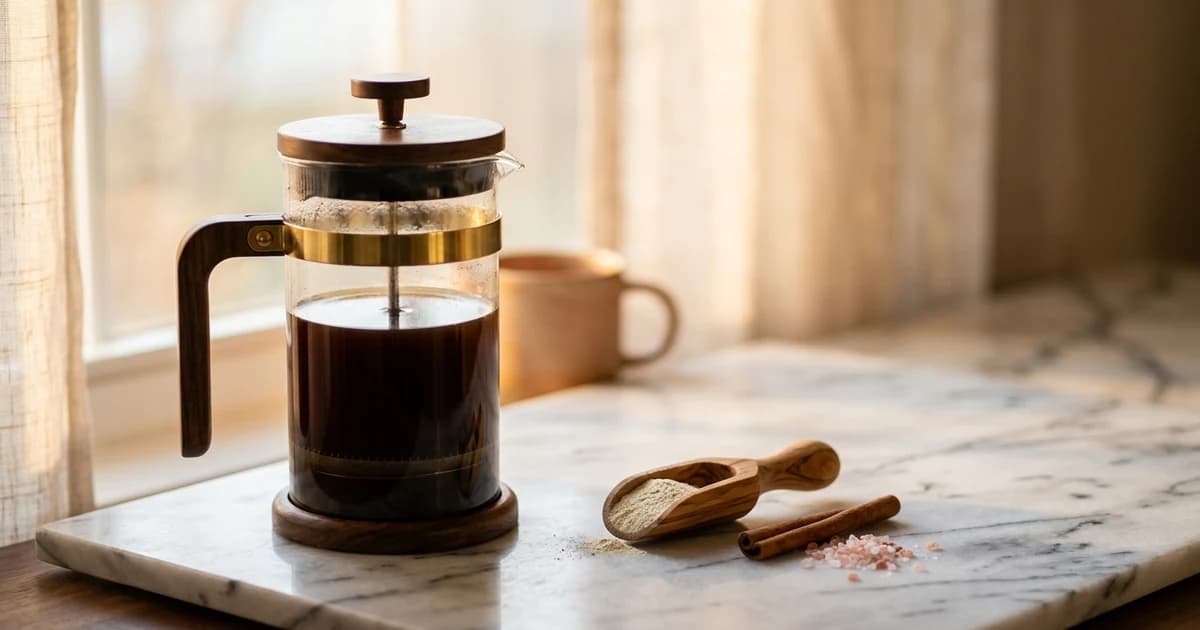
Phil Mickelson's coffee is Ethiopian beans plus a scoop of a powder called The Good Stuff, made by For Wellness, the company he co-founded with performance coach Dave Phillips. Each scoop delivers 2,200 mg collagen, 200 mg L-theanine, 1 g MCT oil, cinnamon, and 100 mg Himalayan pink salt, with no added caffeine beyond the coffee itself. The ingredient Mickelson credits most is L-theanine, and it happens to be the one with the strongest controlled-trial evidence when paired with caffeine.
Key Takeaways
- Mickelson's routine evolved from a simple French press recipe in 2017 to a formulated powder (The Good Stuff) with 200 mg L-theanine per scoop by 2021.
- He describes the result as zero jitters despite drinking coffee throughout the day. That is his reported experience, not a general clinical claim.
- A 2025 systematic review in Nutrition Reviews pooled 50 randomized controlled trials and found that the caffeine plus L-theanine combination improved attention-switching accuracy and alertness versus placebo.
- His cup delivers roughly 200 mg L-theanine per scoop, which is at or above the doses most trials used per session (typically 100 to 250 mg).
What Is in Phil Mickelson's Coffee?
The Good Stuff is a five-ingredient powder you stir into brewed coffee. It contains no caffeine on its own. The caffeine comes from whatever coffee you brew, typically 80 to 120 mg per cup depending on the bean and method.
| Ingredient | Amount per Scoop | What Mickelson Says It Does | What the Evidence Shows |
|---|---|---|---|
| Grass-fed hydrolyzed collagen | 2,200 mg | Joint and gut support | Limited evidence at this dose for skin elasticity; joint data is mixed |
| L-theanine | 200 mg | Eliminates jitters from caffeine | Moderate evidence for improved attention and alertness when paired with caffeine |
| MCT oil powder | 1,000 mg (1 g) | Sustained energy | Provides ~8 calories; energy claims are calorie-based, not stimulant-based |
| Ceylon cinnamon | Not disclosed | Flavor, blood sugar | Trace amounts; clinical blood-sugar trials use 1 to 6 g daily |
| Himalayan pink salt | 100 mg | Taste, electrolytes | ~40 mg sodium; negligible vs. sports-hydration needs |
Sources: For Wellness product page; For Wellness ingredient breakdown.
The recipe has a history. In January 2017, Phillips shared Mickelson's original version with Golf.com: coarse-ground Ethiopian Yirgacheffe in a French press, 200-degree water, stirred five or six times, three minutes, then plunged, finished with almond milk, cinnamon, cacao nibs, and MCT oil. No L-theanine. No collagen. No salt.
By late 2021, the widely reported version added 200 mg L-theanine, collagen, Himalayan pink salt, and manuka honey to the mix (EssentiallySports, 2021). The Good Stuff powder formalized most of those additions into a single scoop.
How the Routine Started
Mickelson was diagnosed with psoriatic arthritis just before his 40th birthday. According to a 2022 Sports Illustrated profile, Phillips began piloting the blend around 2019 and started sharing it with Mickelson about a year later. The two eventually co-founded For Wellness to sell the powder commercially.
Mickelson has described the routine in strong terms. In the same SI piece, he said: "Coffee has changed my life. I have made it the foundation of my overall health and wellness." In a 2019 Golf.com interview, he went further: "I drink coffee all day long and in the last 10 years I have not been sick a single day."
That is his personal account. Coffee is not a documented illness preventive, and no controlled trial supports the claim that daily coffee consumption prevents sickness over a decade.
Why Does Phil Mickelson Put L-Theanine in His Coffee?
In a Q&A on the For Wellness blog (December 2021), Mickelson singled out L-theanine above every other ingredient: "But the biggest thing that you really turned me onto was L-Theanine." He added: "As much coffee as I drink, because of that L-Theanine, I never have any jitters." And: "It allows me to play and perform my best."
Phillips, in a separate For Wellness post, put it in golf-specific terms: the goal was to let a golfer drink caffeine for its performance benefits without shaky hands over a first putt.
These are first-person testimonials from the founders of the brand that sells the product. They are worth hearing, but they are not clinical evidence. The clinical evidence, though, does point in the same direction.
What the Research Says About Caffeine Plus L-Theanine
A 2025 systematic review and meta-analysis in Nutrition Reviews (Payne et al.) searched four major databases and included 50 randomized controlled trials. Of those, 15 were eligible for quantitative meta-analysis. The combination of L-theanine and caffeine, compared to placebo, improved performance on attentional-switching tasks and digit-vigilance tasks. It also showed benefits for self-reported alertness and overall mood.
An earlier foundational study, Owen et al. (2008), tested 50 mg caffeine with and without 100 mg L-theanine and found the combination improved simple reaction time, numeric working memory, and sentence verification accuracy versus placebo. That study helped establish the pairing as a research standard. A ratio and dose guide breaks down how different studies have paired the two.
Mickelson's cup delivers 200 mg L-theanine per scoop, which sits at or above most trial doses (commonly 100 to 200 mg). But note: the trials measure group-level improvements in attention accuracy and alertness. They do not support "I never have any jitters" as a universal outcome. Individual responses to caffeine vary with genetics, tolerance, sleep, and dose. L-theanine takes roughly 30 to 60 minutes to reach peak plasma levels, so timing matters, too.
The Rest of the Scoop
Collagen at 2,200 mg is marketed for joint and skin support. Commonly studied collagen doses range from 2.5 to 15 g daily, so a single scoop falls well short. If Mickelson drinks multiple cups, he could reach a relevant dose, but that is speculation.
MCT oil at 1 g provides about 8 calories. It is a fat source, not a stimulant. The "sustained energy" framing is technically just calories.
Cinnamon and salt serve flavor first. Phillips has described the salt as a way to cut acidity; at 100 mg (roughly 40 mg sodium), it is not a meaningful electrolyte source.
On the Course: Hydration and Focus
Mickelson pairs his coffee routine with deliberate hydration. In a For Wellness blog post from November 2021, he said: "If I don't hydrate my brain, the coffee will help my body, but it won't go up there. When I get headaches, I know I'm not drinking enough water."
He also described his mental approach on the course as trying to "create a bubble of calm" amid the chaos of a tournament environment. That lines up with his interest in L-theanine: he frames it as the ingredient that lets him stay caffeinated without the physiological noise that could disrupt a putting stroke.
Conclusion
Phil Mickelson's coffee routine gets attention because of who he is and how confidently he talks about it. But the ingredient that actually holds up under controlled conditions is L-theanine paired with caffeine. The collagen is under-dosed per scoop. The MCT is just calories. The cinnamon and salt are flavor. The evidence for the caffeine-plus-L-theanine pairing, across dozens of trials, is real: better attention accuracy, improved alertness, reduced self-reported tiredness. Not magic, not a health overhaul, but a measurable cognitive benefit.
Frequently Asked Questions
What coffee does Phil Mickelson drink?
Mickelson uses Ethiopian Yirgacheffe beans brewed in a French press with 200-degree water, based on the original 2017 recipe shared by Dave Phillips. He adds a scoop of The Good Stuff, a powder made by For Wellness (the company he co-founded), which contains collagen, L-theanine, MCT oil, cinnamon, and Himalayan pink salt.
What does Phil Mickelson put in his coffee?
One scoop of The Good Stuff: 2,200 mg collagen, 200 mg L-theanine, 1 g MCT oil, cinnamon, and 100 mg Himalayan pink salt. Earlier versions of the recipe also included almond milk, cacao nibs, and manuka honey. The powder itself contains no caffeine.
Does Phil Mickelson's coffee have caffeine?
Yes. The caffeine comes from the Ethiopian coffee he brews, not from The Good Stuff powder. A typical cup of brewed coffee contains 80 to 120 mg caffeine depending on grind, water temperature, and steep time. The Good Stuff adds zero additional caffeine.
What is L-theanine and why is it in his coffee?
L-theanine is an amino acid found naturally in tea leaves. Mickelson says it eliminates jitters despite heavy coffee consumption. The research supports a narrower claim: L-theanine combined with caffeine improves attention-switching accuracy and alertness in controlled trials. His scoop delivers 200 mg, consistent with doses used in the published studies.
Does Phil Mickelson still drink his coffee?
As of 2025, Mickelson continues to promote For Wellness and has described the coffee routine as his daily foundation. In a For Wellness post, he stated: "I drink it everyday now and use it as the basis of my health and wellness."
Does caffeine with L-theanine actually work?
For attention and alertness, yes. A 2025 Nutrition Reviews meta-analysis of 50 RCTs found the combination improved attentional-switching accuracy and self-reported alertness. The Owen 2008 study found similar results at 50 mg caffeine with 100 mg L-theanine. The pairing does not guarantee zero jitters for every person, and results depend on dose, timing, and individual caffeine sensitivity.
The Pairing Without the Press: Caffeine and L-Theanine in a Pouch
The case for combining caffeine with L-theanine does not depend on a French press, Ethiopian beans, or a scoop of powder. The pairing works because of what L-theanine does to the caffeine experience at a neurochemical level, and that mechanism travels.
Roon is a zero-nicotine oral pouch that delivers caffeine and L-theanine in each pouch (see full ingredient list). Methylliberine (Dynamine) is included for duration: in a randomized, double-blind, crossover PK study (n=12), co-administering methylliberine with caffeine cut caffeine's oral clearance from 41.9 to 17.1 L/hr and extended its half-life from 7.2 to 15 hours, with no increase in peak concentration. That study used 100 mg methylliberine and 150 mg caffeine, roughly 4x and 1.9x what Roon contains, so the magnitude may differ. But the mechanism is directionally the same, and Roon's felt window is 6 to 8 hours. Same peak, longer tail. The trade-off: stop at least 8 hours before bed.
A separate caffeine-and-golf trial (Mumford et al., 2016, Medicine & Science in Sports & Exercise) dosed caffeine before the round and at the turn and found better scores and more greens in regulation. A pouch fits that timing: one at the first tee, one at the turn, no cup to carry, nothing to spill on the cart.
Roon is not a coffee replacement and not a health-and-wellness powder. It is the caffeine-plus-L-theanine pairing in a format that works where a French press does not. Tins start at $9.16 on subscription ($0.61 per pouch) or $15.00 one-time for a 4-tin pack. Try Roon if you want the pairing without the ritual.
Related from Roon
- Does Caffeine Help Your Golf Game?
- Caffeine and L-Theanine: What the Pairing Does
- The Caffeine-to-L-Theanine Ratio Guide
- The Owen 2008 Study: The Trial Behind the Stack
Written by Roon Team