From Matcha's 1:2 to Roon's 4:3: What the Science Says About Every Caffeine-to-Theanine Ratio
Roon Team
From Matcha's 1:2 to Roon's 4:3: What the Science Says About Every Caffeine-to-Theanine Ratio
The internet has a favorite number, and it is wrong more often than it is right. Search "best caffeine to theanine ratio" and you will be told 1:2, then 1:1, then 2:1, each presented as settled fact. None of them are universal truths. They are different tools for different jobs.
The caffeine to theanine ratio decides whether your focus session feels like a calm hum or a sharp push. It is the single most important variable in any caffeine plus L-theanine stack, and it is the one most product marketers gloss over.
This piece walks through every common ratio, what the actual research found at each dose, and why Roon landed on a caffeine-forward 4:3. Spoiler: there is no "the" optimal ratio. There is only the right ratio for what you are trying to do.
Key Takeaways
- The caffeine theanine ratio science is dose-dependent. The famous studies used very different absolute amounts, not just different proportions.
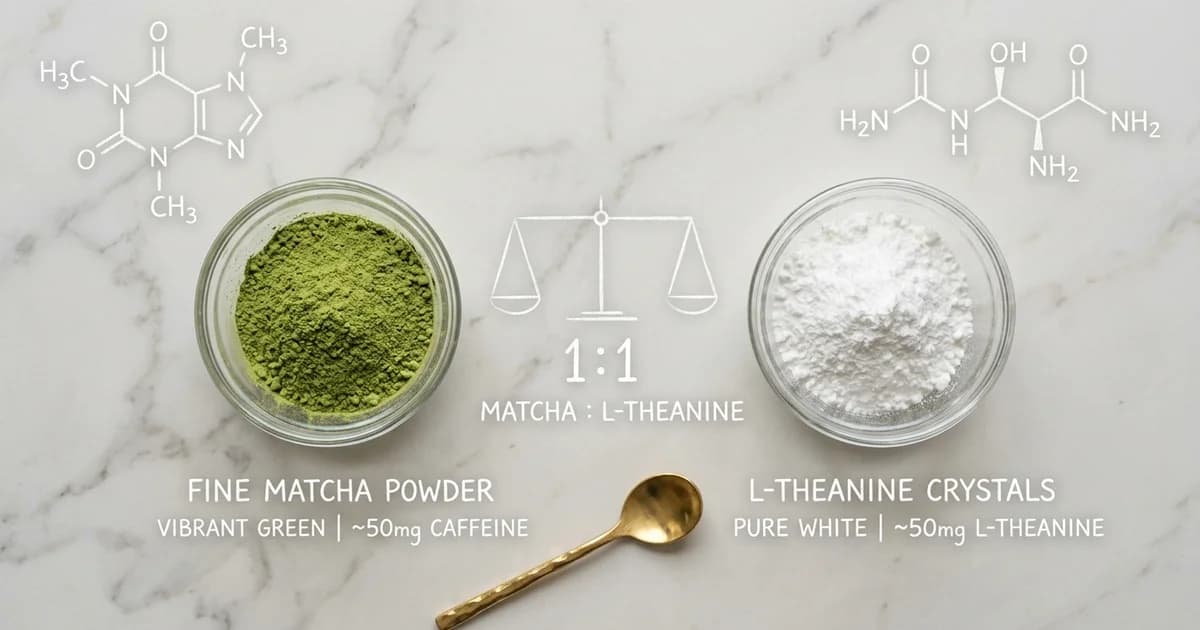
- Matcha sits near a calming 1:2 (more theanine than caffeine), which produces relaxed alertness, not aggressive drive.
- The landmark focus studies actually leaned theanine-rich (as much or more theanine than caffeine) and still sharpened attention and task switching.
- A 4:3 caffeine theanine ratio is built for drive with smoothness, not maximal sedation.
- Theanine is not the only way to smooth caffeine. Theacrine and methylliberine extend the effect without leaning on more theanine.
What the Caffeine to Theanine Ratio Actually Controls
The ratio sets the balance between push and brake. Caffeine is the accelerator. It blocks adenosine receptors, which is why you feel alert and why, in excess, you feel wired and anxious.
L-theanine is the modulator. It promotes alpha brain wave activity, the state linked to calm, wakeful attention, and it takes the edge off caffeine's rougher effects. The two molecules cross the blood-brain barrier and act together, which is why the combination consistently outperforms caffeine alone.
So the ratio is really a dial. More theanine relative to caffeine means more calm. More caffeine relative to theanine means more drive. Neither is "correct" in a vacuum. It depends on whether you want to settle into deep work or hit a hard, alert peak.
The Caffeine Theanine Ratio Science, Ratio by Ratio
Here is the part most articles skip: the headline ratios come from studies that used wildly different absolute doses. A 1:2 ratio at 25mg caffeine behaves nothing like a 1:2 ratio at 200mg caffeine. Proportion and dose both matter.
Below is what the research actually tested.
| Ratio | Example dose (caffeine : theanine) | What it is tuned for | Representative evidence |
|---|---|---|---|
| 1:2 | 50mg : 100mg | Calm, relaxed alertness | Matcha-style; theanine-dominant |
| ~2:5 | 40mg : 97mg | Balanced focus and mood | Giesbrecht et al., 2010 |
| 1:2 | 50mg : 100mg | Task switching, attention | Owen et al., 2008 |
| 4:3 | 80mg : 60mg | Drive with smoothness | Roon v2 formula |
| ~4:5 (high dose) | 160mg : 200mg | Attention under sleep loss | British Journal of Nutrition, 2025 |
Read the absolute doses, not just the ratio: most of the landmark focus studies used as much or more L-theanine than caffeine, even when measuring attention and task performance.
The 1:2 Ratio (Matcha's Territory)
A 1:2 ratio leans theanine-heavy, and it produces calm more than drive. This is roughly where matcha and many green teas sit, with more L-theanine present than caffeine. The result is the smooth, even-keeled alertness tea drinkers describe.
If your goal is to feel relaxed but awake, this end of the spectrum delivers. If your goal is a sharp performance peak, it can feel a little flat.
The Focus Research (Theanine-Rich Ratios)
Most of the landmark cognitive performance studies actually used theanine-rich ratios, with as much or more L-theanine than caffeine. In the Owen, Parnell, De Bruin, and Rycroft study, research published in Nutritional Neuroscience found that 50mg caffeine combined with 100mg L-theanine improved both speed and accuracy on an attention-switching task and reduced susceptibility to distracting information at 60 and 90 minutes after consumption.
A separate trial by Giesbrecht and colleagues, also in Nutritional Neuroscience, reported that a 40mg caffeine with 97mg L-theanine combination improved cognitive performance and increased subjective alertness compared to placebo. The pattern is consistent: pairing the two beats caffeine on its own.
The High-Dose Ratio (Under Pressure)
Push both numbers up and the combination still holds. A 2025 double-blind crossover trial in the British Journal of Nutrition found that a high-dose combination of 160mg caffeine with 200mg L-theanine improved measures of selective attention in acutely sleep-deprived young adults.
The takeaway is not "more is better." It is that the caffeine plus theanine pairing keeps working across a wide dose range, which gives formulators room to tune for a specific outcome.
Why Roon Uses a 4:3 Caffeine Theanine Ratio
Roon runs a caffeine-forward 4:3 ratio: 80mg caffeine to 60mg L-theanine. That is a deliberate choice, and the reasoning is straightforward.
A theanine-dominant ratio like 1:2 is tuned for calm. Roon is tuned for drive that does not turn jagged. The 4:3 ratio keeps caffeine in the driver's seat for genuine push, while 60mg of theanine sands down the sharp edges that pure caffeine produces.
The best caffeine L-theanine ratio for your needs depends on intent. If you want to wind down into reading, lean theanine-heavy. If you want to start a demanding work block and stay locked in, a caffeine forward theanine ratio makes more sense. Roon is built for the second case.
Theanine Is Not the Only Brake
Here is where Roon's design parts ways with most caffeine-theanine products. The standard playbook is to add more theanine to smooth and stretch the caffeine. Roon does not do that.
Instead, two additional compounds carry the duration and the smoothness. Methylliberine (Dynamine) at 25mg and theacrine (TeaCrine) at 5mg extend the effect without relying on a heavier theanine load.
This matters for two reasons. Theacrine, unlike caffeine, does not appear to build tolerance the way regular caffeine does. Research summarized by Compound Solutions notes that even after 8 weeks of daily 300mg TeaCrine, subjects showed no signs of tolerance, dependency, or withdrawal. A pharmacokinetic study on medRxiv similarly notes that theacrine, unlike caffeine, does not appear to be associated with tolerance.
So Roon's 4:3 ratio is the front end of a four-ingredient system, not a standalone caffeine-theanine blend. The ratio sets the character. The other two molecules handle the length.
How to Pick Your Own Ratio
If you are building or buying a stack, match the theanine caffeine ratio for focus to the task in front of you.
- Deep, calm reading or creative work: lean theanine-heavy, around 1:2. You want softness over push.
- General productivity and mood: a balanced 1:1 is a reliable default and the most studied.
- Hard, demanding focus blocks: go caffeine-forward, 2:1 or the 4:3 range, for drive that stays clean.
- Sensitive to caffeine: keep the absolute caffeine dose low regardless of ratio, since proportion does not cancel out a high milligram count.
The ratio is a starting point, not a rule. Your sensitivity, sleep, and the task all shift what feels right.
The Bottom Line on Ratios
There is no single best caffeine to theanine ratio, only the right one for the job. Theanine-rich blends near 1:2 deliver calm alertness and run through most of the landmark focus research. Caffeine-forward ratios push harder while staying smooth.
What the science actually says is simpler than the internet pretends. The two molecules work better together than apart across a wide dose range, and the ratio is the dial you turn to decide whether you get calm or drive. Choose it on purpose.
Frequently Asked Questions
What is the best caffeine to theanine ratio?
There is no universal best ratio. A 1:2 ratio favors calm, relaxed alertness, which is roughly where matcha sits. The landmark focus studies actually leaned theanine-rich, with as much or more theanine than caffeine, and still showed improved attention switching and alertness. The right choice depends on whether you want to settle into calm work or push through a demanding focus block. Match the ratio to the task rather than chasing a single magic number.
What ratio of caffeine to theanine is in matcha?
Matcha tends toward a theanine-dominant ratio, often near 1:2, meaning it contains more L-theanine than caffeine. This balance is part of why matcha produces a smoother, calmer alertness than coffee at a comparable caffeine dose. The high theanine content modulates caffeine's rougher edges, which is the same principle behind purpose-built caffeine plus theanine supplements.
Is a higher theanine ratio always better?
No. A higher theanine ratio increases calm and reduces caffeine's edge, which is ideal for relaxed focus. But if you want genuine drive and a sharp performance peak, a theanine-heavy blend can feel flat. A caffeine forward theanine ratio keeps more push in the formula. Better depends entirely on your goal, not on maximizing theanine.
Why does Roon use a 4:3 caffeine theanine ratio?
Roon uses 80mg caffeine to 60mg L-theanine, a caffeine-forward 4:3 ratio tuned for drive with smoothness rather than maximal sedation. The caffeine provides genuine push while the theanine takes the edge off. It is an honest design choice, not the optimal ratio for everyone. People who want calm reading sessions may prefer a more theanine-heavy blend.
Does the absolute dose matter or just the ratio?
Both matter. A 1:2 ratio at 25mg caffeine behaves very differently from a 1:2 ratio at 200mg caffeine. The studies behind popular ratios used very different absolute doses, so reading only the proportion is misleading. If you are sensitive to caffeine, keep the total milligram count low regardless of how favorable the ratio looks on paper.
Can theanine alone extend a caffeine stack?
Theanine smooths caffeine but does not meaningfully extend its duration on its own. Some formulas add more theanine to try to stretch the effect. Roon takes a different route, using methylliberine and theacrine to carry duration. Theacrine, unlike caffeine, does not appear to build tolerance with regular use, which helps keep the effect consistent over time.
The 4:3 Ratio, and the Two Molecules That Carry It
If you have read this far, you already know the honest version: there is no perfect caffeine to theanine ratio, only the right one for the job. Roon runs a caffeine-forward 4:3, with 80mg caffeine to 60mg L-theanine, because it is tuned for drive with smoothness, not for maximal calm. If your goal is deep, relaxed reading, a theanine-heavy blend may suit you better, and that is a fair trade-off to name out loud.
What sets the formula apart is that it does not lean on theanine alone to stretch the effect. The 25mg of methylliberine (Dynamine) and 5mg of theacrine (TeaCrine) carry the duration, which is how a single sublingual pouch supports 6 to 8 hours of focus with a 5 to 10 minute onset, no jitters, and no crash.
Roon is not a replacement for sleep, training, or a real focus habit. It is the front end of a four-ingredient system built around one deliberate ratio. If you want drive that stays clean, try Roon and feel the difference a caffeine-forward ratio makes.
Written by Roon Team