Caffeine and L-Theanine: What You Need to Know
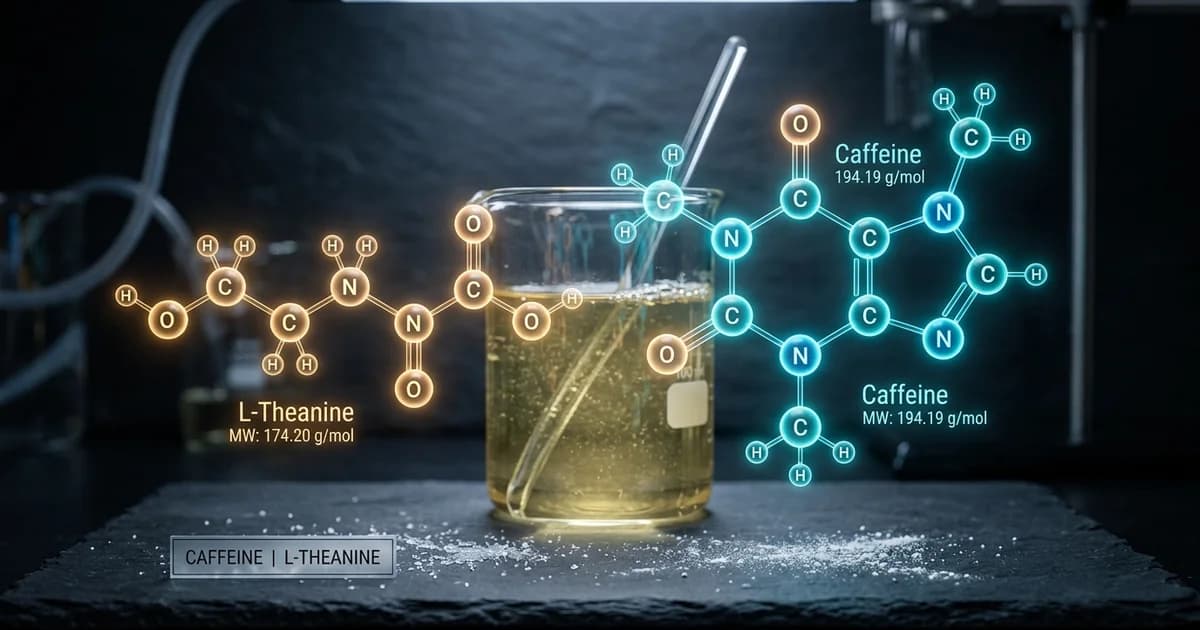
Caffeine and L-Theanine: The Science Behind the Best Two-Ingredient Nootropic Stack
Caffeine and L-theanine is the most studied nootropic combination in existence. When you take both together, caffeine drives alertness while L-theanine smooths out the jitters, anxiety, and crash. The result is 4 to 6 hours of calm, sustained focus that neither compound delivers alone. A 2026 meta-analysis of 31 randomized trials (n = 1,168) in Molecular Psychiatry confirmed that L-theanine on its own improves choice reaction time with an effect size of 0.51. Pair it with caffeine, and the combination outperforms either ingredient in accuracy, attention switching, and subjective alertness.
This pairing isn't new. Green tea has contained both compounds for centuries. But the clinical data explaining why they work together, and exactly how to dose them, has only matured in the last two decades.
Key Takeaways:
- Caffeine and L-theanine together improve accuracy, reaction time, and sustained attention across multiple peer-reviewed trials.
- L-theanine increases alpha brain waves (8 to 12 Hz) and raises levels of GABA, serotonin, and dopamine.
- The most-studied effective ratio is 2:1 L-theanine to caffeine (e.g., 100 mg L-theanine with 50 mg caffeine).
- Adding theacrine and methylliberine to the base stack extends the performance window to 6 to 8 hours and reduces tolerance buildup.
How Does Caffeine Work in Your Brain?
Caffeine is an adenosine receptor antagonist. It blocks the molecule (adenosine) that accumulates throughout the day and signals your brain to feel tired. The result: you feel more awake, more alert, and more driven. But caffeine does not create energy. It borrows it, and the loan comes with interest.
When caffeine wears off, all that blocked adenosine floods back in. That is the crash. Caffeine also stimulates your sympathetic nervous system, the fight-or-flight pathway responsible for elevated heart rate, restlessness, and jitters. At higher doses, it triggers anxiety in a meaningful percentage of users.
Then there is the tolerance problem. Research published in Psychopharmacology found that complete tolerance to some of caffeine's central nervous system effects can develop in as few as 1 to 4 days of consistent use. That means you need progressively higher doses to maintain the same effect, which amplifies every side effect.
| Metric | Caffeine Alone | L-Theanine Alone | Caffeine + L-Theanine |
|---|---|---|---|
| Alertness | High (with jitters) | Mild | High (smooth) |
| Focus Duration | 1 to 3 hours | Subtle | 4 to 6 hours |
| Anxiety Risk | Moderate to high | Low | Low |
| Crash | Yes | No | Minimal |
| Alpha Brain Waves | Decreased | Increased | Maintained |
| Tolerance Buildup | Fast (1 to 4 days) | None observed | Slower |
| Typical Onset | 15 to 45 min (oral) | 30 to 60 min | 30 to 60 min (oral); 5 to 10 min (sublingual) |
What Does L-Theanine Do on Its Own?
L-theanine is an amino acid found almost exclusively in tea leaves (Camellia sinensis). It crosses the blood-brain barrier and shifts your neurochemistry in a direction almost opposite to caffeine: calming without sedating.
According to research reviewed by the Sleep Foundation, L-theanine increases levels of GABA, dopamine, and serotonin while decreasing norepinephrine. GABA is the brain's primary inhibitory neurotransmitter; serotonin and dopamine regulate mood and motivation. The net effect is a calm, focused mental state without drowsiness.
L-theanine also boosts alpha brain wave activity in the 8 to 12 Hz range, the electrical pattern your brain produces during relaxed alertness, the same state associated with meditation and flow. A review on Authorea found that EEG measurements show measurable increases in alpha-wave activity after L-theanine intake, explaining why tea drinkers report feeling calm and focused rather than wired.
The strongest evidence for L-theanine alone comes from the 2026 Molecular Psychiatry meta-analysis by Gerolymos et al., which pooled 31 randomized controlled trials with 1,168 total participants. A single 200 mg dose taken 30 to 60 minutes before testing improved choice reaction time with a standardized mean difference (SMD) of 0.51 (95% CI: 0.25 to 0.77). That is a moderate effect size, real and replicable, though not enormous.
On its own, though, L-theanine does not pack much punch for raw cognitive drive. A systematic review in PMC found that L-theanine alone improved total cognition composite scores, but its effects on specific tasks like inhibitory control were inconsistent. The real power of L-theanine shows up when you pair it with caffeine, which provides the drive it lacks. The same pairing logic applies to nootropic amino acid stacking more broadly.
What Does the Science Say About Caffeine and L-Theanine Together?
The caffeine and L-theanine combination is not just additive. It is complementary. Caffeine provides the drive. L-theanine removes the noise. Together, they create a focused, calm alertness that neither compound achieves solo. Here is what the controlled trials actually found.
Improved Accuracy and Attention Switching
A study published in Appetite (Giesbrecht et al., 2010) found that moderate doses of caffeine and L-theanine together improved accuracy during task switching and self-reported alertness while reducing tiredness. Subjects were not just feeling sharper. They performed measurably better on cognitive tasks requiring rapid switching between problem types, which is exactly what real-world knowledge work demands.
Better Performance Under Pressure
A 2023 study on elite curling athletes found that combined caffeine and L-theanine supplementation improved both cognitive and shooting performance. Caffeine alone improved some metrics, but the combination produced the most consistent results across mental and physical tasks.
A 2025 study on elite Iranian wrestlers confirmed this pattern in a double-blind, placebo-controlled crossover design: caffeine and L-theanine together improved cognitive function and physical performance beyond what either compound achieved alone.
What Is the Optimal Caffeine to L-Theanine Ratio?
The optimal caffeine to L-theanine ratio is 1:2 (caffeine to L-theanine), meaning you take roughly twice as much L-theanine as caffeine. Most positive trials used this proportion. The data is consistent enough that this ratio has become the standard recommendation across clinical and consumer nootropics.
Owen et al. (2008) tested 50 mg caffeine with 100 mg L-theanine in 27 healthy adults using a crossover design. The combination improved both speed and accuracy on an attention-switching task at 60 minutes and reduced susceptibility to distraction on memory tasks at 60 and 90 minutes. Neither caffeine nor L-theanine alone reached significance on those measures.
A study from Psychopharmacology found that combining L-theanine with caffeine at ratios equivalent to one to two cups of tea eliminated caffeine's vasoconstrictive effect and modulated its behavioral effects. The takeaway: you want more L-theanine than caffeine. This ratio ensures L-theanine has enough neurochemical weight to counterbalance caffeine's stimulatory push while preserving the alertness and drive you are after.
Can You Extend the Caffeine and L-Theanine Stack Beyond 3 to 4 Hours?
Yes. Adding theacrine and methylliberine to a caffeine and L-theanine base extends the focus window from roughly 3 to 4 hours to 6 to 8 hours. Both are purine alkaloids found naturally in certain tea and coffee species. Both interact with the same receptor systems as caffeine, but with different pharmacokinetic profiles that fill in gaps the base pair leaves open.
Theacrine (TeaCrine)
Theacrine is structurally similar to caffeine and acts on the same adenosine receptors, with one critical difference: it does not produce tolerance at the same rate. A study in Pharmacology Biochemistry and Behavior found that daily theacrine administration (48 mg/kg) for seven consecutive days produced a consistent locomotor response without inducing tolerance or sensitization in animal models. A separate human trial found no habituation in 60 healthy adults taking up to 300 mg/day of TeaCrine for eight weeks. Caffeine cannot match that.
Methylliberine (Dynamine)
Methylliberine has a faster onset than theacrine and a shorter half-life, which makes it useful for sharpening the front end of the performance curve. Where theacrine extends the tail end of focus, methylliberine gives you a quicker ramp-up without the spike-and-crash pattern of high-dose caffeine.
A study published in Cureus (Tartar et al., 2021) tested 125 mg caffeine, 75 mg methylliberine, and 50 mg theacrine in adult male esports players. The result: improved cognitive performance and reaction time on the Stroop task without negative effects on mood. Stimulant stacks that make you faster but more irritable are not useful in the real world.
The Full Stack in Tactical Settings
A double-blind, placebo-controlled trial in the Journal of the International Society of Sports Nutrition tested caffeine, methylliberine, and theacrine together in tactical personnel. The combination of 150 mg caffeine, 100 mg methylliberine, and 50 mg theacrine produced similar benefits on reaction time during vigilance tasks as 300 mg of caffeine alone, but with better hemodynamic outcomes: specifically, no rise in diastolic blood pressure above placebo. Half the caffeine. Same reaction time. Lower cardiovascular cost.
Is Coffee Enough, or Do You Need a Dedicated Caffeine and L-Theanine Stack?
Coffee gives you caffeine. That is it. A standard 8 oz cup delivers roughly 80 to 100 mg of caffeine, zero L-theanine, zero theacrine, and zero methylliberine. Green tea contains both caffeine (25 to 50 mg) and L-theanine (20 to 60 mg per cup), but the concentrations are low, variable by brew, and nowhere near the 2:1 ratio the clinical trials used.
If you want the effects the studies describe, you need controlled dosing. That means either:
- Capsules or powder: Measured doses of caffeine + L-theanine (plus theacrine and methylliberine if you want the extended window). Onset: 30 to 60 minutes through the gut.
- Sublingual pouches: Ingredients absorb through oral mucosa, bypassing the digestive system. Onset: 5 to 10 minutes.
The format matters because it determines how fast you feel the effect and how consistent the delivery is across days.
What Caffeine and L-Theanine Mean for Daily Performance
The evidence across these trials is clear. Caffeine and L-theanine together outperform caffeine alone on accuracy, attention switching, and subjective alertness, with lower anxiety and a softer crash. Adding theacrine and methylliberine extends the performance window and addresses caffeine's biggest long-term weakness: tolerance.
The practical question is not whether this stack works. It is how to get the right compounds at the right ratios in a format that fits your day without guesswork.
Related from Roon
- L-Theanine Pouches: The Complete Guide
- L-Theanine and L-Tyrosine: The Complete Guide to Nootropic Amino Acid Stacking
Frequently Asked Questions
What does L-theanine with caffeine do for focus?
L-theanine with caffeine improves focus by combining caffeine's adenosine-blocking alertness with L-theanine's alpha-wave-boosting calm. Clinical trials show the pair improves attention-switching accuracy, reduces distractibility, and lowers self-reported tiredness compared to caffeine alone. The 2:1 L-theanine-to-caffeine ratio is the most studied and most effective proportion for sustained cognitive performance.
How much caffeine and L-theanine should I take together?
Most clinical trials used 50 to 200 mg of caffeine paired with 100 to 400 mg of L-theanine, maintaining roughly a 1:2 caffeine-to-L-theanine ratio. A common effective dose is 100 mg caffeine with 200 mg L-theanine. Start at the lower end if you are caffeine-sensitive and adjust based on how you respond.
Does L-theanine cancel out caffeine?
No. L-theanine does not block or neutralize caffeine's stimulant effects. It modulates them. L-theanine reduces the jitters, anxiety, and vasoconstriction caffeine causes while preserving the alertness and reaction-time benefits. Think of it as a filter, not an off switch.
Can I just drink green tea to get both?
Green tea contains both caffeine (25 to 50 mg) and L-theanine (20 to 60 mg per cup), but the amounts are low and variable depending on brew time, water temperature, and tea grade. To match the doses used in clinical studies (100 to 200 mg L-theanine), you would need 3 to 6 cups, which also means 75 to 300 mg of caffeine with no control over the ratio.
How long does the caffeine and L-theanine effect last?
When taken orally as capsules, the combination typically peaks at 60 to 90 minutes and provides noticeable focus for 3 to 4 hours. Sublingual formats (like pouches) can onset in 5 to 10 minutes. Adding theacrine and methylliberine extends the total duration to 6 to 8 hours in clinical settings.
Is caffeine and L-theanine safe to take daily?
L-theanine has no known toxicity at standard supplement doses. The 2026 Molecular Psychiatry meta-analysis of 31 trials found dropout rates were similar between L-theanine and placebo groups, indicating a strong safety profile. Caffeine is safe for most adults at up to 400 mg per day according to the FDA. The combination does not introduce new safety concerns beyond those of caffeine itself.
Does L-theanine help with caffeine anxiety?
Yes. L-theanine raises GABA, the brain's primary inhibitory neurotransmitter, and increases alpha brain wave activity, both of which counteract the sympathetic nervous system activation caffeine produces. Multiple trials report reduced self-reported anxiety and tiredness when L-theanine is combined with caffeine versus caffeine alone.
What is the best format for caffeine and L-theanine: pills, powder, or pouches?
Pills and powder work and are widely available. The tradeoff is a 30 to 60 minute onset through the gut. Sublingual pouches absorb through oral tissue and can deliver effects in 5 to 10 minutes with more consistent bioavailability. The best format depends on whether you need speed of onset or prefer a familiar supplement form.
Why the Caffeine-and-L-Theanine Stack Lasts 6 to 8 Hours Instead of 3 to 4
The research in this article makes the case for pairing caffeine with L-theanine. But duration is the part most stacks ignore. Coffee gives you 3 to 4 hours before the drop. Roon changes the shape of that curve.
Here is the mechanism: Roon contains 25mg of methylliberine (Dynamine), which slows caffeine's clearance. In a human pharmacokinetic study, co-administering methylliberine with caffeine cut oral clearance from 41.9 to 17.1 L/hr and extended caffeine's half-life from 7.2 to 15 hours, with no increase in peak concentration. Same peak, longer tail. That is why the felt window stretches to 6 to 8 hours on just 80mg of caffeine, a small-coffee dose.
L-theanine (60mg) smooths the response. TeaCrine (5mg) resists the tolerance buildup caffeine alone creates. The tradeoff is real: a longer half-life means you should stop at least 8 hours before bed.
Roon is not the cheapest option. It contains no adaptogens, no mushroom extracts, no paraxanthine. It is the caffeine-and-L-theanine pairing this article supports, extended by two compounds that reshape how long it works. 15 pouches per tin, starting at $15.00/tin ($1.00/pouch) one-time or as low as $9.16/tin ($0.61/pouch) subscribed. Try Roon.
Written by Roon Team