P-Synephrine (Bitter Orange): The Ephedra Replacement
Roon Team
P-Synephrine (Bitter Orange): The Ephedra Replacement, Examined Honestly
When the FDA pulled ephedra off the market in 2004, the fat-burner industry needed a new engine. It found one in a citrus peel.
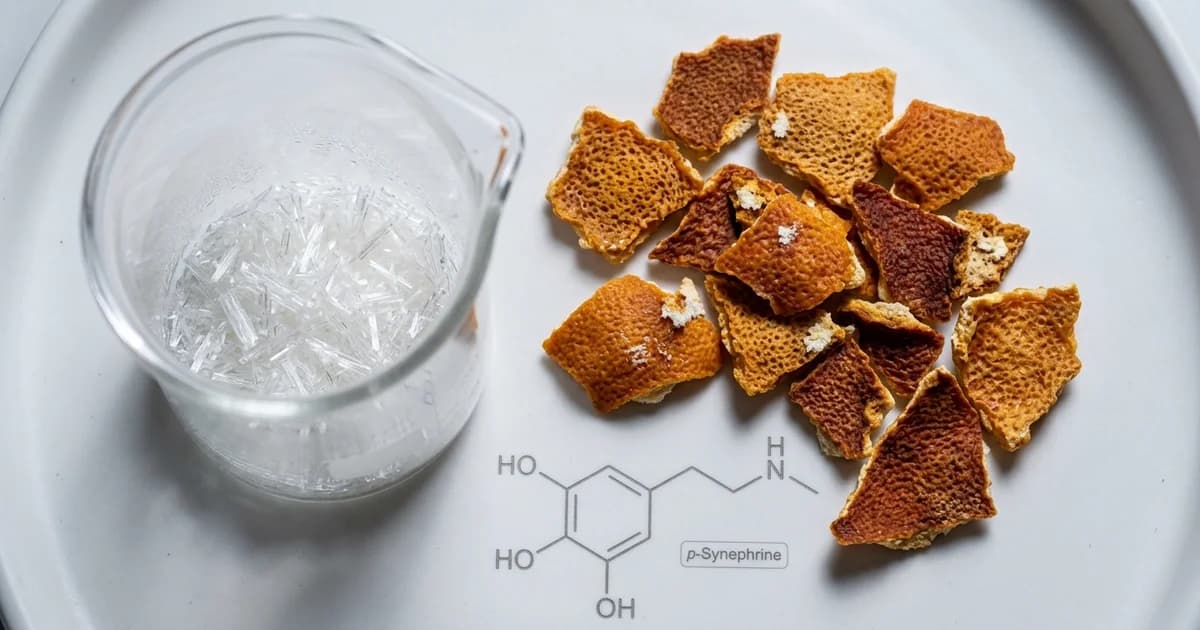
P-synephrine, the active compound in bitter orange extract, stepped into the gap almost overnight. It looked like ephedrine on paper, shared a similar reputation for "thermogenic" energy, and best of all, it was still legal. Two decades later it remains in pre-workouts, weight-loss capsules, and "shred" stacks across the shelf.
So the honest question is the one most brands skip: does p-synephrine actually work, and is it safe to use? The data is clearer than the marketing suggests.
Key Takeaways
- P-synephrine is the main stimulant in bitter orange extract (Citrus aurantium), marketed as a legal ephedra alternative after the 2004 ban.
- It is structurally similar to ephedrine but behaves differently in the body, which is why it is weaker and not a one-to-one swap.
- A 2022 meta-analysis found no reliable evidence that synephrine drives weight loss, while it tended to raise blood pressure and heart rate with prolonged use.
- Regulators in France recommend keeping intake under 20 mg per day and not stacking it with caffeine, which most products do anyway.
What Is P-Synephrine, Exactly?
P-synephrine is a naturally occurring stimulant found in the fruit and peel of bitter orange, the plant scientists call Citrus aurantium. You consume tiny amounts of it whenever you eat a Seville orange or drink certain marmalades' source fruit. Supplements concentrate it far beyond food levels.
The compound belongs to a family called protoalkaloids, and its job in a synephrine fat burner is simple in theory. It is supposed to stimulate the nervous system, raise metabolic rate, and push the body to burn more fat for fuel. That is the pitch.
Here is the part the label rarely mentions. The fruit of bitter orange contains p-synephrine and other naturally occurring chemicals, and p-synephrine is structurally similar to ephedrine, the main component in the herb ephedra, but p-synephrine has different pharmacologic properties. That structural resemblance is exactly why it became famous, and the difference in behavior is why it never lived up to the hype.
Why Bitter Orange Replaced Ephedra
Bitter orange did not become popular because of a breakthrough. It became popular because of a ban.
In 2004, the U.S. Food and Drug Administration banned the use of ephedrine alkaloids in dietary supplements because of safety concerns. Ephedra had been linked to serious cardiovascular events, and its removal left a hole in a very profitable category. Prior to the ban, ephedra was an ingredient in some dietary supplements promoted for weight loss, increased energy, and enhanced athletic performance.
The replacement was waiting in the citrus aisle. Bitter orange products became more popular after ephedra was taken off the market and have been promoted as ephedra alternatives.
That origin story matters. P-synephrine was not chosen because the science said it was the best fat-loss compound. It was chosen because it survived the regulatory cut. Those are very different reasons.
Synephrine vs Ephedrine: The Pharmacology Most Labels Skip
The short answer on synephrine vs ephedrine: they look like cousins, but they do not hit the same receptors with the same force, which is why synephrine is the weaker stimulant.
Ephedrine activates a broad range of adrenergic receptors, including the alpha and beta-1 receptors that drive heart rate and blood pressure hard. P-synephrine has a lower affinity for those receptors and a poor ability to cross into the central nervous system at normal doses. In plain terms, it pushes the same pedals, just softer and less directly.
This is the core of the honest case for bitter orange. It is gentler than ephedra. It is also why a single double-blinded study cited in the research found p-synephrine does not act as a stimulant at the dose tested in 18 healthy subjects.
But "gentler than a banned compound" is a low bar. The real question is whether it does anything useful at all.
Does P-Synephrine Actually Burn Fat?
The honest answer: the controlled evidence does not support reliable weight loss from synephrine.
The most thorough look came from a 2022 systematic review and meta-analysis published in the journal Nutrients by researchers at the University of Szeged. They pooled placebo-controlled human trials to test both efficacy and safety. The goals were to give an overview of the safety and efficacy of p-synephrine, to systematically evaluate its efficacy regarding weight loss and to assess its safety, focusing on cardiovascular side effects, and the analysis included 18 articles.
Their conclusion was direct. Based on the analyzed clinical studies, synephrine tends to raise blood pressure and heart rate, and there is no evidence that synephrine can facilitate weight loss.
Read that again. The compound sold primarily as a fat burner has no reliable evidence that it burns fat. A separate breakdown of the data put it plainly: controlled evidence does not support consistent weight-loss efficacy attributable to synephrine.
You may feel more wired after taking it. Feeling stimulated and losing fat are not the same outcome.
Synephrine Safety: What the Data Says
On synephrine safety, the pattern is mild but real cardiovascular pressure, with the biggest risks showing up in stacks rather than from the compound alone.
The same 2022 meta-analysis quantified the blood pressure effect over prolonged use. It reported that both systolic and diastolic blood pressure increased after prolonged use, by 6.37 mmHg and 4.33 mmHg respectively. Those are not catastrophic numbers for a healthy person, but they are not nothing, especially for anyone already managing blood pressure.
The reported serious events are harder to interpret. Cases of serious medical events, including abnormal heart rhythms, heart attacks, and strokes, have been reported in people who had taken bitter orange products, but most of the products contained multiple ingredients rather than bitter orange alone. So we cannot cleanly blame synephrine, but we also cannot clear it.
Regulators have taken a cautious stance. According to France's ANSES, the agency recommends keeping p-synephrine intake from supplements below 20 mg per day and not combining it with caffeine. Most fat-burner formulas ignore both points.
Two more practical notes. The NCCIH points out that FDA testing has found many products did not match their labeled synephrine amounts, so you often do not know your real dose. And for athletes, the calculus is settled: the National Collegiate Athletic Association has placed synephrine (bitter orange) on its current list of banned drugs, listing it as a stimulant.
The Caffeine Stacking Problem
Nearly every product that contains synephrine also contains caffeine. That combination is where the safety questions sharpen.
Caffeine and synephrine both nudge heart rate and blood pressure upward through overlapping mechanisms. Stack them and the effects compound. This is why ANSES singled out the pairing as something to avoid, and why the most credible cardiovascular concerns cluster around multi-stimulant blends rather than isolated synephrine.
P-Synephrine at a Glance
| Factor | What the evidence shows |
|---|---|
| Primary use | Marketed as a thermogenic fat burner and energy stimulant |
| Source | Bitter orange extract (Citrus aurantium) peel and immature fruit |
| Weight loss | No reliable evidence of efficacy in controlled human trials |
| Cardiovascular effect | Tends to raise blood pressure and heart rate with prolonged use |
| Suggested ceiling (ANSES) | Below 20 mg/day, not combined with caffeine |
| Athletic status | Banned by the NCAA as a stimulant |
| Compared to ephedrine | Structurally similar, weaker effect, different receptor activity |
So Should You Use It?
If your goal is fat loss, the data does not justify the risk. You would be paying for cardiovascular pressure with no proven payoff, often at an unknown dose because of label inconsistencies.
If your goal is energy, there are better-studied tools that you can dose accurately and predictably. Plain caffeine has decades of research behind it. Pairing it with the right partner ingredient gives you the lift without the adrenergic edge that synephrine adds.
The era of treating bitter orange as a clever loophole has run its course. It was never a better stimulant. It was a legal one.
Frequently Asked Questions
Is p-synephrine the same as ephedrine?
No. They share a similar chemical structure, which is why bitter orange replaced ephedra after the 2004 ban. But p-synephrine has different pharmacologic properties, binds adrenergic receptors more weakly, and crosses into the brain poorly at normal doses. The practical result is a milder stimulant that also lacks ephedrine's proven thermogenic punch. Similar on paper, different in the body.
Does bitter orange extract actually help you lose weight?
The controlled evidence says no. A 2022 meta-analysis of 18 studies found no reliable evidence that synephrine facilitates weight loss. You may feel more stimulated after taking it, but feeling wired is not the same as burning fat. Most weight-loss products pair it with caffeine and other ingredients, which makes it hard to credit any single result to synephrine itself.
Is synephrine safe to take?
For healthy adults at low doses, serious harm appears uncommon, but it is not risk-free. Research shows synephrine tends to raise blood pressure and heart rate, with systolic pressure climbing about 6 mmHg over prolonged use. France's ANSES advises staying under 20 mg per day and avoiding caffeine combinations. Anyone with high blood pressure or a heart condition should steer clear.
Why was ephedra banned but bitter orange allowed?
The FDA banned ephedrine alkaloids in 2004 after links to serious cardiovascular events. Bitter orange contains a structurally related but distinct compound, p-synephrine, that was not covered by that ban. It became the go-to legal replacement, not because it was proven safer or more effective, but because it remained available for sale.
Can athletes use synephrine?
Not under NCAA rules. The NCAA lists synephrine, also identified as bitter orange, on its banned-drug list as a stimulant. Athletes subject to that testing should avoid any product containing bitter orange extract or Citrus aurantium. Always check the full ingredient panel, since synephrine often hides inside pre-workout and fat-burner blends under several different names.
How is synephrine different from caffeine?
Caffeine works mainly by blocking adenosine receptors, which is why it improves alertness with a well-mapped dose response. Synephrine acts on adrenergic receptors, the same system adrenaline uses, which is what raises blood pressure and heart rate. The two are often stacked, but that combination is exactly what regulators warn against because their cardiovascular effects can add up.
Where the "No Jitters" Promise Actually Comes From
If you have read this far, the takeaway is clear: adrenergic stimulants like synephrine buy you a feeling of energy at the cost of cardiovascular pressure, with no proven fat-loss benefit to show for it. That tradeoff is the whole reason we built Roon differently.
Roon is a cognitive-focus pouch, not a thermogenic fat burner, and that distinction is deliberate. It contains no synephrine, no bitter orange, and no adrenergic stimulants of any kind. Instead, each sublingual pouch pairs 80 mg caffeine with 60 mg L-theanine, plus 25 mg methylliberine (Dynamine) and 5 mg theacrine (TeaCrine). The L-theanine is the point: it smooths the edge off caffeine so you get focus without the racing-heart feeling that synephrine adds.
To be clear about what Roon is not, it will not strip body fat, and it is not a weight-loss product. If clean, sustained focus is what you actually want, with an onset in 5 to 10 minutes and a 6 to 8 hour window with no jitters and no crash, try Roon and skip the adrenergic gamble entirely.
Written by Roon Team