Orexin: The Brain's Master "Stay Awake" Switch
Roon Team
Orexin: The Brain's Master "Stay Awake" Switch
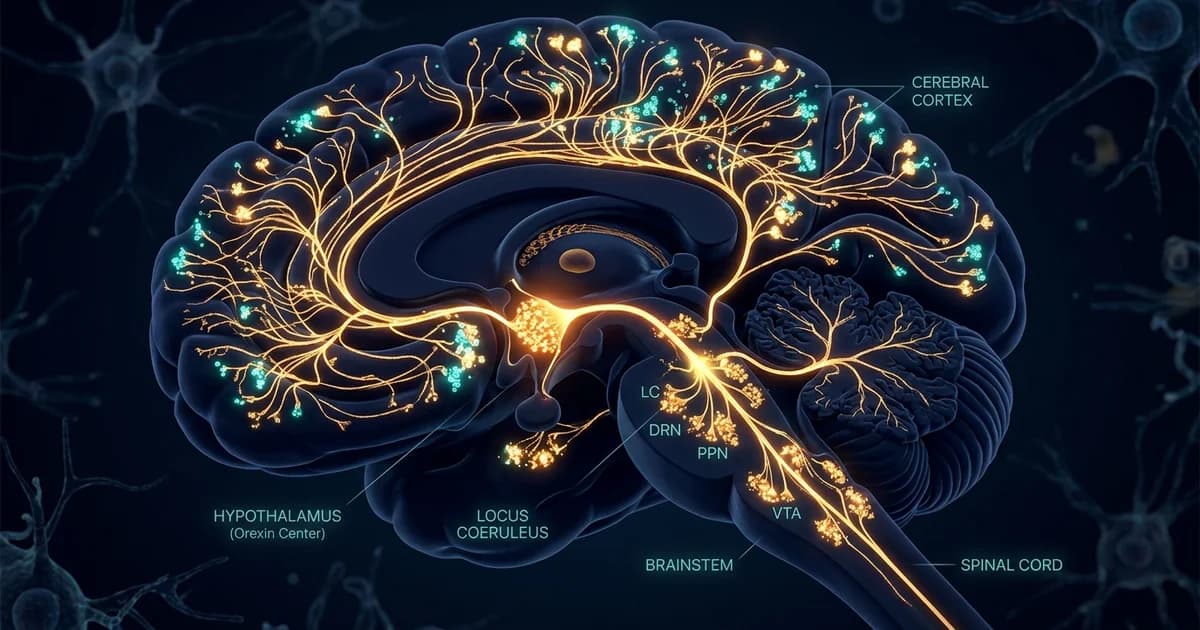
Your brain runs a single molecule that decides whether you stay alert or fade out. It is called orexin, and it sits in the lateral hypothalamus like a hand on a dimmer switch. When orexin neurons fire, you are awake, focused, and motivated to move. When they go quiet, the lights go down.
This is not a metaphor stretched too far. People who lose these neurons cannot reliably stay awake at all, even after a full night of sleep. Orexin is the reason your brain holds a long, stable waking state instead of dropping into sleep every few minutes.
Here is how the switch works, why losing it causes narcolepsy, and why your morning coffee depends on it more than you think.
Key Takeaways
- Orexin (also called hypocretin) is a wake-promoting neuropeptide made by a small cluster of neurons in the hypothalamus.
- It keeps you in a consolidated, stable awake state by exciting the brain's arousal systems.
- Narcolepsy type 1 is caused by the autoimmune loss of orexin neurons.
- New insomnia drugs called orexin antagonists work by blocking this exact system.
- Caffeine's wake-up effect is partly downstream of orexin, which links your coffee to the same circuit.
What Is Orexin? The Wakefulness Molecule
Orexin is a neuropeptide that regulates arousal, wakefulness, and appetite, produced by a small population of neurons in the hypothalamus. It comes in two forms, orexin-A and orexin-B, and goes by a second name too.
Two research groups identified it independently in 1998. One named the peptides after the Greek word orexis, meaning appetite, because of their role in feeding. Orexins were so named for their stimulatory role in feeding (Sakurai et al., 1998). The other group called the same molecule hypocretin, which is why you see the terms orexin hypocretin used together in the scientific literature.
The neurons themselves are surprisingly few. Orexin, also known as hypocretin, is a neuropeptide that regulates arousal, wakefulness, and appetite, and it exists in the forms of orexin-A and orexin-B. A small population, between roughly 50,000 and 80,000 cells, runs a system that influences your entire state of consciousness.
They send projections almost everywhere. The hypothalamus already manages hunger, body temperature, and sleep, and orexin neurons sit at the crossroads of all three.
How Orexin Keeps You Awake
Orexin maintains wakefulness by exciting the brain's arousal centers and locking them into a stable "on" state. Without that steady signal, the boundary between sleep and waking gets blurry.
Here is the circuit in plain terms. Orexins activate orexin neurons, monoaminergic and cholinergic neurons in the hypothalamus and brainstem regions, to maintain a long, consolidated awake period. Those monoaminergic and cholinergic cells are the brain's classic arousal systems, the ones that release dopamine, norepinephrine, serotonin, and acetylcholine.
Think of orexin as the conductor rather than the orchestra. It does not generate alertness alone. It coordinates the systems that do, so they all fire together and keep you in one continuous waking block instead of nodding off and snapping back awake.
Orexin neurons also read your body's internal state. The responsiveness of orexin neurons to peripheral metabolic cues, such as leptin and glucose, indicates that they might act as sensors for the metabolic status of animals. That is why a heavy meal can make you drowsy and why hunger keeps you sharp. The same cells that keep you awake also track whether you have eaten.
This makes orexin wakefulness a feature, not an accident. The system evolved to keep an animal alert when it needs to find food and to let it rest when energy is abundant.
Orexin and Narcolepsy: What Happens When the Switch Breaks
Narcolepsy type 1 is caused by the loss of orexin-producing neurons, which is why patients cannot sustain wakefulness. This is the clearest evidence that orexin is the brain's master stay-awake signal. Remove the cells, and the switch fails.
The damage appears to be self-inflicted by the immune system. Narcolepsy type 1 is probably caused by an autoimmune-mediated, marked, selective, and irreversible loss of hypocretin (orexin) neuropeptide-producing neurons. The attack is selective. It targets these specific cells and leaves the rest of the brain intact.
The result is a brain that cannot hold a waking state. Orexin chemicals bind to orexin receptors on certain neurons, which increases their activity, and this promotes wakefulness and suppresses rapid eye movement (REM) sleep. Lose the orexin, and REM sleep starts intruding into waking hours, which produces the sudden sleep attacks and cataplexy that define the condition.
What triggers the immune attack is still being worked out. Evidence suggests that bacterial and viral infections may trigger an autoimmune attack on orexin neurons. The link between orexin and narcolepsy is one of the most direct cause-and-effect relationships in all of sleep medicine.
Orexin Antagonists: Turning the Switch Off on Purpose
An orexin antagonist is a drug that blocks orexin receptors to promote sleep, and a new class of these is now approved for insomnia. If losing orexin makes you fall asleep involuntarily, blocking it on demand is a way to treat people who cannot fall asleep at all.
These drugs are called dual orexin receptor antagonists, or DORAs. Dual orexin receptor antagonists, which include suvorexant, daridorexant, and lemborexant, have recently been approved by the United States Food and Drug Administration as a novel pharmacotherapeutic alternative. Instead of sedating the whole brain like older sleep medications, they quiet one specific arousal signal.
The mechanism is the mirror image of narcolepsy. These medications work by targeting the orexin system that arouses brainstem and hypothalamic arousal areas. Daridorexant, the newest of the three, was tested at scale before approval. Daridorexant has been approved by the FDA for the treatment of insomnia in adults, based on a phase 3 program involving 1,854 adults across more than 160 clinical trial sites.
This is what makes the orexin antagonist sleep approach interesting. It treats insomnia by dialing down the same switch that narcolepsy destroys, just temporarily and on purpose.
What Keeps You Awake: Caffeine, Adenosine, and Orexin
Caffeine works partly by removing a brake on orexin neurons, which is why your coffee taps into the same wake system. The link between the world's most popular stimulant and your brain's wakefulness molecule is more direct than most people realize.
Start with adenosine. As you stay awake, adenosine builds up and presses the sleep pedal. Caffeine blocks adenosine A1 and A2A receptors in the brain, and since adenosine accumulation is one of the primary drivers of sleepiness, caffeine directly opposes it. Adenosine is one big part of the answer to what keeps you awake and what eventually makes you tired.
Now connect the two systems. Orexin neurons carry adenosine receptors, so adenosine does not just slow the brain in general, it specifically silences your stay-awake cells. When caffeine blocks those receptors, it takes the brake off orexin and lets the wake signal come back through.
Researchers tested this directly. In sleep-deprived mice, the inhibitory effect of adenosine on orexinergic neurons increased, resulting in a decrease in wakefulness and spontaneous activity. Then they added caffeine and saw arousal return, and an orexin receptor antagonist blocked the pro-arousal effect of caffeine. In other words, block orexin and caffeine stops working.
That is the punchline. Caffeine is a non-selective adenosine receptor antagonist with pro-arousal and pro-sympathetic effects, and these pharmacological effects fit well with the physiological functions of orexin. Your coffee does not create alertness from nothing. It clears the path for a system your brain already runs.
Orexin at a Glance
| Feature | Detail |
|---|---|
| Also known as | Hypocretin |
| Forms | Orexin-A, Orexin-B |
| Location | Lateral hypothalamus |
| Neuron count | ~50,000 to 80,000 |
| Main job | Sustaining stable wakefulness and arousal |
| Also regulates | Appetite, metabolism, motivation |
| What happens when lost | Narcolepsy type 1 |
| Drugs that block it | Suvorexant, daridorexant, lemborexant (for insomnia) |
| Link to caffeine | Caffeine removes adenosine's brake on orexin neurons |
Conclusion
Orexin is the closest thing your brain has to a single stay-awake switch. A small cluster of hypothalamic neurons holds your waking state together by coordinating every major arousal system at once, while also tracking whether you have eaten enough to justify staying alert.
The proof runs in both directions. Lose these neurons and you get narcolepsy, where wakefulness collapses. Block them with a drug and you get sleep, which is now an approved treatment for insomnia.
The most useful insight may be about your daily habits. Caffeine does not act on some separate stimulant pathway. It works by clearing adenosine off the orexin system and letting your own wake signal come through, which means understanding orexin is really understanding how alertness works at the source.
Frequently Asked Questions
Is orexin the same thing as hypocretin?
Yes. Orexin and hypocretin are two names for the same neuropeptide, discovered independently by two research groups in 1998. One group named it orexin after the Greek word for appetite, and the other named it hypocretin. The scientific literature uses both terms, sometimes written together as orexin hypocretin, but they refer to the identical molecule and the same neurons in the lateral hypothalamus.
What does orexin actually do in the brain?
Orexin sustains a long, stable period of wakefulness. It works by exciting the brain's arousal systems, including the neurons that release dopamine, norepinephrine, serotonin, and acetylcholine. Rather than producing alertness on its own, orexin coordinates these systems so they fire together. It also senses metabolic cues like glucose and leptin, which links your level of alertness to whether you have eaten.
How is orexin connected to narcolepsy?
Narcolepsy type 1 is caused by the loss of orexin-producing neurons. Research indicates the loss is autoimmune, selective, and irreversible, meaning the immune system destroys these specific cells. Without orexin, the brain cannot hold a stable waking state, so sleep and REM intrude into the day. This produces the excessive daytime sleepiness and sudden muscle weakness, called cataplexy, that characterize the condition.
What is an orexin antagonist?
An orexin antagonist is a medication that blocks orexin receptors to promote sleep. The dual orexin receptor antagonists suvorexant, daridorexant, and lemborexant are approved by the FDA for insomnia. Instead of broadly sedating the brain like older sleep drugs, they quiet the specific arousal signal that orexin carries. It is essentially a temporary, controlled version of what happens permanently in narcolepsy.
How does caffeine interact with orexin?
Caffeine blocks adenosine receptors, including the ones found on orexin neurons. As you stay awake, adenosine builds up and inhibits orexin cells, which makes you drowsy. By blocking adenosine, caffeine removes that brake and lets orexin-driven wakefulness return. In animal studies, blocking orexin receptors stopped caffeine from producing its usual arousal, showing how dependent caffeine's effect is on the orexin system.
Can you boost orexin naturally?
Orexin activity responds to several inputs you can influence. Physical movement, exposure to light, and being in a fasted rather than overfed state all tend to support orexin-driven arousal, while heavy meals and rising adenosine push the other way. There is no proven supplement that directly raises orexin, but caffeine indirectly supports its activity by clearing the adenosine signal that suppresses it.
Why does a big meal make me sleepy?
Part of the answer involves orexin. These neurons sense glucose and other metabolic signals, and a large rise in blood sugar can reduce their activity, which lowers your level of arousal. At the same time, the metabolic work of digestion adds to adenosine accumulation. Both shifts nudge your brain toward sleepiness, which is why a heavy lunch often leaves you fighting to stay alert.
Where Your Coffee Meets the Wake System
If there is one practical takeaway from the orexin story, it is that caffeine is not a brute-force stimulant. It works by clearing adenosine off your orexin neurons so your own wake signal can come through cleanly. The quality of that effect depends on how steady the signal is, not just how much caffeine you take.
That is the thinking behind Roon. Each sublingual pouch pairs 80 mg of caffeine with 60 mg of L-theanine, 25 mg of methylliberine (Dynamine), and 5 mg of theacrine (TeaCrine), a four-ingredient stack built for a 5 to 10 minute onset and 6 to 8 hours of focus without the jitters or crash. The aim is a smooth, sustained arousal curve rather than a spike, working with the same adenosine-and-orexin mechanism this article describes.
Roon is not a sleep aid, a narcolepsy treatment, or a replacement for actual rest, and orexin antagonists exist precisely because alertness is something you sometimes need to turn off. If you want to understand the other half of the equation, read our breakdown of how caffeine blocks adenosine and why the right dose matters. Try Roon when you want the wake system working for you, on the days you actually need it.
Written by Roon Team