How Much Caffeine Is in McDonald's Coffee? Not on the Menu
How Much Caffeine Is in McDonald's Coffee? Not on the Menu
McDonald's does not publish a caffeine number for any of its McCafé coffees. The company's own FAQ says it publishes the nutrients the FDA requires, and "the FDA does not require publishing caffeine levels." The only McDonald's drink with a printed caffeine figure is the Red Bull Dragonberry Energizer, at 80 mg. For a generic estimate of brewed coffee, USDA data puts it at about 95 mg per 8 fl oz.
What McDonald's Prints for Each Coffee Drink
| McDonald's drink | Caffeine on mcdonalds.com | Cup size (oz) on mcdonalds.com | What the page does list |
|---|---|---|---|
| McCafé Premium Roast Coffee (S / M / L) | Not published | Not published | 5 / 10 / 10 calories; "100% Arabica" |
| McCafé Premium Roast Decaf Coffee | Not published | Not published | Product page only |
| McCafé Iced Coffee | Not published | Not published | Ingredients: brewed coffee, ice, light cream, liquid sugar |
| McCafé Americano, Latte, Cappuccino | Not published | Not published | Ingredient: espresso; no shot count |
| McCafé Frappé (Caramel, Mocha) | Not published | Not published | Product page only |
| Hot Tea | Not published | Not published | Product page only |
| Red Bull Dragonberry Energizer (regular and Reduced Sugar) | 80 mg | Not published | Footnote: "Energizers contain 80mg of caffeine" |
Source: mcdonalds.com US product pages and FAQ, checked Oct 2026. "Not published" means the page shows no figure.
How We Checked
We read every McCafé product page and the McDonald's US FAQ on Oct 31, 2026, then cross-referenced caffeine data from USDA FoodData Central and the FDA's caffeine guidance. No lab assay was run, and no drinks were bought or sampled. Roon makes a caffeine pouch and this article links to it. Every number below comes from public sources you can verify yourself.
Why McDonald's Doesn't List Caffeine
The McDonald's US FAQ answers the question in one sentence: "We publish the nutrients in our food as required by the FDA. However, the FDA does not require publishing caffeine levels." That is the full response. No milligram estimate, no range.
The FDA confirms the gap. According to its caffeine guidance page, restaurants and other retail food establishments "are not required by law" to disclose caffeine content. McDonald's US product pages list calories, fat, protein, sodium and other nutrients, with a footer noting that nutrition information is "correct as of January 2022, unless stated otherwise," but they include no caffeine line and no cup size in fluid ounces. Without either figure, even a per-ounce caffeine estimate cannot be tied to a specific McDonald's drink.
Many third-party sites fill the gap with numbers attributed to "McDonald's website" or "customer service." McDonald's itself has published none of them.
A Generic Estimate for Brewed Coffee, by Cup Size
Because McDonald's publishes no caffeine data, the next best reference is the USDA. FoodData Central entry 171890 lists 40 mg of caffeine per 100 g for generic brewed coffee prepared with tap water. Treating brewed coffee as roughly 1 g per ml, the math for common cup sizes looks like this:
Formula: mg = 40 mg per 100 g × volume in ml
| Cup size | Volume | Estimated caffeine (USDA generic) | Share of FDA's 400 mg daily reference |
|---|---|---|---|
| 8 fl oz | 237 ml | about 95 mg | about 24% |
| 12 fl oz | 355 ml | about 142 mg | about 35% |
| 16 fl oz | 473 ml | about 189 mg | about 47% |
| 20 fl oz | 592 ml | about 237 mg | about 59% |
These are estimates for generic US brewed coffee, not for McDonald's specifically. The FDA's own table lists 113 to 247 mg for 12 fl oz of regular brewed (non-specialty) coffee, which shows how widely a real cup can vary depending on bean type, grind and brew strength. For a deeper breakdown by brew method, see how much caffeine is in a cup of coffee.
Is McDonald's Iced Coffee Stronger Than Hot Coffee?
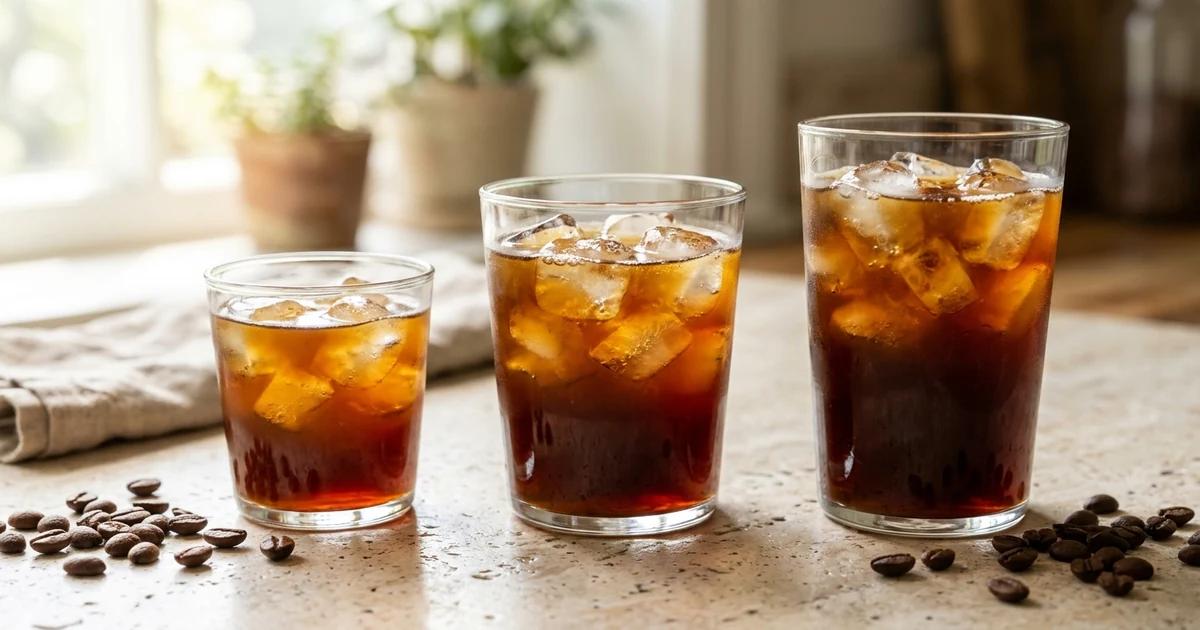
McDonald's does not publish caffeine for either its hot or iced coffee, so there is no official comparison. The Iced Coffee product page lists brewed coffee, ice, light cream and liquid sugar as ingredients. Because ice displaces liquid volume in the cup, an iced coffee of the same labeled size holds less actual coffee than its hot counterpart. Beyond that, no verified data exists for McDonald's specifically. For general iced-coffee caffeine numbers, see how much caffeine is in iced coffee.
Americano, Latte and Cappuccino
McDonald's lists "Espresso" as the coffee ingredient in its Americano, Latte and Cappuccino but publishes no shot count and no caffeine for any size. Without a shot count, any caffeine figure for a McDonald's espresso drink would be a guess. For general espresso-based math, see how much caffeine is in an Americano.
The McDonald's Drink That Does List Caffeine
One category on the McCafé menu actually prints a number. The Red Bull Dragonberry Energizer and the Reduced Sugar version both carry a footnote: "Energizers contain 80mg of caffeine and are not recommended for children, pregnant or nursing women, and persons sensitive to caffeine." The regular version lists 200 calories. Neither page lists the drink's size in ounces.
For Red Bull's own figures by can size, see how much caffeine is in Red Bull.
Decaf at McDonald's
McDonald's sells McCafé Premium Roast Decaf Coffee. As with every other McCafé coffee, the page lists no caffeine. The FDA notes that decaf coffee typically contains 2 to 15 milligrams per 8 fl oz cup. Decaf is not caffeine-free; it is caffeine-reduced.
How Much Caffeine Is Too Much
The FDA cites 400 mg a day as the amount not generally associated with negative effects for most healthy adults. Rapid consumption of around 1,200 mg can cause toxic effects including seizures. If you are pregnant, trying to become pregnant or breastfeeding, the FDA recommends talking to a health care provider about caffeine intake. McDonald's own Energizer footnote adds children and people sensitive to caffeine to the caution list. For a fuller look at daily limits, see how much caffeine is too much and is 200 mg of caffeine a lot.
Related from Roon
Frequently Asked Questions
Does McDonald's coffee have more caffeine than Starbucks?
No one can answer that with published data from both sides. McDonald's prints no caffeine figure for its brewed coffee. Starbucks does publish caffeine by size and drink type. Without a McDonald's number, any head-to-head comparison is based on someone else's estimate, not on what either chain has confirmed. For Starbucks' published figures, see Starbucks caffeine content.
How much caffeine is in a large McDonald's coffee?
McDonald's does not publish caffeine for any size, and its US product pages do not list cup sizes in fluid ounces. Without an ounce size, no honest milligram figure exists for a large. The only tool is generic math: USDA brewed-coffee data works out to about 11.8 mg per fl oz, so check the ounces printed on your cup, if any, and multiply. That is an estimate for generic coffee, not a McDonald's figure.
Does McDonald's sweet tea or hot tea have caffeine?
Not published. McDonald's US product pages list no caffeine content for its sweet tea or hot tea.
Is 80 mg of caffeine from the McDonald's Energizer a lot?
Eighty milligrams is 20% of the FDA's 400 mg daily reference for healthy adults. That is roughly the caffeine in one 8 fl oz cup of generic brewed coffee per USDA data. It is a moderate single serving, not a high one.
A Dose You Can Read on the Tin
The takeaway from McDonald's menu is an information gap: you are drinking caffeine, but nobody will tell you how much. If knowing the number matters to you, a printed label changes the math.
Each Roon pouch delivers 80 mg of caffeine alongside 60 mg L-theanine, 25 mg methylliberine (Dynamine) and 5 mg theacrine (TeaCrine), all listed on the tin. The methylliberine is there for duration. In a randomized, double-blind crossover study (n = 12), co-dosing methylliberine with caffeine cut caffeine's oral clearance from 41.9 to 17.1 L/hr and extended its half-life from 7.2 to 15 hours, with no increase in peak concentration (study). That study used 100 mg methylliberine and 150 mg caffeine, roughly 4× and 1.9× what a single Roon pouch contains, so Roon follows the same mechanism directionally rather than replicating the study's exact figures. The practical result: a felt window of 6 to 8 hours from a single pouch, which is why 80 mg is enough without stacking cups. A 15-hour half-life is a clearance number, not 15 hours of perceived energy; plan your last pouch at least 8 hours before you want to sleep.
Roon is a caffeine pouch, not a coffee replacement and not a medical product. Cap intake at 4 pouches a day to stay within the FDA's 400 mg guideline from all sources. Roon costs from $9.16 per tin on the 12-tin subscription, as little as $0.61 per pouch.
Sources
- McDonald's FAQ: How Much Caffeine Is in McDonald's Coffee?
- McDonald's: McCafé Premium Roast Coffee (Small)
- McDonald's: McCafé Iced Coffee (Small)
- McDonald's: Red Bull Dragonberry Energizer
- FDA: Spilling the Beans: How Much Caffeine Is Too Much?
- USDA FoodData Central: Beverages, coffee, brewed, prepared with tap water (171890)
Written by Roon Team