Is Menthol Mint? What "Cool" Actually Is (and Why They're Not the Same Thing)

Is Menthol Mint? What "Cool" Actually Is (and Why They're Not the Same Thing)
No. If you are asking "is menthol mint," the short answer is that they are not the same thing. Menthol is a single chemical compound, a cyclic monoterpene alcohol, that happens to occur naturally in some mint plants. Mint is an entire genus of plants (Mentha) that produce dozens of aromatic compounds, of which menthol is just one. And the "cool" sensation you feel from menthol is not a flavor at all. It is a nerve response, triggered by a specific receptor on your sensory neurons called TRPM8. Three different things. Most people treat them as interchangeable. They are not.
Key Takeaways:
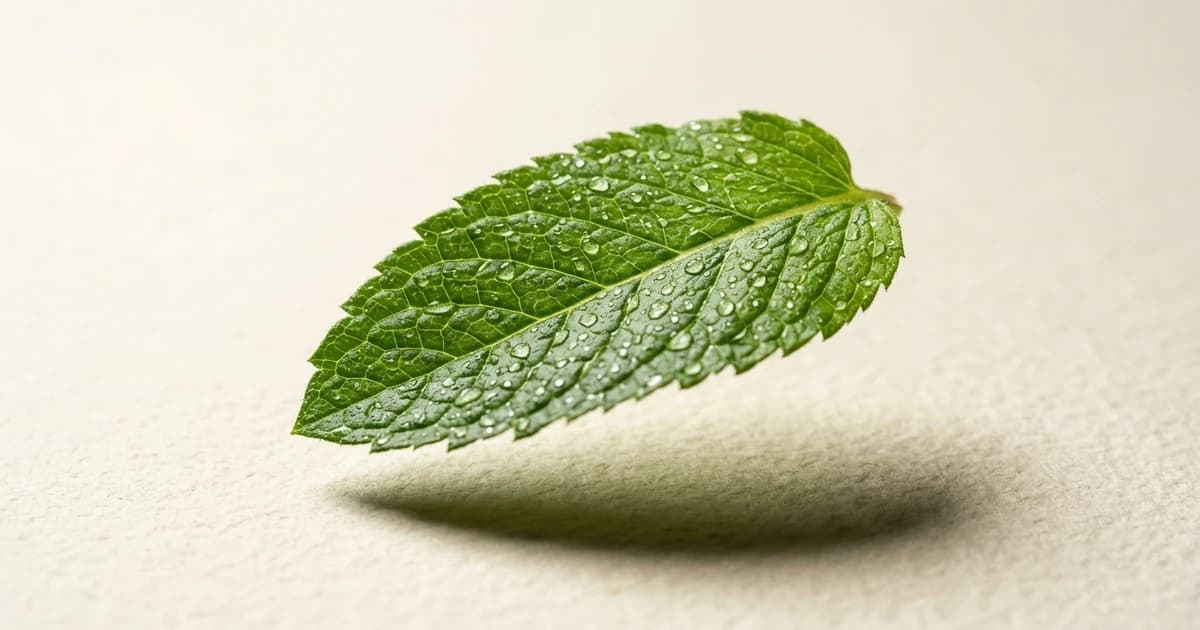
- Mint is a plant family. Peppermint, spearmint, and others each produce a unique blend of aromatic compounds. Menthol concentration varies wildly between species.
- Menthol is one molecule. It creates a cooling sensation by activating the cold-sensing TRPM8 receptor on nerve cells, the same receptor that fires when you touch something actually cold.
- "Cool" is a sensation, not a taste. Synthetic cooling agents like WS-23 trigger the exact same TRPM8 receptor with zero minty flavor, proving that cooling and mintiness are separate properties.
- Most commercial menthol is synthetic. Roughly 65% of global menthol production is manufactured, not extracted from plants.
What Menthol Actually Is
Menthol (C₁₀H₂₀O) is a cyclic monoterpene alcohol found as a major constituent of certain mint essential oils. Its molecular structure gives it two key properties: a characteristic minty odor and the ability to trigger cold-sensing nerve receptors.
Here is where the confusion starts. Not all mints contain meaningful amounts of menthol.
| Mint Species | Primary Compound | Menthol Content | Cooling Sensation |
|---|---|---|---|
| Peppermint (M. × piperita) | l-Menthol | 40%+ of essential oil | Strong |
| Cornmint (M. arvensis) | l-Menthol | 70–90% of essential oil | Very strong |
| Spearmint (M. spicata) | Carvone | <1% menthol | Minimal |
Spearmint tastes distinctly "minty" to most people, yet it contains almost no menthol. Its signature flavor comes from carvone, a completely different molecule. So you can have a mint flavor with no cooling, and you can have cooling with no mint flavor. They are independent variables.
Why Menthol Feels Cold: The TRPM8 Receptor
Menthol does not lower the temperature of your mouth. It tricks your nervous system into reporting cold where there is none.
The mechanism was identified in two landmark 2002 papers. McKemy, Neuhausser, and Julius identified a cold-sensitive receptor they called CMR1 (now TRPM8), published in Nature. Peier et al. independently characterized the same channel in Cell. Both teams showed that TRPM8 is an ion channel on sensory neurons that opens in response to cool temperatures (below roughly 26°C) and to menthol.
When menthol binds TRPM8, the channel opens and allows calcium and sodium ions to flow into the neuron. The neuron fires. Your brain interprets the signal the same way it would interpret actual cold. That is why menthol "feels" cold even at room temperature.
This also explains why menthol amplifies real cold. Put a menthol cough drop in your mouth and then breathe in cold air, and the sensation is sharper than either stimulus alone. Both are opening the same channel.
Cold vs. Minty: They Are Different Things
If "cooling" and "minty" were the same property, every cooling agent would taste like mint. They do not.
The flavor industry uses a family of synthetic cooling agents, most commonly WS-3 and WS-23, that activate the same TRPM8 receptor menthol does. WS-23 in particular is described by formulators as completely odorless and tasteless. It produces a clean, pure cold sensation with no minty character at all.
This is why "cool mint" as a flavor concept is actually two separate engineering decisions:
- The cooling component. Menthol, WS-23, WS-3, or a blend of these.
- The mint flavor component. Spearmint-type flavoring (carvone-based), peppermint-type flavoring (menthol contributes here, but so do menthone, menthyl acetate, and other compounds), or a custom blend.
A product labeled "cool mint" is not necessarily telling you it contains menthol. It might use WS-23 for the cool part and a carvone-based compound for the mint part. Or it might use menthol for both. Or some combination. The phrase "cool mint" describes the sensory target, not the ingredient list.
The reverse case is just as telling. Spearmint gum tastes thoroughly "minty" with almost no cooling because carvone delivers flavor without activating TRPM8 in any strong way. For a deeper look at how these two mints diverge, see menthol vs. carvone, the fuller comparison.
Natural vs. Synthetic Menthol
If you assumed the menthol in your toothpaste, shaving cream, or lip balm was extracted from mint leaves, the odds are against you. Synthetic menthol represents roughly 65% of total global production, with natural menthol making up the remaining 35%.
The natural supply comes primarily from Mentha arvensis (cornmint), grown at scale in India and China. But synthetic production, led by companies like Symrise and BASF, has grown steadily because it offers consistent purity and lower cost volatility compared to agricultural supply chains that shift with weather and crop yields.
Chemically, the end product is identical. Synthetic l-menthol and plant-derived l-menthol are the same molecule. Your TRPM8 receptors cannot tell the difference. This matters for the "is menthol natural?" question: the compound can be, but in most commercial products, it probably is not. Neither version is safer or more effective than the other.
Where "Cool Mint" Flavoring Fits
Understanding the distinction between menthol-the-compound and cool-mint-the-flavor-experience changes how you read product labels.
A product that says "cool mint flavoring" is describing an engineered sensory profile. It may achieve cooling through menthol, synthetic coolants, or both. It may achieve the "mint" character through menthol's own odor, through carvone-type compounds, through other aromatic molecules, or through some combination. The phrase tells you what the product tastes like, not what is in it.
Roon's oral pouches, for example, list "cool mint flavoring and sucralose." That describes the flavor outcome. It does not specify whether menthol, WS-23, or any particular botanical extract is the source. If you want to know what is actually driving the cooling or mint taste in any product, you need the full ingredient panel, not just the flavor descriptor. For context on how different mint-family flavors compare across pouch products, see wintergreen, spearmint, and peppermint differences.
Menthol Can Also Irritate at High Concentration
The intuition that more menthol equals more cooling is not quite right. Menthol has a dose-dependent twist.
Beyond activating TRPM8 (the cooling channel), menthol also acts on a second receptor: TRPA1, an ion channel associated with pain and irritation. Karashima et al. (2007) demonstrated that menthol's effect on TRPA1 is bimodal. At low concentrations, menthol activates TRPA1, contributing a subtle sharp or pungent edge. At higher concentrations, menthol actually inhibits TRPA1.
This bimodal action means there is a concentration window, roughly in the low-to-moderate range, where menthol simultaneously activates both TRPM8 (cooling) and TRPA1 (sharp, pungent edge). At very high concentrations, menthol inhibits TRPA1, which is why the sensory profile of a strong menthol product is not a simple linear escalation of both cooling and bite. Product formulators balance these two receptor effects to hit a target sensation, which is one more reason "cool mint flavoring" is a formulation decision, not a single-ingredient dump.
Cooling, Mint, and Menthol: Three Separate Things
The conflation of menthol, mint, and cooling is understandable. They overlap in peppermint. But they are three distinct things: a plant genus, a chemical compound, and a neural sensation. Spearmint proves you can have mint without meaningful menthol. WS-23 proves you can have cooling without any mint. And synthetic production proves you can have menthol without any plant at all. Knowing the difference makes you a better reader of ingredient lists and a more informed consumer of anything labeled "cool," "mint," or "menthol."
Frequently Asked Questions
Is menthol a flavor or a sensation?
Both, technically. Menthol has a characteristic minty odor and taste (flavor), but its most distinctive property is a cooling sensation produced by activating the TRPM8 cold receptor on sensory neurons. The cooling is a neurological event, not a temperature change. Synthetic cooling agents like WS-23 produce the same cold sensation without menthol's minty flavor, proving the two effects are separable.
Is menthol bad for you?
Menthol is generally recognized as safe (GRAS) by the FDA when used in food and consumer products at typical concentrations. At very high topical concentrations it can cause skin or mucosal irritation, partly through TRPA1 activation. It is a common ingredient in cough drops, topical analgesics, and oral care products. If you have specific health concerns, talk to your clinician.
Is menthol vegan?
Yes. Menthol, whether natural or synthetic, is a chemical compound with no animal-derived components. Natural menthol comes from mint plants. Synthetic menthol is manufactured from petrochemical or terpene feedstocks. Neither production method involves animal products.
Why does spearmint taste minty but not feel cold?
Spearmint's dominant aromatic compound is carvone, not menthol. Carvone produces the sweet, familiar "mint" taste, but it does not strongly activate the TRPM8 cold receptor the way menthol does. Spearmint essential oil typically contains less than 1% menthol, which is why it tastes minty without the intense cooling of peppermint.
Why do some products say "mint" but have no menthol?
Because "mint" describes a flavor profile, not an ingredient. A product can taste minty using carvone, synthetic flavor compounds, or other aromatic molecules from the mint family without including menthol specifically. The word "mint" on a label tells you what the product tastes like, not what chemical is responsible.
What is WS-23?
WS-23 is a synthetic cooling agent (chemical name: N,2,3-trimethyl-2-isopropylbutanamide) widely used in food, beverage, and oral product formulation. It activates the same TRPM8 receptor as menthol but is odorless and tasteless, giving formulators a way to add cooling without adding any mint flavor. It is commonly used alongside or instead of menthol in modern "cool" products.
Is natural menthol better than synthetic menthol?
Chemically, they are identical. Synthetic l-menthol and plant-extracted l-menthol are the same molecule. Your body processes them the same way, and your TRPM8 receptors respond to them the same way. The choice between them is a supply-chain and cost decision for manufacturers, not a quality or safety difference for consumers.
Does menthol numb your mouth?
Menthol can produce a mild local anesthetic effect at certain concentrations. This is related to its interaction with voltage-gated sodium channels, separate from its TRPM8 cooling activity. At typical consumer-product concentrations, you may notice a slight numbing alongside the cooling sensation, but it is not a strong anesthetic effect.
Why "Cool Mint" Is an Engineering Decision, Not One Ingredient
If this article changed one thing about how you think about product flavors, let it be this: "cool mint" is a target, not a recipe. Every product that delivers a cooling mint experience is making separate decisions about its cooling agent, its flavor compounds, and how to balance the two.
Roon describes its flavor as cool mint, delivered through a zero-nicotine sublingual pouch built around a four-ingredient functional stack: 80 mg caffeine, 60 mg L-theanine, 25 mg methylliberine (Dynamine), and 5 mg theacrine (TeaCrine). The flavor uses cool mint flavoring and sucralose. It is not an "all natural" product, and it does not claim to be. Zero sugar, zero calories, zero nicotine.
What Roon is not: a mint supplement, a menthol product, or a flavor-first novelty. It is a focus pouch. The cool mint is the delivery format, chosen because sublingual absorption in the mouth pairs well with a clean cooling sensation. Tins start from $9.16 each on a 12-tin subscription ($0.61 per pouch). If you want to try it, you can order at takeroon.com.
Related from Roon
- Spearmint vs. Peppermint
- Wintergreen vs. Spearmint vs. Peppermint
- Zyn Flavors Ranked: Complete Guide
Written by Roon Team