Hurkle-Durkle Meaning: The Scots Word for Staying in Bed
Roon Team
Hurkle-Durkle Meaning: The Scots Word for Staying in Bed
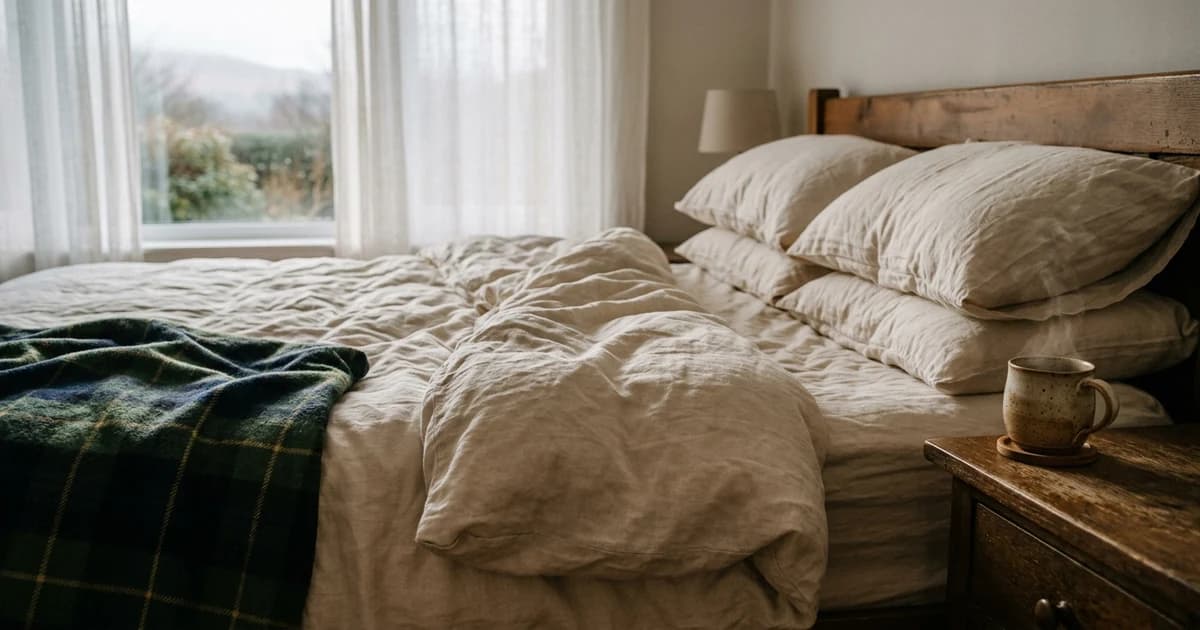
Hurkle-durkle is a Scots word meaning to lie in bed or lounge about after it is time to get up. It was recorded in Fife dialect in John Jamieson's 1825 dictionary supplement and went viral on TikTok in January 2024, when actress Kira Kosarin introduced it to millions of viewers. The word is charming. The grogginess after you finally get up is less charming, and it has a name too: sleep inertia.
Key Takeaways
- Hurkle-durkle is a Scots (not Gaelic) verb and noun phrase first recorded in 1825, meaning to stay in bed when you should be up.
- It went viral thanks to a January 2024 TikTok by Kira Kosarin and was later used in The New York Times, Bustle, and the New York Post.
- It is not the same as bed rotting. Hurkle-durkling is a short, chosen morning lie-in; bed rotting is an extended retreat that can last hours or days.
- The fog you feel after a long lie-in is sleep inertia, worst in the first 30 minutes. Light, movement, and caffeine all help shorten it.
What Does Hurkle-Durkle Mean?
Hurkle-durkle has two recorded senses in the Dictionaries of the Scots Language. As a noun phrase, "in hurkle-durkle" means in a state of indolence. As a verb, it means to lie in bed or lounge about when one should be up and about.
Jamieson's original wording is still the clearest: "To lie in bed, or to lounge, after it is time to get up or to go to work."
Pronunciation: say it as spelled, HUR-kul DUR-kul. The two halves rhyme. No formal phonetic transcription exists in any major dictionary, but this is the plain reading of the Scots spelling and matches how Kosarin says it in the video that made it famous.
Where Does Hurkle-Durkle Come From?
The root word "hurkle" means to crouch, stoop, or huddle. The DSL traces it to Older Scots around 1500, with Middle English usage back to the 14th century. "Durkle" is rhyming reduplication, the same word-formation pattern behind helter-skelter or hurly-burly. It adds no separate meaning; it makes the word fun to say.
Many sources date the word to 1808. That is the year Jamieson published An Etymological Dictionary of the Scottish Language, but the DSL entry for hurkle-durkle is labeled "Fif. 1825 Jam.", placing it in his two-volume Supplement, published in 1825. The first dictionary exists; the word appears in the second volume.
One important note: Scots is a Germanic language, closely related to English. It is not Scottish Gaelic, which is a Celtic language. Hurkle-durkle is Scots, full stop.
Why Did Hurkle-Durkle Go Viral in 2024?
On January 10, 2024, actress and singer Kira Kosarin (Nickelodeon's The Thundermans) posted a TikTok captioned "hurkle-durkle, u deserve it." The video racked up millions of views. Her delivery was direct: "I do be hurkling, and I do be durkling, and once I've hurkled my last durkle in a given morning I will get up."
The word was not entirely new to the internet. Wiktionary credits lexicographer Susie Dent with popularizing the term starting in 2015. But Kosarin's video turned a niche word-nerd favorite into a cultural moment.
Within weeks, the mainstream press picked it up. On January 31, 2024, Carolyn Steber wrote about hurkle-durkling in Bustle. On February 14, Brooke Steinberg used it in the New York Post. And on February 17, Elizabeth Passarella brought it into The New York Times.
Hurkle-Durkle vs Bed Rotting: What Is the Difference?
Both involve staying in bed. The similarity ends there. Here is how they differ:
| Hurkle-Durkle | Bed Rotting | |
|---|---|---|
| When | Morning, after your alarm | Any time of day |
| How long | Minutes to an hour | Hours or entire days |
| Mood | Cozy, chosen, low-guilt | Often burnout, avoidance, or fatigue |
| Endpoint | Yes, you get up and start your day | Often none, can blend into the next sleep |
| Cultural origin | 1825 Scots dialect | 2023 TikTok / Gen Z slang |
The numbers on bed rotting come from a real survey. According to the 2025 AASM Sleep Prioritization Survey (n = 2,007 US adults), 18% of US adults have tried bed rotting. Among 18- to 24-year-olds, the figure rises to 31%. Among adults 65 and older, it drops to 5%.
Hurkle-durkling is closer to hitting the snooze button than it is to bed rotting. It has a natural end. You are lingering, not retreating.
How to Use Hurkle-Durkle in a Sentence
The word works as a verb, a gerund, and part of a noun phrase. Some examples:
- "I hurkle-durkled for twenty minutes before my second alarm went off."
- "Sunday mornings are for hurkle-durkling."
- "She lay in hurkle-durkle until the coffee smell reached the bedroom."
- "Don't call me lazy. I'm a committed hurkle-durkler."
- "He hurkle-durkles through every alarm, then sprints to the shower."
- Bustle, Jan 31, 2024: Steber wrote that the subject "isn't being 'lazy' or 'wasting her day' when she hurkle-durkles."
- New York Post, Feb 14, 2024: "So hurkle-durkle to your heart's desire."
The gerund "hurkle-durkling" is also common, especially on TikTok, where it functions as both activity and identity.
Is Hurkle-Durkling Bad for You?
A chosen morning lie-in with a clear endpoint is rest. It is not a character flaw.
A study by Sundelin et al. (online 2023, print 2024) in the Journal of Sleep Research tested 31 habitual snoozers in a sleep lab. Thirty minutes of snoozing improved or did not affect cognitive performance right after waking, cost about 6 minutes of total sleep, and had no measurable effect on mood, sleepiness, or the cortisol awakening response. Their larger survey (n = 1,732) found that 69% of respondents snoozed at least sometimes, for an average of 22 minutes. In other words, what most people do naturally is not harmful.
What does cost you is total sleep under 7 hours. The AASM and Sleep Research Society consensus (2015, 15-member panel) found that adults need 7 or more hours per night for health. Hurkle-durkling is not a substitute for adequate sleep, and catching up on sleep debt is harder than it sounds.
If you find that you persistently cannot get out of bed, feel low energy all day, or notice changes in mood that do not lift, talk to a clinician. That is a different situation.
Why Do You Feel Groggy After a Long Lie-In?
That post-lie-in fog has a clinical name: sleep inertia. The CDC's NIOSH training module defines it as "a temporary disorientation and decline in performance and/or mood after awakening from sleep." It typically lasts 30 to 60 minutes. A 2019 review by Hilditch and McHill notes that it has been observed lasting up to 2 hours in some cases.
That same 2019 review by Hilditch and McHill in Nature and Science of Sleep identified three factors that make sleep inertia worse:
- Prior sleep loss. If you are underslept, the fog is thicker.
- Waking from slow-wave (deep) sleep. The later you snooze past your natural wake point, the more likely you are to sink back into a deep stage.
- Waking near the circadian low. Your body temperature hits its floor in the early morning hours. Waking close to that low makes the transition harder.
The good news: impairment is most severe in the first 30 minutes and then drops off. Understanding morning brain fog as a temporary, measurable state makes it easier to plan around rather than fight.
How to Get Up After the Last Durkle
Once you decide the hurkle-durkle is over, the goal is to move through sleep inertia efficiently. Here is a 10-minute wake-up sequence distilled from the research:
- Light. Open the curtains or turn on a bright lamp. Light is the strongest signal to your circadian clock that the day has started.
- Feet on the floor. The physical act of standing changes your blood pressure and sends a wake signal to your brain. Move a little: stretch, walk to the kitchen.
- Cold water on the face. A simple splash triggers the dive reflex and raises alertness. It sounds trivial. It works.
- Caffeine, with realistic expectations. In a double-blind crossover study (n = 15), 100 mg of caffeine gum given immediately on waking beat placebo on reaction speed at 12 and 18 minutes after a 1 a.m. awakening and at 18 minutes after a 6 a.m. awakening. Caffeine helps, but not instantly. Expect 15 to 18 minutes before it shows up.
- Protect the first half hour. Save important decisions, driving, or anything safety-critical until after that initial 30-minute window clears. This is when how to get rid of sleep inertia matters most.
If you want to become a morning person, the steps above are the foundation, not willpower.
So, Should You Hurkle-Durkle?
The Scots had a word for something the rest of us pretend we do not do. A short, deliberate lie-in after your alarm is normal. The research says it does not hurt your cognition or your cortisol. What matters is total sleep, a clear endpoint, and how you manage the fog in the first 30 minutes once you do get up. Say the word. Enjoy the durkle. Then get on with it.
Frequently Asked Questions
How do you pronounce hurkle-durkle?
Say it as spelled: HUR-kul DUR-kul. The two halves rhyme. No major dictionary provides an official phonetic transcription, but this pronunciation matches the Scots spelling and how Kira Kosarin says it in the TikTok video that popularized the word. It rolls off the tongue easily once you try it.
Is hurkle-durkle a real word?
Yes. It appears in the Dictionaries of the Scots Language, recorded in Fife dialect in Jamieson's 1825 Supplement to the Etymological Dictionary of the Scottish Language. It has also been cited in The New York Times, The Wall Street Journal, and Bustle, among others.
What language is hurkle-durkle?
Scots, which is a Germanic language closely related to English. It is not Scottish Gaelic, a Celtic language. The root word "hurkle" (to crouch or huddle) traces back to Older Scots around 1500 and Middle English in the 14th century.
Is hurkle-durkle the same as bed rotting?
No. Hurkle-durkling is a short, chosen morning lie-in, usually lasting minutes to an hour, with a clear endpoint. Bed rotting can happen at any time of day, often lasts hours or entire days, and is more closely associated with burnout or avoidance. According to the 2025 AASM survey, 18% of US adults have tried bed rotting. See our internet slang glossary for more terms like this.
Who started the hurkle-durkle trend?
Actress Kira Kosarin posted the viral TikTok on January 10, 2024, though lexicographer Susie Dent had been popularizing the word since 2015, according to Wiktionary. Kosarin's video brought it to a mass audience, and major publications covered it within weeks.
How long does morning grogginess last?
Sleep inertia, the clinical term for post-waking grogginess, typically lasts 30 to 60 minutes and resolves faster with light exposure, movement, and caffeine. It is worst in the first 30 minutes and is made worse by sleep deprivation, waking from deep sleep, or waking near your circadian low point.
For the 30 Minutes After the Last Durkle
The article's through-line is simple: the hurkle-durkle is fine. The cost is the 30-minute fog after it. That fog, sleep inertia, is where the Newman et al. caffeine-gum study measured improvement at 12 to 18 minutes. The study used 100 mg of plain caffeine, not Roon.
But the logic extends. Roon is something you can reach for while still in bed: a sublingual pouch, no kettle, no water, no waiting for a pour-over. Onset is 5 to 10 minutes. Each pouch contains 80 mg caffeine, 60 mg L-theanine, 25 mg methylliberine (Dynamine), and 5 mg theacrine (TeaCrine). The value argument is duration: methylliberine slows caffeine clearance. In a randomized, double-blind crossover PK study (n = 12), co-administration cut caffeine's oral clearance from 41.9 to 17.1 L/hr and extended its half-life from 7.2 to 15 hours, with no increase in peak concentration (study). That arm used 100 mg methylliberine and 150 mg caffeine, roughly 4x the methylliberine and 1.9x the caffeine in a Roon pouch (25 mg and 80 mg). The mechanism is directionally the same; the magnitude may differ. The felt window is 6 to 8 hours, not 15.
The trade-off: take it in the morning. Stop at least 8 hours before bed, because a longer half-life means the caffeine sticks around. Roon is not a sleep product and it is not a reason to skip the durkle. From $9.16 per tin on subscription, or $15.00 per tin one-time. Try Roon.
Related reading:
- How to Get Rid of Sleep Inertia
- How to Wake Up Easily in the Morning
- Morning Brain Fog: How to Wake Up Mentally Sharp Instead of Groggy
- Crashing Out Meaning
Written by Roon Team