Coffee Fruit Extract: Caffeine, BDNF and the Evidence
Coffee Fruit Extract: Caffeine, BDNF and the Evidence
Coffee fruit extract comes from the cherry surrounding the coffee bean, a part of the plant that traditional processing discards. Depending on the extract type, 100 mg can contain as little as 1.8 mg of caffeine or at least 70 mg. The human studies behind its main claim, raising the brain protein BDNF, are small, acute and mostly funded by the company that sells the extract.
What Is Coffee Fruit Extract?
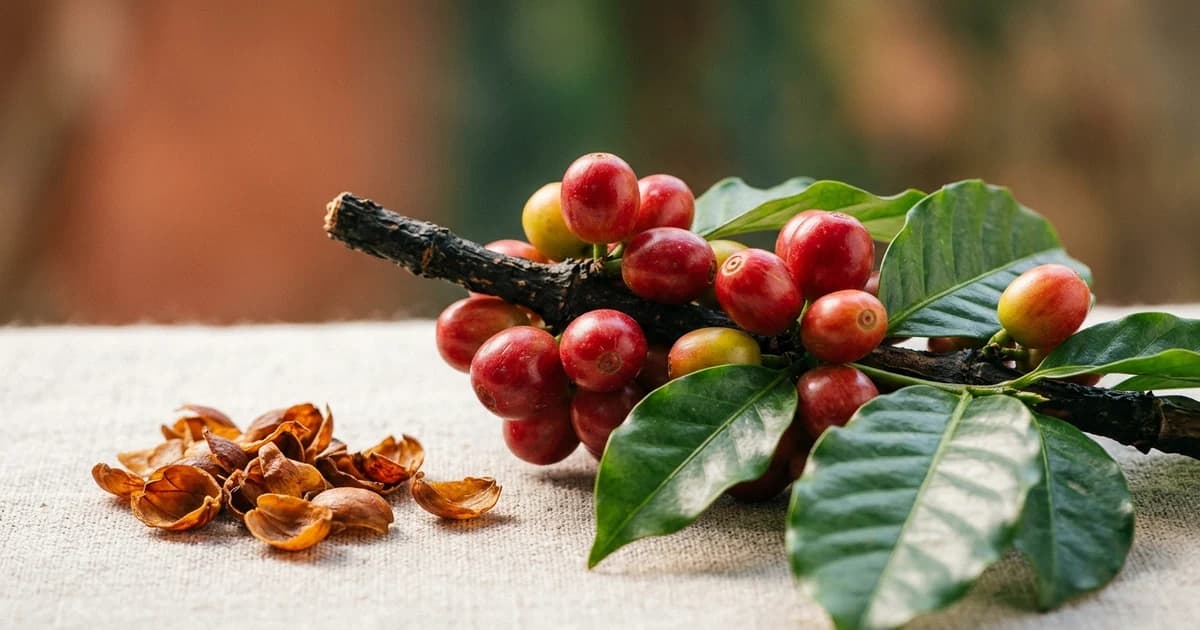
The coffee cherry is the whole fruit of the Coffea plant; the bean is the seed inside. The flesh, skin and mucilage have historically been discarded but contain chlorogenic acids, procyanidins and caffeine.
Three forms show up in products:
- Low-caffeine polyphenol extract (e.g. NeuroFactor). Standardized to at least 40% chlorogenic acids, under 2% caffeine. This is the form behind the BDNF studies. See our NeuroFactor explainer.
- Caffeine-rich extract. At least 70% caffeine by weight, used as a "natural caffeine" source. Nemzer et al. (2021) characterized both a chlorogenic-acid type and this caffeine-rich type.
- Cascara. Dried husk brewed as tea. The EFSA (2022) judged cascara safe as a novel food under its proposed uses but noted infusions could reach up to 600 mg of caffeine per liter, comparable to coffee beverages (EFSA lists coffees at 270 to 1,340 mg/L and teas at 150 to 220 mg/L).
How Much Caffeine Is in Coffee Fruit Extract?
About 1.8 mg per 100 mg of NeuroFactor, versus at least 70 mg per 100 mg of a caffeine-standardized extract. The name alone tells you almost nothing.
| Form | Description | Caffeine per 100 mg | Source |
|---|---|---|---|
| NeuroFactor (FutureCeuticals) | Polyphenol extract, 40%+ chlorogenic acids | About 1.8 mg | Robinson et al. 2021, Table 1 |
| Chlorogenic-acid extract ("WCCE1") | 40%+ chlorogenic acids | Not published | Nemzer et al. 2021 |
| Caffeine-rich extract ("WCCE2") | Standardized to 70%+ caffeine | At least 70 mg | Nemzer et al. 2021 |
| Cascara (dried husk) | Brewed drink | Up to 600 mg/L | EFSA 2022 |
Source: composition data in linked studies and EFSA opinion, checked Oct 2026. Per-100 mg figures computed from mg/g or minimum percentage.
If a supplement lists "coffee fruit extract" without a caffeine figure, check the Supplement Facts panel or contact the brand.
Does Coffee Fruit Extract Raise BDNF?
Two small studies report acute plasma BDNF increases after a single 100 mg dose, and both involve the ingredient's manufacturer.
Reyes-Izquierdo et al. (2013) gave fasted adults a single dose. The coffee fruit group (n = 10) showed a 143% BDNF rise from baseline within two hours; green coffee caffeine powder and grape seed extract each rose about 31%. Authors Nemzer and Pietrzkowski appear as FutureCeuticals staff in later publications.
Robinson et al. (2021) ran a crossover in 8 older adults with subjective cognitive impairment. Exosomal BDNF increased after the extract (one-tailed p = 0.04) but not after placebo. FutureCeuticals funded the work, and three authors are employees.
A rise in circulating BDNF after one dose is a biomarker shift, not evidence of improved memory. Blood BDNF does not confirm the same change is happening in the brain. For context, see BDNF and neuroplasticity explained.
Does Coffee Fruit Extract Improve Focus or Memory?
Reaction time improved versus placebo in two FutureCeuticals-funded trials of older adults with cognitive decline, and we found no large independent trial in healthy younger adults. A Japanese 12-week trial of a different extract, from Robusta coffee cherry pulp, found a memory score gain at the high dose only.
| Study | Participants | Result | Funding |
|---|---|---|---|
| Robinson et al. 2020 | 71 adults, mild cognitive decline, 28 days | Faster reaction time vs placebo; no accuracy effect | VDF FutureCeuticals affiliation |
| Robinson et al. 2021 | 8 older adults, crossover | Faster n-back reaction time; higher exosomal BDNF | FutureCeuticals funded; 3 employees |
| Ariki et al. 2026 | 66 adults 40+, suspected MCI, 12 weeks (Robusta pulp) | Memory composite higher at high dose only | UCC coffee company author |
| Pavis et al. 2026 | 12 cyclists, crossover | 4.6% more work in time trial; no glycogen benefit | FutureCeuticals funded; 3 employees |
The Pavis cycling trial gave 12 trained cyclists a coffee cherry extract supplying 200 mg caffeine and 15 mg polyphenols, against a placebo with no caffeine, so the performance gain cannot be separated from the caffeine. Products that list coffee-fruit-derived caffeine count toward the daily total the same way any caffeine does; for more on plant-derived vs synthetic forms, see natural caffeine vs synthetic caffeine.
Is Coffee Fruit Extract Safe?
Rat studies found no mutagenic or genotoxic potential and no adverse effects at up to 5% of diet over 90 days. Those results are in rats, not people, and long-term human safety data for low-caffeine coffee fruit extracts remain limited; if you take medication, check with a pharmacist first. For cascara, EFSA concluded it is safe under the proposed uses but will add significantly to total caffeine intake.
For caffeine-rich forms, the main concern is caffeine itself. People who are pregnant, breastfeeding, managing a heart condition, taking stimulant medication, or under 18 should consult a clinician before adding a concentrated caffeine source. Keep total caffeine from all sources within the FDA's 400 mg daily guideline for healthy adults.
Related from Roon
Frequently Asked Questions
Is coffee fruit extract the same as green coffee bean extract?
No. Coffee fruit extract comes from the cherry surrounding the seed; green coffee bean extract is made from the unroasted seed. Reyes-Izquierdo et al. (2013) gave green coffee bean extract as its own arm, separate from the whole coffee fruit concentrate.
Is cascara the same as coffee fruit extract?
Cascara is the dried husk of the coffee cherry brewed as a drink, one form of coffee fruit product but not the concentrated extract sold in capsules. The EFSA judged it safe as a novel food in 2022 and flagged its caffeine content.
Will a low-caffeine coffee fruit extract keep me awake?
A 100 mg dose of NeuroFactor contributes about 1.8 mg of caffeine, a tiny fraction of what a cup of coffee delivers. A caffeine-standardized extract delivering 70+ mg per serving is a real stimulant dose and should be timed like any other caffeine source.
Can I take coffee fruit extract with coffee?
With a low-caffeine polyphenol extract the added caffeine is negligible. With caffeine-rich forms, the milligrams add up. Keep total daily caffeine from all sources within the FDA's 400 mg guideline for healthy adults.
When You Want the Caffeine You Can Feel
Most coffee fruit extract sold for focus is chosen for its polyphenols and delivers roughly 1.8 mg of caffeine per serving. If sustained alertness is the goal, the active ingredient is still caffeine, dosed high enough to notice and paired with compounds that shape its clearance.
Roon skips the fruit entirely: each pouch pairs 80 mg caffeine with 60 mg L-theanine, 25 mg methylliberine (Dynamine) and 5 mg theacrine (TeaCrine), with zero nicotine, and we make no BDNF claims for it. The design targets duration: in a randomized crossover PK study (n = 12), methylliberine co-administered with caffeine cut oral clearance from 41.9 to 17.1 L/hr and extended caffeine's half-life from 7.2 to 15 hours without raising peak concentration (Mondal et al. 2022). That study dosed 100 mg methylliberine with 150 mg caffeine, about 4x the methylliberine and 1.9x the caffeine in one Roon pouch, so the mechanism applies directionally but not at the study's exact magnitude. A longer half-life is not the same as hours of lift; one pouch tends to stay noticeable for about 6 to 8 hours, so time your last one eight or more hours before sleep. Zero sugar (contains sucralose), and pricing starts from $9.16 per tin, or $0.61 per pouch, on the 12-tin subscription.
Sources
- Reyes-Izquierdo T et al. Br J Nutr 2013;110(3):420-5 (FutureCeuticals-affiliated authors)
- Robinson JL et al. Aging Neuropsychol Cogn 2020;27(6):918-34 (VDF FutureCeuticals affiliation)
- Robinson JL et al. Antioxidants 2021;10(2):144 (FutureCeuticals funded; 3 employee authors)
- Ariki S et al. Complement Ther Med 2026;100:103395 (UCC coffee company author)
- Pavis GF et al. J Int Soc Sports Nutr 2026;23(1):2682323 (FutureCeuticals funded; 3 employee authors)
- Nemzer B et al. Molecules 2021;26(14):4306
- Heimbach JT et al. Food Chem Toxicol 2010;48(8-9):2517-25
- EFSA NDA Panel. EFSA J 2022;20(2):e07185
- FDA: Spilling the Beans: How Much Caffeine Is Too Much?
- Mondal A et al. 2022 (methylliberine + caffeine PK, cited in CTA)
Written by Roon Team