Brain Fog Weed: Why Cannabis Clouds Your Thinking and How to Clear It
Roon Team
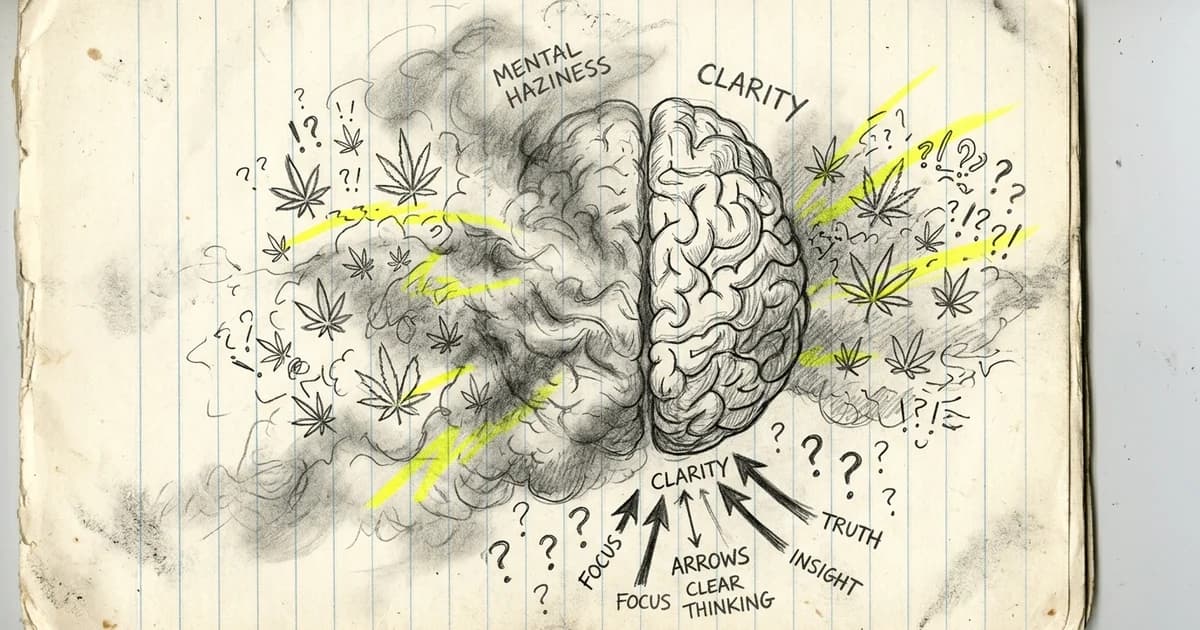
Brain Fog Weed: Why Cannabis Clouds Your Thinking and How to Clear It
You forgot what you walked into the room for. The sentence you were reading five seconds ago already dissolved. Your thoughts feel like they're pushing through wet cement.
If you use cannabis regularly, this probably sounds familiar. Brain fog weed is one of the most common cognitive complaints among users, and it's not just in your head (well, technically it is). The science behind why THC disrupts your mental clarity is well documented, and the path back to sharp thinking is clearer than you might expect.
This guide breaks down exactly what's happening in your brain, how long brain fog weed lasts, and how to clear brain fog for good.
Key Takeaways
- THC directly impairs working memory by binding to CB1 receptors in the hippocampus and prefrontal cortex.
- Heavy, long-term use is associated with reduced brain activity during memory tasks, even when you're sober.
- Brain fog weed effects are reversible. CB1 receptor density returns to normal within about four weeks of abstinence.
- Targeted compounds like L-theanine and caffeine can support cognitive recovery and promote sustained focus.
What Brain Fog Weed Actually Feels Like
Brain fog isn't a clinical diagnosis, and understanding what brain fog actually is starts with its symptoms: difficulty concentrating, sluggish recall, poor word retrieval, and a general sense that your mental engine is idling in second gear.
For cannabis users, the brain fog weed experience tends to follow a pattern. Short-term memory takes the biggest hit. You lose track of conversations mid-sentence. Tasks that require holding multiple pieces of information at once, like following a recipe or doing mental math, become harder than they should be.
Some people describe brain fog weed as thinking through a filter. Others say it feels like their brain has a half-second delay on everything.
The frustrating part? Brain fog weed doesn't always clear up the moment you stop using. For regular users, the fog can linger for days or even weeks after the last session.
The Neuroscience: How THC Creates Brain Fog Weed
Understanding why weed causes brain fog requires a quick look at your endocannabinoid system (ECS). Your body naturally produces compounds called endocannabinoids that bind to CB1 receptors throughout the brain. These receptors help regulate memory, mood, appetite, and pain.
THC is structurally similar to your natural endocannabinoids. When you consume cannabis, THC floods these receptors, particularly in two regions that matter most for clear thinking: the hippocampus (memory formation) and the prefrontal cortex (decision-making, attention, and working memory).
THC and Working Memory
Working memory is your brain's scratchpad. It's what lets you hold a phone number in your head long enough to dial it, or follow a multi-step argument without losing the thread.
A 2025 study from CU Anschutz Medical Campus, the largest ever conducted on cannabis and brain function, found that 63% of heavy lifetime cannabis users showed reduced brain activity during working memory tasks. Among recent users, that number was 68%. The study defined heavy users as young adults who had used cannabis more than 1,000 times over their lifetime.
Research published in Neuropsychopharmacology pinpointed the mechanism: CB1 receptors in the hippocampus directly mediate the memory-impairing effects of THC. When researchers blocked these specific receptors with an antagonist drug, the memory disruption from THC was completely eliminated.
THC and the Prefrontal Cortex
Your prefrontal cortex is the CEO of your brain. It handles executive functions: planning, prioritizing, filtering distractions, and switching between tasks.
A study from Massachusetts General Hospital found that THC increases the variability of functional connectivity in the prefrontal cortex. In plain terms, THC makes the communication patterns in this region less stable, which reduces your brain's ability to adapt efficiently to changing demands.
This is why brain fog weed doesn't just make you forgetful. It makes you scattered. The prefrontal cortex can't coordinate properly when its signaling is disrupted.
The Dose Problem: More THC, More Brain Fog Weed
The relationship between THC and cognitive impairment isn't binary. It follows a dose-response curve. Research reviewed in the European Journal of Clinical Investigation describes a biphasic effect: very low doses of THC may have minimal or even slightly positive effects on cognition in certain contexts, while higher doses reliably impair memory and executive function.
Today's cannabis products are stronger than anything available 20 years ago. Concentrates can exceed 70% THC. That matters because, as the Canadian Centre for Addictions reports, higher-potency products cause deeper receptor downregulation, which means more pronounced brain fog weed and a longer recovery timeline.
How Long Does Brain Fog Weed Last?
This is the question everyone asks, and the honest answer is: it depends on how much and how long you've been using.
The Acute Phase (0 to 72 Hours)
The heaviest brain fog weed lifts within the first few days. A meta-analysis cited by the Canadian Centre for Addictions found that cognitive deficits became statistically non-significant in studies that required more than 72 hours of abstinence. Your CB1 receptors begin recovering availability within 48 hours.
But "statistically non-significant" in a research setting doesn't mean you feel sharp. Most people still notice mental sluggishness during this window.
The Recovery Phase (1 to 4 Weeks)
This is where the real repair happens. A study published in Molecular Psychiatry found that CB1 receptor density returned to normal levels after approximately four weeks of monitored abstinence. The downregulation was most pronounced in cortical brain regions, which are the same areas responsible for higher-order thinking.
For most regular users, the brain fog weed recovery timeline looks something like this:
| Timeframe | What's Happening |
|---|---|
| 48 hours | CB1 receptors begin upregulating. Acute fog starts lifting. |
| 1 week | Noticeable improvements in short-term memory and attention. |
| 2 to 3 weeks | Executive function and verbal recall continue improving. |
| 4+ weeks | CB1 receptor density returns to baseline for most users. |
The Long Game (3+ Months)
Harvard Health reports that long-term, frequent cannabis use is associated with measurable cognitive impairment in midlife, and that people close to heavy users often noticed memory and attention problems. The more frequently someone used, the greater the impairment.
The good news: brain fog weed effects appear to be largely reversible with sustained abstinence, though recovery may take longer for people who started using in adolescence, when the brain is still developing.
Brain Fog Weed: What Actually Helps You Recover Faster
Waiting four weeks for your receptors to reset is the baseline. But you can actively support the process.
1. Prioritize Sleep
Sleep is when your brain consolidates memories and clears metabolic waste. THC disrupts REM sleep, which is the phase most closely tied to cognitive restoration. Once you stop using, your sleep architecture starts normalizing, but it can take a week or two. Keep your room dark, maintain a consistent schedule, and avoid screens before bed.
2. Exercise
Aerobic exercise increases blood flow to the hippocampus and promotes the release of brain-derived neurotrophic factor (BDNF), a protein that supports the growth of new neural connections. Even 30 minutes of moderate cardio three to four times a week makes a measurable difference. Running, cycling, swimming, or brisk walking all count. The key is consistency, not intensity.
3. Targeted Nutritional Support
Certain compounds have strong evidence for supporting the exact cognitive functions that brain fog weed impairs.
L-Theanine, an amino acid found naturally in green tea, promotes alpha brain wave activity, which is the brain state associated with calm, focused attention. A study published in Nutritional Neuroscience found that combining L-theanine with caffeine improved accuracy during task switching and increased subjective alertness while reducing tiredness.
This combination is particularly relevant for people recovering from brain fog weed because it targets working memory and attention, the two functions hit hardest by THC.
Theacrine, a compound structurally related to caffeine, provides sustained energy without the tolerance buildup that regular caffeine users experience. Methylliberine works through similar pathways and complements theacrine's effects by supporting quick-onset mental clarity.
4. Reduce or Eliminate Use
This one's obvious but worth stating plainly. If you're experiencing brain fog weed symptoms and you keep using, you're refilling the hole you're trying to dig out of. Even reducing frequency or switching to lower-THC products can make a difference, but full abstinence gives your receptors the best chance to recover on schedule.
If quitting entirely isn't on the table, try limiting use to weekends only. That gives your CB1 receptors five consecutive days to begin recovering between sessions, which is enough to notice a real difference in weekday clarity.
The Bigger Picture: Cognitive Performance Without the Trade-offs
Cannabis appeals to a lot of people because it reduces stress and quiets a busy mind. Those are real benefits. But the cognitive cost, especially with regular use, is equally real.
The ideal scenario is getting the calm focus you're after without sacrificing your working memory, attention, or mental sharpness. That's the logic behind stacking compounds like caffeine, L-theanine, theacrine, and methylliberine together. Each one targets a different aspect of cognitive performance, and together they promote sustained focus for six to eight hours without the jitters, crash, or tolerance issues.
Roon was built around exactly this stack. It's a zero-nicotine sublingual pouch that delivers 80mg of caffeine alongside L-theanine, theacrine, and methylliberine, designed to support clean mental clarity without the brain fog weed that comes from less precise tools. If you're looking for focus without compromise, it's worth a look.