Why Tyrosine Works for Some People and Not Others: COMT
Roon Team
Why Tyrosine Works for Some People and Not Others: COMT and the Dopamine Inverted-U
You took tyrosine because a forum told you it sharpens focus. A friend swears it saved their workday. You felt nothing, or worse, you felt foggy and irritable. The reason isn't a fake supplement or a placebo gone wrong. It comes down to your tyrosine COMT genotype and where you sit on a curve that governs how dopamine drives your prefrontal cortex.
Two people can swallow the same dose of the same amino acid and walk away with opposite results. One gets cleaner thinking under pressure. The other gets restless and scattered.
This isn't mysterious once you understand the mechanism. Your brain runs dopamine on an inverted-U, and your genes set your starting point on that curve.
Key Takeaways
- Tyrosine is a precursor your body converts into dopamine, but more dopamine isn't always better.
- Prefrontal cognition follows a dopamine inverted-U: too little hurts, too much hurts, and there's a narrow sweet spot in the middle.
- The COMT val158met gene sets how fast you clear dopamine from your prefrontal cortex, placing you at a different point on that curve.
- "Why tyrosine doesn't work for me" usually means your baseline dopamine is already near the top of the U.
- Tyrosine reliably helps under stress, cold, noise, or sleep loss, when dopamine gets depleted faster than it's made.
What Tyrosine Actually Does in Your Brain
Tyrosine is the raw material your neurons use to build dopamine and noradrenaline. It is not a stimulant and it does not force dopamine release. It simply makes more substrate available so synthesis can keep up when demand spikes.
That distinction matters. Dopamine precursors don't selectively target one pathway over another; they raise the availability of dopamine across all circuits, assuming synthesis isn't already saturated. If your tank is already full, adding raw material does nothing useful.
This is why the timing of the benefit is so specific. Tyrosine's most consistent benefit appears during cognitively demanding or physically stressful situations. A frequently cited 2015 review found the effect held up under real strain: tyrosine supplementation improved working memory and information processing when participants were exposed to cold, noise, or sleep deprivation, and the effect size was modest but reproducible.
The cleanest summary of the whole mechanism comes from the same analysis. Tyrosine helps when dopamine is depleted by stress or demand, not when it's already adequate, which is why studies in rested, healthy people show no effect.
The Dopamine Inverted-U, Explained
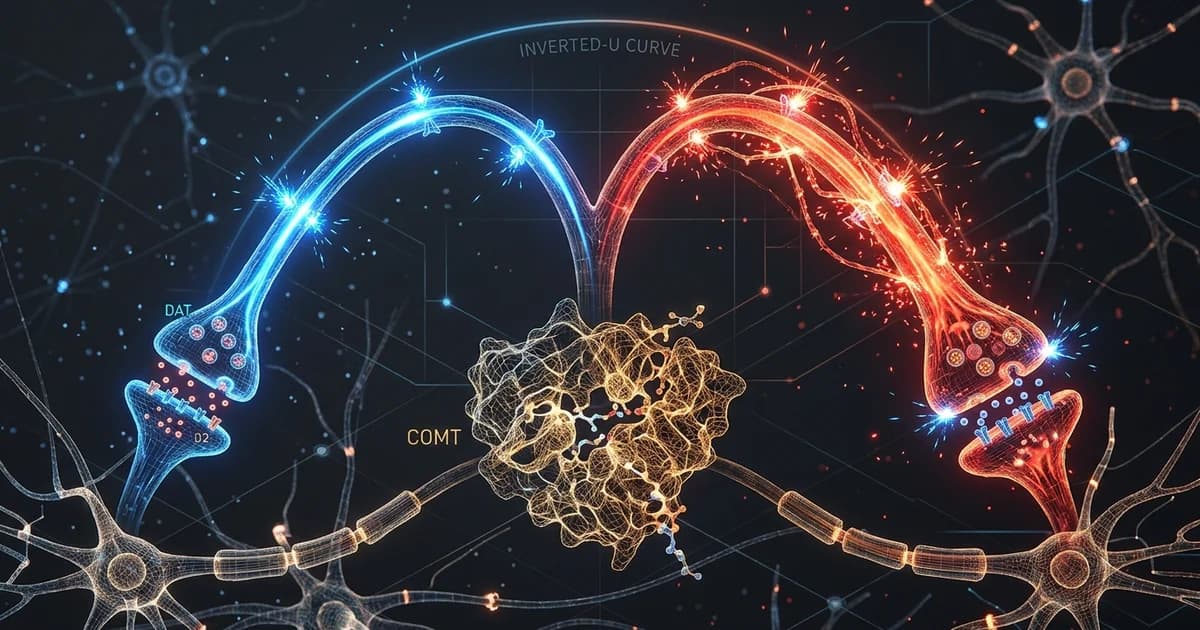
Prefrontal performance and dopamine don't move in a straight line. They follow an inverted-U.
Picture a hill. At the bottom left, dopamine is low and your working memory feels sluggish and unfocused. Climb toward the peak and cognition sharpens. Keep climbing past the peak and you slide down the other side into anxiety, distractibility, and noise.
The peak is narrow. A dose that pushes a low-dopamine person up toward the top can shove a high-dopamine person right over it. Same input, opposite outcome, because they started in different places.
This curve is the hidden logic behind almost every confusing report about prefrontal dopamine and nootropics. The question is never simply "more or less." It's "where were you standing before you took it."
Tyrosine COMT Genotype: Why Your Genes Set Your Starting Point
Your tyrosine COMT genotype determines how quickly your prefrontal cortex clears dopamine, which sets your baseline position on the inverted-U. COMT is the enzyme that breaks dopamine down, and one common gene variant changes how aggressively it works.
The relevant variant is COMT val158met, a single swap at codon 158. The substitution of Met for Val at codon 158 leads to a 3 to 4-fold reduction in COMT enzyme activity. Less enzyme activity means dopamine lingers longer in the prefrontal cortex.
Here's the chain in plain terms. Those with valine (Val158) alleles have greater COMT activity and lower prefrontal extracellular dopamine compared with those with the methionine (Met158) substitution; Val158 alleles may be associated with an advantage in processing aversive stimuli, while Met158 alleles may be associated with an advantage in memory and attention tasks.
Researchers nicknamed this the "warrior versus worrier" model. The matching of the slow-clearing Met carrier to the high-dopamine end of the curve, and the fast-clearing Val carrier to the low end, is what makes the genotype predict the direction of any dopamine-shifting intervention.
Where Each Genotype Sits on the Curve
| COMT val158met genotype | COMT enzyme activity | Baseline prefrontal dopamine | Position on inverted-U | Likely response to extra dopamine substrate |
|---|---|---|---|---|
| Met/Met ("worrier") | Lowest (3 to 4x slower) | Highest | Near or past the peak | Often no benefit; can tip into overshoot |
| Val/Met (intermediate) | Moderate | Moderate | Climbing toward peak | Variable, often mild benefit |
| Val/Val ("warrior") | Highest | Lowest | Left side of curve | Most room to gain, especially under stress |
The table reflects general population tendencies, not a diagnosis. Genotype is one input among many, including diet, sleep, and the cognitive load you're under at the moment.
"Why Tyrosine Doesn't Work for Me": The Likely Answer
If you're searching "why tyrosine doesn't work for me," the most probable explanation is that your baseline dopamine already sits near the top of the inverted-U. Adding more substrate pushes you past the peak instead of toward it.
This lines up with the warrior-worrier framework. A Met/Met carrier under normal, rested conditions has plenty of prefrontal dopamine already. There's no deficit to correct, so a precursor delivers nothing, and a strong dose may even degrade focus.
Stress flips the picture. The inverted-U shaped relationship between working memory and prefrontal dopamine reveals an advantage for Val homozygotes compared to Met homozygotes after psychosocial stress. When stress floods the system with dopamine, the fast-clearing Val carrier copes well while the slow-clearing Met carrier can get pushed over the peak.
So "it doesn't work" and "it backfires" are often the same story told from different starting points on the curve.
Genotype Isn't the Only Variable
COMT gets most of the attention, but it isn't the whole picture of individual response to nootropics. Dopamine signaling depends on receptors too, not just clearance.
A randomized controlled trial looked at a different gene, the C957T variant of the DRD2 dopamine receptor. The researchers investigated whether mixed findings with tyrosine supplementation were due to failure to consider individual differences in dopamine function, examining whether the C957T polymorphism at the DRD2 gene predicted reactivity to tyrosine for working memory and stopping performance. Their finding: receptor genetics shaped who responded, on top of clearance genetics.
The takeaway isn't that you need a full genome workup before trying an amino acid. It's that "tyrosine does X" was always too simple. Your receptors, your clearance rate, your sleep, and your stress level all decide where you land.
If you want the wider context on this, our explainer on why two people respond differently to the same nootropic walks through the same logic across stimulants and amino acids.
How to Actually Use This
Match the tool to your state, not to a forum's enthusiasm. Tyrosine is a depletion-replacement tool, so save it for the conditions where dopamine actually runs low.
- Use tyrosine when you're depleted: poor sleep, cold, high stress, long mentally taxing stretches. That's where the data is strongest.
- Skip it when you're rested and calm: there's likely no deficit to fill, and the inverted-U doesn't reward overshoot.
- Start low: if you suspect you're a slow clearer, a smaller dose keeps you nearer the peak instead of past it.
- Track honestly: note sleep, stress, and dose so you can see your own pattern rather than guessing.
You can approximate your COMT tendency from how you handle pressure and caffeine, though a genetic test is the only direct read. The point is to stop treating a precursor as a guaranteed upgrade and start treating it as a state-dependent lever.
Conclusion
Tyrosine isn't a focus pill that works or fails at random. It's a dopamine precursor, and dopamine drives prefrontal cognition along an inverted-U with a narrow peak. Your COMT val158met genotype sets where you start on that curve, which decides whether more substrate helps, does nothing, or tips you over the top.
Slow clearers sit high and rarely need more, except under heavy stress. Fast clearers sit low and have the most to gain. Once you see the mechanism, "why tyrosine doesn't work for me" stops being a mystery and becomes a question about your baseline and your current load. The smartest move is to match any dopamine input to the moment, not to a one-size promise.
Frequently Asked Questions
What is the COMT val158met gene and why does it matter for tyrosine?
COMT is the enzyme that breaks down dopamine in your prefrontal cortex. The val158met variant changes how fast it works. The substitution of Met for Val at codon 158 leads to a 3 to 4-fold reduction in COMT enzyme activity. Slower clearance means higher baseline dopamine, which places you differently on the inverted-U and changes how you respond to a dopamine precursor like tyrosine.
What is the dopamine inverted-U?
It's the relationship between prefrontal dopamine and cognitive performance. Too little dopamine leaves you sluggish and unfocused. Too much pushes you into anxiety and distraction. There's a narrow peak in the middle where working memory and focus are sharpest. Because the peak is narrow, the same dose of a dopamine precursor can help one person and overshoot another, depending on where each started.
Why doesn't tyrosine work for me?
The most likely reason is that your baseline dopamine already sits near the top of the inverted-U, so adding substrate does nothing or tips you past the peak. Tyrosine helps when dopamine is depleted by stress or demand, not when it's already adequate, which is why studies in rested, healthy people show no effect. Try it during stress, cold, or sleep loss instead.
Are "warriors" and "worriers" real categories?
They're useful labels, not strict types. Val158 alleles may be associated with an advantage in processing aversive stimuli, while Met158 alleles may be associated with an advantage in memory and attention tasks. Most people carry one of each (Val/Met) and land somewhere in between. Treat the labels as a tendency, not a destiny.
Does stress change how tyrosine affects me?
Yes, strongly. Stress floods the prefrontal cortex with dopamine, which moves everyone rightward on the curve. The inverted-U relationship reveals an advantage for Val homozygotes compared to Met homozygotes after psychosocial stress. Fast clearers handle that flood well, while slow clearers can get pushed past their peak, which flips who benefits.
Is COMT the only gene that decides my response?
No. Receptor genetics matter too. A randomized trial found that the C957T polymorphism at the DRD2 gene contributed to individual differences in reactivity to tyrosine for working memory and stopping performance. Clearance rate, receptor density, sleep, and stress all combine to set your response, which is why blanket claims about any nootropic rarely hold for everyone.
Should I get genetic testing before trying tyrosine?
You don't have to. A direct genotype read is the only certain way to know your COMT type, but you can learn a lot by tracking how you respond under different conditions. Start with a low dose during a genuinely demanding or sleep-deprived stretch, note the effect, and build your own evidence before deciding whether it belongs in your routine.
When Consistency Beats Guessing Your Genotype
The whole point of this article is that dopamine inputs are state-dependent and personal. A precursor like tyrosine is a lever that only helps when you're actually depleted, and your genes decide how sharp that lever feels. That uncertainty is exactly the problem Roon was built around.
Roon isn't a tyrosine precursor and it won't rewrite your COMT genotype. It's a sublingual cognitive pouch with a fixed, four-ingredient formula: 80 mg caffeine, 60 mg L-theanine, 25 mg methylliberine (Dynamine), and 5 mg theacrine (TeaCrine). The L-theanine smooths the caffeine, and the methylliberine and theacrine extend the window without the spike-and-slide of dopamine overshoot. It's designed for 6 to 8 hours of sustained focus with no jitters, no crash, and no tolerance buildup, so the response you get on day one is the response you get on day thirty.
If you're tired of supplements that work for your friend but not for you, a consistent, predictable formula is a reasonable place to start. Try Roon when you want a steady baseline instead of a genetic coin flip.
Written by Roon Team