Caffeine and Dopamine: The A2A-D2 Connection Behind Coffee's Lift
Roon Team
Caffeine and Dopamine: The A2A-D2 Connection Behind Coffee's Lift
Coffee does not pour dopamine into your brain. That is the first thing to understand about caffeine and dopamine, and it is the part most people get wrong.
The lift you feel from your morning cup is real. The chemistry behind it is subtle, and it runs through a quiet conversation between two receptor families: adenosine and dopamine. Caffeine never grabs the dopamine system directly. It steps back and removes a brake, which is a very different thing.
That distinction matters. It explains why coffee feels good without behaving like a hard stimulant, and why the question does caffeine release dopamine deserves a more careful answer than yes or no.
Key Takeaways
- Caffeine works mainly by blocking adenosine receptors, not by stimulating dopamine directly.
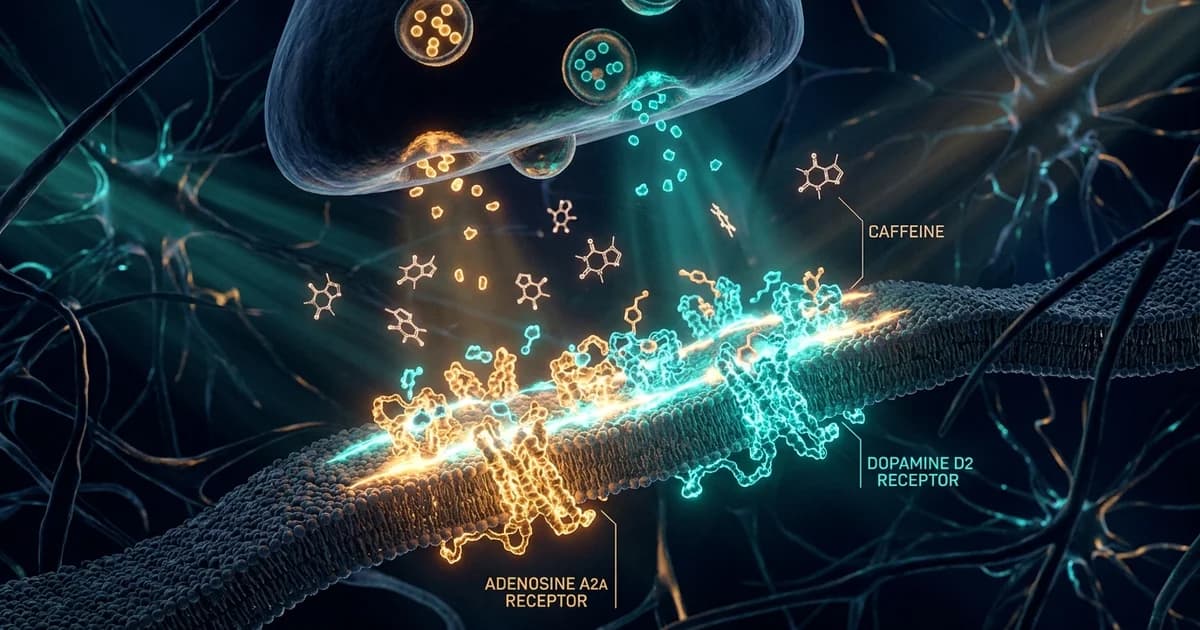
- The adenosine A2A dopamine D2 receptor pair sits side by side in the brain's reward circuitry, where one receptor restrains the other.
- By blocking A2A, caffeine eases the brake on D2 signaling, letting your own dopamine work a little better.
- This indirect route is why coffee gives a mild reward without the spike-and-crash of stronger stimulants.
How Caffeine Actually Works in the Brain
Caffeine is an adenosine antagonist. As you stay awake, adenosine builds up and binds to its receptors, slowing neural activity and making you drowsy. Caffeine fits into those same receptors and blocks them, so the sleepiness signal goes quiet.
Two receptor types do most of this work: A1 and A2A. Research in Nature Neuroscience found that the arousal effect of caffeine depends on adenosine A2A receptors, not A1. Knock out the A2A receptor in mice, and caffeine loses much of its wake-promoting punch.
So the wakefulness is an A2A story. The dopamine story is where it gets interesting.
The Caffeine Reward Mechanism: An Indirect Route to Dopamine
Here is the direct answer to does caffeine release dopamine: yes, but modestly, and through the back door. Caffeine does not act on dopamine neurons the way cocaine or amphetamine does.
A study in the Journal of Neuroscience showed that caffeine increases dopamine and glutamate release in the shell of the nucleus accumbens, the brain's reward hub. The same researchers traced this effect to adenosine A1 receptor blockade, not A2A. The increase was small and regionally specific, nothing like the flood produced by drugs of dependence.
That is the core of the caffeine reward mechanism. It nudges your existing dopamine signaling rather than forcing a surge. The brain stays in charge of how much dopamine actually moves.
This is also why caffeine is not generally treated as a classic drug of dependence. The dopamine bump is real enough to feel rewarding, gentle enough to avoid the runaway loop that defines addictive stimulants.
The Adenosine A2A Dopamine D2 Receptor Connection
The most elegant piece of this puzzle is a physical partnership called the A2A D2 heteromer. In the striatum, the adenosine A2A receptor and the dopamine D2 receptor are not just neighbors. They couple together into a single functional unit.
Inside that unit, the two receptors push against each other. When adenosine activates the A2A receptor, it lowers the D2 receptor's sensitivity to dopamine. The A2A side acts like a dimmer switch on the D2 side.
Caffeine flips the dimmer. By blocking A2A, it lifts the restraint on D2, so the same amount of dopamine produces a slightly stronger signal. You are not adding dopamine to the tank. You are letting the engine respond to the fuel that is already there.
This adenosine A2A dopamine D2 receptor relationship is the cleanest explanation for why coffee sharpens motivation and focus without the chemical violence of harder stimulants. It is modulation, not hijacking.
Why This Explains Why Coffee Feels Good
The reason why coffee feels good comes down to two effects stacking quietly. First, A2A blockade removes the adenosine brake, so you feel more awake. Second, that same blockade frees up D2 signaling, so your own dopamine carries a touch more weight.
Together they produce alertness with a faint glow of reward. Not euphoria. A clean, functional lift that fades smoothly rather than collapsing.
Caffeine vs. Hard Stimulants: A Dopamine Comparison
The contrast with addictive stimulants makes the gentleness of caffeine obvious. The table below shows how different compounds interact with the dopamine system.
| Compound | Primary Action | Effect on Dopamine | Reward Profile |
|---|---|---|---|
| Caffeine | Blocks adenosine A1 and A2A receptors | Small, indirect rise; frees D2 signaling | Mild, self-limiting lift |
| Amphetamine | Forces dopamine release and blocks reuptake | Large, direct surge | Strong, high dependence risk |
| Cocaine | Blocks dopamine reuptake | Large, sustained flood | Intense, high dependence risk |
| L-theanine + caffeine | Adenosine blockade plus calming modulation | Indirect, smoothed | Mild lift with less edge |
Caffeine sits in a category of its own. It touches the reward system enough to feel pleasant, never enough to overwhelm it.
There is even evidence that habitual exposure shifts the receptors themselves. A human PET study in Translational Psychiatry found that caffeine increases striatal dopamine D2/D3 receptor availability, which the authors linked to caffeine's effects on alertness rather than on reward or reinforcement.
Pairing Caffeine for a Cleaner Curve
The indirect nature of caffeine's dopamine effect is exactly why pairing it well pays off. The most studied partner is L-theanine, the amino acid in tea.
A double-blind crossover trial published in the British Journal of Nutrition reported that an L-theanine and caffeine combination improved selective attention in sleep-deprived adults. L-theanine smooths the rough edges of caffeine while keeping the alertness intact.
That combination respects the same principle the whole article rests on. You support the brain's own signaling instead of overriding it. For more on stacking, see how we break down L-theanine and caffeine as a focus combination and the broader question of how to avoid the caffeine crash.
The Mechanism in Plain Terms
Caffeine and dopamine are connected, but loosely and politely. Caffeine blocks adenosine, which both wakes you up and quietly releases the D2 brake inside the A2A-D2 partnership.
Your dopamine does the rest. The molecule does not manufacture a high. It clears a small obstacle and lets your own reward chemistry breathe.
That is the honest version of coffee's lift. Subtle, indirect, and far more interesting than a simple dopamine dump.
Frequently Asked Questions
Does caffeine release dopamine?
Caffeine causes a small, indirect rise in dopamine in the brain's reward hub, the nucleus accumbens. It does this by blocking adenosine receptors, not by acting on dopamine neurons directly. The increase is modest and regionally specific, very different from the large surges produced by addictive stimulants like amphetamine or cocaine. Your brain still controls how much dopamine actually moves.
What is the A2A D2 heteromer?
The A2A D2 heteromer is a physical pairing of the adenosine A2A receptor and the dopamine D2 receptor in the striatum. The two couple into one functional unit where the A2A side restrains the D2 side. When adenosine activates A2A, it lowers D2 sensitivity to dopamine. Caffeine blocks A2A, which eases that restraint and lets D2 respond more strongly.
Why does coffee feel good if it does not flood dopamine?
The pleasant feeling comes from two stacked effects. Blocking adenosine removes the brake that makes you drowsy, so you feel alert. The same blockade frees up D2 dopamine signaling, so your own dopamine carries slightly more weight. The result is a clean, mild lift rather than a euphoric high.
Is caffeine addictive in the way other stimulants are?
Caffeine can create mild dependence and withdrawal, but it is not generally classed as a drug of dependence like cocaine or amphetamine. The difference is the dopamine response. Caffeine's effect is small and self-limiting because it modulates existing signaling instead of forcing a surge, so it lacks the runaway reward loop that drives stronger addictions.
Does caffeine work on A1 or A2A receptors?
Both. Research links caffeine's wake-promoting arousal effect mainly to A2A receptors, while its small dopamine increase in the nucleus accumbens shell traces back to A1 receptor blockade. The two receptor types handle different parts of the experience, alertness and mild reward, which is why caffeine produces a layered rather than one-dimensional effect.
Can you make caffeine's dopamine effect smoother?
Pairing caffeine with L-theanine is the best-studied approach. Clinical research shows the combination improves attention while reducing the jittery edge of caffeine alone. Because both work by supporting your brain's own signaling rather than overriding it, the combination tends to give a steadier curve with a gentler comedown.
The Gentle Pathway, in a Pouch
The takeaway from the A2A-D2 story is that good stimulation works with your brain, not against it. Caffeine earns its reputation by nudging dopamine rather than hijacking it, and that restraint is a feature, not a flaw.
Roon is built on the same principle. Each sublingual pouch delivers 80 mg caffeine and 60 mg L-theanine, the pairing that smooths caffeine's edge while keeping the alertness intact, plus 25 mg methylliberine (Dynamine) and 5 mg theacrine (TeaCrine). Those last two add their own lift through related pathways without the steep tolerance buildup that pushes people toward ever-larger doses.
Roon is not a replacement for sleep, and it is not a hard stimulant. It is a way to use caffeine's gentle dopamine pathway on purpose, with a 5 to 10 minute onset and 6 to 8 hours of steady focus, no jitters and no crash. If you want the lift coffee gives you without the afternoon collapse, try Roon.
Written by Roon Team