Brain Fog Synonym: Every Term You Need to Know
Roon Team
Brain Fog Synonym: Every Term You Need to Know (and What They Actually Mean)
You've felt it. That thick, slow-moving haze behind your eyes where clear thinking used to be. You search for a word mid-sentence and it just... isn't there. Your doctor calls it one thing, and what Reddit says about brain fog is often something else entirely. The medical literature can't even agree on a single definition.
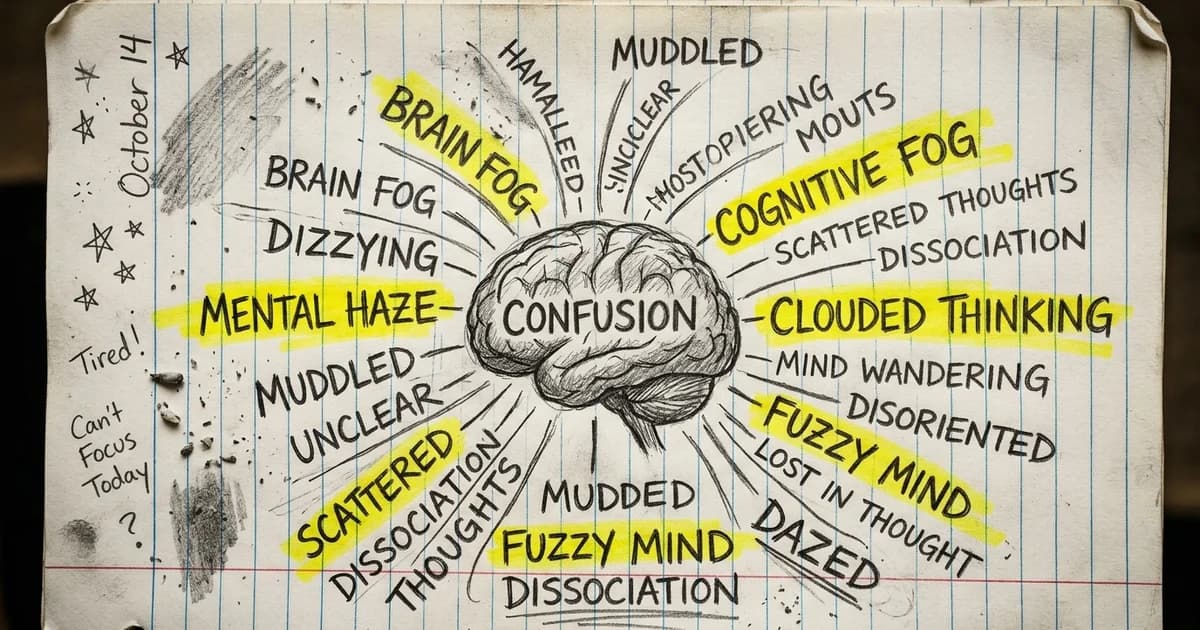
Brain fog synonym is one of the most searched cognitive health terms online, and for good reason. The experience itself is universal, but the language around it is a mess. Depending on who you ask, you'll hear "cognitive dysfunction," "mental fatigue," "clouding of consciousness," or a dozen other phrases, each carrying slightly different clinical weight.
This guide breaks down every major brain fog synonym, explains the differences that matter, and helps you communicate what you're actually experiencing to the people who need to hear it.
Key Takeaways:
- "Brain fog" is not a formal medical diagnosis. Each brain fog synonym covers a cluster of cognitive symptoms.
- Clinicians and researchers use different terminology depending on context, severity, and underlying condition.
- Knowing the right brain fog synonym helps you get better care, do better research, and understand your own cognition.
- The core symptoms (poor focus, sluggish recall, mental fatigue) overlap across nearly all of these terms.
Why "Brain Fog" Has So Many Synonyms
Brain fog isn't listed in the DSM-5 or ICD-11, and understanding what brain fog actually is starts with that absence: it has no diagnostic code, which is the root of the naming problem.
A 2025 review in Trends in Neurosciences examined how brain fog is defined across medical conditions and found three distinct ways the term gets used: as a single distinct symptom (like "fogginess" or "impaired mental clarity"), as a brain fog synonym for other symptoms like "difficulty concentrating," and as a full syndrome involving a bounded set of overlapping complaints. The researchers noted that brain fog commonly involves cognitive dysfunction, fatigue, anxiety, and mood disturbances, all tangled together, which is part of why telling brain fog from tiredness is a question in its own right.
This ambiguity means that when you Google your symptoms, you'll land on wildly different terminology depending on the source. A neurology paper will say "cognitive dysfunction." A chronic fatigue forum will say "brain fog." A psychiatrist might document "concentration difficulties." They're all circling the same experience from different angles.
The Complete Brain Fog Synonym List
Here's every major term used interchangeably with brain fog, organized by where you're most likely to encounter each brain fog synonym.
Clinical and Medical Brain Fog Synonym Terms
These are the phrases doctors, researchers, and clinicians use in formal settings.
| Term | Where You'll See It | Key Distinction |
|---|---|---|
| Cognitive dysfunction | Neurology, psychiatry, research papers | Broad clinical brain fog synonym for measurable deficits in thinking, memory, or processing |
| Cognitive impairment | Geriatrics, neuropsychological testing | Often implies objective, testable decline (not just subjective feeling) |
| Clouding of consciousness | Neurology, emergency medicine | Formal term for reduced wakefulness or awareness; more severe than typical brain fog |
| Subjective cognitive decline | Aging research, Alzheimer's prevention | Self-reported cognitive worsening without objective test abnormalities |
| Cognitive fatigue | Rehabilitation medicine, MS research | Decline in cognitive performance specifically tied to sustained mental effort |
According to Wikipedia's entry on clouding of consciousness, the term "brain fog" or "mental fog" describes a state where a person is conscious but slightly less wakeful or aware than normal. The clinical brain fog synonym carries more weight in emergency and neurological contexts, while "brain fog" remains the go-to in everyday conversation.
Everyday and Colloquial Brain Fog Synonym Terms
These are the words real people use to describe the experience.
| Term | Context | Notes |
|---|---|---|
| Mental fog | General conversation, health forums | The closest direct brain fog synonym; used almost interchangeably |
| Mental haze | Casual description, wellness content | Emphasizes the "unclear" quality of thinking |
| Mental fatigue | Workplace, athletic performance | Focuses on exhaustion of cognitive resources after effort |
| Mental sluggishness | Self-description, symptom reporting | Highlights the feeling of slowed processing speed |
| Fuzzy thinking | Casual conversation | Informal but surprisingly accurate descriptor |
| Cognitive cloudiness | Health and wellness writing | A slightly more polished brain fog synonym |
The PoTS UK resource on cognitive dysfunction notes that other terms commonly used to describe brain fog include "mental clouding" and "mental fatigue," and that patients describe it as forgetfulness, difficulty thinking or focusing, and a cloudy feeling in the head.
Condition-Specific Terms
Some synonyms only show up in the context of a particular diagnosis.
- Chemo brain (chemo fog): Used by cancer patients and oncologists to describe cognitive changes during or after chemotherapy.
- COVID brain fog: The cognitive symptoms associated with long COVID, often documented as part of post-acute sequelae of SARS-CoV-2 (PASC).
- Fibro fog: Cognitive difficulties reported by people with fibromyalgia, typically involving memory lapses and poor concentration.
- Lupus fog: Similar cognitive complaints in systemic lupus erythematosus patients.
- Pregnancy brain (momnesia): The forgetfulness and concentration difficulties many people report during pregnancy and postpartum.
Each of these condition-specific labels describes essentially the same cluster of symptoms: trouble focusing, slow recall, difficulty with word-finding, and a general sense that your brain isn't operating at full capacity.
Brain Fog Synonym vs. Brain Fog: Does the Label Matter?
Yes. More than you'd think.
The brain fog synonym you choose shapes how seriously your complaint gets taken. "I have brain fog" might get a sympathetic nod from your doctor. "I'm experiencing subjective cognitive decline with deficits in attention and working memory" gets you a referral.
A 2025 Yale study found that self-reported cognitive disability among U.S. adults rose from 5.3% in 2013 to 7.4% in 2023. Among young adults ages 18 to 39, rates nearly doubled from 5.1% to 9.7%. These numbers reflect people who identified their cognitive struggles using formal survey language, not casual terms like "brain fog."
The gap between the casual term and the clinical brain fog synonym matters for three reasons:
- Medical documentation. Insurance companies and disability evaluations respond to clinical terminology. "Cognitive dysfunction" carries diagnostic weight and maps onto real brain fog diagnostic codes, while "Brain fog" does not.
- Research literacy. If you're searching PubMed for solutions, "cognitive fatigue" and "subjective cognitive decline" will return useful papers. A casual term will return far fewer.
- Self-advocacy. Knowing the clinical brain fog synonym for your experience gives you a shared vocabulary with your healthcare provider. You stop describing symptoms and start naming them.
What Brain Fog (By Any Name) Actually Involves
Regardless of which brain fog synonym you use, the underlying experience maps onto a consistent set of cognitive domains. The Trends in Neurosciences review identified three core pillars:
Cognition. Attention breaks down first. You can't sustain focus on a single task, or you lose your train of thought mid-sentence. Memory follows, particularly working memory, the kind you use to hold a phone number in your head while you walk across the room. Language and processing speed take hits too. Words come slower. Decisions feel harder.
Fatigue. Not physical tiredness, but mental exhaustion. The feeling that thinking itself requires effort it shouldn't. A cross-sectional study published in Nutrients found a strong negative correlation between sleep quality and brain fog severity, confirming what most people already suspect: poor sleep and brain fog feed each other.
Affect. Mood changes ride alongside the cognitive symptoms. Irritability, anxiety, and a low-grade frustration that comes from knowing your brain isn't performing the way it should. These emotional components aren't side effects of brain fog. They're part of it.
Common Causes Behind Every Brain Fog Synonym
Across every synonym, the common brain fog triggers stay remarkably consistent.
Sleep deprivation. Even one night of poor sleep degrades attention, working memory, and processing speed. Chronic sleep debt compounds the damage.
Chronic stress. Sustained cortisol exposure impairs memory and attention. According to Lone Star Neurology, chronic stress is one of the leading contributors to brain fog because the constant release of cortisol impairs memory, attention, and focus.
Neuroinflammation. The Cleveland Clinic notes that some research shows your immune system could cause inflammation in your brain (neuroinflammation) that temporarily blocks or slows information processing. This mechanism is central to post-COVID cognitive complaints.
Nutritional deficits. Low iron, B12, vitamin D, and omega-3 fatty acids have all been linked to cognitive underperformance.
Sedentary behavior. Physical inactivity reduces cerebral blood flow. Less blood flow means less oxygen and glucose reaching the neurons that need it.
How to Talk to Your Doctor Using the Right Brain Fog Synonym
If you're experiencing persistent cognitive difficulties and want to start testing your cognitive symptoms before your appointment, here's how to translate your experience into language that moves the conversation forward.
Instead of: "I have brain fog." Try: "I'm noticing sustained difficulty with attention and working memory that's affecting my daily functioning."
Instead of: "I can't think straight." Try: "My processing speed feels measurably slower, and I'm having word-finding difficulties."
Instead of: "I'm just tired all the time." Try: "I'm experiencing cognitive fatigue that's disproportionate to my physical exertion."
You're not exaggerating. You're being precise. Precision gets results.
Clearing the Fog: What the Research Says Works
Whatever brain fog synonym you prefer, the question is the same: how do you fix it?
The basics matter most. Sleep, movement, stress management, and proper nutrition form the foundation. But the neurochemistry of focus and mental clarity also responds to specific compounds.
Caffeine is the most studied cognitive enhancer on the planet, but dose matters. High doses create jitters and a crash that can mimic the very brain fog you're trying to escape. A moderate dose comparable to a cup of coffee (around 80 mg), especially when paired with complementary compounds, supports alertness without the overshoot.
L-Theanine, an amino acid found naturally in tea, pairs well with caffeine. A study published in Nutritional Neuroscience found that the combination of moderate levels of L-theanine and caffeine improved accuracy during task switching and self-reported alertness while reducing tiredness.
Theacrine and Methylliberine are purine alkaloids structurally related to caffeine. A study on egamers found that a combination of caffeine, theacrine, and methylliberine improved cognitive performance and reaction time without increasing self-reported anxiety or headaches. That "clean" cognitive effect, focus without the side effects, is exactly what separates useful stimulation from the jittery, crash-prone kind.
Cut Through the Fog
Brain fog, mental fatigue, cognitive dysfunction, clouding of consciousness. The brain fog synonym you give it matters less than what you do about it.
The science points toward a clear pattern: targeted compounds that support sustained attention without the neurochemical whiplash of high-dose stimulants produce the best subjective and objective results.
That's the exact principle behind Roon. It combines 80 mg of caffeine with L-theanine, theacrine, and methylliberine in a sublingual pouch designed for six to eight hours of clean, sustained focus. No nicotine. No crash. No tolerance buildup. Just the kind of mental clarity that makes every brain fog synonym irrelevant.