Brain Fog Medical Term: SSRIs
Roon Team
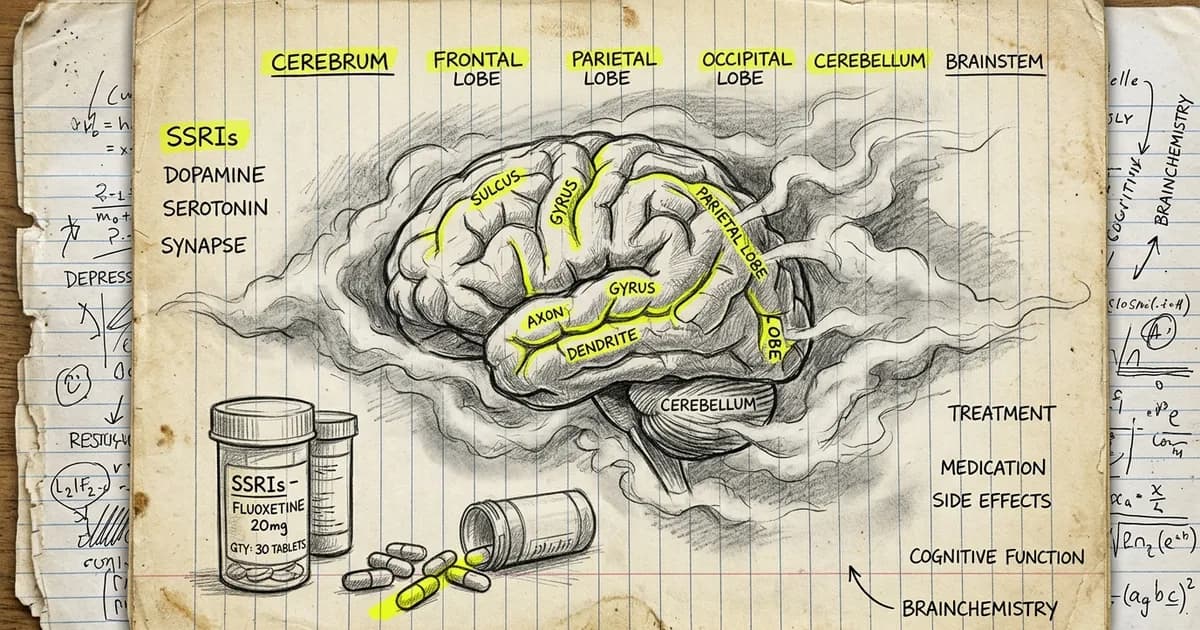
Brain Fog Medical Term: SSRIs, Lexapro & the Drugs Clouding Your Thinking
Your doctor prescribed something to help you feel better. Instead, you can't remember where you left your keys, your thoughts move through wet concrete, and reading a paragraph twice still doesn't make it stick. This is medication-induced brain fog, and it's far more common than most prescribers acknowledge.
"Brain fog" isn't a formal diagnosis. There is no single brain fog medical term in the DSM-5 or ICD-11. The closest clinical language you'll find is "cognitive dysfunction," "clouding of consciousness," or "cognitive impairment," and a full guide to clinical terms for brain fog covers what each one actually means. A 2025 review in Trends in Neurosciences noted that brain fog has been used to describe overlapping symptoms involving cognition, fatigue, and affect, and that the brain fog medical term can refer to a distinct symptom, a syndrome, or a nonspecific umbrella term. Doctors know what you mean when you say it. They just don't have a clean diagnostic code for it.
What they do have is a growing list of medications that cause it.
Key Takeaways
- No single brain fog medical term exists. Clinicians use "cognitive dysfunction" or "cognitive impairment" instead.
- SSRIs like Lexapro (escitalopram) can impair memory, focus, and mental sharpness, even while treating depression effectively.
- Multiple drug classes cause brain fog, including benzodiazepines, anticholinergics, anticonvulsants, and statins.
- The fix isn't always stopping the medication. Dose adjustments, drug switching, and targeted supplementation can help.
Why There's No Single Brain Fog Medical Term
Medicine likes precision. The brain fog medical term question resists a simple answer.
The symptom cluster people describe as "brain fog" spans short-term memory problems, difficulty concentrating, slow processing speed, word-finding trouble, and a general sense of mental cloudiness, and what brain fog actually means clinically goes deeper than any single symptom. A 2025 paper published in PMC stated that cognitive failures have been described as symptoms of brain fog, but the brain fog medical term is "neither a diagnostic symptom" nor "a formally used medical term." That's not because the experience isn't real. It's because the experience maps onto too many possible causes for a single label.
In clinical notes, you'll see the brain fog medical term documented as:
- Cognitive dysfunction: the broadest term, covering deficits in attention, memory, and executive function
- Cognitive impairment: typically used when measurable on neuropsychological testing
- Clouding of consciousness: an older brain fog medical term from neurology, referring to reduced wakefulness or awareness
- Drug-induced cognitive impairment: the most specific brain fog medical term when a medication is the suspected cause
A 2025 review in PMC used the term "drug-induced cognitive impairment" to categorize the mental side effects of everything from anticholinergics to anticonvulsants. If you want to speak your doctor's language, that's the brain fog medical term to use.
Brain Fog and Lexapro: What the Research Actually Shows
Lexapro (escitalopram) is one of the most prescribed SSRIs in the United States, and "brain fog Lexapro" is one of the most common complaints patients search for after starting it. The irony is thick: you take the drug to lift the fog of depression, and it replaces it with a different kind of fog.
Here's what's happening at the neurochemical level. SSRIs increase serotonin availability in the brain by blocking its reuptake. That's the therapeutic mechanism. But serotonin doesn't just regulate mood. It also modulates attention, learning, and cognitive flexibility. Flooding the system with serotonin can disrupt those processes.
A study published in Neuropsychopharmacology found that acute escitalopram administration impaired learning and cognitive flexibility in healthy adults, while improving impulse inhibition. In other words, the drug made some cognitive functions worse and others better, all at the same time.
Meta-analyses paint a broader picture. According to Outro's clinical review, research examining cognitive effects of SSRIs like Lexapro in healthy controls found between 1% and 16% impairments on cognitive tests, with variation depending on the specific task measured.
Then there's emotional blunting, the SSRI side effect that often gets mislabeled using the brain fog medical term. Research from the University of Cambridge estimates that 40 to 60% of patients taking SSRIs experience this effect. You're not confused, exactly. You just feel... less. Less sharp. Less engaged. Less like yourself. Patients describe it as thinking through gauze.
Does Lexapro Brain Fog Go Away?
For many people, yes. The cognitive side effects of Lexapro tend to be strongest in the first few weeks of treatment, while the brain adjusts to the new serotonin levels. Most clinicians recommend giving it 4 to 6 weeks before evaluating whether the fog is a temporary adjustment or a persistent problem.
If it persists, the options include:
- Dose reduction (lower doses may preserve the antidepressant effect with fewer cognitive side effects)
- Switching medications (some SSRIs and non-SSRI antidepressants have lower cognitive burden)
- Augmentation strategies (adding a second agent to counteract the cognitive blunting)
The key point: brain fog from Lexapro doesn't mean the medication is wrong for you. It means the dose, timing, or formulation might need adjusting. Talk to your prescriber before making changes.
Other Medications Linked to the Brain Fog Medical Term
SSRIs get the most search traffic, but they're not the worst offenders. Several other drug classes are more reliably associated with cognitive impairment.
Benzodiazepines
Drugs like Xanax (alprazolam), Valium (diazepam), and Klonopin (clonazepam) work by sedating the central nervous system. That sedation doesn't stop at anxiety. It dampens attention, working memory, and processing speed. EffectiveTreatment.com notes that these drugs sedate the central nervous system broadly, dampening cognitive activity along with anxiety.
The cognitive effects of benzodiazepines are dose-dependent and cumulative. Long-term use is associated with measurable declines in memory and executive function.
Anticholinergic Medications
This is the category most people don't know about, and it may be the most concerning. Anticholinergic drugs block acetylcholine, a neurotransmitter directly involved in memory and learning. The list includes common over-the-counter medications like diphenhydramine (Benadryl), prescription bladder drugs like oxybutynin, and older tricyclic antidepressants like amitriptyline.
A study published in JAMA Neurology found an association between anticholinergic medication use and reduced brain metabolism and increased brain atrophy in cognitively normal older adults. Harvard Health confirms that research has shown a link between these drugs and both dementia and mild cognitive impairment, especially at higher doses.
The scary part: many people take anticholinergics without realizing it. Your allergy pill, your sleep aid, your overactive bladder medication. Check the label.
Anticonvulsants and Mood Stabilizers
Seizure medications like topiramate, phenobarbital, and gabapentin are known to affect memory and concentration. Topiramate is so strongly associated with cognitive side effects that neurologists sometimes call it "dopamax," a reference to the dopey feeling patients report. Harvard Health lists gabapentin among the medications commonly linked to the brain fog medical term.
Statins
Cholesterol-lowering statins like atorvastatin have generated debate around cognitive effects. WebMD reports that statins have been linked to brain fog alongside other serious side effects. The evidence here is mixed. Some patients report dramatic cognitive changes; large-scale studies show minimal average effect. If you notice a mental shift after starting a statin, it's worth discussing with your doctor.
Brain Fog Medicine: What Actually Helps
| Approach | How It Works | Evidence Level |
|---|---|---|
| Dose adjustment | Reduces drug exposure while maintaining therapeutic effect | Strong (clinical standard) |
| Medication switch | Replaces the offending drug with a lower-risk alternative | Strong (clinical standard) |
| Caffeine + L-Theanine | Promotes alertness and attention without overstimulation | Strong (multiple RCTs) |
| Theacrine | Supports sustained energy without tolerance buildup | Moderate (emerging) |
| Exercise | Increases BDNF and cerebral blood flow | Strong |
| Sleep optimization | Restores cognitive function impaired by poor sleep | Strong |
There is no single brain fog medicine that reverses drug-induced cognitive impairment across the board. The first-line approach is always working with your prescriber to adjust the medication causing the problem.
But for the cognitive symptoms that linger, or for the fog that sits in the gap between "my medication is necessary" and "my brain doesn't work like it used to," targeted supplementation has real data behind it.
Research published in Nutritional Neuroscience found that the combination of L-theanine and caffeine improved accuracy during task switching and increased subjective alertness, while reducing tiredness. A 2023 study in PMC on caffeine and L-theanine supplementation confirmed that the combined intake produced the best cognitive performance scores compared to either ingredient alone.
The mechanism makes sense. Caffeine increases dopamine and norepinephrine signaling, sharpening attention. L-theanine modulates alpha brain wave activity, promoting calm focus without sedation. Together, they address two of the core complaints of medication-induced fog: sluggish thinking and difficulty sustaining attention.
Clearing the Fog Without Abandoning Your Treatment
Medication-induced brain fog puts you in an uncomfortable position. The drug you need for one condition is undermining your ability to think clearly. That's not a reason to stop treatment. It's a reason to get strategic.
Start with your prescriber. Ask specifically about the brain fog medical term that fits your symptoms and whether a dose change or alternative medication could help. Track your symptoms so you have data, not just a vague complaint.
And for the daily cognitive support that sits alongside your treatment plan, consider what you're giving your brain to work with. Roon was built for exactly this kind of problem: a zero-nicotine sublingual pouch combining 80 mg of caffeine, L-theanine, theacrine, and methylliberine to promote sustained focus for 6 to 8 hours without jitters, crashes, or tolerance buildup. It's not a replacement for medical treatment. It's the cognitive support layer that helps your brain perform while you and your doctor figure out the rest.