Brain Fog ICD-10: The Complete Guide to Codes, Documentation, and What They Actually Mean
Roon Team
Brain Fog ICD-10: The Complete Guide to Codes, Documentation, and What They Actually Mean
Short answer: There is no single ICD-10 code for brain fog, because "brain fog" is not a formal diagnosis in the ICD-10-CM system. Providers code it with symptom-specific entries from the R41 category, most often R41.89 for the multi-domain cognitive symptoms most people describe. Post-COVID cases pair R41.89 with U09.9, while narrower complaints map to codes such as R41.840 for attention or R41.3 for memory.
You told your doctor you have brain fog. They nodded, typed something into the computer, and moved on. But here's what most patients never learn: there is no single brain fog ICD-10 code. The term "brain fog" doesn't exist as a formal medical diagnosis in the ICD-10-CM system. Your doctor had to translate your experience into a billing code that insurance companies will actually accept.
That disconnect matters. It affects your diagnosis, your treatment plan, and whether your insurance covers the visit at all.
This guide breaks down exactly which brain fog ICD-10 codes map to your symptoms, when each one applies, and what you need to know if you're a patient trying to understand your medical records or a provider trying to code these visits correctly.
Key Takeaways
- "Brain fog" has no dedicated ICD-10 code. Providers must use symptom-specific codes from the R41 category.
- R41.89 is the primary brain fog ICD-10 code used for the multi-domain cognitive dysfunction most people describe as brain fog.
- Post-COVID brain fog requires two codes: R41.89 paired with U09.9.
- Specific symptoms get specific codes: attention problems (R41.840), memory loss (R41.3), and disorientation (R41.0) each have their own entries.
- Documentation quality determines everything. Vague notes lead to claim denials.
What Is Brain Fog ICD-10 Classification Based On?
Brain fog isn't a throwaway term. A 2024 study published in Frontiers in Human Neuroscience analyzed over 25,000 participants and found that people reporting brain fog scored an average of 34.1% higher on disability scales compared to those without it. A history of concussion (OR = 2.4) and long COVID (OR = 3.8) were both strongly associated with the condition.
The Cleveland Clinic defines brain fog as a collection of symptoms including confusion, difficulty concentrating, trouble putting thoughts into words, and feeling mentally "cloudy." Brain fog can stem from illness, medication side effects, or underlying conditions.
A 2025 review in Trends in Neurosciences found brain fog prevalence rates of 68% in perimenopause, 96% in postural tachycardia syndrome (POTS), 85-89% in chronic fatigue syndrome, and 76-83% in fibromyalgia. This isn't a niche complaint. Brain fog is one of the most common cognitive symptoms across dozens of medical conditions.
There are many terms used to describe brain fog, but the ICD-10 system doesn't care what you call it. It cares about specificity.
The Brain Fog ICD-10 Codes: A Complete Breakdown
Since "brain fog" isn't a billable diagnosis, providers choose from a set of codes under the R41 category (Other symptoms and signs involving cognitive functions and awareness). Here's the full picture.
R41.89: The Primary Brain Fog ICD-10 Code
R41.89 covers "Other symptoms and signs involving cognitive functions and awareness." This is the brain fog ICD-10 code most providers reach for when a patient presents with the classic, multi-symptom picture: scattered thinking, poor concentration, memory lapses, and mental fatigue all happening at once.
According to HCMS billing guidelines, R41.89 is the appropriate choice when the cognitive dysfunction spans multiple domains rather than a single isolated symptom. R41.89 is billable, specific enough for most payers, and captures the broad nature of what patients actually experience.
When to Use More Specific Brain Fog ICD-10 Codes
If the patient's complaint is narrow, a more targeted code is better:
| ICD-10 Code | Description | Use When... |
|---|---|---|
| R41.89 | Other symptoms/signs involving cognitive functions | Multiple cognitive symptoms (the "classic" brain fog picture) |
| R41.840 | Attention and concentration deficit | Primary complaint is difficulty focusing |
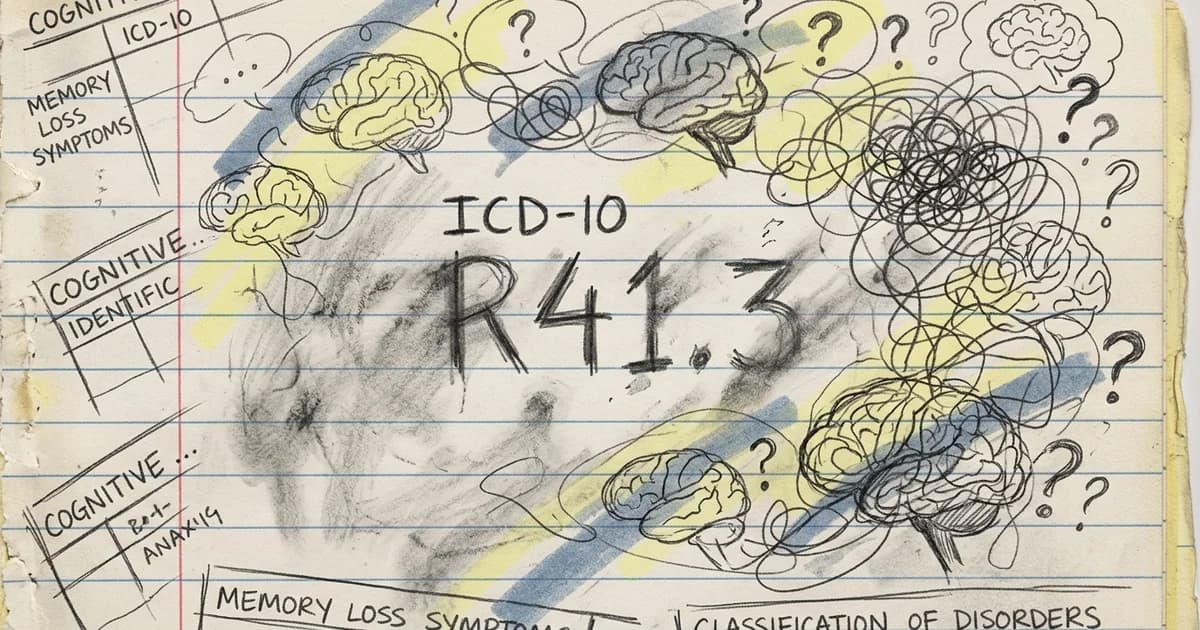
| R41.3 | Other amnesia (short-term memory loss) | Primary complaint is forgetting things |
| R41.0 | Disorientation, unspecified | Patient reports confusion or feeling "lost" |
| R41.9 | Unspecified cognitive symptoms | Documentation is insufficient for a specific code |
| R53.83 | Other fatigue (includes mental fatigue) | Cognitive fatigue is the dominant symptom |
| G93.31 | Postviral fatigue syndrome | Brain fog follows a viral illness (non-COVID) |
| F48.8 | Other specified nonpsychotic mental disorders | Cognitive symptoms are primary, non-psychotic |
The Dr. Biller RCM coding guide puts it plainly: R41.89 is for confirmed cognitive abnormalities, R41.9 is the fallback when documentation lacks detail. Whenever possible, go specific.
R41.9: The Brain Fog ICD-10 Code of Last Resort
R41.9 covers "Unspecified symptoms and signs involving cognitive functions and awareness." Think of this as the catch-all. If a patient says "I just feel foggy" and the chart contains no cognitive test results, no description of which domains are affected, and no clinical observations, R41.9 may be the only defensible option.
But R41.9 is not recommended. Unspecified codes invite payer scrutiny. They're a red flag in audits. If you can document anything more specific, do so.
Post-COVID Brain Fog ICD-10 Coding: The Two-Code Rule
COVID changed the brain fog ICD-10 coding picture entirely. Patients presenting with cognitive symptoms after a SARS-CoV-2 infection need two codes working together.
The first is R41.89 for the cognitive symptoms themselves. The second is U09.9, the ICD-10 code for post-COVID-19 condition. According to ICD-10 coding guidelines, U09.9 must always be accompanied by a code identifying the specific manifestation. You can't use U09.9 alone.
A 2023 study published in PMC examining VA patients with post-COVID conditions found that reduced cognitive function or brain fog appeared in 6.3% of documented cases, alongside more commonly coded symptoms like shortness of breath (37.1%) and fatigue (22.3%). That 6.3% figure likely underrepresents the true prevalence, since cognitive symptoms are harder to quantify than respiratory ones and often go undocumented.
For proper post-COVID brain fog ICD-10 documentation, providers need to establish:
- Temporal relationship: Symptoms began during or after COVID-19 infection
- Duration: Symptoms persisting 4+ weeks after acute infection
- Clinical attribution: Provider's judgment that symptoms represent post-acute sequelae of SARS-CoV-2
Without all three, the U09.9 pairing becomes difficult to defend.
Why Documentation Makes or Breaks Brain Fog ICD-10 Claims
Here's where most providers lose money and most patients get frustrated. A chart note that says "patient reports brain fog" isn't enough. Payers want evidence.
Strong documentation for brain fog ICD-10 coding includes:
- Cognitive test scores (MoCA, MMSE, or similar screening tools)
- Specific symptom descriptions (which domains are affected: memory, attention, processing speed, executive function)
- Functional impact (how symptoms affect work, daily activities, driving)
- Onset and duration (when symptoms started, whether they're constant or intermittent)
- Associated conditions (post-COVID, thyroid disorder, sleep apnea, medication side effects)
The ICDcodes.ai documentation guide warns that under-documentation of cognitive testing results is one of the most common pitfalls. If you ran a MoCA and the patient scored 22/30, that number needs to be in the chart. It transforms a vague complaint into a measurable finding.
Conditions That Commonly Cause Brain Fog (and Their Own ICD-10 Codes)
The underlying causes of brain fog are wide-ranging, and brain fog rarely exists in isolation. Brain fog is usually a symptom of something else, and identifying the underlying cause changes which codes apply.
| Underlying Condition | ICD-10 Code | Brain Fog Prevalence |
|---|---|---|
| Long COVID | U09.9 | ~20% of cases |
| Chronic Fatigue Syndrome | G93.32 | 85-89% |
| Fibromyalgia | M79.7 | 76-83% |
| Perimenopause | N95.1 | ~68% |
| Hypothyroidism | E03.9 | Common (varies) |
| POTS | I49.8 | ~96% |
| Depression | F32.x | Common (varies) |
| Sleep Apnea | G47.33 | Common (varies) |
Prevalence data from Trends in Neurosciences (2025) and ScienceDirect meta-analysis (2024).
When an underlying condition is identified, providers should code both the root cause and the cognitive symptoms. The brain fog ICD-10 code (R41.89) captures the symptom. The condition code captures the "why."
What This Means If You're a Patient
If you're reading this because you Googled your own medical records and saw "R41.89" on a billing statement, here's what to take away.
Your doctor coded your brain fog as a real, documented cognitive symptom. That's good. It means your complaint was taken seriously enough to generate a billable diagnosis code. If you see R41.9 instead, it might mean your visit notes were thin on detail. That's worth a conversation at your next appointment.
Ask your provider whether cognitive screening (like the MoCA) makes sense for your situation. A test score on file strengthens your medical record and gives your care team a baseline to measure against over time.
And if your brain fog hasn't been linked to an underlying condition yet, push for that investigation. The brain fog ICD-10 R41 codes describe symptoms. They don't explain causes.
Clearing the Fog: What Actually Helps
Understanding the brain fog ICD-10 codes is step one. Addressing the cognitive dysfunction itself is step two.
The science on targeted nootropic compounds is clear on a few points. A study published in Nutritional Neuroscience found that the combination of L-theanine and caffeine (40 mg in that study) improved accuracy during task switching and boosted self-reported alertness while reducing tiredness. That specific pairing, low-dose caffeine with L-theanine, consistently outperforms caffeine alone in cognitive research.
A 2022 study published in Cureus took it further, testing the combination of caffeine, theacrine, and methylliberine together. The result: improved cognitive performance and faster reaction times without negative effects on mood. Research in the Journal of the International Society of Sports Nutrition confirmed that co-ingesting these compounds extends the cognitive benefit window compared to caffeine alone, thanks to their different half-lives and pharmacodynamic profiles.
This is the exact stack behind Roon, a zero-nicotine sublingual pouch built around 80mg caffeine, L-theanine, theacrine, and methylliberine. The caffeine is comparable to a cup of coffee, but L-theanine smooths the onset while theacrine and methylliberine extend the benefit window to 6-8 hours of sustained mental clarity without the jitters, crash, or tolerance buildup that come with caffeine alone. If brain fog is dragging down your day and you want a clean, research-backed way to support cognitive function, Roon is worth a look.
Frequently Asked Questions
Is there a specific ICD-10 code for brain fog?
No. Brain fog is not a recognized diagnosis in the ICD-10-CM system, so it has no dedicated code. Providers select from the R41 category of cognitive symptom codes. R41.89 is the most common choice for the multi-domain cognitive complaints people describe as brain fog, while narrower symptoms get more specific codes.
What is the difference between R41.89 and R41.9?
R41.89 covers "other" cognitive symptoms and signs, and it is the preferred code when the chart documents specific findings across several cognitive domains. R41.9 is the "unspecified" fallback used when documentation lacks detail. Payers scrutinize unspecified codes more closely, so providers should reach for R41.89 or a more specific code whenever the notes support it.
How is post-COVID brain fog coded in ICD-10?
Post-COVID brain fog needs two codes working together: R41.89 for the cognitive symptoms and U09.9 for the post-COVID-19 condition. U09.9 cannot stand alone; it must always be paired with a code naming the specific manifestation. Documentation should establish the timing, a duration of four or more weeks, and the provider's clinical attribution to SARS-CoV-2.
Why does my billing statement show R41.89?
Seeing R41.89 means your provider documented your brain fog as a real, billable cognitive symptom rather than dismissing it. It signals that your complaint was taken seriously enough to generate a specific diagnosis code. If you see R41.9 instead, your visit notes may have been thin on detail, which is worth raising at your next appointment.
What documentation supports a brain fog ICD-10 claim?
Strong charts include cognitive test scores such as the MoCA or MMSE, descriptions of which domains are affected, the functional impact on work or daily tasks, onset and duration, and any associated conditions. A recorded screening score, like 22 out of 30 on the MoCA, turns a vague complaint into a measurable finding that payers accept.
Can lifestyle changes or supplements help with brain fog?
Addressing the underlying cause matters most, whether that is sleep, thyroid function, or post-viral recovery. Beyond that, research on low-dose caffeine paired with L-theanine shows improved attention and alertness. Roon builds that pairing into a zero-nicotine pouch alongside theacrine and methylliberine to support sustained focus; you can read more at the Roon product page.
By Roon Team