The Blood-Brain Barrier: Which Nootropics Actually Reach Your Brain
You swallow a focus supplement, wait, and feel nothing. The label looked impressive. The capsule had ten ingredients. So why does your head still feel like static?
The answer usually lives at one checkpoint: the blood brain barrier. Most nootropics get absorbed into your bloodstream just fine. The harder question is whether they pass the gatekeeper that decides what your brain is allowed to touch. A molecule can be in your blood and still be locked out of the tissue it was sold to help.
This is the part the marketing skips. So let's look at the actual chemistry of what crosses, what stalls, and why the dose on the label is not the dose in your neurons.
Key Takeaways
- The blood brain barrier is a tight layer of cells that blocks roughly 98% of small-molecule drugs and almost all large ones from entering the brain.
- Small, fat-soluble (lipophilic) molecules under about 500 daltons cross most easily by slipping through cell membranes.
- Caffeine and L-theanine both cross readily, which is why their combination is one of the most reliable focus pairings in the research.
- "Does it cross?" is only half the question. The real one is how much reaches the brain, which depends on dose, metabolism, and delivery route.
What Is the Blood Brain Barrier?
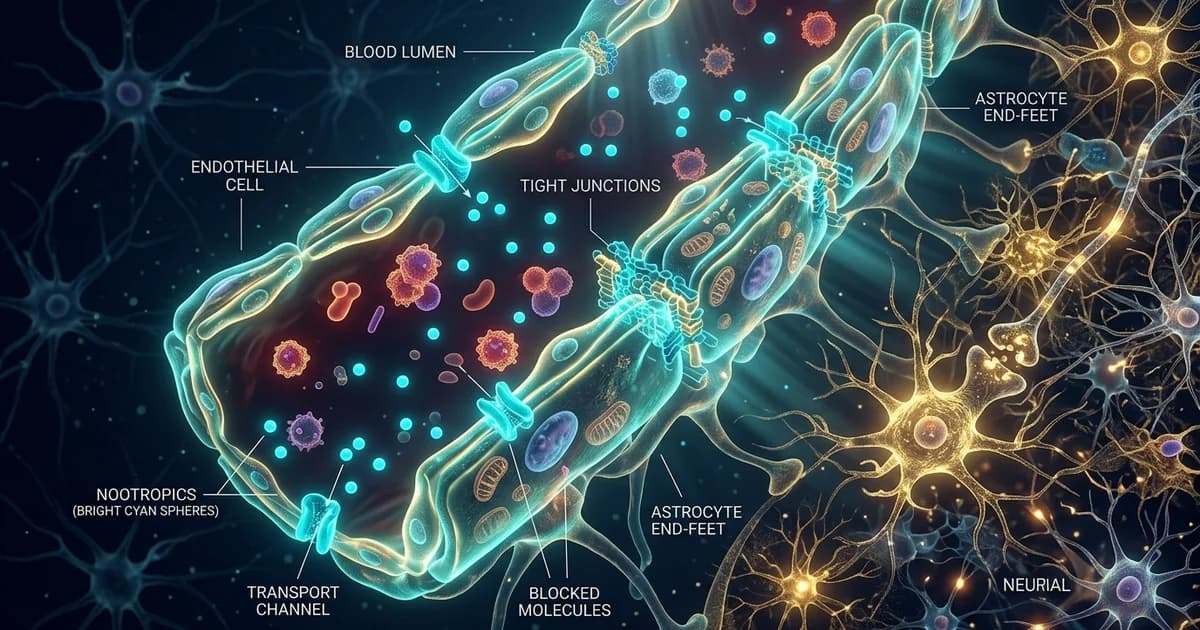
The blood brain barrier is a tightly sealed wall of cells lining the blood vessels in your brain, built to keep toxins, pathogens, and most molecules out while letting fuel in. It is the reason your brain is one of the most chemically protected organs in your body.
Ordinary blood vessels are slightly leaky by design, with small gaps between cells that let nutrients and compounds pass into surrounding tissue. The vessels feeding your brain are different. Their cells are bonded by tight junctions that seal the gaps, forcing nearly everything to pass through the cells rather than between them.
That single design choice is why so many promising brain compounds fail. According to research published in PMC, most small-molecule drugs that do reach the brain get there by passive diffusion straight through the cell membranes, and the properties that allow this are strict.
Do Nootropics Cross the Blood Brain Barrier?
Some do, easily. Many do not, and a few cross in amounts too small to matter. Whether a nootropic crosses the blood brain barrier comes down to its physical chemistry, not its marketing.
The membranes of the barrier cells are made of fat. To pass through them by diffusion, a molecule generally needs to be fat-soluble, small, and not carrying too many water-loving groups that get stuck at an oily wall. Pharmacologists summarized these traits decades ago.
Lipinski's "rule of five" connects barrier permeability to molecular weight, lipophilicity, polar surface area, hydrogen bonding, and charge. The same source notes that a highly lipid-soluble drug, with low hydrogen bonding and low polar surface area, more readily crosses the hydrophobic membrane to enter the brain. Translation: greasy and small wins.
The Four Ways In
Molecules reach the brain through a few distinct routes, and which one applies decides everything:
- Passive diffusion: Small, lipophilic molecules dissolve through the cell membrane. This is the main door for compounds like caffeine.
- Carrier-mediated transport: Specific proteins ferry glucose and certain amino acids across. L-theanine, structurally similar to glutamate, uses this kind of pathway.
- Active efflux: Pumps like P-glycoprotein actively throw certain molecules back out, which is why some drugs barely accumulate even when they technically "fit."
- Receptor-mediated transport: Large molecules like some peptides need to be escorted, which is rare and inefficient for most supplements.
Blood Brain Barrier Permeability: Lipophilicity and Brain Penetration
Lipophilicity is the single best predictor of whether a small molecule crosses the blood brain barrier, with molecular weight and polarity close behind. This is the core of brain penetration, and it explains the gap between two ingredients that look equally "natural" on a label.
Take caffeine. It is small, modestly fat-soluble, and slips through membranes without help. The NCBI Bookshelf pharmacology reference states caffeine is sufficiently lipophilic to pass through all biological membranes and readily crosses the blood-brain barrier. A separate study indexed in PMC restates that caffeine crosses the blood brain barrier easily. There is no debate here.
L-theanine takes a different door. It is water-soluble, so it does not diffuse through fat the way caffeine does, yet it still gets in. Research in PMC notes it is well absorbed from the intestine and can cross the blood-brain barrier, likely riding the amino acid transport system because its structure mirrors glutamate.
Now the cautionary tale. Curcumin is fat-soluble and technically capable of crossing, but the practical result is poor. A review in MDPI's Nutrients describes curcumin's clinical use as limited by poor bioavailability, driven by low absorption, rapid metabolism, and fast clearance. One supplement-science write-up estimates that over 90% of curcumin struggles to reach the brain in standard forms. "Can cross" and "does reach in useful amounts" are not the same sentence.
Which Supplements Reach the Brain
Here is the honest scorecard for popular nootropic ingredients. This answers the question of which supplements reach the brain in practical, not theoretical, terms.
| Ingredient | Crosses the barrier? | How it gets in | Practical brain delivery |
|---|---|---|---|
| Caffeine | Yes, readily | Passive diffusion | Excellent, fast |
| L-theanine | Yes | Amino acid transport | Good |
| Methylliberine (Dynamine) | Yes (small methylurate) | Passive diffusion | Good, fast onset |
| Theacrine (TeaCrine) | Yes (caffeine-like structure) | Passive diffusion | Good, long-acting |
| Creatine | Slowly | Dedicated transporter | Limited, needs loading over weeks |
| Curcumin | Technically, barely | Passive (then cleared fast) | Poor without special formulation |
| Bacopa monnieri | Partially | Mixed | Modest, builds over weeks |
The pattern is clear. The compounds with the most reliable brain delivery tend to be small methylxanthines and methylurates, the chemical family that includes caffeine.
The Question Nobody Asks: How Much Actually Arrives?
A molecule crossing the barrier is necessary but not sufficient. The amount that arrives depends on dose, how fast your liver breaks it down, and how the compound entered your body in the first place. This is where two products with identical ingredient lists can perform very differently.
When you swallow a capsule, the contents go through your gut and then your liver before reaching general circulation. Your liver metabolizes a fraction on the first pass, so the brain only ever sees what survives that trip. The route of delivery changes the math.
This is why methylliberine and theacrine matter as a pairing with caffeine. A human pharmacokinetic study from the University of Memphis examined methylliberine (as Dynamine), theacrine, and caffeine together, using a 25 mg methylliberine dose among others. These methylurates extend and smooth the stimulant curve rather than spiking and dropping, which affects how steadily the brain stays supplied over hours.
If you want the deeper mechanism on the calming half of that equation, our guide to the L-theanine mechanism of action breaks down how it shapes alpha brain wave activity alongside caffeine.
Frequently Asked Questions
What is the blood brain barrier in simple terms?
It is a tightly sealed layer of cells lining the blood vessels in your brain. Unlike vessels elsewhere in the body, these cells are bonded by tight junctions that block gaps between them. That forces molecules to pass through the cells rather than around them, which keeps out toxins and most drugs while letting in fuel like glucose. It is your brain's security system.
Do all nootropics cross the blood brain barrier?
No. Crossing depends on a molecule's size, fat solubility, and polarity. Small, lipophilic compounds like caffeine cross easily by diffusion. Water-soluble ones may need a transporter, and large molecules usually cannot get in at all. Some compounds technically cross but in amounts too small to produce a real effect, which is a different problem from being blocked outright.
What makes a molecule able to cross the barrier?
Three traits matter most: low molecular weight (generally under about 500 daltons), high lipophilicity (fat solubility), and low polar surface area. Lipinski's rule of five ties barrier permeability to these properties plus hydrogen bonding and charge. Fat-soluble molecules dissolve through the membrane easily, while heavily charged or water-loving molecules get stuck at the oily cell wall and stay in the blood.
Does caffeine cross the blood brain barrier?
Yes, easily. Caffeine is small and fat-soluble enough to pass through all biological membranes, and pharmacology references confirm it readily crosses into the brain. This direct access is why caffeine acts fast and why it remains the most studied cognitive ingredient on the planet. Its structure is close to ideal for passive diffusion across the barrier.
Why do some supplements not work even if they cross?
Because crossing is only step one. The dose that reaches your brain depends on how much you took, how fast your liver clears it, and how it was delivered. Curcumin is the classic example: it can cross in theory, but poor absorption and rapid metabolism mean very little arrives. Bioavailability, not just permeability, decides whether you feel anything.
Does delivery method change how much reaches the brain?
Yes. Swallowed capsules pass through the gut and liver first, where some of the dose is broken down before it ever reaches circulation. Routes that absorb compounds directly into the bloodstream can sidestep part of that loss. For small molecules that already cross the barrier well, getting more of the dose into circulation intact means more reaches the brain.
The Real Test of a Brain Supplement
The blood brain barrier is the quiet reason most cognitive supplements underdeliver. Ingredient lists do not tell you what reaches your neurons. Chemistry does.
Two questions decide everything. First, does the molecule cross the barrier at all, which depends on its size, fat solubility, and polarity? Second, does enough of it survive digestion and metabolism to matter? A compound can pass both tests, fail the second, or look great on a label and never show up where it counts.
So the next time a supplement promises focus, skip the front-of-package claims and ask what the molecules actually are. Small, fat-soluble, well-absorbed compounds have a real shot at your brain. Most of the rest are paying rent in your bloodstream and never moving in.
Built Around Molecules That Actually Arrive
Roon was designed for the second question, not just the first. Every active in the formula is a small molecule with documented brain penetration: 80 mg caffeine, 60 mg L-theanine, 25 mg methylliberine (Dynamine), and 5 mg theacrine (TeaCrine). Caffeine and L-theanine cross the barrier reliably, and the two methylurates extend the curve so focus stays level instead of spiking and crashing.
The delivery is the other half. Roon is a sublingual pouch, so a portion of the dose absorbs through the tissue under your tongue and enters circulation directly, which is why the onset lands in about 5 to 10 minutes and the focus window runs 6 to 8 hours with no jitters and no crash.
Roon is not a replacement for sleep, real nutrition, or training your attention. It is a way to make sure the compounds you take are ones that actually reach your brain. If you have been swallowing focus capsules and feeling nothing, try Roon and judge it by the only test that matters: whether you feel it.
Written by Roon Team