From Lab Dye to Brain Booster: The 145-Year Story of Methylene Blue
Roon Team
From Lab Dye to Brain Booster: The 145-Year Story of Methylene Blue
A pure blue dye for cotton became the first drug humans ever built from scratch. Then it spent the next century quietly reinventing itself.
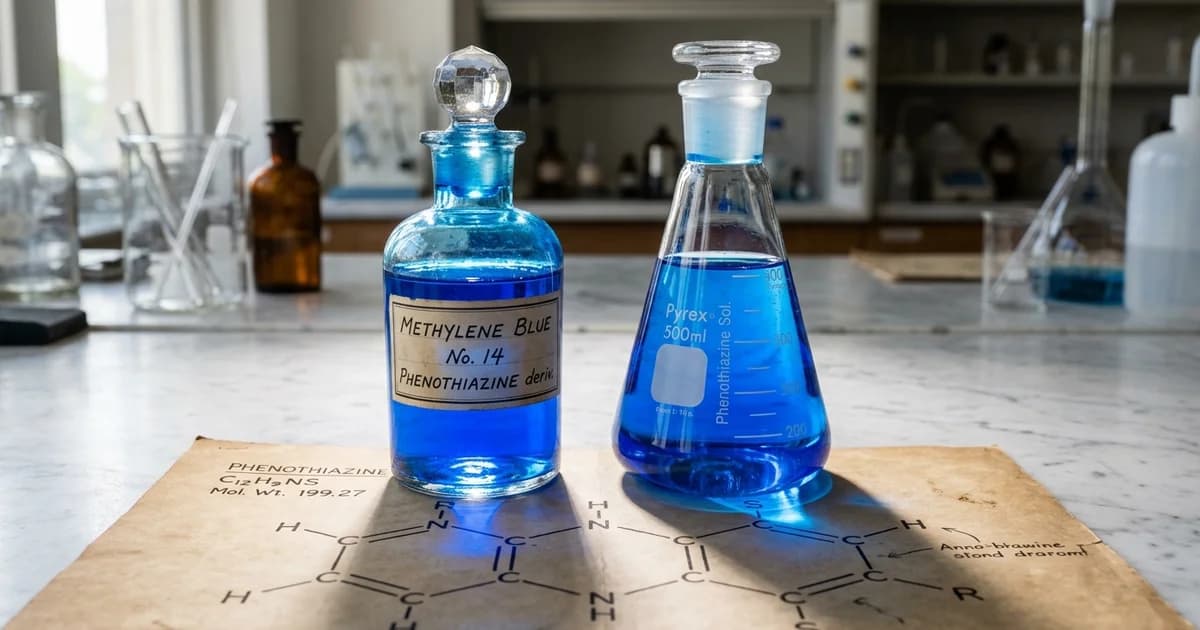
The methylene blue history is one of the strangest careers in pharmacology. A compound invented to color fabric ended up treating malaria, defining the entire field of chemotherapy, and now sits inside fMRI studies on human memory. Few molecules have lived this many lives.
Here is how a textile dye became a brain compound, and what the science actually supports today.
Key Takeaways
- Methylene blue was synthesized in 1876 as a textile dye, not a medicine.
- It became the first synthetic drug ever used in clinical medicine, deployed against malaria in 1891.
- Its chemical skeleton seeded the phenothiazine antipsychotics, including chlorpromazine.
- Modern research examines it for memory, mood, and Alzheimer's, with mixed but interesting results.
The Methylene Blue History Starts in a Dye Factory
Methylene blue began as an industrial product, not a treatment. Heinrich Caro, a German chemist, synthesized it in 1876 when employed at the chemical firm BASF, and it first found use as a textile dye.
This was the golden age of synthetic color. The first synthetic coal-tar dye, mauve, had appeared in England in 1856, and chemists across Europe were racing to build brilliant new pigments that commanded high prices. It was here, in 1876, that, while experimenting with a new intermediate product, Caro succeeded in synthesizing a pure blue dye for cotton, methylene blue.
A year later, the compound earned a place in legal history too. BASF was awarded Germany's first patent for a coal tar dye for methylene blue.
It should have stayed in the fabric industry. It did not.
How a Dye Became the First Synthetic Drug
Methylene blue became medicine because it could stain things selectively. That single property changed the course of pharmacology.
Scientists in the 1880s noticed the dye clung to some microorganisms and nerve cells while leaving surrounding tissue alone. Paul Ehrlich observed that it stained and killed malaria parasites (Plasmodium) in blood samples, leading to its use as the first synthetic antimalarial drug, and it was cheaper than quinine and showed effectiveness, though it was later replaced by more effective drugs like chloroquine.
That leap from microscope slide to patient mattered enormously. In 1892, Paul Guttmann and Paul Ehrlich developed from methylene blue the first fully synthetic drug in medicine and thus opened the world of modern chemotherapy using it against the tropical disease malaria.
Ehrlich's logic was simple and bold. This proposed use was based on Ehrlich's belief that if you can stain parasites with a product such as methylene blue, you can also harm them with the same. The idea of a compound that targets disease while sparing the host became the founding principle of chemotherapy.
The methylene blue malaria story did not end in the 19th century either. It became one of the first synthetic drugs ever used in clinical medicine and remained a frontline malaria treatment for decades before being replaced by newer compounds.
It even followed soldiers into war. Methylene blue continued to be used in World War II, where it was not well-liked by soldiers, who observed, "Even at the loo, we see, we pee, navy blue."
The Surprising Branch Into Psychiatry
Methylene blue's chemical backbone fathered an entire class of psychiatric drugs. This is the part of the history of nootropics most people never hear.
While studying the dye's structure, German chemist August Bernthsen found it was built on a previously unknown molecule. While examining the structure of methylene blue, the German chemist August Bernthsen discovered that it was a derivative of a previously unknown compound that would come to be called phenothiazine.
Phenothiazine became a chemical launchpad. Decades later, chemists building derivatives of that same skeleton arrived at chlorpromazine, widely described as the first effective antipsychotic, which reshaped psychiatric care in the 1950s.
The dye itself was also tested directly on mood. Early work on methylene blue depression ran through bipolar disorder, where researchers gave it to patients who had not responded to standard treatment. In a double-blind crossover 2-year trial, patients on 300 mg of methylene blue had less severe symptoms of depression than on 15 mg, and out of 19 patients who had bipolar disorder, 14 were judged improved.
These were small studies, not modern large trials. They are worth knowing, not worth overstating.
The Modern Question: Methylene Blue and the Brain
Today methylene blue sits in an unusual spot: ancient and intensely current at the same time. It is simultaneously one of the oldest synthetic compounds in medical history and one of the most actively researched, and understanding what that research shows requires separating what is well established from what is still emerging.
The memory research is the headline. A 2016 study published in Radiology put healthy adults through brain scans after a single low oral dose. Low-dose methylene blue increased functional MR imaging activity during sustained attention and short-term memory tasks and potentiated memory retrieval.
The behavioral effect was modest but measurable. According to ScienceDaily, methylene blue was associated with a 7 percent increase in correct responses during memory retrieval.
The Alzheimer's research is more sobering. A derivative of methylene blue went into large trials for dementia, and the top-line results disappointed. As reported by MDedge, its most recent phase III study found that 100 mg twice a day conferred no cognitive or functional benefit upon patients with mild Alzheimer's disease, compared with a control dose. Researchers continue to argue over low-dose subgroups, but the primary endpoint failed.
So the honest picture is split. Strong evidence for some uses, early and unsettled evidence for the brain claims that drive its current popularity.
Where Methylene Blue Actually Earns Its Keep Today
Methylene blue's most solid modern role has nothing to do with focus. It is a frontline antidote.
By the 1930s, the substance found adoption as first-line treatment for methemoglobinemia, and was FDA-approved in 1950. That is the use clinicians trust without debate. It is on the World Health Organization's List of Essential Medicines.
Here is a quick map of where the molecule's reputation stands versus the evidence behind it.
| Use Case | Era | Evidence Strength |
|---|---|---|
| Textile dye | 1876 | The original purpose |
| Malaria treatment | 1891 onward | Strong historically, replaced by better drugs |
| Methemoglobinemia antidote | 1930s onward | Strong, still standard care |
| Antipsychotic chemistry (phenothiazine) | 1950s | Foundational, indirect |
| Bipolar depression symptoms | 1980s | Limited, small trials |
| Short-term memory and attention | 2016 | Early human imaging data |
| Alzheimer's (tau derivative) | 2010s | Failed primary endpoints |
Conclusion
Methylene blue is a lesson in how science actually moves. A compound built to dye cotton became the first synthetic drug, founded the logic of chemotherapy, and seeded a generation of psychiatric medicines, none of which its inventor could have predicted.
Its modern reputation as a brain compound rests on thinner ground than its history as an antidote. The memory imaging data is real and interesting. The dementia trials are a reminder that promising mechanisms often fail at the finish line.
The smartest way to read any 145-year-old molecule is the same way you should read a new one. Follow the strongest evidence, respect the gaps, and resist the urge to turn a single fMRI result into a finished story.
Frequently Asked Questions
Was methylene blue really the first synthetic drug?
It is widely described that way. Heinrich Caro synthesized it in 1876 at BASF, it first found use as a textile dye, and in 1891 Paul Ehrlich used it to stain malaria parasites, laying the groundwork for modern chemotherapy. Its 1890s use against malaria is generally credited as the first fully synthetic compound deployed in clinical medicine, which is why it holds such a specific place in pharmacology's origin story.
Who invented methylene blue and why?
A German chemist named Heinrich Caro created it for industry, not medicine. Caro became the first head of research at BASF, and it was there in 1876 that, while experimenting with a new intermediate product, he succeeded in synthesizing a pure blue dye for cotton. The medical applications came later, after other scientists noticed its unusual biological behavior under the microscope.
Does methylene blue treat malaria?
It used to be a frontline option. Methylene blue's first major medical application came in the 1890s when German physician Paul Ehrlich used it to treat malaria. It was cheaper than quinine and showed effectiveness, though it was later replaced by more effective drugs like chloroquine. Researchers still study it in combination therapies, but it is no longer a standard standalone malaria treatment.
What is methylene blue used for today?
Its clearest accepted use is as an antidote. By the 1930s it became first-line treatment for methemoglobinemia and was FDA-approved in 1950. Among methylene blue uses, this is the one with the strongest backing. It also appears in surgical staining and tissue imaging. The cognitive and mood applications remain experimental rather than established.
Does methylene blue actually improve memory?
The human evidence is early but real. A 2016 imaging study found that low-dose methylene blue increased functional MR imaging activity during sustained attention and short-term memory tasks and potentiated memory retrieval. The behavioral effect was a roughly 7 percent gain in correct memory responses. That is one controlled study in healthy adults, not proof of a reliable, long-term cognitive benefit.
How is methylene blue connected to antidepressants and antipsychotics?
Through its chemistry. August Bernthsen discovered that methylene blue was a derivative of a previously unknown compound that would come to be called phenothiazine. That phenothiazine skeleton later became the structural basis for chlorpromazine and related antipsychotics, which is why a textile dye is sometimes called the grandparent of modern psychiatric medicine.
What 145 Years of a Molecule Teaches About Modern Nootropics
Methylene blue's story is a filter. The compound earned its lasting reputation on the uses with hard data behind them, the malaria work that built chemotherapy and the antidote role that still saves lives. The flashier brain claims sit on early, unfinished research.
That is the same standard worth applying to anything you put under your tongue today. At Roon, the test for an ingredient is whether the evidence holds up, which is how its four actives were chosen: 80 mg caffeine, 60 mg L-theanine, 25 mg methylliberine (Dynamine), and 5 mg theacrine (TeaCrine), in a sublingual pouch built for 6 to 8 hours of focus with no jitters, no crash, and no tolerance buildup.
Roon is not a medicine and does not treat any condition. It is a daily focus tool for people who want reliable cognitive support, not a single-study headline. If you care about evidence over hype, Roon is built to be read the same way you would read a 145-year-old molecule: carefully, and on the merits.
Written by Roon Team