L-Theanine Mechanism of Action
Roon Team
L-Theanine Mechanism of Action: What Actually Happens in Your Brain
Your morning green tea does more than warm your hands. The amino acid L-theanine, found almost exclusively in Camellia sinensis tea leaves, operates through a specific l theanine mechanism of action that touches nearly every major neurotransmitter system in the brain. L-theanine promotes calm without sedation, sharpens attention without overstimulation, and pairs with caffeine better than almost any compound studied.
But how? The answer starts with a molecular trick: L-theanine looks almost identical to one of your brain's most powerful signaling chemicals.
Key Takeaways:
- L-theanine is a structural analog of glutamate, the brain's primary excitatory neurotransmitter, and it binds to the same receptors at much lower potency.
- The l theanine mechanism of action begins when it crosses the blood-brain barrier within 30 to 60 minutes using a dedicated amino acid transport system.
- L-theanine modulates GABA, serotonin, and dopamine levels while promoting alpha brain wave activity associated with relaxed focus.
- Combined with caffeine, L-theanine improves both speed and accuracy on cognitive tasks more effectively than either compound alone.
L Theanine Mechanism of Action: A Glutamate Lookalike With a Different Agenda
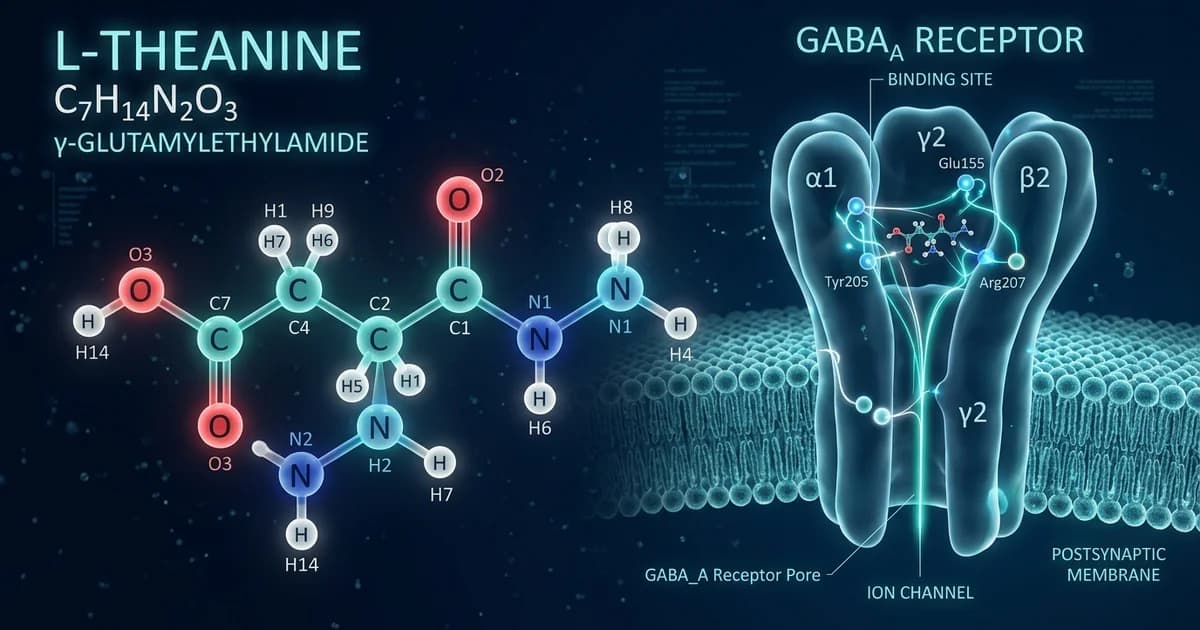
L-theanine's full chemical name is γ-glutamylethylamide (also called N5-ethyl-L-glutamine). That name hints at its origin: L-theanine is essentially glutamic acid with an ethylamine group attached. This structural similarity to glutamate, the brain's most abundant excitatory neurotransmitter, is the foundation of the l theanine mechanism of action.
Glutamate drives the majority of excitatory signaling in the central nervous system. Glutamate binds to three major types of ionotropic receptors: AMPA, kainate, and NMDA. Too much glutamate activity leads to excitotoxicity, a process where neurons are overstimulated to the point of damage. Too little, and cognition slows to a crawl.
L-theanine slots into this system as a low-affinity competitor. According to research published in Bioscience, Biotechnology, and Biochemistry, theanine binds to AMPA, kainate, and NMDA receptors, but its binding affinity is 80- to 30,000-fold weaker than glutamic acid. L-theanine acts as an antagonist at AMPA and kainate receptors and as a partial co-agonist at NMDA receptors, per data compiled on Wikipedia's theanine page.
The practical result: the l theanine mechanism of action occupies glutamate receptors just enough to dampen excessive excitatory signaling without shutting it down entirely. Think of L-theanine as turning the volume knob from 10 to 7, not muting the speaker.
How the L Theanine Mechanism of Action Begins at the Blood-Brain Barrier
For any compound to affect brain chemistry, it first has to get there. The blood-brain barrier is notoriously selective, blocking most molecules from entering the central nervous system.
L-theanine bypasses this filter using the leucine-preferring amino acid transport system. A study published in Neurochemical Research confirmed that after oral ingestion, theanine is incorporated into the brain through this transport pathway. Because L-theanine structurally resembles other large neutral amino acids, the transporter recognizes L-theanine and shuttles it across.
Peak brain concentrations typically occur within 30 to 60 minutes of ingestion. A review published in Nutrition Research Reviews (via ScienceDirect) noted that L-theanine "is well absorbed from the intestine and can cross the blood-brain barrier," which helps explain why its cognitive effects are noticeable relatively quickly.
This is worth emphasizing: many popular "brain supplements" never actually reach the brain in meaningful concentrations. L-theanine does. And because L-theanine uses a dedicated transport system rather than passive diffusion, absorption is reliable and dose-dependent.
The L Theanine Mechanism of Action Across Four Neurotransmitter Systems
Once inside the brain, L-theanine doesn't just interact with glutamate receptors. The l theanine mechanism of action influences at least four major neurotransmitter systems simultaneously.
1. Glutamate Modulation
As covered above, L-theanine competes with glutamate at ionotropic receptors. But there's a second pathway. Research from ScienceDirect's pharmacology database describes how L-theanine also acts antagonistically against glutamine at the ASCT2 transporter. This reduces presynaptic production of glutamate itself, meaning less glutamate is available for release in the first place.
The combined effect: less excitatory noise in neural circuits, which creates the subjective experience of mental calm without drowsiness.
2. GABA Enhancement
GABA (gamma-aminobutyric acid) is the brain's primary inhibitory neurotransmitter, the counterbalance to glutamate. A study published in the Journal of Herb Pharmacotherapy reported that L-theanine increases brain GABA levels. A Frontiers in Nutrition paper further confirmed that L-theanine increases the expression of GABAergic receptors.
Higher GABA activity promotes relaxation and reduces anxiety-like responses. This part of the l theanine mechanism of action feels calming without the sedation you'd get from a pharmaceutical GABA agonist like a benzodiazepine. The increase is moderate, not pharmacological.
3. Serotonin and Dopamine
The same Neurochemical Research study that mapped L-theanine's blood-brain barrier transport also found that theanine administration caused measurable increases in serotonin and dopamine concentrations, particularly in the striatum, hypothalamus, and hippocampus.
Serotonin contributes to mood regulation and emotional stability. Dopamine drives motivation, reward processing, and sustained attention. The fact that the l theanine mechanism of action modestly raises both helps explain why users often describe a feeling of "calm alertness" rather than pure relaxation.
4. Alpha Brain Wave Promotion
This is where L-theanine separates itself from most amino acid supplements. EEG studies consistently show that L-theanine increases alpha-band oscillatory activity, the brain wave frequency (8-13 Hz) associated with wakeful relaxation and creative focus.
A randomized, triple-blind, placebo-controlled study found that a single dose of L-theanine increased frontal region alpha power compared to placebo in response to an acute stress challenge. A separate study published in Brain Topography demonstrated that 250 mg of L-theanine influenced alpha-band oscillations during attention tasks.
Alpha waves are the brain's "flow state" frequency. They appear during meditation, light creative work, and periods of relaxed concentration. The l theanine mechanism of action promotes this state pharmacologically, which is a rare and useful property.
L Theanine Mechanism of Action and Stress: The Cortisol Connection
Beyond neurotransmitter modulation, L-theanine also appears to influence the stress hormone cortisol. A randomized, triple-blind trial published in the Journal of Dietary Supplements (via PMC) found greater decreases in salivary cortisol one hour after L-theanine supplementation compared to placebo (p < 0.001).
A longer-term 28-day trial published in Neurology and Therapy reported that participants taking 400 mg of L-theanine daily showed a 17.98% decrease in Perceived Stress Scale scores after four weeks.
These findings suggest that L-theanine doesn't just change how your brain processes stress signals in the moment. With consistent use, L-theanine may help recalibrate your baseline stress response.
The mechanism likely ties back to the neurotransmitter effects described above. By reducing glutamate-driven excitatory activity and increasing GABA tone, the l theanine mechanism of action lowers the neural "volume" on stress circuits in the prefrontal cortex and amygdala. The cortisol reduction is a downstream consequence of that quieter signaling environment.
Why L-Theanine Works Better With Caffeine
If you've ever wondered why tea feels different from coffee, even at similar caffeine doses, the l theanine mechanism of action is the answer.
A study published in Nutritional Neuroscience found that combining moderate doses of L-theanine and caffeine improved accuracy during task switching and self-reported alertness (p < 0.01) while reducing tiredness (p < 0.05).
Another study from Appetite showed the combination improved both speed and accuracy on attention-switching tasks at 60 minutes, and reduced susceptibility to distracting information in memory tasks at both 60 and 90 minutes.
Here's what makes this pairing work at the mechanistic level:
| Caffeine | L-Theanine |
|---|---|
| Blocks adenosine receptors, increasing alertness | Modulates glutamate, reducing excitatory overshoot |
| Raises cortisol and adrenaline | Lowers cortisol, promotes GABA |
| Can cause jitters and anxiety at higher doses | Promotes alpha waves and calm focus |
| Narrows attention (useful for simple tasks) | Broadens attention (useful for complex tasks) |
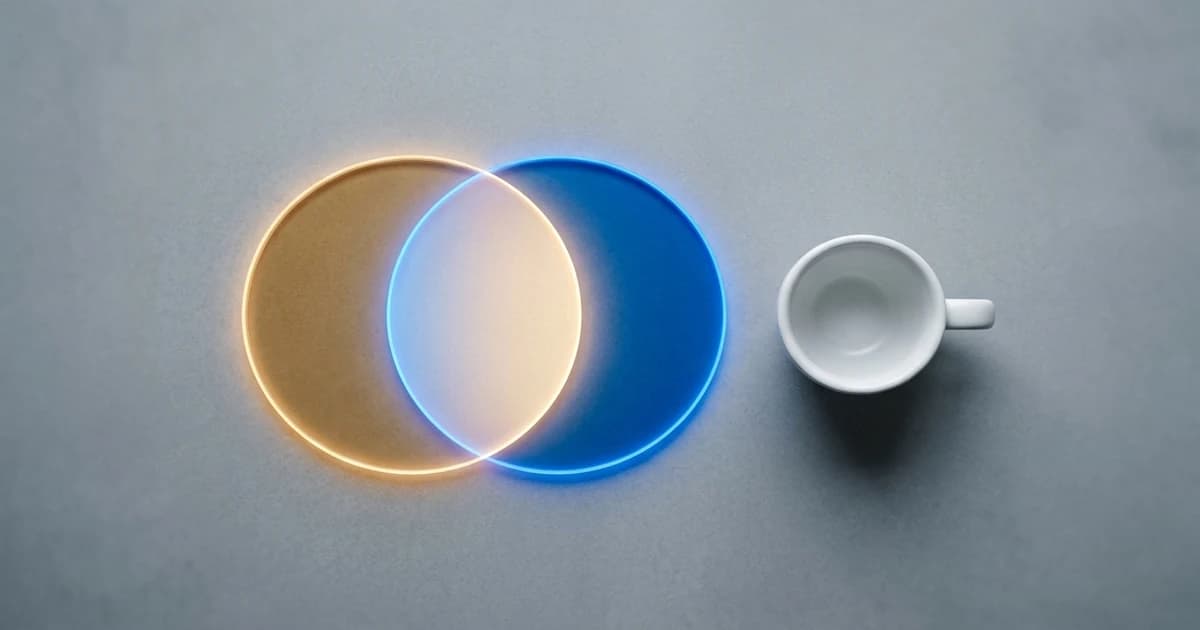
Caffeine provides the engine. L-theanine provides the steering. Together, they produce focused energy without the scattered, anxious quality that caffeine alone often creates.
Dosing and Timing: What the Research Actually Used
Most clinical studies use L-theanine doses between 100 mg and 400 mg. The alpha wave studies typically used 200 to 250 mg. The stress reduction trials used 200 to 400 mg daily.
For cognitive performance paired with caffeine, the research tends to cluster around a 2:1 ratio of L-theanine to caffeine. A common protocol in the literature: 100 mg of L-theanine with 50 mg of caffeine.
Effects typically onset within 30 to 60 minutes and last for several hours. L-theanine does not appear to build tolerance with repeated use, which makes L-theanine unusual among compounds that affect neurotransmitter systems. You can take L-theanine daily without needing to increase the dose, a property that most stimulants and anxiolytics cannot claim.
Getting L-Theanine Where It Counts
Understanding the l theanine mechanism of action makes one thing clear: this amino acid earns its reputation through real biochemistry, not marketing hype. L-theanine modulates glutamate, raises GABA, boosts serotonin and dopamine, promotes alpha brain waves, and pairs with caffeine to produce a cognitive state that neither compound achieves alone.
The challenge is getting the right dose, in the right format, at the right time.
Roon pouches combine L-theanine with 80 mg of caffeine, theacrine, and methylliberine in a sublingual format designed for fast absorption. No brewing, no capsules, no guesswork. Just the stack that the research supports, delivered where your body can actually use it.