Does Oral GABA Cross the Blood-Brain Barrier? The Real Scientific Debate
Roon Team
Does Oral GABA Cross the Blood-Brain Barrier? The Real Scientific Debate
Swallow a GABA capsule and you'd expect it to reach the part of you that needs calming: your brain. The catch is the question that the supplement aisle quietly skips over. Does GABA cross the blood-brain barrier when you take it by mouth? The short, honest answer is that very little of it does, and the science here is more interesting than either the marketers or the skeptics admit.
GABA (gamma-aminobutyric acid) is the brain's main "slow down" signal. It's the neurotransmitter that quiets neural chatter and lets you settle. So selling it as a pill makes intuitive sense.
The problem is geography. The molecule has to travel from your gut to your neurons, and that trip is harder than it looks.
Key Takeaways
- Oral GABA crosses the blood-brain barrier in only trace amounts, so it can't flood your brain with calming neurotransmitter the way the label implies.
- Any real effect from a GABA supplement likely comes from the gut-brain axis and the vagus nerve, not from GABA reaching the brain directly.
- The human evidence for oral GABA supplement effectiveness is thin, small, and mixed.
- Ingredients that demonstrably act centrally, like L-theanine, are a more defensible route to calm focus.
What the Blood-Brain Barrier Actually Does
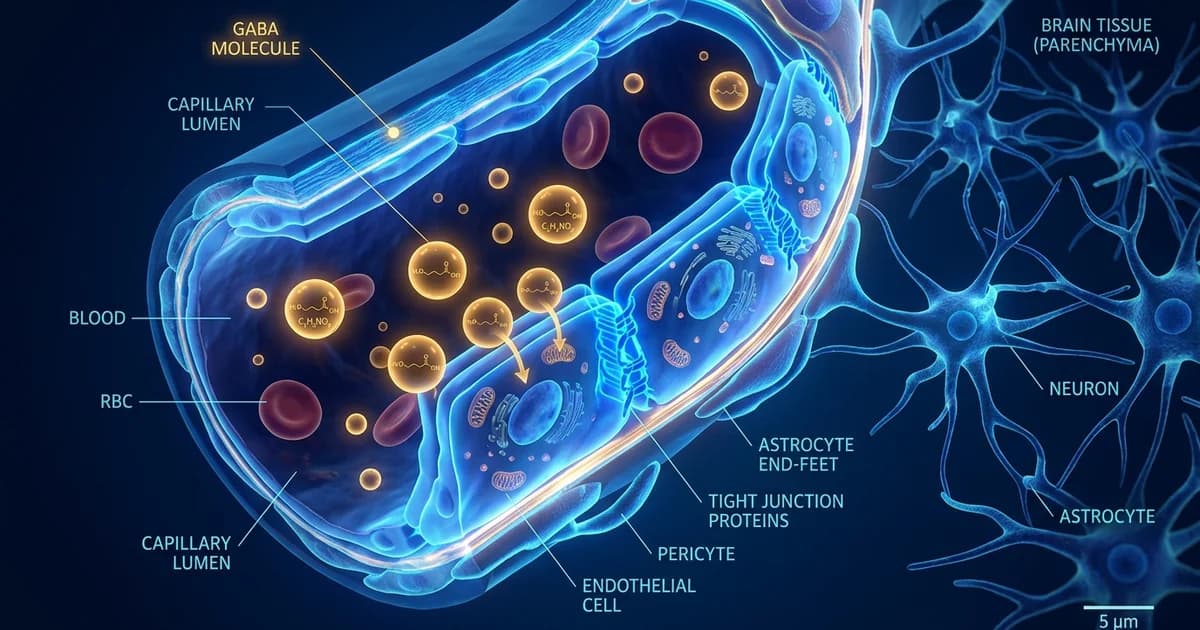
The blood-brain barrier is a tightly sealed layer of cells lining the blood vessels in your brain. Its job is to act as a bouncer, letting fuel and a short list of approved molecules in while keeping most circulating compounds out.
GABA is on the "keep out" list. It's a small, water-loving, charged molecule, and those properties make it a poor candidate for slipping through the barrier's lipid membranes.
This isn't a fringe view. According to a review of the evidence on Troscriptions, oral GABA shows limited ability to cross the blood-brain barrier in meaningful amounts. An independent fact-check from Factually reaches a similar conclusion: the case that swallowed GABA directly raises brain GABA is weak.
So if you've ever taken a GABA pill, felt slightly calmer, and assumed the molecule reached your neurons, the mechanism is probably not what you think.
Does GABA Cross the Blood-Brain Barrier in Any Amount?
A small fraction may get through, but not enough to explain a strong sedative effect. Older animal work and human imaging studies suggest the barrier's permeability to GABA is low, and the debate among researchers is mostly about whether that trickle is functionally zero or just very small.
Here's the honest scientific tension. Some studies report that peripheral GABA can nudge brain activity, while others find no measurable central effect at supplement doses. The disagreement is real, and anyone claiming total certainty in either direction is overselling.
What almost everyone agrees on is this: the dose you'd need for GABA to act like a brain drug, the way a prescription GABAergic medication does, is far beyond what a pouch or capsule delivers. That gap is the whole story.
If It Doesn't Reach the Brain, Why Do Some People Feel Something?
The most plausible answer lives in your gut, not your skull. Your digestive tract is wrapped in the enteric nervous system, sometimes called the "second brain," and it's loaded with GABA receptors.
This is where the gut-brain axis comes in. GABA in the gut can act locally on enteric neurons and the vagus nerve, the long communication cable that runs from your abdomen to your brainstem. Signals travel up that cable and can influence mood and arousal without a single GABA molecule entering the brain.
Research now treats the vagus nerve as the relay station here. A review in Frontiers in Neuroscience describes the vagus nerve as a central interface in the microbiota-gut-brain axis, carrying signals from gut microbes and metabolites up to the brain.
There's also the microbiome angle. Work published in Taylor & Francis examines how microbe-derived GABA influences gut and brain barrier integrity and GABAergic signaling, which hints that gut-level GABA is biologically active even if it never reaches your neurons directly.
So a calming effect, if you feel one, may be real. It just travels by a different road than the label suggests.
Does the GABA Supplement Work? What the Human Evidence Says
The human evidence for oral GABA supplement effectiveness is limited, small in scale, and inconsistent. A handful of studies report modest reductions in self-reported stress or faster relaxation on EEG, but sample sizes are tiny and placebo effects are hard to rule out.
This is the uncomfortable middle ground. "Does GABA supplement work" doesn't have a clean yes or no. It has a "maybe, weakly, and probably not through the mechanism on the bottle."
For a calming neurotransmitter that your body already makes, the smarter question isn't whether you can swallow more of it. It's whether you can support the systems that produce and respond to it, or choose an ingredient that actually gets where it needs to go.
A Cleaner Route: Ingredients That Act Centrally
Compare GABA to L-theanine, an amino acid from tea leaves. Unlike GABA, L-theanine readily crosses the blood-brain barrier and has measurable effects on brain activity.
L-theanine increases alpha-wave activity, the EEG pattern linked to relaxed, alert focus. A study in Brain Topography found that L-theanine changed alpha-band oscillatory brain activity during an attention task, which is direct evidence of a central effect, not an indirect gut signal.
That distinction matters for anyone shopping for calm focus.
| Compound | Crosses blood-brain barrier? | Primary mechanism | Strength of human evidence |
|---|---|---|---|
| Oral GABA | Trace amounts at best | Likely gut-brain axis / vagus nerve | Weak, small, mixed |
| L-theanine | Yes, readily | Direct central action, raises alpha waves | Moderate, repeatable |
| Caffeine | Yes, readily | Blocks adenosine, raises alertness | Strong |
| Magnesium (glycinate) | Crosses to a degree | Supports NMDA/GABA receptor function | Modest |
The pattern is clear. If you want a compound to influence your brain, pick one that can actually get inside it.
Conclusion
The blood-brain barrier is doing exactly what it evolved to do: keeping a tight chemical like GABA out of your brain. That's why swallowing GABA rarely produces the direct calming hit the packaging promises, and why the more credible explanation for any effect runs through your gut and the vagus nerve.
None of this makes GABA useless. It makes it misunderstood. The honest takeaway is that "more GABA in a pill" is the wrong target. The right target is supporting calm focus with ingredients that reach the brain and have the data to show it.
When you understand the barrier, you stop chasing molecules that can't cross it and start choosing the ones that can.
Frequently Asked Questions
Does oral GABA cross the blood-brain barrier?
Only in trace amounts. GABA is a small, charged, water-loving molecule, and those properties make it a poor fit for the lipid membranes of the blood-brain barrier. Most reviews conclude that swallowed GABA does not meaningfully raise brain GABA levels. Any calming effect people report is more likely explained by gut-level signaling through the vagus nerve than by GABA reaching neurons directly.
Does a GABA supplement work at all?
Sometimes, weakly, and probably not the way the label claims. A few small human studies show modest stress reduction or faster relaxation on EEG, but the research is limited, inconsistent, and hard to separate from placebo. If a GABA supplement helps you, it's likely working through the gut-brain axis rather than by flooding your brain with neurotransmitter.
What is the gut-brain axis and how does GABA fit in?
The gut-brain axis is the two-way communication network between your digestive system and your brain. Your gut is lined with GABA receptors and enteric neurons. GABA acting locally in the gut can trigger signals that travel up the vagus nerve to the brainstem, which is why gut-level GABA may influence mood without ever crossing the blood-brain barrier.
Why does the vagus nerve matter for GABA?
The vagus nerve is the main signaling cable between your gut and brain. Research treats it as a central relay in the microbiota-gut-brain axis. When GABA or GABA-producing microbes act in the gut, the vagus nerve can carry that information upward. This indirect route is the most plausible explanation for any real effect from oral GABA.
Is L-theanine better than GABA for calm focus?
For acting on the brain directly, yes. L-theanine readily crosses the blood-brain barrier and raises alpha-wave activity, the EEG signature of relaxed alertness. GABA cannot reliably get into the brain when taken orally. If your goal is calm focus rather than indirect gut signaling, an ingredient with proven central action is the more defensible choice.
Can I just take more GABA to force it across the barrier?
That's not how the barrier works. The blood-brain barrier selectively excludes GABA regardless of how much circulates in your blood, and the dose required to overcome that exclusion is far beyond a normal supplement. Taking more is unlikely to change the outcome and may simply increase gut-level activity instead.
Why Roon Skips Oral GABA Entirely
This is the exact reasoning behind what Roon does not include. We don't sell oral GABA, because the science says a swallowed calming molecule mostly stalls at the blood-brain barrier and works, if at all, through indirect gut signaling. That's an honest read of the evidence, not a marketing angle.
Instead, Roon is built around ingredients that reach the brain and have data behind them. Each sublingual pouch carries 80 mg caffeine, 60 mg L-theanine, 25 mg methylliberine (Dynamine), and 5 mg theacrine (TeaCrine), with the sublingual route designed to maximize real absorption rather than hope a molecule survives digestion. The L-theanine is there for the same reason this article praised it: it crosses the barrier and supports the relaxed, alert state people wrongly expect from GABA.
Roon isn't a sedative and it isn't a substitute for sleep, therapy, or managing chronic stress at the source. It's a tool for sustained calm focus, designed for a 6 to 8 hour window with no jitters, no crash, and no tolerance buildup. If you've been reaching for GABA and feeling underwhelmed, try Roon and see what an ingredient that actually crosses the barrier feels like.
Written by Roon Team